
Francorchamps (Stavelot), Belgium
Spa-Francorchamps: from a cellar at Masta to gravel at Raidillon
History of Spa-Francorchamps: a 14-kilometre road loop, a drivers' revolt, the 1979 shortening, tragedies at Raidillon, the 2022 rebuild and track days.
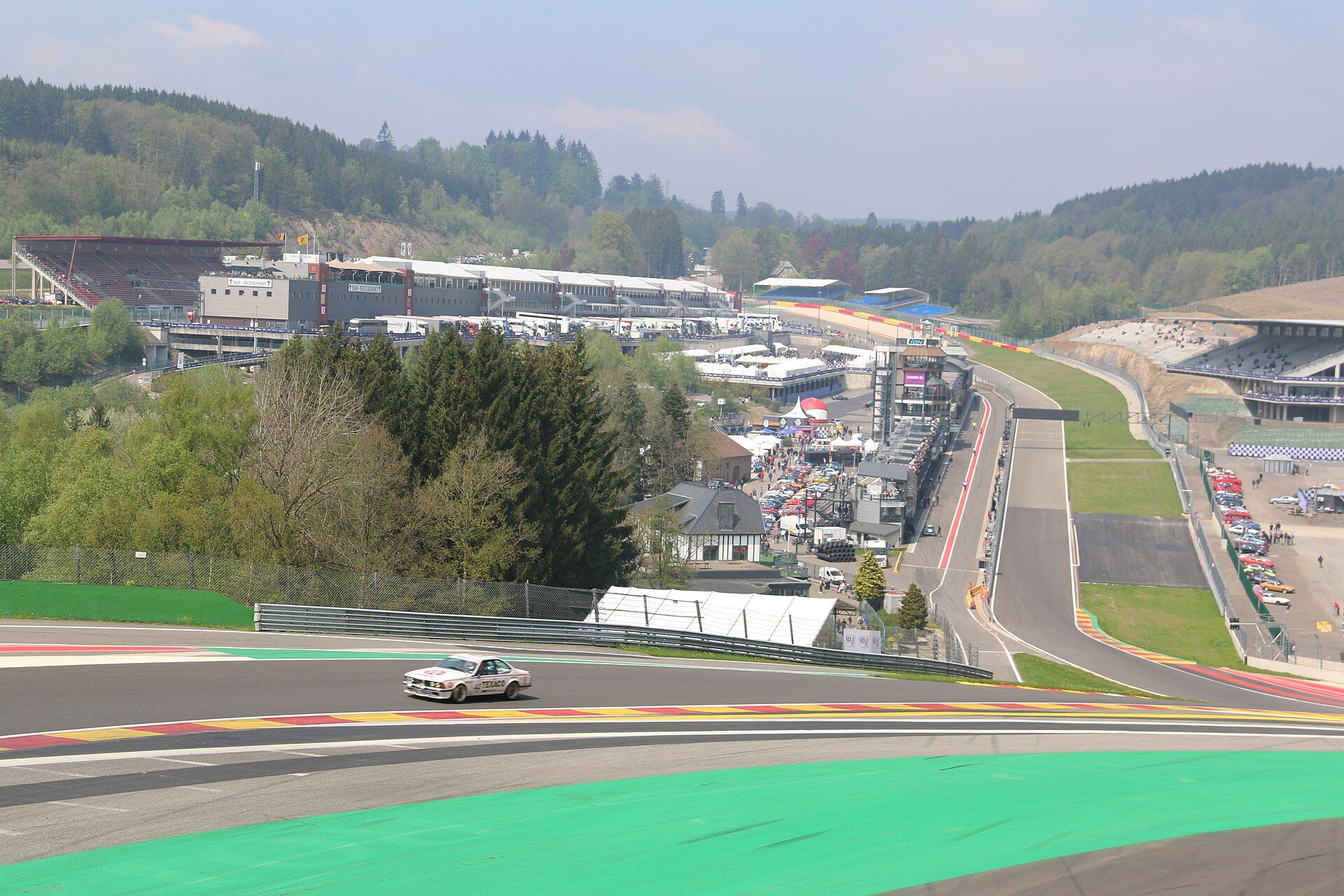
- Type
- race circuit
- Length
- 7.004 km
- Opened
- 1921
Rain fell on the first lap of the 1966 Belgian Grand Prix, as the field was coming up to the Masta corner. Of the sixteen cars that started, only six completed the first lap. Jackie Stewart's BRM hit a telegraph pole, then a woodcutter's hut, and came to rest in the outside cellar of a farm building; the driver sat trapped in the cockpit, into which fuel was pouring from a ruptured tank. Graham Hill and Bob Bondurant pulled him out with a spanner borrowed from a spectator, after twenty-five minutes. Out of that cellar at Masta grew the safety campaign that changed the whole sport, and that made the long loop on the Ardennes roads its first target.
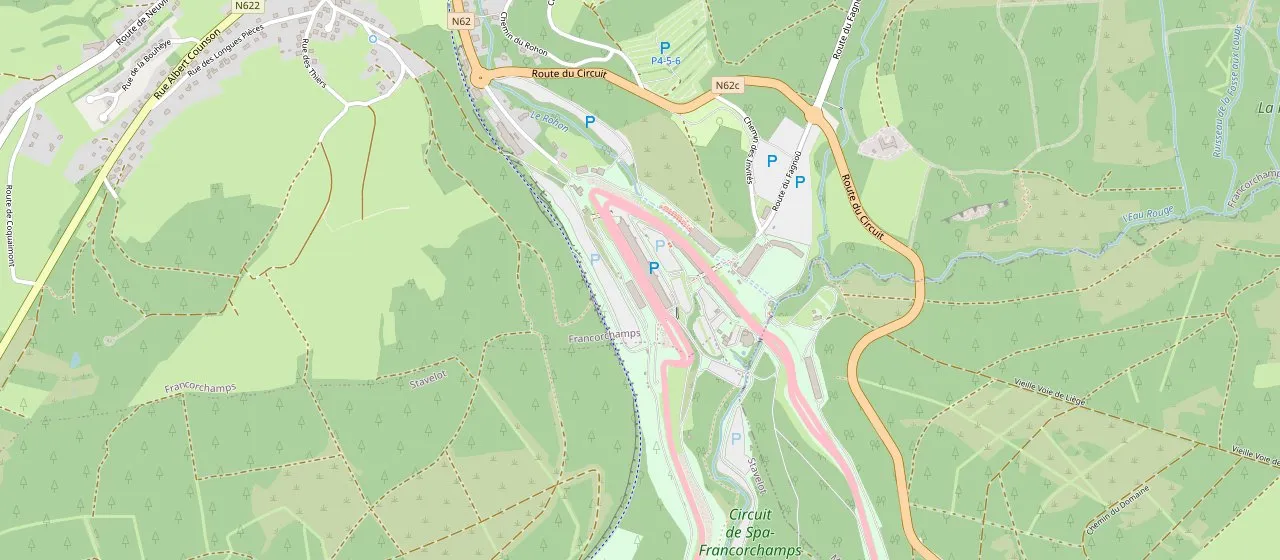
| Location | Francorchamps, municipality of Stavelot, with sections within the municipality of Malmedy, Wallonia, Belgium; no part of the circuit lies within the town of Spa |
| Type | permanent racing circuit, until 1979 a loop on public roads, fully closed to traffic since the turn of the century |
| Length | 7.004 km (configuration since 2007); 6.947 km after the shortening in 1979; 14.100 km in the final form of the old loop |
| Year opened | 1921 (first motorcycle race), 1922 (first car race) |
| Direction of travel | clockwise (FIA licence: pole position on the right) |
| Elevation difference | about 100 m between the summit at Les Combes and the Paul Frère corner; Raidillon alone climbs about 40 m at a gradient of 17 percent |
| Homologation | FIA grade 1 (licence valid until 15.07.2026 according to the list from June 2024), FIM grade C since 2022 |
| Lap record | 1:44.701, Sergio Pérez, Red Bull RB20, 2024 Belgian Grand Prix (official F1 race record on the 7.004 km configuration) |
| Record of the old loop | 3:13.4 (average 262.461 km/h), Henri Pescarolo, Matra-Simca MS670B, 1000 km Spa, May 1973 |
| Owner and operator | SA de droit public “Le Circuit de Spa-Francorchamps”, a public company whose main shareholder is Wallonia (the Walloon Region) through Wallonie Entreprendre |
| Main events | F1 Belgian Grand Prix (1925–1970 with interruptions, since 1983), 24h Spa (since 1924), 6h Spa WEC, 24h Spa EWC Motos (returned in 2022) |
| Status | active, about 220 operating days a year according to the operator |
Three roads and one entered driver
The idea was born out of a wish to revive a newspaper race. After the First World War Jules de Thier, director of the Liège daily “La Meuse”, was looking for a way to bring back the Coupe La Meuse; at a meeting in Francorchamps with baron Joseph de Crawhez, mayor of Spa, and the driver Henri Langlois van Ophem, it was decided that the triangle of roads linking Francorchamps, Malmedy and Stavelot would make an ideal loop. The eastern side of that triangle had until recently lain in Germany: the Eau Rouge stream was the national border, and the hairpin at its foot later took the name Virage de l'Ancienne Douane, after the customs post that stood there until 1920. The first car race was planned for August 1921. One driver entered. The event was replaced by a race of 23 motorcycles, won by Hassal on a Norton 500 at an average of about 90 km/h.
The cars arrived a year later. In 1922 the Royal Automobile Club de Belgique (RACB) staged at Francorchamps its first Belgian Grand Prix, an endurance race for sports cars, won by the Impéria-Abadal of the Tornaco-Bruyère crew at an average of 88.9 km/h. As early as March 1922 the Dutch press was writing about “the well-known circuit of Francorchamps”, where in July the Belgian Grand Prix for motorcycles was to be held with the participation of Gillet, Saroléa, FN, Norton, Triumph and Indian. In 1924, after a timekeeping cabin, a scoreboard and a press stand had been built, the RACB ran the first 24-hour race at Francorchamps, a year after the first Le Mans.
The wider world came down in June 1925 for the Grand Prix of Europe. The Belgian automobile club had earlier invited some fifty journalists on a tour of the course in two coaches; the correspondent of the Amsterdam paper “De Telegraaf” described “the delightful valley of the Eau Rouge” caught between three Ardennes ridges, and an almost finished grandstand. The race itself, on 28 June, was won by Antonio Ascari on an Alfa Romeo at an average of about 120 km/h; the reporter of “Het Nieuws van den Dag” noted that the fields around the circuit were flooded with cars from all over the Netherlands, and that the roar of the engines sounded “as if a countless crowd were letting out one long, sharp cry”. Six weeks later, during the motorcycle Belgian Grand Prix with forty riders taking part, the Englishman Hollowell was killed right after the start; the straight between Masta and Stavelot afterwards carried his name in the English vocabulary of the circuit.
A road built for speed
Every change that followed served one thing: speed. In 1928 the earth surface was covered with asphalt, so that the cars would not fire off stones; a year later the corners were marked with wooden boards at a height of 50 cm, in line with the headlights. The chicane at Malmedy was bypassed in 1930, reinstated four years later and finally abandoned in 1939. The biggest change came in 1939: the tight hairpin by the former customs house was replaced by a short, steep uphill link with a gradient of 17 percent, which the Belgians named Raidillon and which foreigners stubbornly call Eau Rouge, after the stream that runs under the little bridge at its foot. That same year, in a rainy Belgian Grand Prix, the leading Richard Seaman of the Mercedes-Benz team went off on lap 22, hit a tree side-on, the car caught fire at once and the driver died a few hours later.
After the war the circuit was rebuilt and racing returned in 1947, when the Grand Prix of Europe was won by Jean-Pierre Wimille on an Alfa Romeo. In 1949 thirty brick service bays were built, ten of them with a terrace, each measuring 3 by 2.5 m: the germ of a pit lane. For the first Belgian Grand Prix in the Formula 1 world championship, won in 1950 by Juan Manuel Fangio, the road was widened to 8 m, a new surface was laid and a new Stavelot corner was built to eliminate the hairpin at Chefosse. In 1956 the road grew to 10 m in width, the curves at Malmedy, by the quarries and at Blanchimont were eased, and the public was fenced off with a wall 1.1 m high; in the winter of 1956/57 the race direction tower, the Tour Englebert, rose above the pits. In 1960 the reporter of “Motor Sport” was already describing “the magnificent 14.1 kilometre circuit in the Fagnes mountains”, on which Formula 1 drivers were lapping at averages of over 130 miles per hour.
The old loop was in essence a long, fast road with one genuinely slow place: the La Source hairpin, to this day the slowest corner on the circuit. From Les Combes the road dropped through Burnenville to Malmedy, then ran along the Masta straight with its notorious kink between the houses, on towards Stavelot, and from there uphill through La Carrière and Blanchimont back to La Source. Stewart himself called Masta “by far the most difficult corner in the world”; cars arrived there at maximum speed, about 300 km/h, and on the outside of the left-hand curve stood a house, beyond which the ground fell away on both sides of the road. Nobody will ever beat the record of that road: during practice before the 1000 km Spa in May 1973 Henri Pescarolo lapped in 3:13.4, at an average of 262.461 km/h, in a Matra-Simca MS670B prototype on a loop then measuring 14.100 km. Jacky Ickx had been faster still in qualifying the day before, but the operator regards that time as unofficial.
The cellar at Masta
The price of that speed rose with every decade. The 1960 Grand Prix promised to be a return of the great, long races: the RACB extended the distance to 500 km, and Jack Brabham got down to 3:50.0 in practice, seven seconds better than the fastest lap of 1958. On the Saturday Stirling Moss lost a wheel after a half-shaft stub broke at the exit of Burnenville, was thrown out of the car and went to hospital with a broken nose, back injuries and fractured bones in both legs, and almost at the same moment Michael Taylor went into the trees at La Carrière after his steering column broke. On Sunday 19 June, on lap 19, Chris Bristow, fighting with Willy Mairesse, took the wrong line at Burnenville, lost control of his Cooper and was killed on the spot; six laps later Alan Stacey went off in his Lotus at the fast Malmedy curve “for no very obvious reason”, as the “Motor Sport” reporter wrote, and the car burned.
After his 1966 accident Stewart was first taken to a makeshift medical post with cigarette ends on the floor, and the ambulance to the hospital in Liège lost its way. Years later he said that at the circuit “there were no officials at all”, and that had Hill and Bondurant not gone off on the same puddle, he would not be alive today. His fight for barriers and medical services was not popular; Denis Jenkinson of “Motor Sport” wrote in 1969, when the drivers boycotted Spa, that he had always believed a Grand Prix driver had the courage to take on a challenge that ordinary people were not brave enough for, “and now I am not sure”. The 1969 Grand Prix did not take place. A year later, after barriers had been installed along the course and a chicane hastily put in at Malmedy, Pedro Rodríguez won on a BRM the 29th and last Belgian Grand Prix on the great loop, at an average of 241 km/h; afterwards, as the operator puts it, “under the influence of the master Jackie Stewart” the F1 drivers' association judged Francorchamps too dangerous.
Sports and touring cars raced here for another nine years. The night of the 24-hour race on 21 July 1973 ended the BMW versus Ford battle in tragedy: the leading CSL of Hans-Peter Joisten spun and was hit by the Alfa Romeo of Roger Dubos, both drivers were killed on the spot, and half an hour later Massimo Larini went over the barrier at Les Combes and died of his injuries. In 1975 an attempt was made to tame the Masta kink with a chicane, but after tests it was judged more dangerous than the corner itself and it was never used in a race. In the spring of 1976 the Dutch press reported briefly: the Francorchamps circuit is to be shortened, after protests from drivers that it is too dangerous.
A new loop, the old Eau Rouge
The new section turned off from Kemmel just before Les Combes, went down the valley and rejoined the old road before Blanchimont, at a new corner later named after Paul Frère; the loop shrank to 6.947 km. The first car race on the new course was the 24h Francorchamps in July 1979; the motorcyclists had been there earlier, and at their Belgian Grand Prix the leading riders, among them the world champion Kenny Roberts, withdrew, judging the new section dangerous. That same summer the Frenchmen Léon and Chemarin did the same before the 24-hour race of Liège; a few months earlier the track had been given a new layer of asphalt. The “Motor Sport” reporter drove round the new part in an AMC Spirit V8, noted the names Bonn, Bruxelles, Dublin, Londres, Paris, Rome and Liège, and heard from Hans Stuck that three things had to be improved before F1 could return: Eau Rouge needed a run-off, then La Source and the pits, because the present pit lane is “too narrow by far”. The same text mentioned that the cost of the rebuild was covered by “millions of Belgian governmental Francs”.
In 1981, in order to slow the cars before they joined the short straight to La Source, a chicane was inserted which was immediately christened Bus Stop: in the days when the road was a public one, a bus stop stood there. Formula 1 returned in 1983 with new pits between the chicane and La Source; the race was won by Alain Prost in a Renault. Few noticed at the time that Raidillon had been eased, giving more room on the outside of the right-hand curve; photographs from 1982 and 1983 give it away by the shift of a large Texaco advertisement. Keke Rosberg, making his debut there, told Nigel Roebuck:
“It's a bit scary in places. That left-right, Eau Rouge, at the bottom of the hill is not exactly the easiest section of track I have ever encountered. It's fabulous, one of those places that reminds you of why you get paid for driving racing cars”.
The new loop did not lift the curse from Eau Rouge. On 1 September 1985, on lap 78 of the 1000 km Spa, Stefan Bellof in the Brun team's Porsche 956B tried to go around Jacky Ickx on the outside at Eau Rouge at about 240 km/h; the cars touched, the barrier on the left gave way and the Porsche hit the wall below the grandstand. Bellof died an hour later; he was 27. Jochen Mass, his former team-mate, said years later in an ARD documentary that the manoeuvre in that place “was not feasible”. In 1990 the local driver Guy Renard was killed in the 24h Spa, his Toyota Corolla rammed after it had come to a stop over the crest of Raidillon. After the deaths of Ayrton Senna and Roland Ratzenberger at Imola, the FIA put a temporary chicane at the entry to Eau Rouge for the 1994 Grand Prix, with a promise that it was for that one race only; in 1995 the corner returned with an enlarged gravel trap wrapped around the concrete grandstand. Jenkinson himself explained then why that stretch is exceptional:
“Eau Rouge on its own is nothing. Eau Rouge with Raidillon is something, but add the bump at the top and you've got a wonderful piece of racing circuit. The car is changing direction vertically at the same time as changing direction laterally”.
The circuit was still partly a national road. Drivers going from Spa towards Malmedy used Raidillon, while traffic in the opposite direction was routed along the old road behind the grandstands. Only the building of the N62c bypass east of the circuit made it possible to close it to traffic; according to the operator the circuit became fully permanent, with 220 operating days a year. Today, from the Stavelot side, the old section ends in a dead end, as an access road to the karting track and an internal area.
Bankruptcy, Ecclestone and the Walloon Region
With F1 came problems that went beyond the asphalt. In 2003 the Grand Prix fell out of the calendar because of the Belgian law banning tobacco advertising. At the end of 2005 the company DDF1, the organiser of the race, went under, and on 8 February 2006 the FIA announced the withdrawal of the Belgian Grand Prix from the calendar “in order to allow the completion of work improving the circuit's facilities”; Walloon politicians put the work required by the FIA at 15 to 20 million euros, and according to the Belgian press quoted by “La Libre” Bernie Ecclestone was to take over the organisation from 2007 for five years, on condition that the Region paid off 18 million euros of debt and invested 15 million in the circuit. The rebuild between 2006 and 2007 brought new pits to FIA standards, and moving the La Source hairpin and replacing Bus Stop with a new chicane lengthened the circuit to 7.004 km. Since the end of 2006 the Grand Prix has been organised by the company Spa Grand Prix, first under the direction of André Maes, who was replaced at the end of 2018 by Vanessa Maes.
In parallel, Wallonia was putting the ownership in order. Until 2011 the circuit was run by two structures: an intermunicipal association responsible for the infrastructure, created in 1968, and the company “Circuit de Spa-Francorchamps” for the operation, set up in 2003. The decree of the Walloon parliament of 5 December 2008 created the public-law joint-stock company “Le Circuit de Spa-Francorchamps” with a capital of 100,000 euros, with the majority of the supervisory board appointed by the Walloon government and with Sogepa, the Region's financial arm, as administrator ex officio. The budget minister Michel Daerden said in parliament at the time, quite openly, that the “special function” in the new company would go to Jean-Marie Happart, the outgoing president of the intercommunale, while Formula 1 would still be handled by Spa Grand Prix under the chairmanship of Étienne Davignon. The merger took place with more than two years' delay, in February 2011; the new company was 99 percent owned by the Walloon Region through Sogepa. Today the main shareholder is Wallonia through Wallonie Entreprendre, and the general assembly also includes the province of Liège, the towns of Stavelot, Malmedy, Spa and Verviers, the German-speaking Community, the RACB and several motoring clubs. The balance sheet was not light: according to “L'Echo” the company reported for 2017 a carried-forward loss of 5.54 million euros, down from the 16.6 million inherited from both predecessors in 2010.
Even the ground under the circuit was a reminder of the site's age. In March 2010, on a Sunday just before noon, the Blanchimont tunnel running under the track surface collapsed over a length of about ten metres; it had been built from bolted metal sheets in 1977–1978 during the construction of the new loop; nobody was hurt. The circuit was closed until 15 April. In 2018 the left-hand, downhill corner after the long Bruxelles curve, known until then as Speaker's Corner because it could only be seen from the old commentator's cabin, was named after Jacky Ickx; Ickx himself drove a lap at the inauguration in a Ferrari 312B from 1970.
Kemmel, 31 August 2019
The Saturday Formula 2 race during the 2019 Grand Prix weekend was stopped on the second lap. Giuliano Alesi lost control of his car at Eau Rouge, and Anthoine Hubert, driver for the Arden team and 2018 GP3 champion, was hit at high speed at the exit of Raidillon by Juan Manuel Correa. The FIA stated that the incident involving cars number 12, 19 and 20 occurred at 17:07 and that Hubert died at 18:35; Correa was taken in a stable condition to the CHU hospital in Liège. The report of the FIA safety department from February 2020 spoke of “a protracted and complex crash sequence” involving four drivers, ending with an impact into the side of Hubert's car with an energy exceeding the limits of survivability, with no single specific cause and with no evidence that any driver had reacted badly to the yellow flags; the response of the marshals and the race direction was judged “timely and good”.
Four years after Hubert's accident, on 1 July 2023, in the rainy second Formula Regional race held before the 24h Spa, after a restart shortly before the end, Tim Tramnitz spun at the top of Raidillon, and the eighteen-year-old Dutchman Dilano van 't Hoff, standing across the Kemmel straight, was hit in the side at high speed; according to nl.motorsport.com by the car of Adam Fitzgerald. The MP Motorsport driver died, and the car broke in half.
Eighty million and the return of the motorcycles
The answer to those accidents came together with the motorcycles. On 9 October 2020 the Walloon economy minister Willy Borsus and the circuit's general director Nathalie Maillet announced an investment plan of 80 million euros spread over ten years: 21 million from own funds, a loan of 29.5 million from Sogepa and a bank loan of the same amount. The reason was a ten-year contract signed with Eurosport Events for a round of the motorcycle world endurance championship, which required FIM grade C homologation: larger safety zones, fewer protruding barriers and the return of gravel at La Source, Raidillon, Les Combes, Stavelot and Blanchimont. “Raidillon is the most risky corner, but also the most spectacular in the world”, Maillet told RTBF; “we are not going to touch it, but we will make it safer by cutting into the rock to open up space”. The announcement assured that the 7.004 km layout would remain unchanged, but the film accompanying the announcement showed a new, alternative variant of the left-hand corner after Bruxelles for motorcycles, alongside the existing one for cars.
The key to the project was a grandstand: covered, seating 4,600, with boxes, at the top of Raidillon, on the site of the EBRT club chalet, with a view from the exit of Blanchimont to the Kemmel climb; a second one, with 4,150 covered and 3,000 uncovered seats, was to replace the old 24h grandstand on the descent. Maillet said that fans had been asking for a grandstand above Raidillon for decades, and that the number of seats would rise from 13,100 to 26,000. She did not live to see it open: on 15 August 2021 her body was found at her house in Gouvy; the Luxembourg prosecutor's office stated that her husband had shot her and a second woman, and had then taken his own life. The circuit bade her farewell as a woman who “had become the face of the circuit”; she was an architect by training, raced in the Fun Cup and had run the facility since June 2016.
The work began in the middle of October 2021 and went on through the winter; in February 2022 “L'Avenir” gave 4,583 seats and five boxes for 1,050 people for the new grandstand. In January 2022 Sogepa added 7 million euros of subordinated loan, explaining it by more than 150 days of activity lost to the pandemic. The changes at Eau Rouge were designed by Jarno Zaffelli's company Dromo, which went through more than twenty versions of the corner, two days in the simulator under the supervision of Thierry Boutsen and Emanuele Pirro, and submitted the design to the FIA Circuits Commission; the new surface, the first in almost twenty years, made the circuit faster, and Eau Rouge remained a flat-out corner in F1. The motorcycles returned on 4 and 5 June 2022 for the 24h Spa EWC Motos, almost twenty years after the last two-wheel event, the 24h Liège of 2003, and more than thirty years after the FIM decision which in 1991, for safety reasons, ended motorcycle Grands Prix here. In the winter of 2022/23 terraces and grandstands for 7,300 spectators were added on the descent to La Source.
It paid off in January 2025, when Formula 1 announced an extension of the contract with Spa Grand Prix in a rotating format: races in 2026, 2027, 2029 and 2031, four of six seasons, after the two new grandstands had raised the capacity by 10,000 seats and the 2024 Grand Prix had been watched by 380,000 spectators. The Walloon chamber of commerce added that, despite record attendance, the race had produced a deficit covered by the Region. In July 2026 Spa Grand Prix organised the race for the twentieth time in a row, expecting close to 400,000 people including staff.
A circuit for amateurs: Public Driving Experience and open pitlane
Between races the circuit earns money from drivers without a licence. The operator runs its own “Public Driving Experience” days: untimed sessions, reserved exclusively for amateurs in their own cars, with a compulsory briefing, a helmet, long sleeves and long trousers and closed shoes; six dates were set for 2026, from 4 April to 11 October. One run lasts 25 minutes and costs 135 euros, a package of four 389 euros; slick tyres, racing cars, SUVs and off-road vehicles are excluded, the car may not exceed 103 dB and must have a tow hook. The registration office is in the “Eau Rouge” building at the foot of Raidillon, open from 7:30. Anyone who prefers to start from the passenger seat has the “baptême de piste”: two laps in an Alpine A110 with a professional driver, a visit to the Race Control room and two laps in one's own car in a convoy behind a leading car, for 209 euros, from the age of 16. Guided tours of the paddock, the press room and the podium are organised from March to November; a group of up to 20 people pays 210 euros, and a convoy parade at about 80 km/h costs 375 euros for a maximum of 15 cars.
Real track days in the open pitlane format, with driving from 9:00 to 18:00 and overtaking on both sides, are sold by external organisers who rent the circuit. The Belgian Skylimit Events stipulates the same 103 dB limit, with a first warning and exclusion after the second, a ban on electric cars and large SUVs, a compulsory helmet for driver and passenger, a minimum age of 16 with a racing licence, slowing to 60 km/h under a full course yellow and the signing of a liability declaration on site. According to the listing kept by the blogger K. Zannos, the calendar for 2026 featured more than a dozen organisers, from the British Javelin and Lotus On Track to RSRSpa, Porsche Club Francorchamps Days and Creventic, with prices ranging from a few hundred to more than a thousand euros a day. The company RSRSpa offers, at the circuit, the rental of sports and racing cars, its own track days, training and passenger rides. For those who prefer to watch, the circuit opened in 2023 the free Circuitsp'Adventure and Balade du centenaire trails.
The history is kept outside the circuit. In the vaulted cellars of the abbey at Stavelot the Musée du Circuit de Spa-Francorchamps is open, with an exhibition of cars and motorcycles, from Ferrari to Cooper, and with the “ladies of Herstal”, that is the machines of FN, Gillet and Saroléa, marques entered for the motorcycle Grand Prix as early as 1922. The old loop itself is still a public road. The chicane built at Masta in 1975 and never used serves today as a lay-by beside the road, and the old kink between the houses lies, as Mat Coch wrote, “within earshot” of the new circuit: an unremarkable piece of asphalt from which Stewart's crusade began.
Timeline
- 1920–1921: Jules de Thier, Joseph de Crawhez and Henri Langlois van Ophem choose the Francorchamps–Malmedy–Stavelot triangle of roads; in August 1921 the planned car race with one entry is replaced by a race of 23 motorcycles won by Hassal on a Norton.
- 1922: the RACB organises the first Belgian Grand Prix for sports cars; victory for the Impéria-Abadal of the Tornaco-Bruyère crew.
- 1924: the first 24-hour race at Francorchamps.
- 1925: Antonio Ascari on an Alfa Romeo wins the Grand Prix of Europe; in August Hollowell is killed in the motorcycle Grand Prix.
- 1928: the earth surface is asphalted.
- 1939: Raidillon is built in place of the hairpin by the former customs house; death of Richard Seaman in the Belgian Grand Prix.
- 1947: racing returns after the war; Jean-Pierre Wimille wins the Grand Prix of Europe.
- 1950: Juan Manuel Fangio wins the first Belgian Grand Prix of the F1 world championship on a circuit widened to 8 m, with a new Stavelot corner.
- 1956–1957: widening to 10 m, protective wall, Tour Englebert.
- 1960: deaths of Chris Bristow and Alan Stacey in the Belgian Grand Prix; serious accidents to Moss and Taylor in practice.
- 1966: Jackie Stewart's accident at Masta.
- 1968: the Association intercommunale pour l'exploitation du Circuit de Spa-Francorchamps is created.
- 1969: boycott of the Grand Prix by the F1 drivers.
- 1970: Pedro Rodríguez wins the last F1 Grand Prix on the 14-kilometre loop, average 241 km/h.
- 1973: Pescarolo's record of 262.461 km/h; Joisten, Dubos and Larini are killed in the 24h.
- 1975: the chicane at Masta that was never used.
- 1979: the shortened 6.947 km loop opens; boycotts by the motorcyclists; first 24h on the new circuit.
- 1981: the Bus Stop chicane.
- 1983: Formula 1 returns, Alain Prost wins.
- 1985: death of Stefan Bellof at Eau Rouge during the 1000 km Spa; first 24h 2CV.
- 1989: finish of stage 3 of the Tour de France at the circuit.
- 1991: the FIM ends motorcycle Grand Prix racing at Francorchamps.
- 1994: a one-off chicane at Eau Rouge after the tragedy at Imola.
- 2003: the F1 Grand Prix falls out of the calendar because of the anti-tobacco law; the SA “Circuit de Spa-Francorchamps” is created.
- 2005–2006: bankruptcy of the organiser DDF1, the 2006 Grand Prix is cancelled.
- 2007: new pits, new chicane, length 7.004 km, F1 returns.
- 2008: decree on the public-law company “Le Circuit de Spa-Francorchamps”.
- 2010: collapse of the Blanchimont tunnel, the circuit closed until 15 April.
- 2011: merger of the intercommunale and the SA into one company 99 percent owned by the Region.
- 2018: the Jacky Ickx corner.
- 2019: death of Anthoine Hubert in the Formula 2 race.
- 2020: announcement of the 80 million euro investment plan.
- 2021–2022: rebuilding of the safety zones, new surface, grandstand at Raidillon; return of the motorcycles for the 24h Spa EWC Motos.
- 2023: new grandstands on the descent to La Source; death of Dilano van 't Hoff in Formula Regional.
- 2025: rotating contract with Formula 1 for 2026, 2027, 2029 and 2031.
News from this circuit
Sources (63)
- Mat Coch, Masta Kink: The story of motorsport's most dangerous corner, Speedcafe, 2023-08-13 [en]
- Circuit de Spa-Francorchamps, Les virages du Circuit de Spa-Francorchamps [fr]
- Circuit de Spa-Francorchamps, Le plus beau circuit du monde [fr]
- spa-francorchamps.be [en]
- Spa 1000 Kilometres 1973 – Race Results, RacingSportsCars, 1973-05-06 [en]
- 1960 Belgian Grand Prix race report: Brabham wins tragic race, „Motor Sport” [en]
- FIA, List of FIA licensed circuits, updated on 2024-06-03, 2024-06-03 [en]
- Belgian Grand Prix 2026 – Circuit, Formula1.com [en]
- J.W., Spa Francorchamps, „Motor Sport” [en]
- Circuit de Spa-Francorchamps, Gouvernance [fr]
- La société Le Circuit de Spa-Francorchamps enfin en piste, „La Libre”, 2011-02-23 [fr]
- History of the 24 Hours of Spa, CrowdStrike 24 Hours of Spa (SRO) [en]
- Formula One World Championship Limited, Formula 1 announces multi-year extension with the Belgian Grand Prix [en]
- Gary Watkins, Eau Rouge: deadly fascination of the greatest corner in motor sport, „Motor Sport” [en]
- Spa-Francorchamps, RacingCircuits.info [en]
- Automobilisme. De Belgische Grand Prix voor motorrijwielen, 1922-03-06 [nl]
- De autobaan te Francorchamps. In afwachting der snelheidsduivels, „De Telegraaf”, 1925-06-16 [nl]
- De auto-duivels te Francorchamps. Ascari's grootsche zegepraal op Alfa Romeo, „Het Nieuws van den Dag”, 1925-07-02 [nl]
- Motorwielrijden. De Groote Prijs van België, „Het Vaderland”, 1925-08-10 [nl]
- Circuit de Spa-Francorchamps, Wikipedia (fr.) [fr]
- Circuit Spa-Francorchamps in Belgien: Schon 52 Tote!, Speedweek [de]
- Spa-Francorchamps map, history and latest races, Motor Sport Magazine Database [en]
- Sir Jackie Stewart recalls how Graham Hill and Bob Bondurant rescued him from a 1966 Spa-Francorchamps crash, Motorsport.com [en]
- C.R., Spa 24-hour & Zandvoort 4-hour, „Motor Sport” [en]
- 24H Spa: 1973, 1983, 1993,… Toute une histoire à chaque fois!, „La DH/Les Sports+”, 2023-06-28 [fr]
- Francorchamps korter, 1976-04-27 [nl]
- Short-circuit Spa 24 hours, „Motor Sport” [en]
- Opnieuw boycot Francorchamps, 1979-08-13 [nl]
- Stefan Bellof, Motorsport Memorial [en]
- Vor 32 Jahren: Stefan Bellof verunglückt tödlich in Spa, de.motorsport.com [de]
- Circuit de Spa-Francorchamps, Wikipedia (de.) [de]
- Circuit Spa-Francorchamps – De geschiedenis, Circuits of the Past [nl]
- Le GP de Francorchamps 2006 officiellement annulé, „La Libre”, 2006-02-08 [fr]
- Spa Grand Prix, Le circuit [fr]
- Il y a 20 ans, le GP de Belgique était annulé et Spa Grand Prix prenait le relais, „L'Avenir”, 2026-07-17 [fr]
- Parlement wallon, Décret portant création de la société anonyme de droit public « Le Circuit de Spa-Francorchamps », 2008-12-05 [fr]
- Spa/Francorchamps nouvelle formule, „La DH/Les Sports+” [fr]
- Francorchamps traîne encore une perte de plus de 5 millions, „L'Echo”, 2018-05-23 [fr]
- Spa-Francorchamps: un tunnel s'effondre sans endommager le circuit, RTBF [fr]
- Effondrement du tunnel Blanchimont: le circuit de Spa-Francorchamps fermé jusqu'au 15 avril!, Vedia [fr]
- Un virage Jacky Ickx bientôt à Francorchamps, „La DH/Les Sports+”, 2018-06-19 [fr]
- F2 driver Hubert killed in Spa-Francorchamps crash, Motorsport.com, 2019-08-31 [en]
- FIA, Statement: Incident during FIA Formula 2 Feature Race, Spa-Francorchamps, 2019-08-31 [en]
- FIA concludes investigation into fatal Formula 2 accident in Belgium, Formula1.com, 2020-02-07 [en]
- 18-year-old Dilano van 't Hoff dies in Spa Formula Regional crash, Motorsport.com, 2023-07-01 [en]
- Nederlands talent Dilano van 't Hoff (18) overleden na zware crash op Spa, nl.motorsport.com, 2023-07-01 [nl]
- Circuit de Spa-Francorchamps: 80 millions d'investissements et le retour de la moto, RTBF, 2020-10-09 [fr]
- Le circuit de Spa-Francorchamps va se métamorphoser, „L'Avenir”, 2020-10-10 [fr]
- Spa dévoile des travaux à 80 M€ et le retour de bacs à gravier, fr.motorsport.com [fr]
- La directrice du circuit de Spa-Francorchamps assassinée à Gouvy, VRT NWS, 2021-08-15 [fr]
- Circuit de Spa-Francorchamps, Le Circuit de Spa Francorchamps perd sa Directrice générale [fr]
- Le nouveau visage du circuit de Spa-Francorchamps prend forme, „L'Avenir”, 2022-02-07 [fr]
- La Sogepa renforce son soutien au Circuit de Spa-Francorchamps, CCI Mag' (AKT – CCI), 2022-01-25 [fr]
- Eau Rouge remains flat out for F1 at "faster" revamped Spa, Motorsport.com [en]
- La prolongation de la F1 est garantie au moins jusque 2031 à Spa Francorchamps, AKTus – CCI, 2025-01-10 [fr]
- Circuit de Spa-Francorchamps, Public Driving Experience: La piste vous appartient! [fr]
- Circuit de Spa-Francorchamps, Baptême de piste [fr]
- Circuit de Spa-Francorchamps, Visite guidée des coulisses [fr]
- Skylimit Events, Trackday Spa-Francorchamps – 13/08/2026 [en]
- K. Zannos, All Spa Francorchamps trackdays for 2026, kzannos.com, 2026-01-02 [en]
- RSRSpa [en]
- Abbaye de Stavelot, Musée du Circuit de Spa-Francorchamps [fr]
- Tourisme Stavelot, F1 Circuit van Francorchamps [en]