
Mettet, Belgium
Circuit Jules Tacheny Mettet: from a road diabolo to a permanent track
History of the Mettet circuit: the road diabolo, record-breaker Jules Tacheny, the 1967 tragedy, the 2010 permanent track and amateur trackdays.
- Type
- race circuit
- Length
- 2.28 km
- Opened
- 2010
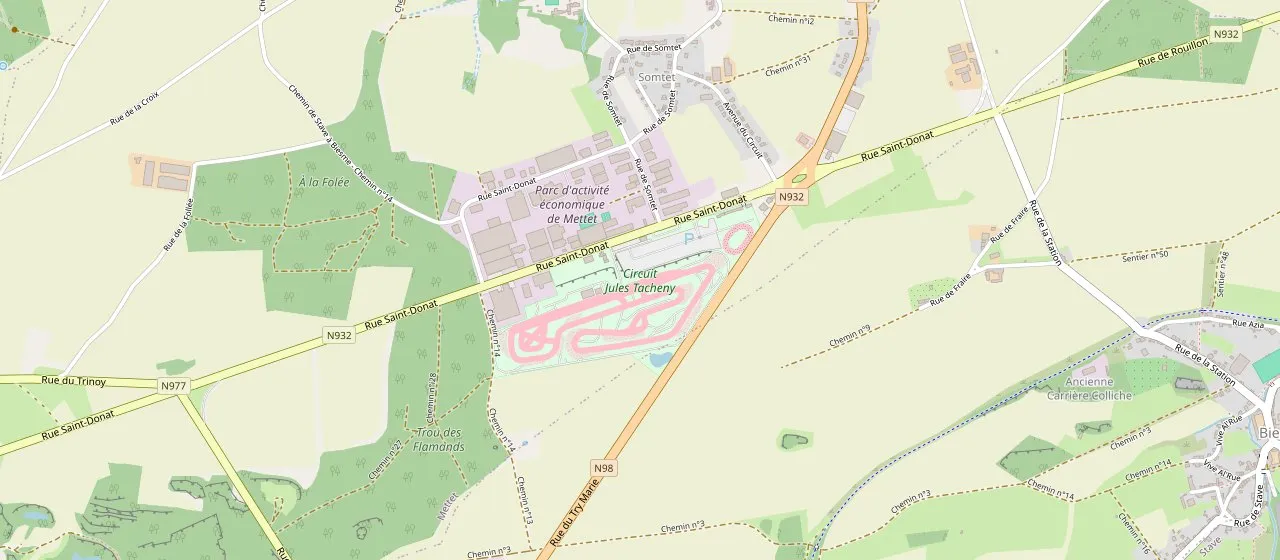
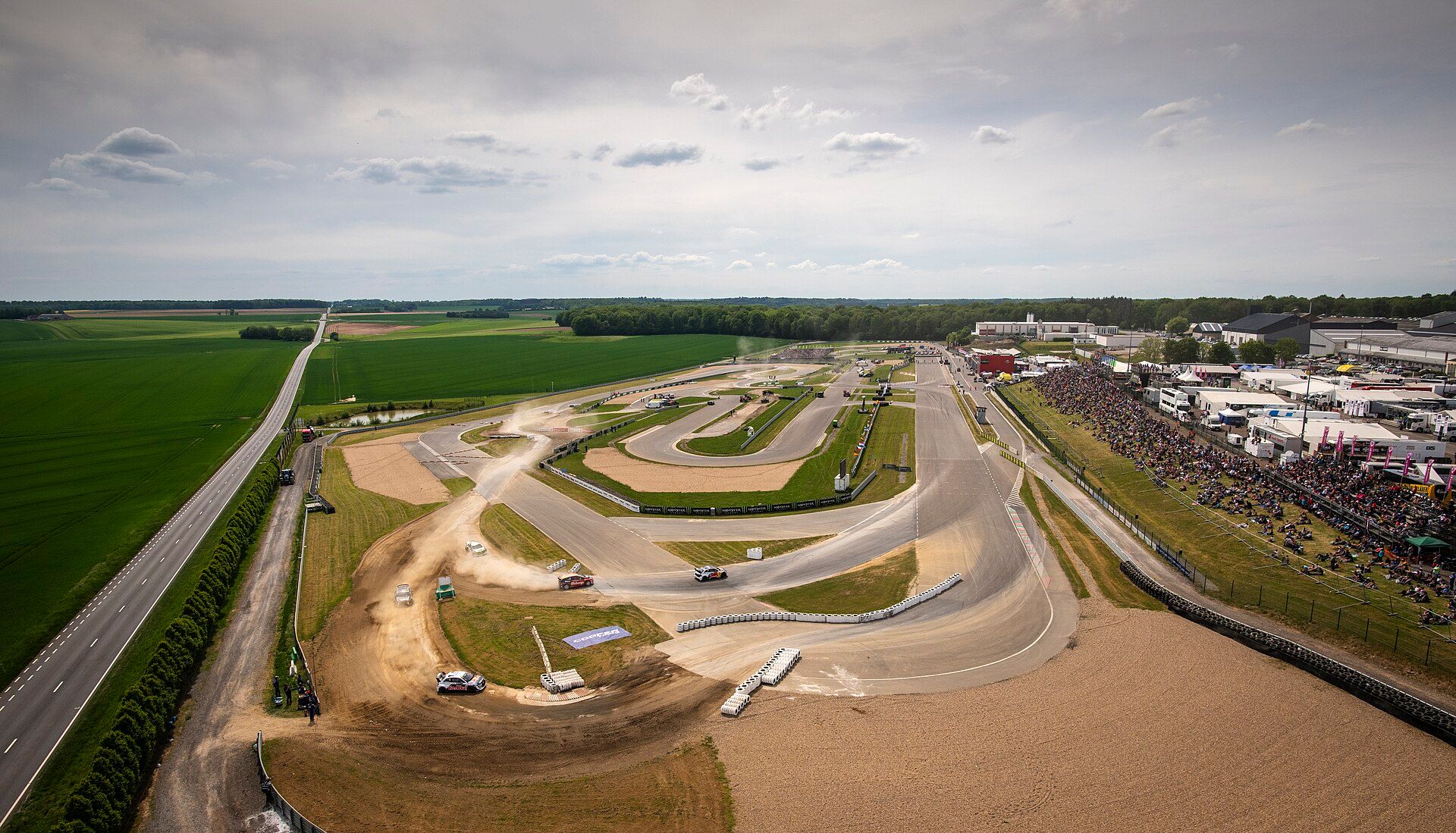
On 12 March 2010, on the Saint-Donat hill near Mettet, the ribbon was cut on a circuit whose construction had begun less than a year earlier, on 4 May 2009. The new venue was named after Jules Tacheny, a local mechanic who in 1931 broke world records on FN motorcycles and in 1946 won a race on his own circuit. That “own circuit” was, however, something else: a figure of eight made of public roads between Mettet and Florennes, on which racing went on for eight decades from 1927. The new asphalt was laid right next to it, at the former Café du Circuit corner.
| Location | Rue Saint-Donat 6, 5640 Mettet, Wallonia, Belgium |
| Type | permanent asphalt circuit for motorcycles and cars, with gravel sections for rallycross and supermoto |
| Length and configuration | 2.280 km, several configurations depending on the event |
| Width | 12 m, 14 m on the start straight |
| Longest straight | 609 m |
| Number of corners | 10 (7 left, 3 right), each named after a rider from Mettet |
| Site and elevation | 14 ha, 13 m of elevation difference |
| Opening | 12 March 2010 |
| Lap records (operator's data) | motorcycle: 1:03.550, Grégory Fastré, BMW S1000RR, 2011; car: 1:03.202, Philippe Daniels, Norma, 2011 |
| Predecessor | the Saint-Donat road circuit: a 2.8 km loop (1927–1931), an 8.5 km diabolo from 1932, the last Grand Trophy in the mid-2000s |
| Owner and operator | Royal Union Motor Entre Sambre et Meuse (RUMESM) ASBL, since 2024 under the Mettet XP brand |
| Main events | Grand Trophy (since 1928), Superbiker (since 1987), FIA World Rallycross 2014–2018, Belgian supermoto and rallycross championships |
| Noise limit on trackdays | 94 dB static, 101 dB dynamic |
| Status | active |
Beginnings on the hills of Pontaury
The date on which racing at Mettet was born is not certain even for the club that organises it. When RUMESM announced the centenary celebrations in 2024, president Freddy Tacheny explained to a journalist from “L'Avenir” that 1923 seems to be the start of the adventure, but there is a doubt, so the club decided to celebrate the centenary over five years, until 2027. According to an RTBF broadcast, the first group of motorcyclists gathered in 1923 at the Dogot café; among them were Jacques Rops, grandson of the painter Félicien Rops, and Jules Tacheny. The circuit operator itself now writes cautiously that it is hard to give an exact date, and that in the early 1920s “a few rare motorcyclists” were trying their hand on the local roads.
The facts begin in 1927. In January the Union Motor de l'Entre Sambre et Meuse (UMESM) was founded, and on 11 September the first speed race was held on the hills of Pontaury, on the small Saint-Donat loop of 2.8 km, run anti-clockwise. The prizes, according to press reports quoted by RacingCircuits.info, included a stone bust, works of art and a rifle. One of the club's founders, Jacques Rops, fell, hit a bridge parapet and flew about 18 m over the little bridge on which his mother and sister were standing; he came away with grazes. A year later, on 8 August 1928, the first Grand Prix de l'Entre-Sambre-et-Meuse was run; the main 500 cm³ race was won by the Belgian Albert Breslau on an AJS.
A diabolo between Mettet and Florennes
Until 1931 racing was held on the small loop at an average speed of, as the operator puts it, an “aeroplane” 90 km/h. In 1932, at the request of the Belgian federation FMB, the course was extended along the road towards Florennes and back. That produced the diabolo: a figure of eight 8.5 km long, whose two loops crossed at the Saint-Donat junction, with about 70 m of elevation difference. In 1932 it was still run anti-clockwise, from 1933 clockwise, and it stayed that way until the end. In 1934 the descent towards Florennes, where motorcycles reached 170 km/h, was widened, and in 1935 the circuits commission granted Mettet the right to organise international races.
The war closed the circuit, and the club paid a high price for it: president Jean Rops, founder Louis Galloy and the club secretary did not return; in November 1945 more than 2000 people paid tribute to them. The presidency was taken over by Jules Tacheny, who had never managed to win at Mettet before the war. In 1946, in pouring rain and almost 40 years old, he won the Senior category and the Grand Trophy, beating an international field. His son Johnny told “L'Avenir” about the “crazed crowd”; as he added, there was no television, there were still so few amusements.
The event itself changed its name under pressure from the federation. The 1946 race was run as the “10th Grand Prix”, although it was already the eleventh edition; the club's archives counted from 1929 and that numbering error dragged on for years. When the FIM reserved the Grand Prix title for one national event, from 1947 to 1950 the race was called the Circuit de l'Entre-Sambre-et-Meuse, and from 1951 the Grand Trophy.
The man who gave the circuit its name
Jules Tacheny was born in 1907 in Mettet, became an apprentice in a workshop in 1924, and at the age of 18 was already running his own garage on the edge of the town. He won his first race, at Sorinnes, without his parents' knowledge. The FN factory in Herstal, which made weapons, cars and motorcycles, hired him as a works rider; during a test at Montlhéry in 1930 he set the best time despite a fall and a burnt leg. In October 1931, taking turns at the handlebars with René Milhoux, he broke 41 world records at the Linas-Montlhéry autodrome; they covered the first 500 km at an average of 141 km/h. In 1934 and 1935 he was Belgian champion at Francorchamps, and he ended his racing career in 1952.
He also turned racing into a business. According to “L'Avenir” he was the first to import Honda motorcycles into the Benelux, and his son Johnny recalls that his father, “traumatised by losing many friends in racing”, forbade his three sons to compete in motorcycle events. He died on 16 July 1984 at Floreffe, aged 77, in a car that collided with a quarry lorry; it happened on the course of the former Floreffe road circuit, where he had once won. He had led the club for 38 years by then.
Formula 2 on the Place Joseph Meunier
In 1949 the club, under Tacheny's leadership, thoroughly rebuilt the course: a grandstand for 1200 people was erected at the start line, the road was widened to 7 m and surfaced with uniform macadam, and banked curves were built at the Cloquettes, Biesmerée, Florennes and Oret corners. The length officially remained 8.5 km, although it was estimated at 8.3–8.4 km, until in 1957 it was definitively measured at 8.05 km.
Formula 2 cars were let onto such a circuit in 1950 and 1951. According to the “Motor Sport” database, in 1950 Alberto Ascari in a Ferrari dominated until the rear axle failed in the second heat, which gave overall victory to Robert Manzon in a Gordini; the fastest lap belonged to Maurice Trintignant (Simca-Gordini 15, 3:19.0). Ten of the 24 drivers reached the finish, and second and third were Stirling Moss and Lance Macklin of HW Motors. A year later Manzon won again, this time ahead of his Gordini team-mates André Simon and Trintignant. The cars were parked on the Place Joseph Meunier in the centre of the town, and the adventure ended quickly, because as Johnny Tacheny says, the drivers' fees were astronomical.
In 1952 the king granted the club the title “Royal” and so the acronym RUMESM came about. A golden period began: Geoff Duke, John Surtees, Bob McIntyre, Giacomo Agostini and Jarno Saarinen stood on the podium, and the early date of the event meant that works teams treated Mettet as a pre-season test. In 1956 Surtees dominated the 500 cm³ class on an MV. In 1961 trees considered dangerous were cut down, the road was widened to 9 m, and the Saint-Donat crossroads was rebuilt as a junction with an island; for the riders the tight corners turned into wide curves, but the works forced the cancellation of that year's races.
The second lap of 30 April 1967
A shadow had already fallen on Mettet in 1960, when the Englishman Dave Chadwick died during the Grand Trophy; his motorcycle went into the crowd, killing one person and injuring two. Motorsport Memorial names the spectator Albert Nossaint as the victim. That drama and the decline in the popularity of motorcycles explain, according to Guy Thonus, the cancellation of the Grand Trophy in 1961, 1963, 1965 and 1968.
The blackest day came on 30 April 1967. On the same day the world championship season was opening in Barcelona, so a less experienced field came to Mettet. In the 500 cm³ race the Belgian Robert Claeys could not fire up his Norton Manx and pushed it all the way to the first, very fast left-hand corner on the crest of a rise, beyond which the course dropped along the Rue Hennevauche; the marshals did not show yellow flags. On the second lap the leaders Tom Dickie and Oliver Howe managed to avoid the stationary rider, but the Frenchman Claude Vigreux, French champion and winner of the 1965 Volant Shell, riding right behind them, had his field of vision blocked and hit Claeys at more than 190 km/h. Both died on the spot. The Englishman John Denty, avoiding the debris, crashed into a house by the road, and his Norton tore away the rope separating the spectators, which fatally injured the spectator Michel Gilet; Denty died in hospital in May 1967.
The race was restarted. Motorsport Memorial writes that there was no ambulance on site, the marshals remained passive and the bodies were taken away in a private van; the French press blamed the organisers, who had allowed a rider without experience to start, and his motorcycle was said to have been pushed by his wife, which should have ended in disqualification. In 1968 RUMESM gave up organising races in order to work on the safety of the course. The corner where the accident happened no longer belongs to any configuration in use.
Continental Circus and the 1000 km
Thonus calls the 1970s the golden age of the Grand Trophy: world championship riders, poorly paid in Grand Prix racing, hunted for start money in better-funded international races, and the public came to watch Agostini, Phil Read, Barry Sheene and Johnny Cecotto. In 1972 Saarinen won the 250 and 500 cm³ classes, and in the latter he turned a lap at an average of 202.233 km/h. In 1976 Cecotto turned a qualifying lap at an average of 220 km/h; within a decade the circuit record had fallen by more than 30 seconds. In 1972 the club launched the 1000 km Mettet endurance race, won by the pairing of Rouge and Chemarin on a Honda, and alongside the Grand Trophy it organised the first motorcycle rally, which drew close to 800 people. In 1975 the Grand Trophy was a round of the FIM Formula 750 Cup, won by the Frenchman Patrick Pons on a Yamaha. The last 1000 km was run in 1979.
Rising speeds bred further compromises. In 1972 a new banked curve was built at the Mettet corner on the inside of the old one, and in 1977 a variant through the industrial estate was introduced, which lengthened the lap to 8.288 km but irritated the riders with its uneven concrete. In 1985 a permanent bus-stop chicane was built before the start line, and with it a pedestrian footbridge. In May 1998 Michaël Paquay won both parts of the Grand Trophy, passing Stéphane Chambon in that very chicane just before the finish; a few days later, on 7 May, he died during practice for a Supersport world championship round at Monza. RUMESM named the chicane after him.
From the late 1970s club races used only the southern triangle, and in 1992 the northern loop was abandoned for good. By then the circuit had lost its shine: in 1980 seven of the eight Grand Trophy races were won by Belgians, and the stars could no longer be brought in. The club's answer was the Superbiker. Michel Fiévet, RUMESM's sporting president, and Freddy Tacheny had seen footage of the American “Superbikers” from Carlsbad, where from 1979 ABC television had pitted motocross, superbike and dirt track riders against each other on a mixed course. The first Superbiker at Mettet was held in October 1987 and was won by the multiple motocross world champion Georges Jobé. In 1989 the win by the American Broc Glover made the event an established fixture of the calendar.
The Mathilde project
In the 1990s the Grand Trophy was dying out: ever stricter safety requirements, overloaded calendars and contracts forbidding stars to start outside the world championship meant that the event survived only thanks to volunteers. In 2003 a third chicane was added before Florennes, which was never used, and in the same year the de la Baronne chicane was abandoned because of the state of the surface. The Grand Trophy on public roads came to an end in the mid-2000s; one of its last editions, in 2005, brought a double win for Stéphane Mertens. The club then made an agreement with the Bikers' Cup series, which was run only on permanent circuits. For a few more years, all that was left on public roads were races for historic machines, the Gold Trophy.
The idea for a way out of the impasse arose, as RTBF relates, in the late 1990s at a meeting of Fiévet, Freddy Tacheny, Mertens and Pierre Capart, head of the magazine “Moto 80”. The plan for a permanent circuit was to stay secret, so it was called “projet Mathilde”, because on that day the royal palace announced the engagement of Prince Philippe to Mathilde. The operator explains that the income from the Superbiker allowed Fiévet, the club's president for 35 years, to buy land piece by piece. Work began on 4 May 2009, the design was done by the Igretec office, and the contractor was the Wanty company.
Opened on 12 March 2010, the circuit cost several million euros, of which, according to “L'Avenir”, the Walloon Region put up 2,563,000 euros; the sports minister André Antoine, present at the inauguration, spoke of infrastructure “respectful of the environment and of the neighbours”. The direction of travel was reversed compared with the old circuit in order to limit the nuisance, and the first event was the Grand Trophy of 9–11 April 2010, the first in several years. Ten corners were given names: Surtees, Fergus Anderson, Jack Findlay, Agostini, Saarinen, Didier de Radiguès, Richard Hubin, Mertens, Chambon and Paquay; the lower paddock was named Espace D'Hollander. In the following years came the control tower with a medical centre and a café (2011), gravel sections for rallycross and supermoto (2014), the Michel Fiévet Pavilion with five pits for 1,489,491 euros (2017), a dirt track 226 m long (2019), LED boards (2020), 360 solar panels along the straight (2022) and an asphalt training area for 1.2 million euros (2024).
From 2014 to 2018 Mettet hosted a round of the FIA world rallycross championship; from 2019 the Belgian round was taken over by Spa-Francorchamps after the circuit parted ways with the series promoter. Motorsport Memorial records two fatal motorcycle accidents on the new circuit, in 2012 and 2014.
The circuit and its neighbours
Noise accompanied the new circuit from the start. In 2011 a resident of Scry, 3 km from the circuit, told “L'Avenir”: “It is not the sound level that bothers, it is the duration. It is nagging”; the local Ecolo recalled 300 signatures under a petition, and the circuit's management announced probes measuring decibels, to check compliance with the environmental permit. Mayor Michel Remy did not question the nuisance, but spoke of three letters of complaint and of driving to the circuit after evening telephone calls and finding nobody there. In December 2013 Ecolo Mettet wrote of the “exemplary management” of RUMESM and of residents nobody listens to, demanding an independent noise study. In April 2024 councillor Damien Floymont resigned as auditor of the municipal company managing the circuit after a dispute over the carbon balance; mayor Yves Delforge admitted that the unanimously adopted motion “had slipped his mind”, and added that the municipality has nothing to impose on a private association.
The same Delforge opened the driver training centre with Freddy Tacheny in April 2024, the beginning of the Mettet XP brand. The RUMESM president spoke then of “Mettet 1.0” with the road circuit and cars passing each other at 200 km/h at the Café du Circuit, “Mettet 2.0” from 2010 and “Mettet 3.0” with the driving improvement centre. For the centenary celebrations an album “100 ans, 100 photos” was planned for 2025, a year of cars and the opening of a new administrative building on the site of the old grandstands in 2026, and the opening of the circuit to electric and hydrogen vehicles and to cyclists in 2027. Under the grandstands there were once reception rooms and thirty bedrooms, which for ten years served as a centre for asylum applicants. On 1 May 2026, at the Mettet XP open day, track sessions for everyone and a Superprestigio dirt track show were planned.
The Superbiker has remained the flagship event. For the 39th edition on 9–11 October 2026 the organiser announced more than 400 riders in the Supermoto, Senior, Junior, Prestige and Quad categories. The German Marc-Reiner Schmidt won it seven times: in 2015 and in 2018, 2019, 2021, 2022, 2023 and 2024.
A trackday at Mettet
The motorcycle Mettet Speed Trackdays are run by the Mertens School in cooperation with RUMESM. The day consists of six sessions of 20 minutes in four groups by level, with transponders and tyre service; at midday the groups are arranged anew. The price in 2026 was 155 euros on a weekday and 179 euros at the weekend, a one-day course 350 euros and a two-day one 650 euros; the office opens at 7:00, the track works from 9:00 to 13:00 and from 14:00 to 18:00 with compulsory silence at lunchtime. The limits are 94 dB in the static measurement and 101 dB in the dynamic one. For 2026, 22 dates were scheduled from 15 April to 16 September.
The operator does not organise car trackdays itself; it rents the circuit to outside companies, among which it lists RACB Experience, Sprint Racing and Expert Pilot, and offers individual rates to drivers with their own car. RACB Experience admits own cars on its Driving Days, racing cars included, with a limit of 94 dB static or 101 dB dynamic, requires a fire extinguisher fixed in the cabin and does not let in convertibles without a roll cage or hybrid and electric cars. Speed4Fun offered a day in the open pitlane format from 9:00 to 18:00 for 30 cars at 295 euros, with lunch, as well as shorter afternoon and evening sessions at 370 and 230 euros.
In winter the circuit changes character. From November to March there are Supermoto Trackdays in groups of up to 35 motorcycles (105 euros, quads 90 euros), and on the mixed surface the rallycross RX Experience: 180 euros a day, an additional driver 105 euros, with any contact between cars banned on pain of exclusion after a second incident. Rallycross uses a course of 1149 m (60 per cent asphalt), supermoto one of 1428 m (66 per cent asphalt).
The old circuit can still be driven round. Herman from the Dutch site Circuits of the Past parked in 2015 in the old pits, which are still standing, climbed the raised marshals' post with its rotten sleepers and drove both versions of the figure of eight, passing four banked curves; at the last chicane, by the gate of the new circuit, he heard from an employee: “The circuit is closed today”. On the Saint-Donat hill the slower, older version of the first banked curve has become completely overgrown, while the faster one is still in good condition.
Timeline
- 1923: according to RTBF a group of friends with Jacques Rops and Jules Tacheny form the club at the Dogot café; the date is regarded by the club as uncertain.
- 1927: UMESM is founded in January; on 11 September the first race on the Saint-Donat loop (2.8 km).
- 1928: on 8 August the first Grand Prix de l'Entre-Sambre-et-Meuse, won by Albert Breslau (AJS).
- 1932: the course is lengthened to 8.5 km, the diabolo comes into being; from 1933 running clockwise.
- 1935: approval for international races.
- 1946: Jules Tacheny wins at Mettet and becomes president of the club.
- 1949: a grandstand for 1200 people, widening and macadam, banked curves.
- 1950–1951: Formula 2 races, both won by Robert Manzon.
- 1952: the club receives the title “Royal”.
- 1960: the deaths of Dave Chadwick and a spectator.
- 1967: on 30 April an accident with four victims: Claeys, Vigreux, Gilet, Denty.
- 1972: the first 1000 km Mettet; Saarinen turns a lap at an average of 202.233 km/h.
- 1975: a round of the FIM Formula 750 Cup.
- 1979: the last 1000 km Mettet.
- 1984: on 16 July Jules Tacheny dies.
- 1985: a permanent chicane before the start line, later the Chicane Michaël Paquay.
- 1987: the first Superbiker, won by Georges Jobé.
- 1992: the northern loop is abandoned, races only on the southern triangle.
- Mid-2000s: the last Grand Trophy on the road circuit.
- 2009: on 4 May the groundbreaking for the permanent circuit.
- 2010: on 12 March the inauguration of the Circuit Jules Tacheny; on 9–11 April the first Grand Trophy on the new circuit.
- 2014–2018: rounds of the FIA World Rallycross Championship.
- 2017: the opening of the Michel Fiévet Pavilion.
- 2024: the launch of the Mettet XP brand and the driver training centre; the beginning of the five-year centenary celebrations.
Sources (49)
- Mettet et son nouveau circuit : une épreuve de vitesse !, Automag [fr]
- RUMESM / Mettet XP, Jules Tacheny, world record-breaker [en]
- Mettet, RacingCircuits.info [en]
- Claude Vigreux, Motorsport Memorial [en]
- RUMESM / Mettet XP [en]
- Commune de Mettet, Circuit Jules Tacheny [fr]
- RUMESM / Mettet XP, The circuit's infrastructures [en]
- Mettet: inauguration du nouveau circuit Jules Tacheny, L'Avenir, 2010-03-12 [fr]
- RUMESM / Mettet XP, Mettet Speed Trackdays [en]
- Pierre Wiame, Le centenaire du circuit Jules Tacheny à Mettet : 5 ans de festivités, sinon rien, L'Avenir, 2024-05-05 [fr]
- Classic 21, Le centenaire du circuit Jules Tacheny à Mettet, 1/10 - Organiser un rallye en 1923, la genèse du circuit de Mettet, RTBF Auvio [fr]
- The Royal Union Motor Entre Sambre et Meuse [en]
- RUMESM / Mettet XP, Our history [en]
- Circuitdag Mettet, Circuit Mettet, Vrij rijden, Mettet circuit, Racecracks.nl [nl]
- Greg, La Balade des Circuits - Chapitre 1, classic-motorcycle.be, 2020-10-19 [fr]
- Classic 21, Le centenaire du circuit Jules Tacheny à Mettet, 2/10 - 1946, l'après-guerre et la revanche de Jules Tacheny sur le circuit de Mettet, RTBF Auvio [fr]
- Guy Thonus, La vitesse en Belgique de 1945 à 2012, bikesnplanes.be [fr]
- Mettet Racing Circuit • Details, Motorsport Database [en]
- Motorcycle, sidecar and ATV fatalities by circuit: Mettet (Circuit de Saint-Donat), Motorsport Memorial [en]
- Claude Vigreux [en]
- Classic 21, Le centenaire du circuit Jules Tacheny à Mettet 5/10 - 70's, RTBF Auvio [fr]
- Le Grand Trophy (Bientôt l'ouverture du nouveau circuit de Mettet), Objectif-Moto [fr]
- Michaël Paquay, Motorsport Memorial [en]
- Superbiker de Mettet : 35e anniversaire ce week-end pour ce fleuron du Sport Moto belge !, RTBF, 2022-10-08 [fr]
- Classic 21, Le centenaire du circuit Jules Tacheny à Mettet 6/10 - 80's, RTBF Auvio [fr]
- The Superbiker, superbiker.com [en]
- Circuit Jules Tacheny de Mettet - Belgique, Le Repaire des Motards, 2012-10-23 [fr]
- Classic 21, Le centenaire du circuit Jules Tacheny à Mettet 7/10 - 90's, RTBF Auvio [fr]
- Classic 21, Le centenaire du circuit Jules Tacheny à Mettet 8/10 - Les années 2000 : le projet Mathilde voit le jour, RTBF Auvio [fr]
- G.Old Trophy Mettet 2009, Mototribu [fr]
- Le retour du Grand Trophy, L'Avenir, 2010-04-10 [fr]
- Le Grand Trophy de retour à Mettet, Objectif-Moto [fr]
- Classic 21, Le centenaire du circuit Jules Tacheny à Mettet 9/10 - Les années 2010, RTBF Auvio [fr]
- De nouvelles infrastructures en vue pour le circuit de Mettet, RTBF, 2015-03-22 [fr]
- Martin Businaro, Le Circuit de Mettet entre dans sa phase 3.0 et se dote d'un nouveau centre de formation à la conduite, La DH/Les Sports+, 2024-04-24 [fr]
- Spa to join World Rallycross calendar from 2019, Motorsport.com [en]
- Motorcycle, sidecar and ATV fatalities by circuit: Mettet (Circuit Jules Tacheny), Motorsport Memorial [en]
- Circuit de Mettet : Écolo veut aussi faire du bruit, L'Avenir, 2011-07-04 [fr]
- B.M., Du bruit autour des nuisances du circuit (Mettet), L'Avenir [fr]
- Circuit de Mettet, Ecolo Mettet, 2013-12-28 [fr]
- La rétro d'avril 2024 en province de Namur: crash politique autour du circuit de Mettet, L'Avenir, 2024-12-26 [fr]
- RUMESM / Mettet XP, Mettet XP Open Day [en]
- Classic 21, Le centenaire du circuit Jules Tacheny à Mettet 10/10 - Les années 2020, RTBF Auvio [fr]
- RUMESM / Mettet XP, Cars [en]
- Driving Days à Mettet, RACB Experience [fr]
- Trackdays Mettet, Speed4Fun [fr]
- RUMESM / Mettet XP, Mettet Supermoto Experience [en]
- Mettet RX Experience [en]
- Herman, Circuit Mettet Circuitbezoek 2015, Circuits of the Past, 2019-05-20 [nl]