
Heusden-Zolder, Belgium
Circuit Zolder: from races around the church to a trackside velodrome
Zolder's history: tyre barriers from the mine, the 1973 and 1981 Belgian GP chaos, Villeneuve's death, cycling world titles, the noise dispute, track days.
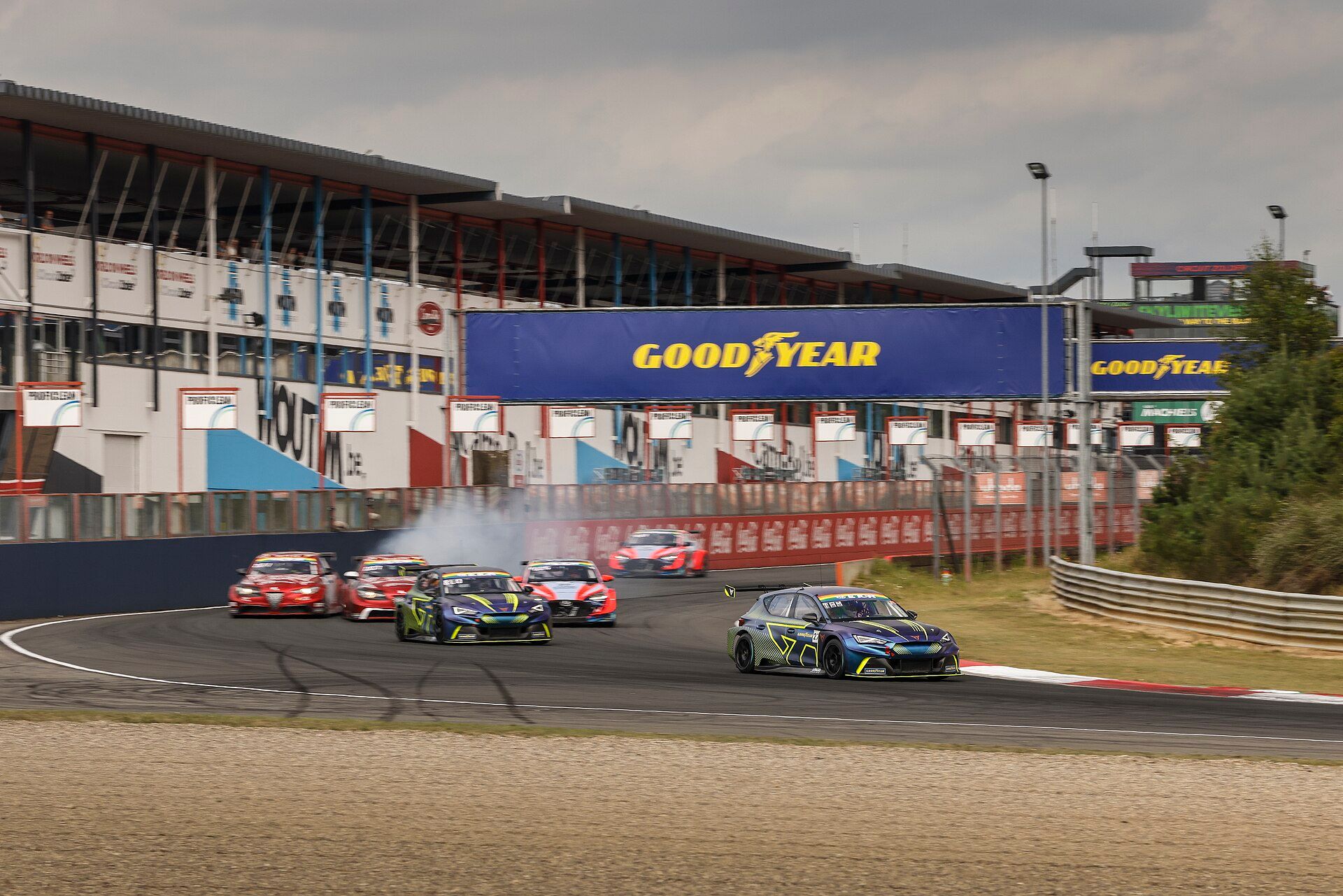
- Type
- race circuit
- Length
- 4.01 km
- Opened
- 1963
On Friday 1 June 1973, on the new asphalt of the Zolder circuit, the Formula 1 drivers gathered for a meeting instead of practising. The surface had been laid only on the evening before the first practice, it had not had time to harden and it began to break up during the very first runs; the Grand Prix Drivers' Association threatened to call off the race if the asphalt fell apart again on Saturday. Denis Jenkinson described in „Motor Sport” how „lumps of soft tar were flying about” on two of the corners and how sand was coming through the asphalt. While the drivers protested, the owners of the circuit brought in the contractor, who stripped off the faulty layer and started laying a new one. The Belgian Grand Prix made its debut at Zolder in an atmosphere that was to become the hallmark of the place for twelve years: cramped, controversial and still returning to the calendar every year.
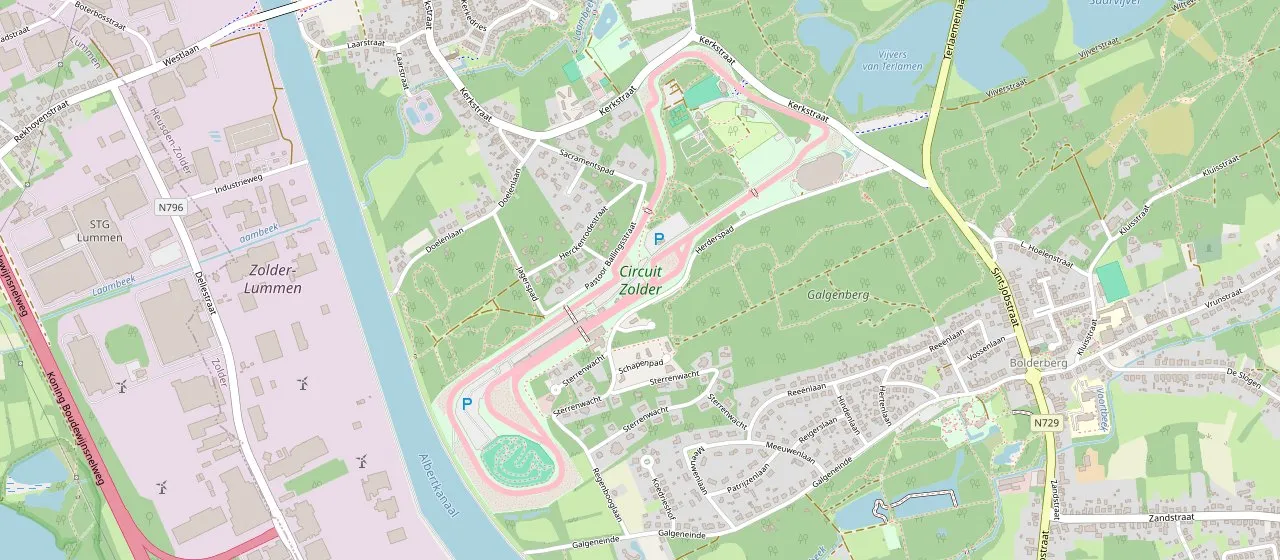
| Location | Terlaemen 30, 3550 Heusden-Zolder, Limburg, Belgium; by the junction of the E313 and E314 motorways |
| Type | permanent race circuit, FIA grade 2 licence valid until 24 April 2027 |
| Length | 4.010 km in the current configuration (since 2006); 10 corners |
| Opening | 19 June 1963, opened by minister Alfred Bertrand |
| Designer | John Hugenholtz sr. and Maurice Beliën |
| Lap record | 1:14.089 in the race and 1:12.821 in qualifying, Sébastien Bourdais, Champ Car (Panoz DP01), 26 August 2007 |
| Operator | vzw Terlamen (a non profit association), general director Harry Steegmans |
| Most important events | 10 Belgian F1 Grands Prix (1973, 1975–1982, 1984), the first DTM race in history (1984), the 24 Hours of Zolder, DTM, WTCC/WTCR, the cycling world championships of 1969 and 2002 |
| Status | active; about 400,000 visitors a year according to the operator |
Around the church, then in the Terlaemen forest
Racing at Zolder began on the streets. In the late 1950s the Auto-Motor Club Bolderberg organised speed races in the centre of the village; as Jos Bervoets of the circuit's museum section put it, the drivers „literally raced around the church”. The operator's anniversary publication states that in 1959 such races drew 10,000 spectators. After a serious accident the municipality bought land from the Palmers family and in 1961 the first loop was built on the grounds of the Terlaemen holiday centre: the Omloop van Terlaemen. According to RacingCircuits.info the owner of the land, Antoine Palmers de Terlaemen, agreed to the racing on condition that the circuit bore his name; the site gives this anecdote with the caveat that this is only what is „said”. Yvette Fontaine, Belgian touring car champion of 1969 and 1970, recalled years later that she lived in neighbouring Viversel at the time and saw the circuit being built „in the woods of Antoine Palmers de Terlaemen and Baron de Villenfagne”.
The makeshift loop soon stopped being enough for the club. The design of a larger facility was ordered from the Dutchman John Hugenholtz, author of Suzuka, Jarama and the stadium section of Hockenheim; the Belgian co-author and the circuit's first director was the architect Maurice Beliën. Construction started at the end of 1962, and on 19 June 1963 the facility was opened by the minister of communications Alfred Bertrand. The first race on the new loop, the Grand Prix of Limburg, was won by the Dutchman Rob Slotemaker. The circuit measured 4.186 km then and survived in that form until 1971. Formula 2 arrived here as early as 1964: among the winners of the Grand Prix of Limburg in 1964–1970 the operator lists Denny Hulme, Jack Brabham, John Surtees and Jochen Rindt.
David Tremayne, a historian of Formula 1, wrote in 2022 on the official F1 site that Zolder „was widely regarded as a rather mediocre circuit”. The facility had, however, another asset that the operator still puts at the head of its history: safety. In the anniversary publication the director Harry Steegmans and board member Frank Beliën, son of the first director, claim that it was at Zolder that „the first safety walls were devised and built by hand: bumpers of stacked tyres held together by long strips of conveyor belt from the mine”, a solution „eagerly copied”, in which the belt was later replaced by EPDM straps. The same publication credits Beliën with a large part in the development of the first fences protecting spectators and adds that this was noticed by Bernie Ecclestone, who „pulled” Roland Bruynseraede out of the circuit's management. Bruynseraede, a Ford employee active in the sport after hours, was race director at Zolder in the 1970s, from 1987 a starter and inspector of F1 circuits, and in 1988–1995 Formula 1 race director and FIA safety delegate. These superlatives come from the operator and should be read as such; what is a fact is that the man who was responsible for safety in F1 for seven seasons learned his trade in a Limburg forest.
The asphalt that had no time to harden
Formula 1 came to Zolder in 1973, when the Belgian Grand Prix began to be held alternately between Flanders and Wallonia: a year earlier and a year later it ran at the Nivelles-Baulers circuit. Before the first F1 visit a chicane was added on the rise by the Sacrament chapel (Sacramentshelling), because it was feared that the cars would leave the ground there; the length of the circuit grew to 4.220 km. The rest was as in the introduction: a dispute over the surface, a protest, a contractor working through the night. The role of the man who broke the deadlock is attributed to Jacky Ickx. The Belgian did not belong to the drivers' association, which he had left because he did not agree with the constant threats of boycotts; while the others were deliberating, he took his Ferrari out on track. The operator's publication puts it briefly: Ickx went out, „and the Belgian GP was saved”. The race over 70 laps was won by Jackie Stewart ahead of François Cevert, both in Tyrrells; 11 of the 23 drivers reached the finish, and Ickx retired after six laps with an oil pump failure.
In 1975, after a year's break, F1 returned to a changed circuit: the fast double curve before the start straight was replaced by a tight ess that today bears Ickx's name, and the lap length grew to 4.262 km. Jenkinson judged that Zolder was a circuit „quite friendly and attractively set in pine woods on a sandy soil with the self-contained paddock area in the middle”, but that the race itself was „not very inspiring and certainly not a memorable one”. A year later he was harsher still:
„It resembles a Go-Kart circuit for 500 b.h.p. Formula One cars. It is not so much that there is anything particularly wrong with Zolder, it is just that there is not very much right with it.”
On that „karting circuit”, however, things happened that mattered for the history of F1. Niki Lauda won here in 1975 and 1976, Mario Andretti in 1978 took the first victory of the Lotus 79, the first full ground effect car, Jody Scheckter took the first win for Ferrari here in 1979, and Didier Pironi gave Ligier victory in 1980. That same year of 1980 brought the circuit's only round of the motorcycle world championship: the Belgian Grand Prix was moved from Spa-Francorchamps after the works teams withdrew because of the slippery, freshly laid surface in the Ardennes; on 6 July Randy Mamola won the 500 cc class.
A crowded pit lane
The weekend of the 1981 Belgian Grand Prix is a synonym for chaos in the history of F1. The pit lane at Zolder was narrow and, according to the account of The Race, more than a thousand people were milling about in it. On Friday 15 May, about ten minutes before the end of qualifying, the 21 year old Osella team mechanic Giovanni Amadeo stepped back from a wall a foot wide and fell under the approaching Williams of Carlos Reutemann; the driver had nowhere to turn, because half of the lane was taken up by parked cars and people. Amadeo, with a skull injury, was taken first to the hospital in Genk and then to the university clinic in Leuven, where he died on 17 May 1981, on the Sunday of the race. Jenkinson wrote of the „totally inadequate size of the pit area” and of „ridiculous over-crowding”.
The news of the mechanic's death reached the circuit a few hours before the start and provoked a demonstration by the mechanics, which twelve drivers joined. The start was an organisational disaster: Riccardo Patrese stalled his Arrows on the grid, his mechanic Dave Luckett jumped over the wall to start the car, and the marshals switched on the green light all the same; Siegfried Stohr, Patrese's team mate, hit the back of the stationary Arrows, beside which Luckett was kneeling. The mechanic survived with a broken leg, and the race, won by Reutemann, was stopped after 55 of the 70 laps because of rain. According to The Race the twelve drivers who got out of their cars in protest were fined 5,000 dollars each by the FISA president Jean-Marie Balestre, the clerk of the course Paul Grutman resigned, and a rule appeared in the regulations that a delayed start requires the whole starting procedure to be repeated. For the next season the organisers rebuilt the pits and the paddock from scratch; „Motor Sport” noted that the work was finished „well on time”.
Terlaemenbocht, 8 May 1982
A year later the new pit lane made no difference. On Saturday 8 May 1982, at the end of qualifying, Gilles Villeneuve went out on his last set of qualifying tyres; his Ferrari team mate Didier Pironi, with whom the Canadian had not spoken since the race at Imola two weeks earlier, had a time one tenth better. On the approach to the fast left hand curve behind the paddock Villeneuve caught Jochen Mass, who was returning slowly to the pits in his March. Mass moved right to let him through; at the same moment Villeneuve decided to overtake on the right. The Ferrari struck the March's rear wheel with its front wheel at a speed estimated at about 225 km/h, was thrown into the air, fell nose first to the ground and broke apart in a series of somersaults; the driver was thrown out together with his seat towards the fencing on the outside of Terlaemenbocht.
„I was going down the middle of a straight and saw Villeneuve in my mirror coming up. I moved right to let him through, but he came in on the right as well. He touched my right rear wheel and somersaulted.”
Villeneuve died that evening in the university hospital in Leuven, after the doctors found a fracture of the neck at the base of the skull; RaceFans gives the time as 21:12. FISA held that the cause was an error by the Ferrari driver and did not blame Mass. Niki Lauda judged that a driver returning to the pits should either pull over onto the verge or keep to the ideal line, because „moving over at the last moment simply takes the man behind by surprise”, but added that Villeneuve was „perhaps the only driver around who would have chosen the risky option of overtaking a slower car going flat out off the ideal line”. Ferrari withdrew Pironi's car, and the race was won the next day by John Watson, starting from twelfth on the grid. After the 1982 season ground effect was banned in F1, and the new regulations required that the driver's feet should not reach ahead of the axle of the front wheels.
Formula 1 came back to Zolder once more. On 29 April 1984 Michele Alboreto in a Ferrari 126C4 started from pole and led all 70 laps; it was his first triumph for the Scuderia. On the grid there was also Thierry Boutsen in a BMW powered Arrows A7, a driver who had begun his career at Zolder and whom the circuit supported in his move up to Formula 3 with the „Racing for Zolder” programme. From 1985 the Belgian Grand Prix returned for good to Spa-Francorchamps.
Zolder has not forgotten Villeneuve, although the memory of him has had a turbulent history. In 1986 the first corner was tightened and a chicane was laid at the site of the accident, which RacingCircuits.info calls „clumsy”; today it is the Gilles Villeneuve Bocht. The operator explains that before Terlaemenbocht there was no room for a run off area, so „first one more corner was inserted”. In 1984 a monument was erected in the pit lane: a monolith of marble with Gilles' helmet and a small statue in a glass case; according to Mark Hughes of „Motor Sport” it was removed by the previous management of the circuit in 1995, and the main elements went to the private museum of the Belgian Ferrari importer Jacques Swaters. A new monument by Stefan Bongaerts, five white columns topped with a helmet, the silhouette of a Ferrari 126C2 with the number 27, the Ferrari logo, a signature and maple leaves, was put up away from the pits, and at the site of the accident a black granite plaque appeared on the initiative of the Ferrari club from Genk. On 8 May 2023, on the 41st anniversary of his death, a bronze bust of Villeneuve by Alessandro Rasponi was unveiled at Terlaemenbocht, a copy of the sculpture stolen in 2012 from the Enzo Ferrari park in Modena.
Without Formula 1: DTM, twenty four hours and the loop by the canal
Formula 1 left, but the calendar of Zolder did not empty. On 11 March 1984, a month before the last Grand Prix, the first race in history of the series that was to become the DTM was held here: the Deutsche Produktionswagen Meisterschaft. It was won by Harald Grohs in a BMW 635 CSi, ahead of three other BMW drivers; about an hour and a half after the race he was disqualified over a technical detail, the victory was awarded to him, but without points. Thirty five years later Grohs, then 75 years old, said that „alongside the Nürburgring, Zolder is my home circuit”.
In that same year of 1984 the 24 hour race, run since 1977 by Rétro Organisation, was taken over by the circuit itself; the first edition under the new management, in 1983, was won by Albert Vanierschot and Raymond Raus in a Renault 5 Turbo. Vanierschot, called „the king of Zolder”, recalled that he drove for more than 16 hours because his partner was ill, and that throughout the race he chased the BMW of the Bastos team from the European championship, passing it during its refuelling stops; he finally overtook it on the last lap. The same driver gives a description of the circuit from a competitor's point of view that is rare in the sources: „at the Zolder circuit weight and the suspension setup are more important than the difference in horsepower”, and in the 24 hour race „at Francorchamps it is simple: drive as fast as you can. At Zolder you have to adapt your driving style or the car will break”. Since 1997 the race has belonged to the Belgian Belcar series; the record holder is Bert Longin with seven victories.
The 1980s and 1990s also brought the European touring car championship, the BMW M1 Cup and the single Formula 3000 round of 1988, in which Olivier Grouillard in a Lola T88/50 set a qualifying record of 1:28.27. The circuit itself changed piece by piece. In 1994 an enlarged entry tunnel forced the route behind Terlaemenbocht to be moved and the lap to be shortened to 4.184 km; in 1996 the new management laid new asphalt over the whole facility and widened the start straight; in 2001 almost a kilometre of the circuit in the loop by the canal was dug up and routed anew, and the length fell to 3.977 km. On the circuit thus shortened the FIA GT championship raced in 2001–2005; the first round, on 20 May 2001, was won by Christophe Bouchut and Jean-Philippe Belloc in a Chrysler Viper GTS-R.
In 2006 the chicane on the Sacrament rise was reprofiled into a slower, single line passage; the first design proved troublesome and a year later it was corrected again, and the circuit reached its present 4.010 km. The reason for the hurry came from America: on 26 August 2007 Zolder hosted the first and, as it turned out, the only Champ Car race in Belgium. Sébastien Bourdais won from pole position, and his times of 1:12.821 from qualifying and 1:14.089 from the race remain to this day the fastest laps in the history of the circuit. The WTCC world touring car championship raced here in 2010 and 2011, and its successor, WTCR, in September 2020. The DTM came back after a break of seventeen years in May 2019 and came again in 2020; the head of the series Gerhard Berger spoke then of a return „to the birthplace”.
A rainbow jersey on the asphalt
From the beginning Zolder was a circuit for bicycles as much as for engines. On 10 August 1969 the road cycling world championships were held here; the favourite was Eddy Merckx, but the whole peloton rode against him, the Belgian dropped away on the last lap, and two outsiders fought for the rainbow jersey: the Belgian Julien Stevens and the Dutchman Harm Ottenbros, called up at the last moment in place of the ill Jan Janssen. Ottenbros won the sprint by half a wheel and never afterwards won a race of the highest rank. Thirty three years later, on 13 October 2002, the championships returned and produced the fastest championships in history: Mario Cipollini won the bunch sprint ahead of Robbie McEwen and Erik Zabel with an average of 46.538 km/h over a distance of 256 km, after a crash in the last kilometre had eliminated some of the favourites. In February of the same year the cyclo-cross world championships were held on the circuit and in the sands around it; according to Wikipedia 47,000 spectators came, and Belgians took the whole podium: Mario De Clercq, Tom Vannoppen and Sven Nys. Vannoppen, the silver medallist, recalled that an hour of riding „through a screaming crowd” was tiring because of the noise alone, and that the section on the Sacrament rise was „actually a rest point”.
The bicycles stayed. In 2008 a BMX track was built by the circuit, on which the UCI world championships were held in 2015 and 2019. The operator describes giving part of the land to the municipality for the construction of a velodrome as a „conscious move”, and calls cycling the „second lung” of the facility. The Sport Vlaanderen Heusden-Zolder Velodroom Limburg complex, with a wooden track 250 m long, cost 23.5 million euros according to Sport Vlaanderen; the first laps were officially ridden on 13 June 2023, and the ceremonial opening took place on 27 October 2023. On three evenings a week, from 17:30 to 21:00, the track is open to amateur cyclists; according to VRT 800 people take part in the evening sessions.
Noise, neighbours and an empty till
The circuit lies between the Viversel and Bolderberg housing estates, and two chapels stand inside the loop. The Respondeco association, representing dissatisfied residents, keeps a dossier in which it accuses the operator of degrading the heathland landscape and of worsening noise; according to that association the environmental permit of 26 March 2019 raised the permissible emission of vehicles on the so called B and C days from 95 to 98 dB(A), measured at the edge of the track. The operator itself argued in 2018 that it wanted to raise the limit to a „more realistic” 98 dB. The dispute ends in a compromise: on 30 January 2026 VRT reported that after talks with the neighbours the circuit is cutting the number of „noise days” from 250 to 115 a year, giving up the complicated division into A, B and C days, and that the new permit is to be ready by the end of 2027. The local news service gives different figures, 283 days with noise now and 163 after the change, and describes an information meeting for the neighbours on 2 February 2026. Steegmans commented on VRT that the circuit will have fewer worries about appeal procedures and that everything will become clearer for the neighbourhood; on quiet days the facility remains open to electric vehicles and cyclists.
Money was a problem for longer than the decibels. In 2013 the then director Thierry Deflandre admitted that the losses had been mounting since the end of the F1 era in 1984, that 2010 had been „catastrophic”, that the till was „practically empty” and that the association, with about 25 employees, needed half a million euros for upkeep alone; the rescue was to come from regional projects, among them an indoor cycling track for 18 million euros. Deflandre's contract was terminated in December 2015, and in May 2016 the board of vzw Terlamen appointed Sven Pribylla, previously the manager of a Mercedes dealership. Under him the DTM came back to Zolder, and revenues rose according to the RallyandRaces site from 5.8 to 9.4 million euros in 2016–2019. On 8 July 2020 the chairman of the board Jacques Heynen announced that after three months of selection the general director would be Harry Steegmans, an entrepreneur and former Belcar driver, second in the 24 Hours of Zolder 2007 in a Porsche 996.
The pandemic brought the circuit something rare: 25 days of quiet for the works. In December 2019 an investment of a million euros was announced, and on 23 March 2020 the replacement of the whole surface began, more than 55,000 m², together with the construction of wadis buffering water, 8.2 km of fibre optic cable for the cameras and new kerbs. Autosport.be described how the asphalt on a special Shell bitumen was laid after three dimensional measurement and milling, and how the contractor APK worked on weekdays, deliberately leaving the weekends to the neighbours. Today the operator advertises the future of the circuit under the name Park Terlaemen: a hotel, an office building with a gaming centre, a cycling bridge over the track, an adventure park in the forest; the site gives neither a schedule nor financing and invites investors.
A track day at Zolder
For the amateur, Zolder has two gates. The international test days, usually on Thursdays and some Tuesdays, are open only to holders of a valid racing licence; the morning session 9:05–11:55 costs 455 euros in summer, the afternoon one 605 euros, the whole day 965 euros, and in the winter tariff (January and February) 400, 400 and 675 euros respectively. The calendar for autumn 2026 includes, among others, 17 September, 8 and 22 October and 26 November. The second gate is the Petrolhead Days for drivers without a licence: you have to be 18, have a driving licence and a sports car of more than 300 hp (a Porsche Cayman can also be rented), there are at most 30 cars on track at a time, and the organiser stresses that there is no noise limit; in the „Sport” version it is five runs of 20 minutes, in the „Warming up” version three runs with an instructor and two on your own. Motorcyclists have their own school, the Motorsportschool Zolder, with four levels of courses and open riding in two variants: with the original silencer or with open exhausts.
The Dutch portal Racecracks warns that the noise measurement takes place at the Bianchi corner and that exceeding the limit means a black flag, although „you usually get one more chance”. The names of the corners are a history lesson here: the first curve bears the name of Lucien Bianchi, winner of Le Mans 1968, who died in testing a year later; the small chicane has been called Thierry Boutsen since March 2018; further on are Gilles Villeneuve, Terlaemenbocht, the Jacky Ickx chicane and the Jochen Rindt corner. Eddy Joosen, who in 1965 as an 18 year old „borrowed” his father's Mustang for an open driving day at Zolder, recalled that the Boutsen chicane was not there then, „you went straight through”, and that the Ickx chicane was much gentler: „we used to fly through there in fifth”.
Driving for amateurs has its dark page too. On 6 June 2024, during an international practice day, a 57 year old motorcyclist from Wetteren died; according to the police the footage showed that the rider had fainted, missed the corner after the start straight and hit the barrier. On 15 June 2026, during open riding, a 53 year old Dutchman from the Maastricht area died; Steegmans told VRT that the motorcyclist „probably changed down badly” and „went off the corner at high speed”. The Motorsport Memorial database lists seventeen fatalities at Zolder among drivers, riders and mechanics since 1969.
The memory of the circuit is housed behind the permanent grandstand at the start line, in a small museum opened during the main events. There is a „Wall of Fame” there: a wall from the former OTO bar, which in 1967 the later caricaturist Steven decorated with seven figures made from motorcycle fuel tanks, and on which Clay Regazzoni was the first to sign in 1973, followed by about a hundred more guests, among them Lauda, Berger, Scheckter and Senna. Beside it, according to the museum's page, lies a piece of carbon fibre from Gilles Villeneuve's Ferrari.
Timeline
- 1959: AMC Bolderberg street races around the church in Zolder; according to the operator 10,000 spectators.
- 1961: the municipality buys the Terlaemen site; opening of the first loop, the Omloop van Terlaemen.
- 19 June 1963: minister Alfred Bertrand opens the circuit designed by Hugenholtz and Beliën (4.186 km); the first race is won by Rob Slotemaker.
- 1964–1970: Formula 2 Grand Prix of Limburg; winners include Hulme, Brabham, Surtees, Rindt.
- 10 August 1969: cycling world championships, the title for Harm Ottenbros.
- 1972: chicane on the Sacrament rise before the arrival of F1 (4.220 km).
- 1973: the first Belgian F1 Grand Prix at Zolder, the crisis of the surface, victory for Stewart.
- 1975: the Ickx chicane (4.262 km); F1 returns, Lauda wins.
- 6 July 1980: the only Belgian motorcycle Grand Prix at Zolder, Mamola wins.
- 15–17 May 1981: death of the mechanic Giovanni Amadeo, the mechanics' protest, chaos at the start; rebuilding of the pits for 1982.
- 8 May 1982: death of Gilles Villeneuve in qualifying.
- 11 March 1984: the first DTM race in history, won by Harald Grohs.
- 29 April 1984: the last Belgian F1 Grand Prix at Zolder, won by Alboreto.
- 1986: tightening of the first corner and the Villeneuve chicane (4.194 km).
- 1994: new entry tunnel (4.184 km); 1996: new management, new asphalt, widened straight.
- 2001: rebuilding of the loop by the canal (3.977 km); the first FIA GT round.
- 2002: world championships in cyclo-cross (February) and on the road (13 October, Cipollini).
- 2006–2007: the new Sacrament chicane (4.010 km); 26 August 2007 the Champ Car race, records for Bourdais.
- 2010–2011: WTCC rounds.
- 2015 and 2019: BMX world championships.
- 2016: Sven Pribylla as director; May 2019: the DTM returns after 17 years.
- 26 March 2019: new environmental permit, a limit of 98 dB(A) on B and C days.
- March–April 2020: replacement of the whole surface; July 2020: Harry Steegmans as director.
- 2023: the 60th anniversary of the circuit; opening of the velodrome by the circuit; Villeneuve's bust at Terlaemenbocht.
- January 2026: agreement with the neighbours on cutting the number of noise days from 250 to 115.
Sources (77)
- Belgian GP, 1973, GrandPrix.com [en]
- D.S.J. (Denis Jenkinson), Grote Prijs van Belgie, „Motor Sport” [en]
- Circuit Zolder, Praktische info & FAQ [nl]
- FIA, List of FIA licensed circuits, updated on 2026-03-31, 2026-03-31 [en]
- Zolder, RacingCircuits.info [en]
- Cedric Van den Langenbergh, Circuit van Zolder viert 60-jarig bestaan: «Ervoor raceten ze rond de kerktoren», VRT NWS, 2023-06-19 [nl]
- Circuit Zolder bestaat vandaag 60 jaar, Internetgazet Heusden-Zolder, 2023-06-19 [nl]
- David Tremayne, John Hugenholtz, the circuit designer who made Suzuka his «magnum opus», Formula1.com, 2022-10-08 [en]
- Limburg, Heusden-Zolder, Terlaemen [nl]
- Zolder, Motorsport Database [en]
- Circuit Zolder, Wikipedia (ang.) [en]
- Harry Steegmans nieuwe directeur Circuit Zolder (Update), Autosport.be, 2020-07-08 [nl]
- circuit-zolder.be [nl]
- Matt Bishop, F1 at Zolder: Unravelling the history of Belgium's other iconic circuit, Motor Sport Magazine, 2023-07-25 [en]
- Circuit Zolder, Formula One History [en]
- Circuit Zolder, Over ons [nl]
- VZW Terlaemen (wyd. odp. Harry Steegmans), 60 jaar collectief geheugen in foto's & anekdotes [nl]
- Roland Bruynseraede, GrandPrix.com [en]
- Denis Jenkinson, Grote Prijs van Belgie, „Motor Sport” [en]
- Denis Jenkinson, Belgian Grand Prix: A Ferrari enthusiast's delight, „Motor Sport” [en]
- 1980 Belgian MotoGP, Motorsport Database [en]
- 1980 Belgian motorcycle Grand Prix, Wikipedia (ang.) [en]
- A tragically shambolic race in a toxic F1 season: Zolder '81, The Race, 2021-12-27 [en]
- Giovanni Amadeo, Motorsport Memorial [en]
- Denis Jenkinson, Grote Prijs van Belgie, „Motor Sport” [en]
- Cari Jones, Today in 1981: Reutemann wins after F1's deadly fiasco at Zolder, RaceFans, 2011-05-17 [en]
- 1982 Belgian Grand Prix, Motorsport Database [en]
- Gilles Villeneuve, Motorsport Memorial [en]
- Adam Cooper, The inside story of Villeneuve's final F1 weekend, Motorsport.com, 2023-05-09 [en]
- On this day in 1982: Gilles Villeneuve killed at Zolder, RaceFans, 2012-05-08 [en]
- Denis Jenkinson, Grote Prijs van Belgie, „Motor Sport” [en]
- Mark Hughes, Gilles Villeneuve: The racer's racer, WhichCar (pierwodruk „Wheels”, sierpień 2002) [en]
- Károly Méhes, A pilgrimage to Zolder, where Gilles Villeneuve lost his life, Motorsport Guides [en]
- Gilles Villeneuve's bust connects Zolder to Modena in memory of Ferrari F1 legend, Scuderia Fans [en]
- Julia Spacek, Alles begann in Zolder: DTM kehrt 2019 zur «Geburtsstätte» zurück, Motorsport-Total.com, 2019-01-12 [de]
- BMW Group PressClub, Harald Grohs and the historic Zolder victory: «That makes me proud and happy», 2019-05-16 [en]
- 35 Jahre nach DTM-Geburtsstunde: Sieger Grohs fährt mit 75 in Zolder, Motorsport-Total.com, 2019-05-16 [de]
- 24 uur van Zolder, Wikipedia (nid.) [nl]
- 1988 Zolder F3000, Motorsport Database [en]
- FIA GT Championship Zolder 2001, Racing Sports Cars, 2001-05-20 [en]
- The Associated Press, Frenchman Bourdais captures inaugural Belgian event, CBC Sports, 2007-08-26 [en]
- FIA WTCR Race of Belgium, Wikipedia (ang.) [en]
- Harm Ottenbros (78), wereldkampioen wielrennen in Zolder 1969, is overleden, Sporza, 2022-05-05 [nl]
- Oud-wereldkampioen wielrennen Harm Ottenbros (78) overleden, NOS, 2022-05-05 [nl]
- Wereldkampioenschappen wielrennen 1969, Wikipedia (nid.) [nl]
- Retro: Ottenbros uit het niets wereldkampioen in 1969, Wieler Revue, 2017-08-10 [nl]
- AFP, Monday's Euro-file: All hail King Mario; Zolder wrap up, VeloNews, 2002-10-14 [en]
- 2002 UCI Road World Championships – Men's road race, Wikipedia (ang.) [en]
- Wereldkampioenschappen veldrijden 2002, Wikipedia (nid.) [nl]
- Uitslag UCI Wereldkampioenschap Veldrijden Heusden-Zolder 2002, Cyclocross24.com [nl]
- 2019 UCI BMX World Championships, Wikipedia (ang.) [en]
- Circuit Zolder, Wikipedia (nid.) [nl]
- Sport Vlaanderen, Officiële eerste rondje op gloednieuwe piste van Velodroom in Heusden-Zolder, 2023-06-13 [nl]
- wielerverhaal.com, 2023-10-27 [nl]
- Velodroom Limburg, Wikipedia (nid.) [nl]
- Klaas Wauters, Circuit Zolder halveert aantal «geluidsdagen» na overleg met buurtbewoners, VRT NWS, 2026-01-30 [nl]
- Respondeco vzw, Circuit Zolder [nl]
- Vergunning circuit: vragen over geluidsnormen, Internetgazet Heusden-Zolder, 2018-06-20 [nl]
- Milieu omgeving circuit Zolder, Nieuws Heusden-Zolder, 2026-02-03 [nl]
- Circuit Zolder tekent nieuw toekomstperspectief uit, DVO, 2013-05-14 [nl]
- Sven Pribylla nieuwe directeur Circuit Zolder, DVO, 2016-05-31 [nl]
- Circuit Zolder: Harry Steegmans volgt Sven Pribylla op als algemeen directeur, RallyandRaces.com, 2020-07-08 [nl]
- Circuit Zolder investeert 1 miljoen: renovatie asfaltlaag, betere waterbuffering, 8,2 kilometer glasvezelkabel, RaceXpress, 2019-12-20 [nl]
- Een overzicht van de vernieuwingen aan Circuit Zolder, Autosport.be, 2020-04-24 [nl]
- Circuit Zolder, Park Terlaemen [en]
- Circuit Zolder, Internationale testdagen [nl]
- Circuit Zolder, Testdays [nl]
- Circuit Zolder, Petrolhead Days [nl]
- Circuit Zolder, Motorsportschool Zolder [nl]
- Circuit Zolder, Racecracks.nl, 2025-10-06 [nl]
- Yente Van der Sande, Motorrijder uit Wetteren (57) vliegt uit de bocht en overlijdt op Circuit Zolder, VRT NWS, 2024-06-06 [nl]
- Mariken Veldhuis, Nederlandse motorrijder (53) komt om het leven na ongeval op Circuit Zolder, VRT NWS, 2026-06-15 [nl]
- Motorrijder verongelukt op Circuit Zolder, Internetgazet Heusden-Zolder, 2026-06-15 [nl]
- Motorsport Memorial [en]
- Circuit Zolder, Museum [nl]
- Circuit Zolder Museum, FAAM Vlaanderen [nl]
- Blikvangers in het circuit-museum (3), Internetgazet Heusden-Zolder, 2015-08-21 [nl]