
Nürburg, Germany
Nürburgring Nordschleife: from Landrat Creutz's cows to 5:19.55
History of the Nordschleife: 1925–1927 public works in the poor Eifel, Grand Prix era up to Lauda's crash, 24h Nürburgring, NLS, records, Touristenfahrten.
- Type
- race circuit
- Length
- 20.832 km
- Opened
- 1927
In July 1924 the Landrat of the Adenau district, Otto Creutz, drove with a few councillors to the Eifelrennen, an ADAC race held since 1922 on public roads near Nideggen. He came back discouraged: despite the barriers, spectators, residents and cattle kept crossing the course. “I am not going to let my cows be run over. I am first of all the Landrat for the farmers here, and only then for the motorists”, he is said to have declared. Out of that objection came the idea of a track completely separated from traffic, with viaducts and crossings, laid out around Nürburg castle. Three years later that road was 22.810 km long and was called the Nordschleife.
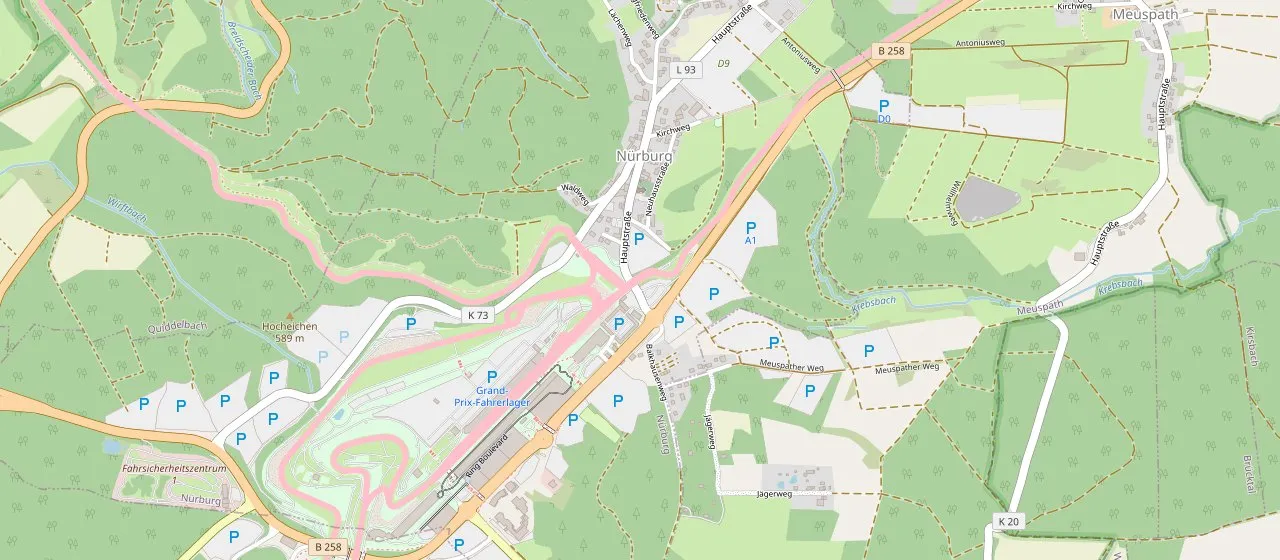
| Location | Nürburg, Ahrweiler district, Rhineland-Palatinate, Germany; the track runs through the municipalities of Adenau, Herresbach, Herschbroich, Meuspath, Müllenbach, Nürburg, Quiddelbach and Wimbach |
| Type | permanent road course, the northern loop of the Nürburgring complex |
| Length | 20.832 km since the 2001/2002 rebuild; 22.810 km in the 1927 configuration |
| Opening | 18–19 June 1927 (Eifelrennen) |
| Highest point | Hohe Acht, more than 600 m above sea level; the lowest in Breidscheid |
| Fastest lap on a race weekend | 6:11.13, Stefan Bellof, Porsche 956, practice for the 1000 km Nürburgring, 28 May 1983 (shortened 20.835 km configuration) |
| Fastest lap of all | 5:19.55, Timo Bernhard, Porsche 919 Hybrid Evo, record run on 29 June 2018, 20.832 km |
| Operator | Nürburgring 1927 GmbH & Co. KG |
| Main events | ADAC 24h Nürburgring (since 1970), Nürburgring Langstrecken-Serie (formerly VLN, since 1977), Touristenfahrten |
| Status | active |
The Landrat's cows and the “Prussian Siberia”
In the mid-1920s the Adenau district was regarded as the poorest in the country, and the whole Eifel was called the “Prussian Siberia”. The administrative report for 1925 recorded that the district, in which “apart from a few quarries any industry is lacking”, had a surplus of hands to work, because the barren soil was not able to feed the people. Creutz, Landrat from 1924 to 1932, saw two things at once in the track: a way to draw tourists and a proving ground for the motor industry. The originators also included the mayor of Nürburg Hans Pauly, the local baker Franz-Xaver Weber and the Bonn merchant Hans-W. Weidenbrück, who leased the hunting rights in Nürburg. It was Weidenbrück who laid out the basic course of the route over the hills and plateaus around the castle.
On 15 April 1925 Creutz went to Berlin and convinced officials of the Prussian ministry of social welfare and of the Reich transport ministry that the track was an urgent crisis undertaking; KuLaDig calls it the largest public works programme of the Reich. The cost estimate first came to 2.5 million marks, grew that same year to 4 million, and in 1926 to 5 million. The Cologne ADAC also stood behind the project; according to RacingCircuits.info Creutz agreed it with the mayor of Cologne Konrad Adenauer, the later chancellor. Work started on 1 July 1925, before the formal permission arrived on 13 August. On 10 July a meeting was held at the castle at which about 110 people, among them the Eifelverein, protested against the disfigurement of the landscape; the authorities found the objections groundless. The foundation stone was laid on 27 September 1925, and on 30 October the name “Nürburg-Ring” was settled, still with the hyphen.
Two years of construction
Construction took two years; at its peak thousands of workers were employed on it, mostly by hand. The finished complex measured 28.265 km and consisted of three parts: the Nordschleife, 22.810 km long, the Südschleife (7.747 km) and a short start loop, officially the Start-und-Ziel-Schleife, colloquially the Betonschleife. To this came a separate test section for the industry, the Steilstrecke, with a climb at a gradient of 27 percent. The longest straight, from Döttinger Höhe to Tiergarten, was 2.6 km, the tightest curve, the Karussell, had a radius of 33 m, and the climbs reached 17 percent. The Nordschleife partly followed the line of existing roads and paths, especially between Hatzenbach and Adenauer Forst, whereas the section from Breidscheid to Hedwigshöhe was laid out from scratch. Along the loop ten (later sixteen) marshals' huts connected by telephone were set out.
The opening took place on 18 and 19 June 1927, when the Eifelrennen was moved here from the Düren district. On the first day motorcycles raced; Tony Ulmen won on a Velocette. On the second day the main car race over 340 km, that is 12 laps of the full complex with the southern loop, was won by Rudolf Caracciola, born in nearby Remagen, on a Mercedes in a time of 3:33:21.0, at an average of about 96 km/h. The municipality of Nürburg states that 85,000 spectators came, most of them by rail, by bicycle or on foot. An English journalist present at the opening judged that the course had probably been laid out by a “staggering, completely drunken giant”.
Caracciola's ditch and the first stone
The most recognisable corner of the Nordschleife came out of cutting a corner. In the Karussell Caracciola used to catch the roadside ditch with his inside wheel, which gained him as much as two seconds a lap. When rivals began to imitate him, in the 1933 season the ditch was filled with concrete and so the banked curve was born; in time the concrete strip was widened so that it took a whole car. In 2001, on the hundredth anniversary of the driver's birth, the corner was officially named the Caracciola-Karussell.
The first fatality came a year after the opening. On 15 July 1928 the Czech Čeněk Junek crashed a Bugatti 35B on the Bergwerk section and was killed; today a memorial stone in front of the Dorint hotel recalls him. More victims followed. RacingCircuits.info lists among those killed on the Nordschleife Onofre Marimón, Peter Collins, Carel Godin de Beaufort and Gerhard Mitter. By 1976 dozens of racing drivers had died on the Ring, and the weekly „Der Spiegel” added to that 53 tourists who had gone out on the track in their own car or on a motorcycle, four spectators and one marshal. Jochen Rindt himself is said to have remarked after his first drive: “I was really afraid”.
The war interrupted racing. The hotel by the grandstand served as a shelter for people evacuated from bombed cities, and later as a military hospital; cattle were kept in the lower rooms of the Mercedes tower. In the last months of the fighting the track was destroyed by Allied tanks. The first post-war race was held in 1947, on the Südschleife; the Nordschleife came back into use in May 1949, and Formula 1 arrived for the first time in 1951. The German and European Grand Prix of 1954 was watched, according to KuLaDig, by 300,000 spectators.
The boycott, the bulldozers and the barriers
Until the rebuild of 1970–1971 the Nordschleife had no guardrails, but it did have jumps and banked curves. The first changes were local: in 1967 the Hohenrain chicane was put in before the start straight, because cars coming out of the fast curve came dangerously close to the Dunlop tower, and in 1969 the new pit lane was for the first time separated from the track by a barrier. That was not enough. In 1970 the Formula 1 drivers boycotted the track and the German Grand Prix was moved to Hockenheim.
In February 1971 the bulldozers moved onto the Nordschleife. Barriers were fitted, the grass verges were widened, the jumps in Kesselchen and Brünnchen were removed, trees blocking visibility were cut down. Formula 1 judged the rebuild sufficient and came back in 1971, for the time being for two spells of three years; the winner was Jackie Stewart in a Tyrrell, the same man who had protested most loudly against the dangers of the Ring and to whom the Nordschleife owes the nickname “Green Hell”. In the winter of 1972/73 the bridges at Hatzenbach and Breidscheid were rebuilt so that the track passed under them at full width. After that work the Nordschleife measured 22.835 km.
The second lap, Bergwerk
In the summer of 1976 Formula 1's contract with the Nürburgring was running out. Before the race Niki Lauda said openly that the combination of the Nordschleife with F1 cars was simply too dangerous and that the start should be given up; over the race weekend some of the fans were hostile to him for that reason. On 1 August, on the second lap, his Ferrari 312T2 went off at the left-hand curve before the Bergwerk section, went through the fencing, hit the embankment and came back onto the track in flames, where the following cars could not avoid it. Other drivers pulled the unconscious Lauda out of the fire. The race was restarted, and a few weeks later Lauda went back to racing and lost the world championship by a hair.
The track operator today corrects the legend that Lauda's crash by itself ended the Grand Prix era on the Nordschleife. The decision was taken only in March 1977, during an inspection of the course with representatives of the F1 drivers. RacingCircuits.info adds to that the needs of television and the logistics: on a 14-mile loop it was not possible to deploy marshals and medical help effectively. Other series stayed longer. In 1981, during the 1000 km, Herbert Müller died after hitting an earth bank in Kesselchen while avoiding a spinning car. The last race on the old loop with the historic pit lane was run in October 1982, and in November the bulldozers demolished the pits and the Nordkehre in order to create a new link from Hohenrain. Construction of the short Grand Prix loop ran from November 1981 to 12 May 1984; the opening race, on lightly modified production Mercedes, was won by the then still little-known Ayrton Senna, and Lauda was among the entrants. The new loop has a story of its own; the Nordschleife stayed beside it as a place for long-distance races and tourist drives.
Ninety-nine cars at dusk
In the years 1967–1969 ADAC Nordrhein organised 24-hour endurance trials on the Nordschleife, which the teams liked so much that in 1969 a plan for a real race was announced. The premiere in 1970 gathered 99 cars. It was won by the nineteen-year-old Hans-Joachim “Striezel” Stuck paired with Clemens Schickentanz on a BMW of the Koepchen team. In 1973 a format of eight hours of running, eight of break and eight of running was tried, with a funfair for the spectators; the winners then were Niki Lauda with Hans-Peter Joisten on a BMW 3.3 CSL in Jägermeister colours. The oil crisis cancelled the 1974 and 1975 editions, and the rebuilding of the track the 1983 one; since 1984 the race has run on the combination of the Grand Prix loop and the Nordschleife.
The ADAC chronicle is full of numbers that would be unthinkable anywhere else. In 1999, after the regulations were liberalised, 201 crews entered and some of the entries had to be rejected; in 2007, 224 cars started. In 1998 a BMW 320d took the world's first diesel win in a 24-hour race, in front of 63,000 spectators. In 1996 Sabine Schmitz, then still Reck, became the first woman to win the race, together with Johannes Scheid and Hans Widmann; a year later she repeated the success. In 2021 the first left-hand corner of the Nordschleife, the former Nordkehre after the T13 section, was named after her. The distance record belongs to the Phoenix team's Audi R8 from 2014: 159 laps, 4035.102 km. The closest finish came in 2016, when two Mercedes began the last lap 0.78 s apart and Maro Engel passed Christian Hohenadel in the Ravenol-Kurve; at the finish the gap was 5.697 s.
The race has its darker pages too. In March 2015, during the first round of the VLN, Jann Mardenborough's Nissan GT-R GT3 took off at the crest of Flugplatz and went into a spectator area; one of the spectators died. The DMSB suspended the Nordschleife's licence for the fastest classes, and after it was restored zones with a speed limit were introduced: 200 km/h at Flugplatz, Schwedenkreuz and Antoniusbuche and 250 km/h on Döttinger Höhe. Those limits also applied during the 24h in 2015, for the first time in the history of the race. For the 2016 season the surface at Quiddelbacher Höhe and Flugplatz was levelled and the layout of the spectator areas was changed.
The cup that became a series
A year after Formula 1 raced here for the last time, a series for amateurs was born on the Nordschleife. In 1976 the Veranstaltergemeinschaft Langstreckenpokal Nürburgring, VLN for short, the association of organisers of the long-distance cup, was created, conceived as a platform both for professional teams and for ambitious amateurs. The first race was held on 23 April 1977; it was organised by the Auto-Sport-Club Ahrweiler in the ADAC, and it was won by Matthias Schneider and Franz-Rudolf Ubach on a Ford Escort RS 2000. In the first thirteen seasons the most frequent winners were Volkswagens (397 wins) and Fords (284); today BMW and Porsche lead. Today eight clubs stand behind the VLN abbreviation: ADAC Nordrhein, MSC Adenau, MSC Sinzig, MSC Ruhr-Blitz Bochum, AC Altkreis Schwelm, Düsseldorfer Automobil- und Motorsport-Club 05, Rheydter Club für Motorsport and Motor-Club Roetgen. By March 2019, 421 races had been run.
In 2020 the series changed its name to Nürburgring Langstrecken-Serie, NLS, but the concept stayed: several rounds in a season, usually of four hours, on the combination of the Nordschleife with the Grand Prix loop, in one field from small production cars to GT3. On 14 March 2026 the fiftieth season started. Manufacturers treat these races as a test platform, and many later works drivers began right here.
6:11.13 and 5:19.55
On 28 May 1983, in practice for the last 1000 km race run on the Nordschleife, Stefan Bellof drove a lap in a works Porsche 956 in 6:11.13. Because of the construction work under way the loop was shortened to 20.835 km, and the average was 202.07 km/h. The result was achieved in traffic, on a race weekend, in a car complying with the regulations, and nobody could beat it regularly afterwards, because such categories were no longer admitted on the Nordschleife. In 2013, on the thirtieth anniversary, a part of the Pflanzgarten was named the Stefan-Bellof-S.
The record lasted 35 years and 31 days. On the morning of 29 June 2018 Timo Bernhard drove the full 20.832 km in a Porsche 919 Hybrid Evo in 5:19.55, at an average of 233.8 km/h and a maximum speed of 369.4 km/h. The car was a version of the prototype that had won Le Mans three times, released from the WEC regulations: 1160 hp of system power, 849 kg, active aerodynamics with more than 50 percent more downforce. “Today my regard for his feat, achieved with the technology of that time, has grown even more”, Bernhard said of Bellof. KuLaDig quotes “auto motor und sport” on that occasion: purists and racing historians are rather unlikely to recognise a record set in laboratory conditions.
The operator writes that for almost a century the asphalt through the Eifel has been a touchstone for manufacturers from all over the world, and recalls the slogan „Jeder lobt, was Nürburgring erprobt” (“everyone praises what the Nürburgring has tried out”). Since the 2019 season lap records have been officially recorded, confirmed and published by the Nürburgring: what counts is a full lap of 20.832 km from a flying start, measured from the start and finish line on the T13 section, with certified timing, in the presence of a notary, and in the case of production cars after an independent organisation has verified the factory condition. Cars are classified according to the categories of the Federal Motor Transport Authority.
A ticket for a lap
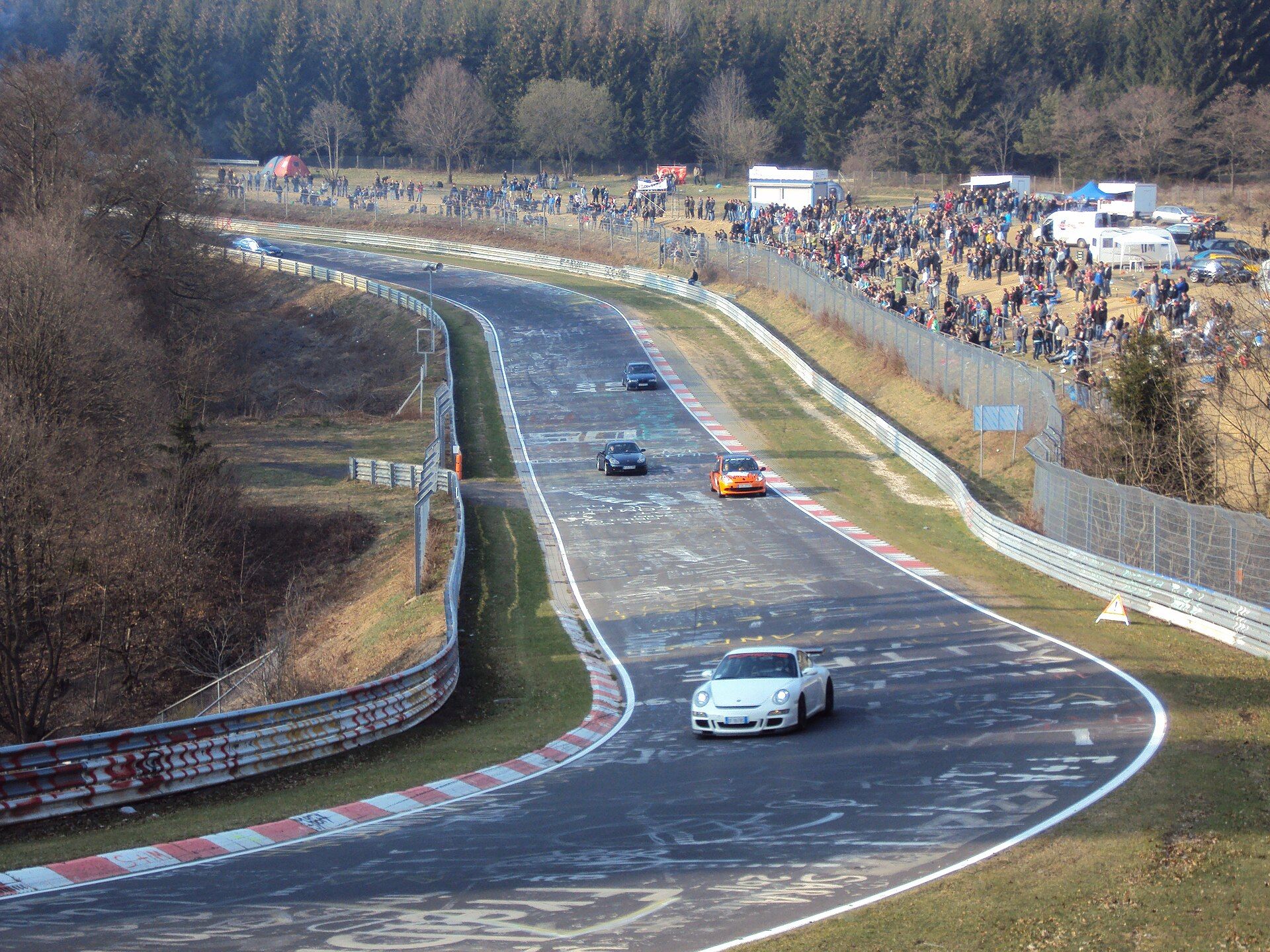
From its first years the Nordschleife also served as a tourist road, and after the Grand Prix loop opened in 1984 it gained even more from that. A lap once cost 4 marks; in 2019, 25 euros during the week and 30 euros from Friday to Sunday. In 1998 the Grüne Hölle complex with a restaurant, a car park and ticket gates was built on the Döttinger Höhe straight, so that a full lap without slowing down is no longer possible. Amateurs time themselves “from the bridge to the gantry” (Bridge to Gantry), of which the operator does not approve. During the Touristenfahrten the road traffic code applies, together with a ban on overtaking on the right, a ban on driving after a fluid leak has been found or after a collision, and a noise limit of 130 dB(A). Vehicles which by design or because of their technical condition do not reach 130 km/h, and quads as well, are not admitted; photography and filming and commercial taxi rides are forbidden. The statistics of tourist fatalities from 1976 show that these rules did not come from nowhere.
The owner changed more often than the layout of the corners. The operating companies, belonging mostly to the state of Rhineland-Palatinate and the Ahrweiler district, declared bankruptcy in May 2013, after the „Nürburgring 2009” project, an amusement park with a shopping centre, had consumed more than 300 million euros of public money. On 11 March 2014 the assets were bought by the capricorn group, and in October of the same year its 77 percent stake was taken over by the Russian pharmaceutical entrepreneur Viktor Kharitonin. Today the track is run by Nürburgring 1927 GmbH & Co. KG. Since 1927 almost everything in the Eifel has changed apart from the loop itself: in 2027 the Nordschleife will be one hundred years old, and the operator's calendar for that year already carries a survey of demand for track dates.
Timeline
- 1924: Landrat Otto Creutz and councillors from Adenau watch the Eifelrennen near Nideggen; the idea of a track separated from traffic is born.
- 1925: 15 April, the meeting in Berlin; 1 July, the start of the work; 27 September, the foundation stone; 30 October, the name „Nürburg-Ring”.
- 1927: 18–19 June, the opening with the Eifelrennen; Tony Ulmen (motorcycles) and Rudolf Caracciola (cars) win; 85,000 spectators.
- 1928: 15 July, Čeněk Junek dies, the track's first victim.
- 1933: the ditch in the Karussell is filled with concrete.
- 1947: the first post-war race on the Südschleife; 1949, racing returns to the Nordschleife; 1951, the first Formula 1 Grand Prix.
- 1967: the Hohenrain chicane; 1969, the new pit lane with a barrier.
- 1970: the Formula 1 boycott; 1971, the rebuild with barriers and the return of F1.
- 1970: the first 24h Nürburgring, 99 cars, victory for Stuck and Schickentanz.
- 1976: 1 August, Lauda's crash before Bergwerk; March 1977, the decision on the end of F1 on the Nordschleife.
- 1977: 23 April, the first VLN race.
- 1982: October, the last race on the old loop; November, the demolition of the pits and the Nordkehre.
- 1983: 28 May, Bellof, 6:11.13.
- 1984: 12 May, the opening of the Grand Prix loop; the 24h on the combined track.
- 1998: the Grüne Hölle complex on Döttinger Höhe.
- 2001/2002: the last major rebuild; the Nordschleife measures 20.832 km.
- 2013: the bankruptcy of the operating companies; 2014, the sale to the capricorn group and the takeover of the shares by Kharitonin.
- 2015: the crash at Flugplatz, the death of a spectator, the speed-limited zones.
- 2018: 29 June, Bernhard, 5:19.55.
- 2019: the Nürburgring begins to record lap records officially.
- 2020: the VLN changes its name to NLS.
- 2021: 18 June, the Sabine-Schmitz-Kurve.
- 2026: 14 March, the start of the 50th NLS season.
News from this circuit
Sources (10)
- Franz-Josef Knöchel, Automobilrennstrecke Nürburgring, KuLaDig – Kultur.Landschaft.Digital (Landschaftsverband Rheinland) [de]
- Nürburgring, RacingCircuits.info [en]
- Ortsgemeinde Nürburg, Der Nürburgring, Nürburg.de [de]
- Nürburgring 1927 GmbH & Co. KG, Vor 50 Jahren: Der Unfall von Niki Lauda, nuerburgring.de, 2026-08-01 [de]
- 50 Jahre ADAC TotalEnergies 24h Nürburgring: Chronik der 24h Nürburgring 1970 – 2022, 24h-rennen.de (oficjalny serwis wyścigu), 2022-05-20 [de]
- VLN-Statistik jetzt komplett ab dem Gründungsjahr 1977, ADAC Nürburgring Langstrecken-Serie (nuerburgring-langstrecken-serie.de), 2019-03-17 [de]
- 50 Jahre Langstreckensport auf der Nordschleife, Motorsport XL [de]
- 5:19.55 minutes – Porsche 919 Hybrid Evo takes record in the “Green Hell, 2018-06-29 [en]
- Nürburgring 1927 GmbH & Co. KG, Rekordfahrten, nuerburgring.de [de]
- Nürburgring 1927 GmbH & Co. KG, Touristenfahrten Nürburgring – Wichtige Hinweise und Regeln, nuerburgring.de [de]