
Valkenswaard, Netherlands
Eurocircuit Valkenswaard: the first track built for rallycross
The Eurocircuit in Valkenswaard: from motocross on the Lage Heide moor in 1967 to Europe's first permanent rallycross track and the 1977 zoning dispute.
- Type
- rallycross track
- Length
- 1.033 km
- Opened
- 1971
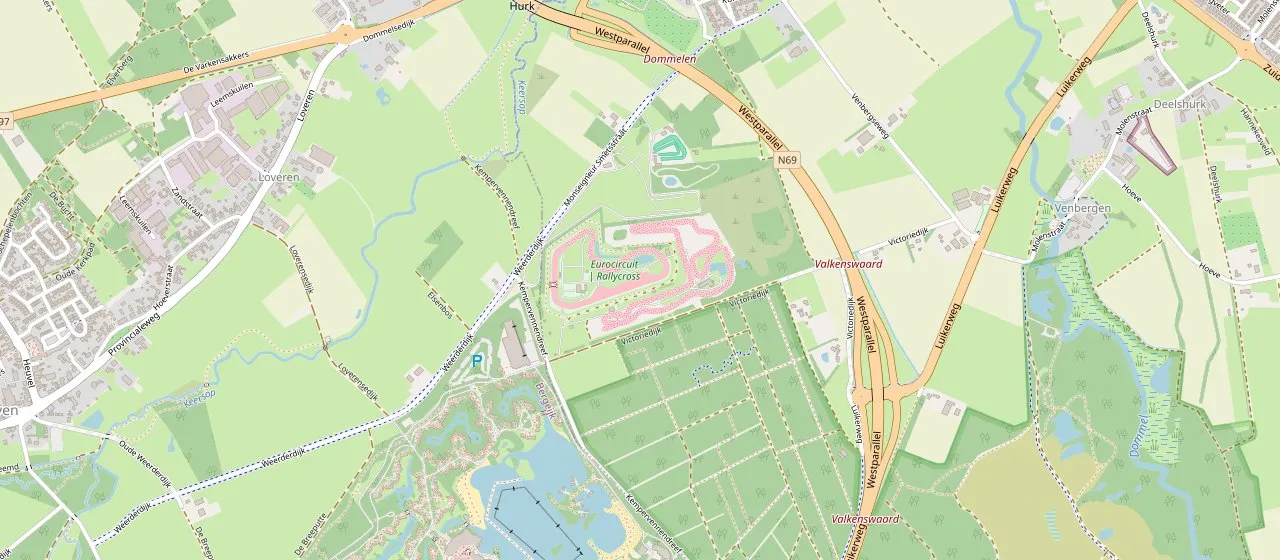
On the evening of 20 October 1967, in the kitchen of the De Rietvink cafe in Valkenswaard, the ticket money was being counted. The young motorcycle club had invited three Belgian riders to a race on the Lage Heide moor, but had nothing in the till for their start money; it was agreed they would be paid if anything was left after the event. Something was left, and the Belgians took the entire podium. On the same ground, a few kilometres from the Belgian border, the first permanent rallycross track in continental Europe opened three and a half years later. Today the Eurocircuit is shared by five clubs, and what may be done on it is decided by the Dutch Council of State.
| Location | Valkenswaard, North Brabant, the Netherlands; the site of the former Lage Heide moor |
| Type | permanent rallycross track with a motocross track on the same site |
| Length | 1033 m, of which 60 per cent is sealed surface and 40 per cent gravel; 1066 m with the 60 m joker lap |
| Width | 10–16 m |
| Opened | 17 April 1971 |
| Fastest run | 2:32.821 over 4 laps, Martin Schanche, Ford Escort RS 2000, 1995 (according to the operator) |
| Operator of the rallycross track | Nederlandse Rallycross Vereniging (NRV) |
| Main events | FIA European Rallycross Championship (until 2012), motocross world championship Grands Prix (1974–2020), RallyX (from 2025) |
| Status | active, with use temporarily restricted by a ruling of the Council of State of May 2025 |
The kitchen of the De Rietvink cafe
The club that organised that October race was born at the tables of De Rietvink as a group of supporters of the local motocross rider Piet Cuijpers. The chronicle of Motorcross Vereniging Valkenswaard records that Cuijpers' career soon faded, but several of his supporters had caught the bug strongly enough to rename the fan club Motor en Automobiel Club de Rietvink and decide to bring motocross back to Valkenswaard. They had to choose a federation: the national KNMV, founded in 1904, or the southern NMB, founded in 1949, which for decades had waged a war so bitter that a rider from one starting at a track of the other counted as contamination. De Rietvink went with the KNMV and was rewarded that same year with a free date in the calendar.
At the race on 20 October 1967 Jan Boonen crossed the finish line first, followed by Jaak van Velthoven and Harry Everts; all three Belgians got their money once the takings had been counted. The success pushed the club into founding the Motorsport Stichting Valkenswaard foundation. The KNMV officially recognised De Rietvink on 18 April 1968, and on 3 February 1969 the organisation took the name MSV/MVV, that is Motor Sport Stichting Valkenswaard and Motor Vereniging Valkenswaard: the double structure had a purely legal and financial justification for organising events. The club crest carried the letters MSV, the KNMV emblem, a shield with an off-road motorcycle and a falcon in yellow and blue, a reference to the municipality of Valkenswaard.
Saturday evenings in front of the television
The cars came to Lage Heide from Venlo. The Nederlandse Rallycross Vereniging, the Dutch rallycross association, was founded in 1969 and held its first events on a moor near Venlo, on a military training ground where the public could not be admitted. The club was looking for a place where spectators would be welcome, and found it in Valkenswaard. The Eurocircuit opened on 17 April 1971; the NRV describes it as the first permanent rallycross track on the European continent and the first venue in the world designed purely for rallycross. The inaugural race was won by Jan de Rooy in a DAF 555 Coupe. The organiser of the RallyX series repeats the same claim of being first in the world.
Rallycross in the Netherlands of the 1970s was a television sport. According to the NRV chronicle, television showed the Valkenswaard events until 1980, and the country stayed at home on Saturday evenings to watch them; the association recalls that TROS later took the theme further with the programme “Achteruitrijden” (reversing) and with caravan races. Such popularity has to be treated as the operator's own account, but it explains why a small venue near Eindhoven spent years in the FIA European Championship calendar. RallyX states that the Dutch round of the European Championship was held here until 2012.
The track itself measures 1033 m, of which 60 per cent is sealed surface and 40 per cent gravel. The first corner after the long start straight is named after Per Eklund, and according to RallyX it was there, on the slippery asphalt, that most of the action in the European Championship took place. In 1992 the venue underwent a thorough rebuild: an earth bank with safety fencing on top was raised around the track, the fences around the service park were made higher and replaced, and a kilometre of barrier was added. In 2011 a joker lap appeared, and in 2022 the NRV replaced the entire base layer and top layer of the gravel sections. Between 2003 and 2018 the Eurocircuit also hosted the Dakar Rally pre-prologue, shown by RTL.
For three decades all of this was run by Sjaak Noordermeer. In the summer of 2015 he told Omroep Brabant that he had been chairman for 28 years and wanted to step down in two years' time, because he had “reached an age at which he thought younger people should be carrying it on”. He did not get the chance: he died in February 2017 at the age of 68. The KNAF, the Dutch motorsport federation, recalled then that he had been active in the sport since 1973, that on 10 September 2016 he had been made a knight of the Order of Orange Nassau, and that under his leadership the Eurocircuit had grown into a multifunctional venue, although his motto was to get what he wanted without spending a cent.
"It is just like a family, with all the ups and downs. And that is what I like most about it."
Herlings' sand
The motorcycles never disappeared from Lage Heide. In 1974 Sylvain Geboers won the 250 cc class Grand Prix of the world championship here; the MXGP series website notes that this was the Belgian's last major international victory. The 500 cc class arrived in 1980, and the first winner was Andre Vromans; in 1981, in the 125 cc class, Eric Geboers failed to finish the second race and, as MXGP reckons it, that result cost him the title, which went to Harry Everts. The 125 cc podium of 1987, with Dave Strijbos, Pedro Tragter and John van den Berk, is called by the website the golden era of Dutch motocross.
After an 18 year break the 250 cc class returned in 1992 and was won straight away by Stefan Everts, the fresh 125 cc world champion who had only just moved up to the bigger bike; he also triumphed at Valkenswaard in 1994–1996 and in 2004. The twisty, tough sand, as the series website describes the track, suited Jeffrey Herlings best of all. The Dutchman won here in the MX2 class every year from 2010 to 2016, both races each time; the series website called him “the King of Valkenswaard”. Only in 2017, by then in the MXGP class and back from injury, did he lose, to Gautier Paulin. The last Grand Prix was held here in 2020: Herlings beat Tim Gajser, Tom Vialle won in MX2, and immediately afterwards the pandemic cut the season short. MX Large writes of that race as the end of the Grand Prix story at Valkenswaard; in 2022 the Netherlands had no world championship round, and since 2023 Arnhem has hosted it.
The plan of 1977
Rallycross stayed, and in 2025 it received a new impulse: the RallyX series, moving to Europe, chose the Eurocircuit as one of its venues, and in the 2026 calendar Valkenswaard appears as the first round, RallyX South, on 25 and 26 April. For its fiftieth anniversary the NRV also drew up a “Rallycross Vision 2030”, which speaks of alternative fuels and electric drive; according to the association, several teams have already tested the first electric cars at a practice day.
The trouble lies in the paperwork. The municipality of Valkenswaard admits that the Eurocircuit has been the subject of disputes for years, because the zoning plan in force dates from 1977 and it was not clear what was and was not allowed on the site. Since 2020 the municipality has been working on a new plan for the whole area, on which, besides the NRV and the motocross club MVV, there are the Lion D'Or BMX track, the TWC De Kempen cycling club and the De Verdediger police dog club. Residents were asked for their views in a representative survey, and on 15 July 2021 the municipal council chose the second of five scenarios: to record in the new plan the existing physical situation and the existing, licensed use. Then came the environmental impact procedure, with studies of noise, air quality, ecology and nitrogen; the draft plan was open for inspection from 12 May to 22 June 2023, and on 7 November 2024 the municipal council adopted the final plan.
In May 2025 the Council of State, the highest administrative court in the Netherlands, ruled on an application for an interim injunction against that plan. According to the municipality, the ruling limits the way the track may be used by the NRV and the MVV until the final judgment; the plan is in force, but in a tightened version, and it is that version which in 2026 is the basis for what happens at the Eurocircuit. The municipality is waiting for a hearing date to be set. Until then, Valkenswaard runs within the limits set by the court: NRV cars, MVV motorcycles, BMX bikes and police dogs on one moor, where in 1967 there was not enough money for the start money of three Belgians.
Timeline
- 1967: on 20 October the first motocross race of the De Rietvink club on the Lage Heide moor.
- 1969: the club takes the name MSV/MVV; in the same year the NRV is founded and holds its first rallycross events near Venlo.
- 1971: on 17 April the Eurocircuit opens; the first race is won by Jan de Rooy in a DAF 555 Coupe.
- 1974: the first motocross world championship Grand Prix (250 cc), won by Sylvain Geboers.
- 1980: the end of regular television broadcasts of rallycross; the first 500 cc GP.
- 1992: rebuild of the track with an earth bank and new barriers.
- 1995: the fastest run in the track's history according to the NRV, Martin Schanche.
- 2003–2018: the Dakar Rally pre-prologue for RTL.
- 2011: the joker lap.
- 2012: the last Dutch round of the FIA European Rallycross Championship.
- 2017: the death of the long serving chairman Sjaak Noordermeer.
- 2020: the last motocross world championship Grand Prix.
- 2021: on 15 July the municipal council chooses the scenario for the new zoning plan.
- 2022: new base layer and surface of the gravel sections.
- 2024: on 7 November the adoption of the new zoning plan.
- 2025: the interim ruling of the Council of State restricting use; the RallyX debut at the Eurocircuit.
Sources (9)
- Motorcross Vereniging Valkenswaard, Over ons [nl]
- Nederlandse Rallycross Vereniging, Het circuit [nl]
- Gemeente Valkenswaard, Eurocircuit [nl]
- RallyX, Valkenswaard [en]
- Nederlandse Rallycross Vereniging, Historie [nl]
- Geoff Meyer, Valkenswaard winners, MXGP.com (Infront Moto Racing) [en]
- Al 44 jaar rallycrossplezier dankzij het Eurocircuit in Valkenswaard: 'Een groot familiegevoel', Omroep Brabant, 2015-06-14 [nl]
- KNAF, Oud-voorzitter en erelid Nederlandse Rallycross Vereniging Sjaak Noordermeer overleden, 2017-02-13 [nl]
- A Legendary Circuit - Valkenswaard, MX Large [en]