
Zandvoort, Netherlands
Circuit Zandvoort: the dune track that lost Formula 1 twice
The story of Circuit Zandvoort: a mayor building under occupation, the tragedies of the 1970s, bankruptcy, the F1 return in 2021 and the 2026 farewell.
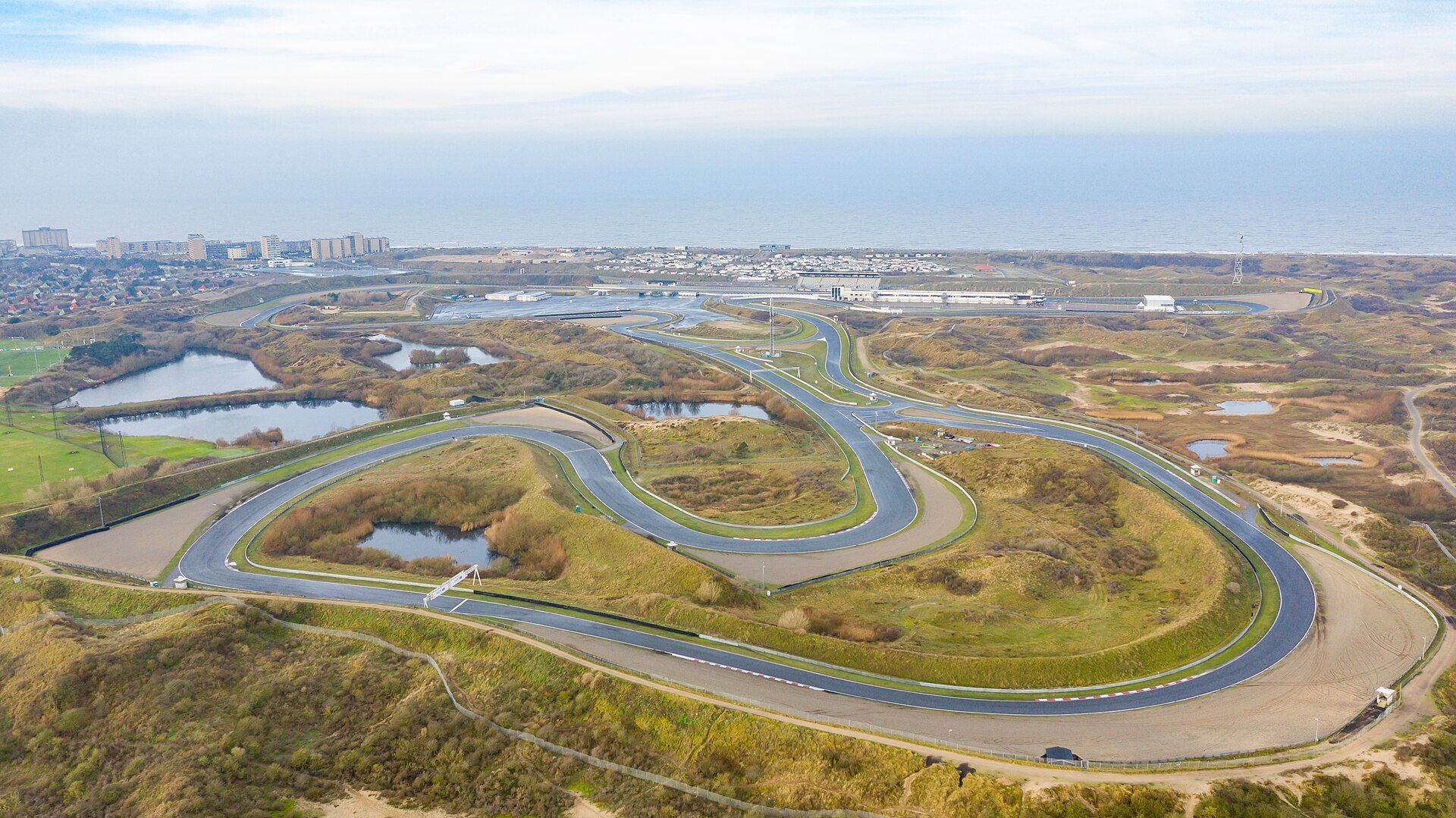
- Type
- race circuit
- Length
- 4.259 km
- Opened
- 1948
On 23 August 2026 King Willem-Alexander of the Netherlands handed Lando Norris the trophy for winning the last Dutch Grand Prix, while Max Verstappen was out of the race on the very first lap. Over four days 325,000 spectators came to the track in the dunes, a record for the event. So ended Zandvoort's second romance with Formula 1. The first lasted from 1952 to 1985 and finished with debts, bankruptcy and bulldozers.
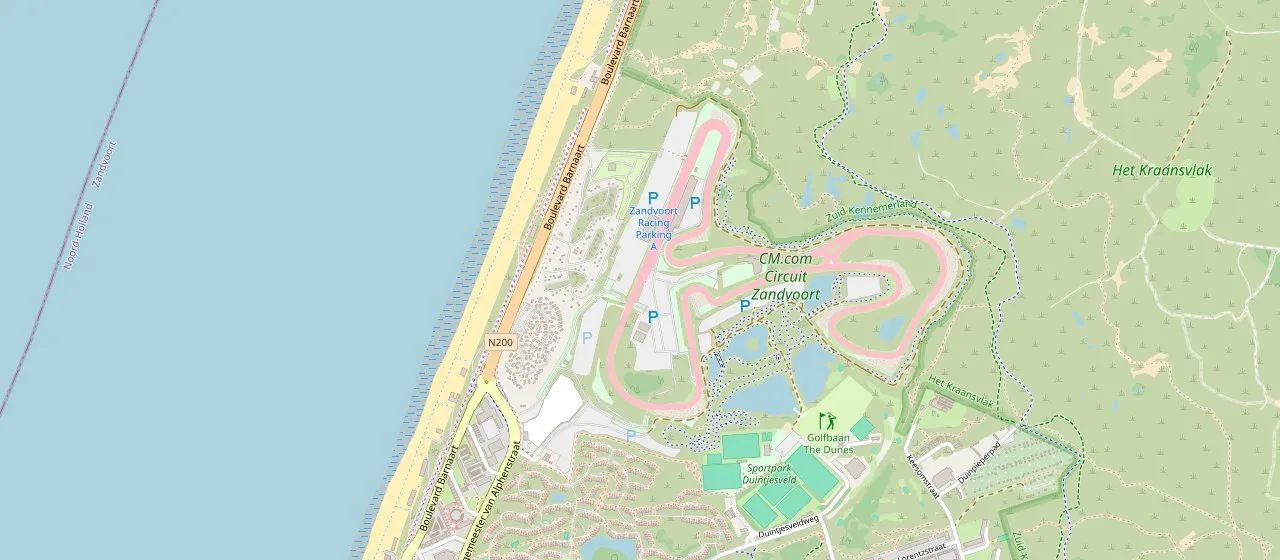
| Location | Zandvoort, North Holland, about 30 km from Amsterdam |
| Type | permanent road circuit, FIA Grade 1 licence |
| Length | 4.259 km in the Grand Prix configuration since 2020 |
| Number of corners | 14 |
| Year of opening | 1948, first race on 7 August |
| Race lap record | 1:11.097, Lewis Hamilton, Mercedes-Benz F1 W12 E Performance, F1, 2021 |
| Fastest qualifying lap | 1:08.662, Oscar Piastri, McLaren MCL39-Mercedes-Benz, F1, 2025 |
| Main events | Dutch Grand Prix F1 (1952–1985, 2021–2026), Masters of Formula 3, DTM, A1GP, Formula E from 2027 |
| Status | active; sponsor name MASCOT Circuit Zandvoort |
The mayor and the occupier
Zandvoort and racing were brought together on 3 June 1939 by a one-day race on a temporary street circuit, organised by local enthusiasts. The event was a success, and mayor Henri van Alphen saw in it a way to restore to the resort the standing it had had in the second half of the 19th century. He began planning a permanent track in the dunes, but the outbreak of the war stopped the work.
The circuit's official site states that the Germans removed Van Alphen from office and that he secretly carried on working on the construction. According to Motor Sport Magazine, after the war communication roads along the North Sea coast, left behind by the retreating German army, were used.
After the war the track became part of the town's reconstruction. The Dutch racing club appointed a panel of experts to lay out the circuit's route through the dunes, and Sammy Davis, winner of the 1927 Le Mans 24 Hours, was brought in as a consultant on the layout. Hans (John) Hugenholtz, founder of the club and director of the circuit from 1949 to 1974, did not design Zandvoort. The circuit's own site writes about him with a wink, saying that at Zandvoort he was „only” the director, and that he designed elsewhere, Suzuka among other places.
Despite resistance from national politicians the circuit was ready in 1948; on 7 August the first race was held, won by Prince Bira of Siam. The pits, the main grandstand and the asphalt were finished in time. The loop measured 4.195 km and survived in that form until 1967. Only five corners had names then: Hoek van Tarzan, Hunserug, Scheivlak, Bos In and Bos Uit. The name Hunserug comes from Cas Hunse of the Dutch motorcycle federation KNMV, who advised running a section of the track over a dune ridge; the place became one of the highest points of the loop.
The Dutch Grand Prix and five named corners
Formula 1 took to Zandvoort quickly. After non-championship races in the preceding years, in 1952 the Dutch Grand Prix entered the world championship, which then counted just eight rounds; Alberto Ascari won, leading a Ferrari triple. In the 1950s Juan Manuel Fangio, Stirling Moss and Ascari won here, in the following decade Graham Hill, Jackie Stewart and Jack Brabham. The record holder remains Jim Clark with four wins, and among the teams Ferrari with eight.
The circuit was liked by the teams from the beginning and often served for testing. The public roads that formed part of the loop were gradually closed, until the venue became fully enclosed; apart from that little changed over two decades: in 1968 a wall separating the service lane was put up, and in 1972 Armco barriers around the track. At the heart of the layout was the combination of a fast final curve, a long straight and the 180 degree Tarzan hairpin, where drivers brake from full speed into a very wide entry; the dunes served as natural grandstands. The circuit's first fatality was, according to the venue's site, Wim Gerlach, who died at Whitsun 1957 when his Porsche Carrera Speedster caught loose sand and rolled; there were no barriers yet, and the second corner bears his name today.
Two fires
At the turn of the 1960s and 1970s speeds were rising and the circuit was left with its old safety measures. In 1970 Piers Courage died in the fast Tunnel Oost curve; the race was restarted, but mourning spread through the paddock, as the circuit's site puts it. In 1972 the Grand Prix did not take place because the venue failed a safety inspection. For 1973 the fast Bos In corner was rebuilt into the S-shaped Panoramabocht, which quickly won an audience because there was a lot of overtaking there.
The return ended in tragedy. On 29 July 1973, on the eighth lap of his second F1 race, the 24-year-old Roger Williamson lost control of his March 731. The car bounced off a badly fixed barrier, flew across the track and came to rest on its roof; the fuel tank split and a fire broke out. David Purley, a fellow member of the same debut year, stopped, tried to turn the car over on his own and emptied a fire extinguisher into the cockpit, but the marshals had no equipment to put out the fire. Williamson died of smoke inhalation, and the race was not stopped; Jackie Stewart won ahead of François Cevert. A few months later Purley received the George Medal, the highest British civilian decoration for bravery. Motorsport Memorial notes that the accident happened in almost the same place as Courage's crash, and that in 2013 a joint marble monument to both drivers was unveiled by the entrance to the infield.
After further safety improvements the Grand Prix returned in 1974 and was won by Niki Lauda. At the end of the decade more changes were demanded: in 1979 a chicane was hastily put into the Hondenvlak esses, advised on by Lauda and Jody Scheckter; RacingCircuits.info remarks maliciously that they turned out to be better drivers than designers, because a year later the esses were replaced by a new section named after the sponsor Marlboro. From 1973 the loop measured 4.226 km.
The year the bulldozers came
Formula 1 cost more and more, and safety requirements were growing. With no money for changes and with debt from the previous race, the circuit organised the 1985 Grand Prix; on 25 August Lauda won, and it was his last victory of his career as well as the last Dutch Grand Prix for 36 years.
The circuit had opponents in local politics from its earliest years, and noise was a constant argument. A serious proposal in 1982 to close the venue, which belonged to the municipality, provoked protests and cost the governing party heavy losses in the local elections. Three years later the sale of part of the land closest to the town for a holiday resort was approved, and the authorities proposed a much shorter layout with earth banks shielding the town from noise. The plans were adopted in January 1987, and then the circuit went bankrupt. The circuit's site states that in 1988 the venue was converted into an „interim circuit” on which national racing was to survive.
The bulldozers moved in in mid-1989. The new loop measured just 2.526 km, that is 1.5 miles; the section of the old track from Hunserug to Scheivlak and the Marlboro chicane was cut off and overgrown, the rest turned into a golf course and holiday cottages. Bungalows stood where Bos Uit used to be, so the last corner was moved, keeping the name. The new corner was opened in 1989 escorted by a fleet of Nissan rescue cars and was named Nissanbocht; today it is the Hans Ernst chicane, after the director who in the 1990s brought Zandvoort back onto the international calendar.
Masters and the circuit growing back
The rescue turned out to be the idea of a non-championship race in which the best Formula 3 drivers would settle which of them was the best. The Marlboro Masters of F3 started in 1990 and quickly became the circuit's biggest event, drawing the rising stars of European racing. The list of winners and podium finishers explains why it worked: David Coulthard, Jos Verstappen, Tom Coronel, Christian Klien, while Lewis Hamilton, Nico Hülkenberg, Valtteri Bottas and Max Verstappen also stood on the top step.
The money and prestige from the Masters made it possible to return to the long-planned extension. In 1998 new pit buildings went up, and in 1999 the expansion was ready: the loop again ran through Slotemakerbocht and Scheivlak, then turned sharply right into a new loop by the remains of the old Marlboro corner. In the new times a tobacco name was out of the question, so the corner was called Mastersbocht. The circuit's site draws attention to the change of direction: before 1989 the run after Scheivlak was a left-right combination, from 1999 the track turns right. The Grand Prix configuration of 1999–2019 measured 4.307 km.
The longer circuit attracted the DTM, which came to the Netherlands in 2001 and returned every year until 2013, as well as the A1GP series with races watched by as many as 120,000 spectators; in 2006 Jeroen Bleekemolen drove a home race here in front of an enthusiastic crowd. Noise was still a problem: court-imposed limits on the number of „loud days” drove the Masters to Belgian Zolder for two years, and the provincial authorities studied building a replacement circuit at Julianadorp in the north of the country; it ended with the signing of a new land lease which, according to RacingCircuits.info, secures racing at least until 2041. In 2008 the circuit celebrated its 60th anniversary with a parade through the centre of Zandvoort, and in 2012 the first Historic Grand Prix was held.
A prince, Verstappen and two banked curves
At the beginning of 2016 the venue was bought by Chapman Andretti Partners, a company founded by the entrepreneurs Menno de Jong and Bernhard van Oranje, a Dutch prince and occasional GT driver. The new management switched the business from „an old circuit on the coast” to a year-round business and leisure centre, and once permission for more noise days had been obtained, the ADAC GT Masters, the European Formula 3 and the Blancpain Sprint Series appeared on the calendar. In 2017–2019 the „Jumbo Racedagen, driven by Max Verstappen” drew a hundred thousand fans and, as the operator writes, caught the attention of Formula One Management. On 14 May 2019 the return of the Dutch Grand Prix was announced with a contract for at least three years, starting in 2020.
The circuit had to be raised to an FIA Grade 1 licence, that is the right to host Formula 1. The rebuild was designed by Jarno Zaffelli and the work was supervised by his company Dromo, which declared that the changes were to be minimal so as to preserve the character of the track. The start line was moved towards Tarzan so that the grid would be visible from the main grandstand; the exit of Gerlachbocht and the inside of Hugenholtzbocht were widened; the second part of the Hans Ernst chicane was shortened; and Arie Luyendykbocht was widened and banked so that it could be taken flat out, with a SAFER barrier fitted on the outside. The final curve, named in 2001 after the two-time Indianapolis 500 winner, was given 18 degrees of banking; F1.com notes that this is almost twice as much as on the Indianapolis oval. Hugenholtzbocht became a curve with progressive banking of up to 18 degrees, in which the outer part is banked more steeply than the inner one, which according to the operator gives several lines through it.
„You don't really appreciate the banking until you go around it at Turn 3. In theory there are many lines, but everyone bolts for the outside and tries to get the exit right. And again, in the final corner, running the banking.”
That is how Jolyon Palmer, the former Renault driver, described it, adding that the circuit is still hard to overtake on, as it was on the old layout, and that it demands commitment especially in the undulating middle sector, because it punishes sudden oversteer. On 4 March 2020 the circuit was reopened with a „Legendary Lap”; Max Verstappen drove it in an F1 car, and according to Autosport Jos Verstappen and Arie Luyendyk also took part in the ceremony. The Grand Prix planned for 3 May 2020 was first postponed, then cancelled because of the pandemic; the new layout was christened instead by the Historic Grand Prix and GT World Challenge races. On 26 August 2020 the circuit took the sponsor name CM.com Circuit Zandvoort, which it carried until 1 January 2024.
On 5 September 2021 the first official F1 race at Zandvoort in 36 years was held; Verstappen won from pole position in front of full grandstands, in a season that ended with his world championship title. Christian Horner summed up the weekend with the words: „It feels as if I have been in a nightclub non-stop for four days”. In 2022, for three days running, more than a hundred thousand people arrived each day, by bicycle, shuttle bus or train.
The last lap and what remains
The reason for the end was not failure. According to Ronald Vording of Autosport, Formula One Management wanted to stay at Zandvoort, but the race is one of the few on the calendar without government support and lives off ticket sales and „founding partners”; the organisers preferred to leave before interest began to fall, and rotation every other year is too costly for them, because keeping the organisation going in a year without a race is expensive, and dismantling and rebuilding equally complicated. The director of the Dutch Grand Prix, Robert van Overdijk, said that Zandvoort remains on standby should a race drop off the calendar, but preparing a Grand Prix takes six weeks, because the venue has less permanent infrastructure, grandstands for instance, than other circuits.
The balance of six editions: Verstappen won in 2021, 2022 and 2023, Norris in 2024 and 2026, Oscar Piastri in 2025; altogether almost two million spectators. The 2026 weekend was the first at Zandvoort with an F1 sprint. On the final days the Saturday and the Sunday were sold out at 105,000 people each, and sporting director Jan Lammers wrote in an open letter to the fans: „Dat hebben jullie gedaan”, that is „you did this”.
The circuit is not dying after Formula 1. The Zandvoort E-Prix has been announced for 18 and 19 June 2027, two Formula E races in the debut of the GEN4 generation, organised by the same companies that ran the Grand Prix: SportVibes, TIG Sports & Events and Circuit Zandvoort. For the amateur driver the venue is available all year round: in your own car during Rensportschool Zandvoort open sessions with a booked slot, on Driving Fun and GP Elite track days (with or without an instructor), in rented sports cars from Bleekemolens Race Planet or on BMW Driving Experience courses. The circuit's site advertises it as „the most beautiful circuit in the Netherlands”; that is the operator's opinion. What is a fact is what remains after the trucks have left: 14 corners in the dunes, two of them banked, and by the tunnel to the infield the marble monument to Courage and Williamson.
Timeline
- 1939: 3 June, a race on a temporary street circuit in Zandvoort.
- 1948: 7 August, the first race on the new circuit, won by Prince Bira.
- 1952: the Dutch Grand Prix in the F1 world championship for the first time, won by Alberto Ascari.
- 1957: the death of Wim Gerlach, the circuit's first fatality.
- 1970: the death of Piers Courage in Tunnel Oost.
- 1972: the Grand Prix cancelled after a failed safety inspection.
- 1973: the new Panoramabocht; on 29 July Roger Williamson dies.
- 1979: a chicane in Hondenvlak; a year later the Marlboro section.
- 1985: on 25 August the last Grand Prix of the first era, won by Niki Lauda.
- 1989: the loop shortened to 2.526 km.
- 1990: the first Marlboro Masters of F3.
- 1999: the extension to 4.307 km.
- 2001: the first DTM race; the last corner named after Arie Luyendyk.
- 2016: the purchase of the circuit by Chapman Andretti Partners.
- 2019: on 14 May the announcement of the F1 return.
- 2020: the rebuild with banked curves, opened on 4 March; the Grand Prix cancelled by the pandemic.
- 2021: on 5 September the F1 return, won by Max Verstappen.
- 2026: on 23 August the last Dutch Grand Prix, won by Lando Norris.
- 2027: the Zandvoort E-Prix of Formula E announced, 18–19 June.
News from this circuit
Sources (10)
- 325.000 bezoekers nemen afscheid van iconisch hoofdstuk Nederlandse sportgeschiedenis, Circuit Zandvoort (serwis oficjalny, dział Nieuws), 2026-08-23 [nl]
- Zandvoort, RacingCircuits.info [en]
- CIRCUIT GUIDE: Everything you need to know about Circuit Zandvoort, Formula1.com, 2026-08-20 [en]
- Bochten. Veertien keer met het mes tussen de tanden, Circuit Zandvoort (serwis oficjalny) [nl]
- Geschiedenis, Circuit Zandvoort (serwis oficjalny) [nl]
- Zandvoort map, history and latest races, Motorsport Database [en]
- Formula E rijdt vanaf 2027 in Zandvoort: focus op innovatie, energietransitie en topsport, Circuit Zandvoort (serwis oficjalny, dział Nieuws), 2026-06-23 [nl]
- Roger Williamson, Motorsport Memorial [en]
- Ronald Vording, Why the Dutch GP is ending despite F1 wanting Zandvoort to stay, Autosport, 2026-08-20 [en]
- Circuitdag. Realiseer je droom, Circuit Zandvoort (serwis oficjalny) [nl]