
Assen, Netherlands
TT Circuit Assen: from a sandy road at Borger to the MotoGP Cathedral
History of TT Circuit Assen: the first Dutch TT in 1925 on Drenthe roads, the circuit built in 1955, the northern loop cut in 2006, records and trackdays.
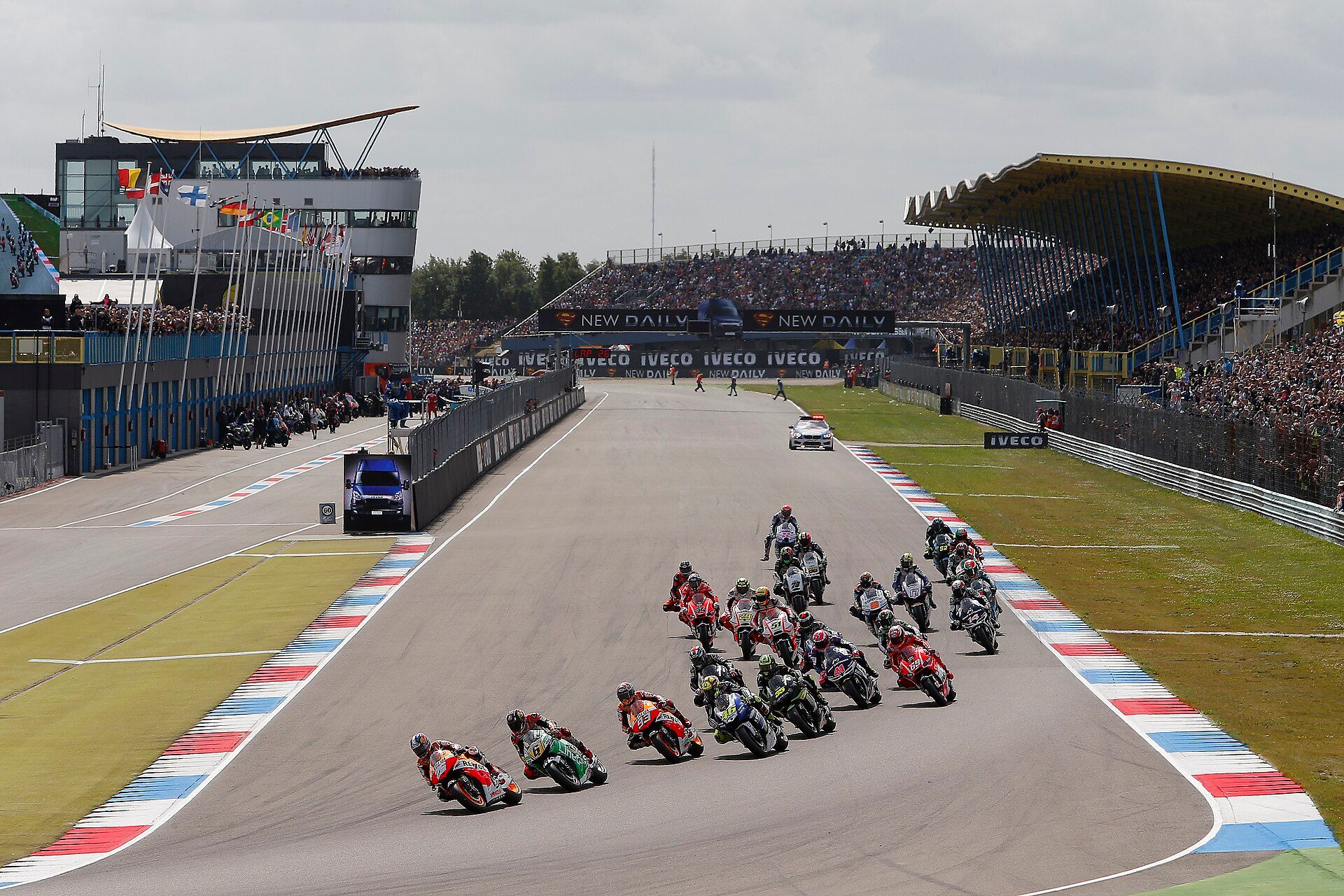
- Type
- race circuit
- Length
- 4.555 km
- Opened
- 1955
The treasurer of Motorclub Assen en Omstreken had exactly two and a half cents in the till when, on 11 July 1925, the first motorcycles lined up for the start on the Grote Brink in Rolde. The course was 28.4 km long and ran as a triangle of roads between Rolde, Borger and Schoonloo: over gravel, over cobbles and over sand, where overtaking was forbidden. Out of that one-off event on the country roads of Drenthe grew a circuit which is the only one to have hosted the motorcycle world championship every year since it began in 1949 (with a single break in 2020).
| Location | De Haar 9, Assen, province of Drenthe, the Netherlands |
| Type | permanent race circuit, FIA grade 2 and FIM grade A homologation |
| Length | 4.555 km (full GP configuration since 2006); 4.542 km in the motorcycle variant since 2010 |
| Year opened | 1955 (purpose-built circuit, 7.7 km); first Dutch TT on public roads in 1925 |
| Fastest lap (MotoGP qualifying) | 1:30.540, Francesco Bagnaia, Ducati, 29 June 2024 |
| Main events | Dutch TT (MotoGP, every year since 1949), a WSBK round, car races (including DTM, TCR Europe) |
| Attendance | 167,000 spectators at the TT in 2019; close to 60,000 seats and about 80,000 standing places |
| Status | active |
The road the municipality of Borger would not pave
Until 1925 motorcycle races on public roads were forbidden in the Netherlands. The loophole was opened by article 21 of the 1924 act on motor vehicles and bicycles, which allowed an exemption to be granted, and Motorclub Assen en Omstreken, founded in 1922, made use of that possibility. The course came about by accident: as part of public works a new stretch of road was built near Borger, and only that stretch closed the triangle between Rolde, Borger and Schoonloo. According to Egbert Braakman, for many years an employee of the TT office, the club knew that this gravel road was opening and wanted it in the course. The name was borrowed from the Isle of Man, where the Tourist Trophy had been run since 1907; as Braakman puts it, „it was about motorcycle tourists and about testing the endurance and reliability of the machines”.
The race was won by importers and home tinkerers. In the 500 cc class the winner was Piet van Wijngaarden, a Rotterdam trader who imported Nortons, at an average of 91.4 km/h; in the 350 cc class Hajo Biezo on a New Imperial, in the 250 cc class Arie Wuring on a BSA at an average of 67.3 km/h. In the 500 cc class only three other riders besides the winner were classified. The fastest lap in the 350 cc class was set by Frans Vermaak on an AJS at an average of 93.1 km/h. According to RacingCircuits.info about 10,000 spectators stood along the road, and on two small bridges the motorcycles could only fit in single file.
The sandy stretch in the municipality of Borger decided the future of the event. The riders asked the club's board to have that section surfaced, the board went to the municipality, and the municipality refused. So the club moved the race closer to Assen, onto a rectangle of roads through Hooghalen, Laaghalerveen, Witten and De Haar, named Circuit van Drenthe. „If the municipality of Borger had agreed back then, the history of the TT would have gone completely differently”, Braakman says.
A debut with five thousand guilders of losses
According to RacingCircuits.info the new circuit measured 16.536 km, while the Drents Archief encyclopedia gives a rounded 17 km. The first edition in 1926 turned out to be a financial flop: 2600 tickets were sold and the loss came to 5000 guilders. Even so the club invested: the carriageway was widened from 2.5 to 4 m, and near the start at De Haar to 6 m. In 1927 as many as 14,000 spectators came, and the entry of the Norton works rider, the Irishman Stanley Woods, gave the third TT international status.
Assen quickly learned to sell a spectacle. In 1928, as the first venue in the world, the circuit got a public address installation which let the crowd follow the course of the race; from 1931 KRO broadcast Piet Nortier's live radio commentary. In 1933 the crowd watched a duel between the local workshop owner Geert Timmer on a New Imperial and De Ridder on a Grindlay Peerless; Timmer finished third after a slide. His name would return to the circuit half a century later.
Widening the circuit in 1936 required 120,000 guilders, more than the club could carry. The solution was the Stichting Circuit van Drenthe foundation, set up on 23 June 1936 by the municipalities of Assen and Beilen together with the Motorclub; its statutes spoke of organising the „KNMV Grand Prix of the Netherlands”, and from that year the race has been called the Dutch TT. The war interrupted the series for the years 1940–1945; in 1946 it resumed as a national event, and 80,000 people passed through the ticket offices. A year later the TT was international again, and in 1949, when the FIM created the world championship, the race at Assen immediately became one of its rounds.
Four months for a new circuit and a strike before the start
In 1954 a new provincial road from Assen to Hooghalen was opened which formed part of the circuit; the difference between the old and the new surface was so great that a decision was taken to build an entirely new venue. The official reason was the road, but a dispute with the board of the municipality of Beilen meant that the new circuit was laid entirely within the boundaries of Assen, which kept the income from the event for itself. According to RacingCircuits.info the circuit, 7705 m long and 7 m wide, was built in a record four months; thanks to the wider carriageway sidecar races entered the programme from 1955.
The jubilee, 25th Dutch TT was run on 16 July 1955, and not, as until then, on the last Saturday of June. The 500 cc race began with a revolt: after the warm-up lap the riders came in and, seeing the size of the crowd, demanded a larger share of the takings; the organisers gave way, and the race was won by Geoff Duke on a Gilera. The shape of the circuit settled in this way, with banked curves and fast corners, survived without major changes for twenty years. In 1962, on race day, 101,992 paying spectators came through the gates; for the first time more than a hundred thousand.
The White Giant from Abbekerk
In the mid-1970s a sharp division could be seen in the field: the works teams of the Japanese groups on one side, privateer riders on the other. On 25 June 1977 Wil Hartog, known as the „White Giant from Abbekerk”, took the lead in the 500 cc class right after the start, two laps before the finish he had a 16 s advantage over Barry Sheene, and after 52 minutes and 35 seconds he became the first Dutchman to win a premier class race. On Monday he went back to work at the grass drying plant in Abbekerk.
The circuit at that time began to change under pressure from safety regulations. In 1976 the fast Kniebocht corner was replaced by a chicane named after Geert Timmer, and Mandeveen and Duikersloot were rebuilt in order to gain run-off; in 1981 Ruskenhoek was moved, and in 1982 a new pit complex was built with garages and a service lane separated from the track. After a fire in 1983, a new main grandstand and a tunnel to the paddock went up in 1984, and the northern loop was cut in half: the Bedeldijk, Stroomdrift and De Vennen corners disappeared, and the circuit shrank to about 6.1 km. Right after the TT in 1989 the carriageway was widened from 7 to 10 m (to 14 m at the start), and the length was set at 6.049 km.
Only at the beginning of the 1990s did the circuit stop being a public road. According to RacingCircuits.info the authorities closed it permanently after a series of accidents, some of them fatal, which happened outside of competition when the surface was open to traffic; the same thing opened the way to car races. Motorsport Memorial lists 22 motorcycle riders who died at the TT Circuit in the years 1957–2016, among them the Japanese rider Yasutomo Nagai on 13 September 1995; the fatalities from the time of the pre-war Circuit van Drenthe are kept separately by the database.
The northern loop goes under a car park
In the autumn of 1998 a three-stage modernisation began, completed in April 2002: a new starting tower, press centre, offices, pits and medical centre, then a two-lane tunnel for the teams' trucks and the shifting of the Veenslang section about 50 m to the east in order to enlarge the paddock. On 29 June 2002 the races got under way on a circuit 6.027 km long. In 2004 Valentino Rossi on a Yamaha was the first to go under two minutes a lap in the race, at an average of more than 180 km/h. In 2005 a „floating” grandstand was hung over the run-off area behind the Geert Timmer corner, built, according to RTV Drenthe, at the riders' request.
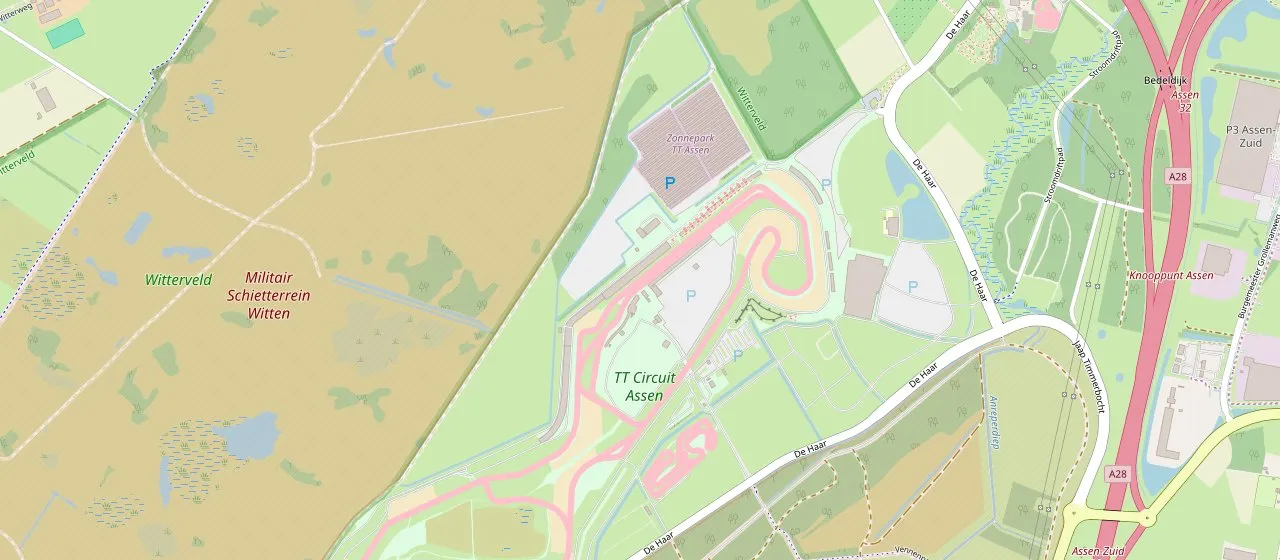
The biggest cut came in the winter of 2005/2006. In order to fit in 7000 parking spaces right next to the circuit and to build the TT World complex, the northern loop was shortened, and the length of the circuit fell from 5997 m to 4.555 km. The S-bocht, Witterdiep, Madijk and the old Ossebroeken disappeared; Haarbocht came back tighter, with 5 per cent banking instead of 8, and Ossebroeken in a narrower form. Together with the asphalt of the section from the S-bocht to Haarbocht, the oldest material of the circuit went under the milling machines: a stretch used since the second TT in 1926, on which 74 editions had been run. The start and finish section, also from 1926, stayed. In 2005 Rossi covered 19 laps, and in 2006 the fans were to see their favourites 24 times. On the northern side grandstands for 14,700 spectators went up.
In 2010 the line of Ruskenhoek was changed as well: the motorcycle variant bypasses the chicane, is 13 m shorter and measures 4.542 km, and the chicane was left for cars. Since 2016 the race no longer takes place traditionally on Saturday, but on the last Sunday of June.
Today: the MotoGP Cathedral and trackdays
MotoGP.com calls the circuit the „Cathedral” of motorcycle racing and justifies it with one fact: Assen is the only venue to have hosted a round of the world championship without interruption since 1949. In 2019, 167,000 people passed through the gates and it was the best attended TT in history; in 2021 covid regulations limited the crowd to 11,500 people, and a year later the grandstands were full again. The new Winterdijk grandstand from 2017 has 9100 bucket seats.
The circuit holds FIA grade 2 and FIM grade A homologation and, besides MotoGP, hosts a round of the Superbike world championship; on four wheels Champ Cars, Superleague Formula, DTM and TCR Europe, among others, have raced here. On 29 June 2024 Francesco Bagnaia on a Ducati set 1:30.540 in qualifying, the fastest lap in the history of the circuit, 0.081 s ahead of Jorge Martin. For amateurs the operator runs trackdays for motorcyclists and car drivers, including for beginners, with a calendar on the official site; the same site offers guided tours. Braakman, who guides such tours himself, puts it this way: a Norton 500 from 1925 had maybe 25 hp, today's MotoGP machine has 250 or more.
Timeline
- 1925: the first Dutch TT, 11 July, 28.4 km of roads between Rolde, Borger and Schoonloo.
- 1926: the move to Circuit van Drenthe near Assen and Hooghalen; a loss of 5000 guilders.
- 1927: the first foreign riders, among them Stanley Woods on a Norton.
- 1936: Stichting Circuit van Drenthe is created; the race takes the name Dutch TT.
- 1949: the Dutch TT becomes a round of the first FIM world championship.
- 1955: the opening of the purpose-built 7.7 km circuit within the boundaries of Assen, 16 July.
- 1962: 101,992 paying spectators.
- 1977: Wil Hartog becomes the first Dutch winner in the 500 cc class.
- 1984: the shortening of the northern loop, a new main grandstand after the fire of 1983.
- 1989: the circuit is widened to 10 m; length 6.049 km.
- 2002: the end of the three-stage modernisation; 6.027 km.
- 2006: the removal of the northern loop; 4.555 km.
- 2010: a new line of Ruskenhoek for motorcycles; 4.542 km.
- 2019: an attendance record, 167,000 spectators.
- 2024: Bagnaia, 1:30.540 in MotoGP qualifying.
Sources (10)
- „TT”, Encyclopedie Drenthe [nl]
- Uit het archief: de allereerste TT in 1925, RTV Drenthe, 2021-06-16 [nl]
- TT Circuit Assen, History [en]
- Netherlands. TT Circuit Assen, MotoGP.com (kalendarz 2026) [en]
- TT Circuit Assen, RacingCircuits.info [en]
- Lewis Duncan, MotoGP Dutch GP: Bagnaia smashes lap record to take pole, Marquez crashes, Motorsport.com, 2024-06-29 [en]
- De historie van de Dutch TT, RTV Drenthe, 2012-01-25 [nl]
- Motorcycle, sidecar and ATV fatalities by circuit: Assen (TT Circuit), Motorsport Memorial [en]
- Verbouwing Noordlus TT Circuit Assen in volle vaart gestart, Racesport.nl, 2006-05-04 [nl]
- TT Circuit Assen, Trackdays [en]