
Osła, Poland
Tor Krzywa: asphalt on a runway that launched Su-24s
The story of Tor Krzywa near Legnica: a Luftwaffe airfield with a Gross-Rosen subcamp, a Soviet bomber base, the fall of Pixers Ring in 2018 and track days.
- Type
- race circuit
- Opened
- 2017
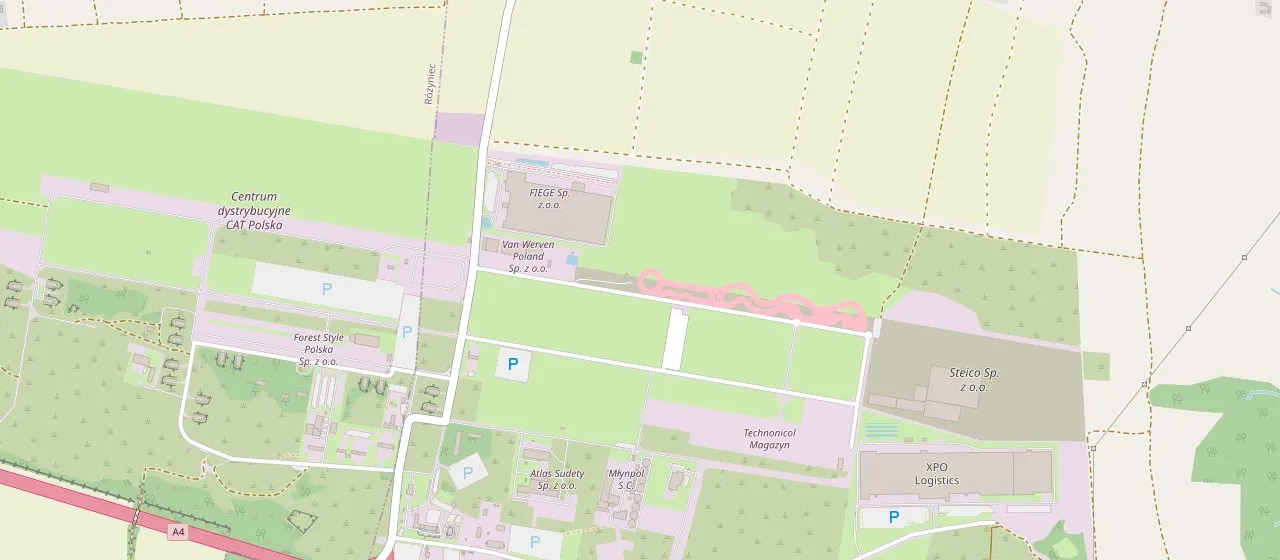
At night, in frost reaching twenty degrees, prisoners of the Aslau subcamp were driven out with shovels onto the airfield to clear snow from the runways; the factory airfield beside the Focke-Wulf fighter assembly plant already served a military role by then. That is how one of them remembered the winter of 1944/1945. Eighty years later, in the same place, between the A4 motorway and the village of Osła, amateur drivers buy two-hour sessions on an asphalt loop laid along the axis of the former runway. Tor Krzywa is not quite a decade old, but the ground beneath it passed through the hands of the Luftwaffe, Soviet bomber aviation, a company with a plan for a cargo terminal and an investor who gave up after fourteen months.
| Location | Osła 1 JA, Gromadka commune, Bolesławiec county; the grounds of the former Krzywa military airfield, exit from the A4 at the "LSSE Krzywa" junction |
| Type | permanent asphalt circuit for cars and motorcycles; the site also has a skid pad and a karting track |
| Width | 8–16 m |
| Number of corners | 12 |
| Configurations | standard and reversed layout (Cup rounds run in both directions) |
| Opening | July 2017 as Pixers Ring; from the 2019 season as Tor Krzywa |
| Operator | Tor Krzywa Sp. z o.o., Osła, registered on 27 November 2018 |
| Best lap time (standard layout) | 54.977 s, driver given as "Mateusz", Honda Civic V, PRO-1 class, Japfest 2025; according to the operator's table |
| Most important events | Puchar Toru Krzywa (since 2019), Sakura JDM Track Day (2019), Japfest Time Attack (since 2022) |
| Status | active; track days in the April–October season |
A hangar 233 metres long
Henry L. deZeng IV, the author of a catalogue of Luftwaffe airfields, places the Aslau airfield 12 km east-north-east of Bunzlau, that is Bolesławiec, and 1.6 km south-west of the village from which it took its name. It was an Einsatzhafen I. Ordnung, an operational airfield of the first category. The landing field was grassy, rectangular, measuring about 1100 by 825 m, surrounded by a taxiway. In the hangar section stood one very large assembly hangar measuring 233 by 41 m, four further very large hangars and one large repair hangar, all with concrete aprons at the front. The Berlin–Breslau motorway ran less than a kilometre from the southern boundary of the airfield, and a railway siding reached the hangars.
For most of the war the airfield was used by flying schools; combat units were stationed here in September 1939 and again from October 1944. The hardest chapter, however, began in the middle of July 1944, when a subcamp of KL Gross-Rosen was set up in the forest near the village of Aslau. It held at least 616 prisoners, 89 per cent of them Poles, employed by the Concordia-Werk company from Bunzlau assembling Focke-Wulf fighters in halls on the airfield, 3–4 km away from the camp. During the existence of the camp and during the evacuation at least 90 people died. deZeng specifies that from the end of 1944 to the beginning of February 1945 the Fw 190 in the A-8 and D-9 versions was assembled here.
A prisoner named Perkowski, whose memoirs are made available by the Gross-Rosen Museum, described the plant from the inside: all the assemblies were brought in from other factories, in Aslau the final assembly took place on a line in twelve stages, and after the technical inspection at the last of them the aircraft was pulled out onto the airfield for test flights. The largest hall, no. 3, started up in September 1944 and was not heated; the prisoners worked in it in their striped uniforms alone. On the tenth of February 1945 the prisoners were driven on foot to Nordhausen, a subcamp of KL Mittelbau; the sick stayed in the barracks and on the same day were liberated by Soviet soldiers. According to deZeng, a day later the evacuation of the airfield personnel westwards began. The full list of the 616 prisoners, a plan of the camp and copies of the Luftwaffe correspondence concerning the airfield were collected by Alfred Konieczny in the monograph "Arbeitslager Aslau podobóz KL Gross-Rosen. 1944–1945", published by the Gross-Rosen Museum.
Forty Su-24s past the last village before the airfield
Soviet troops took the airfield on 15 February 1945. After the war the site formally ended up in Polish hands, and from the early 1950s Soviet aviation was based here. The name under which the site operates to this day does not come from the village on whose land it lies. Karol Placha Hetman, who describes the site on the Polot service, explains it prosaically: Soviet soldiers travelled from Legnica along today's road no. 94 through Chojnów, and the last locality before the airfield gate was Krzywa. Krzywa itself lies in the Chojnów commune in Legnica county, while the runway and the hangars belong to Osła in the Gromadka commune, already in Bolesławiec county. Hence the confusion over the address that trails the circuit: broker portals sell it as the "Wrocław circuit", although it is more than a hundred kilometres from here to Wrocław.
The Russians rebuilt the grassy field into a jet base. The concrete runway on the 10/28 heading measured 2450 m in length and 60 m in width. According to Placha Hetman the whole complex with its housing estate occupied 476 ha, and in three zones 40 AU-14 type hardened shelters were laid out, holding Su-24s with folded wings; the bomb store was located in the forest about 3 km from the Krzywa estate. The units stationed here included the 164th Kerch Guards Independent Reconnaissance Aviation Regiment, present from 30 November 1952 to 31 December 1958 and again from 1 November 1990. The host of the airfield for three decades, however, was the 3rd regiment, which on 1 May 1955 arrived in Poland from China with its personnel but without aircraft; initially it was stationed in Szprotawa, and it was rebased to Krzywa in 1961. It flew in turn the MiG-17 and MiG-15UTI, from December 1960 the Su-7B fighter-bombers, from 1976 the MiG-27, and from the 1980s the Su-24 bombers; the ww2.dk database states that in 1988 it had forty of them.
The withdrawal began at the turn of 1990 and 1991, when the third squadron was sent back to the USSR. The rest of the regiment, ten Su-24s in each of two squadrons, was withdrawn in March 1992. The regiment went to Lebyazhye in the Volgograd oblast and on 9 September 1992 was disbanded. The airfield was handed over to the Polish Army on 21 August 1992, and in the autumn of 1993 the site was entirely in Polish hands.
An airfield that did not want to be an airfield
About 150 ha of the former airfield went to the Gromadka commune and quickly began to decay. Hopes for a second life were tied to the Krzywa S.A. company, which planned a cargo terminal handling freight traffic from Germany; nothing came of the plans. In 1997 the site was handed over to the Legnica Special Economic Zone, established by a Council of Ministers regulation of 15 April that year; the Krzywa subzone covers 52.26 ha according to an encyclopaedic summary. Lucjan Zientek, who photographed the site in June 2007, noted that the large post-Soviet airfield had been turned into an economic zone, and that in its central part a monument to airmen from the time of the Second World War remained.
The aviation history did not end entirely. From 1 August 2011 the eastern part of the runway was bought and is leased by the Consensus LEX Association, which in 2012 opened the Krzywa airstrip there. The airfield database for pilots describes it as an unregistered airstrip with a concrete runway on the 100/280 heading and adds a dry remark: the concrete runway is being progressively dismantled, and its middle part has been taken over by a car driving school. That "driving school" is precisely the circuit.
A loop along the runway axis
"The new circuit opens tomorrow", wrote Szymon Sołtysik in "Auto Świat" on 30 June 2017. The layout ran largely along the axis of the old runway, 100 km west of Wrocław and 10 km north of Bolesławiec. On the opening day entry cost 29 zł, and half an hour of driving in one's own car cost 79 zł as standard; five new Ford Focus RS, a BMW M4, a KTM X-Bow and a Tesla were waiting on site. The owner announced a mini karting track, a drift zone, VR simulators, a skimboarding track, a hotel and a restaurant. The official opening of Pixers Ring was set for 8 July 2017; the site was to operate every day from 10 to 22, and passes cost 420 zł for four hours and 1050 zł for ten. Michał Sztorc of Premiummoto wrote in August about several dozen cars for hire, from a 1964 Mustang to a Dodge Challenger SRT, Friday quarter-mile races and the Pixers Cup with a prize of 1000 zł.
Behind the project stood Maciej Białek, described as the head of strategy of the Pixers brand and the initiator of the venture, and the operator was the Wrocław company Onion Ring sp. z o.o., registered on 28 March 2017 with capital of 5000 zł, with Maciej Damian Białek and Andrzej Słowiński as partners. The plans were disproportionately large for that sum: next to the circuit there were to be a beach with food trucks, an artificial surfing wave and a wind tunnel.
On the nineteenth of September 2018 a notice appeared on the circuit's Facebook profile about the closure of the site at the end of the month. "Forced by financial realities, we are waving the chequered flag for the last time", wrote the founders, mentioning the loans they had taken out and apologising to their co-workers, customers and creditors. Marcin Zabawa of the istotne.pl portal pointed out that the notice contained not a word for the people who had paid for passes in advance, and that he had not managed to contact the company.
Sometimes, however, one has to know when to leave the stage.
That was one of the sentences of the statement quoted by Ścigacz.pl, which judged that the operator had bet on subscriptions, which put off motorcyclists looking for single training sessions. The circuit was closed on 30 September 2018, after fourteen months of operation.
A cup for everyday cars
Two months after the last chequered flag, on 27 November 2018, the company Tor Krzywa Sp. z o.o. with its seat in Osła appeared in the court register, with capital of 10,000 zł. The partners are Kamila Wengrzyn and Jan Mirosław Wengrzyn, Kamila Wengrzyn sits on the board, and the object of the business was entered as out-of-school forms of education in driving and piloting. The surname appears in the area once more: Wengrzyn Sp. z o.o. from Jaroszówka in the Chojnów commune, trading in construction machinery and headed by Jan Wengrzyn, offers for rent or sale a rectangle measuring 1215 by 100 m with an area of more than 12 ha, half of it covered by the concrete of the former runway, 500 m from the LSSE Krzywa junction.
The new operator started with the thing its predecessor had not managed to build: a calendar of competitions. Regulations dated 29 March 2019 announced the Puchar Toru Krzywa as a series of eight events from April to November "in a modified Rally Sprint format": six runs of two laps each, a limit of 45 crews, an entry fee of 200 zł, clerk of the course Marcin Borsuk. The STREET class was reserved for completely standard cars, with the rear bench and door cards in place; all sportier versions, such as the Ford ST or the Honda Type R, went into the prepared-car classes. A few days later, on 2 April 2019, the circuit announced the introduction of MyLaps timing with transponders rented for 20 zł per session and promised a gift to the first person to drive the standard layout under a minute. Motorcyclists were offered MotoMondays, and on 30 June 2019 the company szkoleniatorowe.pl ran a full-day training here for 350 zł with instructor Bartosz Tymoszuk, a separate women's group led by Katarzyna Łapczyńska and an advanced group under the eye of Damian Ołdakowski.
The first big event under the new name was the Sakura JDM Track Day, a gathering of Japanese motoring held from 31 May to 2 June 2019: a time attack in five groups for 70 drivers, plus drifting competition. Michał Nowak, who came in a Honda CRX, improved over the weekend from 1:16.7 to 1:09.153 and summed up the competition briefly: "The cars competing with me were 'gutted' to the minimum".
In July 2021 the operator added more than 700 m² of asphalt so that, as it wrote, one of the harder corners would become safer. In the same season the character of the Cup changed: "we moved away from rally regularity and went for one atomic lap", the circuit announced, introducing a time attack format with a STREET category up to 200 hp and a SPORT category in three capacity classes. In 2022 the Japfest Time Attack was held here for the first time, and the fifth round of the Cup on 15 October 2022 gathered five competitors under 18; the fastest in the SPORT II class, Dariusz G., drove a lap in a Renault Clio in 57.138 s. Since 2023 every second round is run on the reversed layout; after the first such round, on 20 May 2023, the organiser admitted that "opinions on the difficulty of the route are divided".
The regulations for the 2025 season show what the series looks like today: five rounds from April to October, an entry fee of 300 zł, a limit of 31 crews, groups of up to six cars going out for four ten-minute sessions, of which the best lap counts. STREET means road cars under 250 hp on road-homologated tyres, without a roll cage, bucket seats or coilovers; SPORT is divided into classes up to 1600 cm³, up to 2500 cm³ and OPEN, with a factor of 1.6 for turbo with drive to one axle and 1.7 with four-wheel drive. Tyre warmers are banned, alcohol is permitted in a quantity of 0.00 g/l, and a helmet is compulsory in cars with a roll cage or an open body. The leaders of the classification collect the Master of Tor Krzywa trophies at the end of the season. The table of best times kept by the operator opens with a result of 54.977 s achieved in a Honda Civic V in the PRO-1 class during Japfest 2025 on the standard layout; on the reversed layout the fastest remains Krzysztof K., Honda Civic, 57.292 s from the second round of the 2022 Cup, and in the STREET category Paweł M. in a Subaru BRZ, 1:00.542 from 2025. The list gives only first names and surname initials.
A track day for a hundred and thirty zloty
For a driver without a licence, Krzywa is one of the cheaper ways onto a circuit in Poland, at least in the price list: a two-hour Track Day session costs 130 zł, and with timing 150 zł. The day is divided into four blocks: 10–12, 12–14, 14–16 and, in the season from April to October, 16–18. Each block is either for cars, with a limit of 10 cars, or for motorcycles, with a limit of 16 machines, which is decided by the order of booking; the date has to be agreed by telephone before arrival. The regulations are unambiguous on one matter: "DRIFTING IS FORBIDDEN while driving as part of a Track Day! Driving in a drift, initiating a slide, burning rubber and doing donuts are categorically forbidden", under threat of financial penalties. The driver must have a driving licence and be at least 150 cm tall; minors drive with a guardian on the site and after training with an instructor. The car is to be in working order, without leaks, with complete bodywork and a towing eye screwed in. The motorcyclist arrives in a helmet, a zip-together leather suit, gloves and boots; textiles are out.
Those keen on sliding have a separate product. The Drift Training lasts five hours, from 10 to 15, takes place in one's own prepared car, with a maximum of two drivers per car and a compulsory two-kilogram fire extinguisher; it costs 400 zł for a driver with a passenger or 500 zł for two drivers. The date of 20 September 2026 was sold out at the beginning of September. The operator writes of 10 ha of area, a flat circuit layout and four separate sections for practising five types of motorsport, with a drift school on the skid pad with sprinklers and water curtains. Motovoyager, a guide to circuits for motorcyclists, notes that it is mainly car drivers who train here, but track days for two-wheelers also take place. A separate channel is the portals selling vouchers: rides in a Lamborghini, a Ferrari or a Porsche at prices from about 240 to 750 zł.
In the register of airstrips the ribbon of asphalt that Pixers Ring laid along the axis of the Soviet runway still figures as a concrete runway "progressively dismantled", whose middle has been taken over by a driving school.
Timeline
- July 1944: creation of the KL Gross-Rosen Aslau subcamp; prisoners assemble the Fw 190 in the airfield hangars.
- 10 February 1945: evacuation of the prisoners to Nordhausen; liberation of the remaining sick by Soviet troops.
- 15 February 1945: capture of the airfield by Soviet troops.
- 1953: the airfield officially taken over by Soviet aviation; the expansion of the base begins.
- 1961–1992: stationing of the 3rd regiment (in Szprotawa from 1955), flying in turn the MiG-17, Su-7B, MiG-27 and Su-24.
- March 1992: withdrawal of the last Su-24s; on 21 August 1992 the airfield is handed over to the Polish Army.
- autumn 1993: the site passes to the Gromadka commune.
- 1997: the site is handed over to the Legnica Special Economic Zone.
- 2012: opening of the Krzywa airstrip at the eastern end of the runway.
- 8 July 2017: official opening of the Pixers Ring circuit.
- 30 September 2018: closure of Pixers Ring.
- 27 November 2018: registration of the company Tor Krzywa Sp. z o.o.
- 2019: first season of the Puchar Toru Krzywa; MyLaps timing; Sakura JDM Track Day.
- 2021: more than 700 m² of new asphalt; the Cup moves to a time attack format.
- 2022: first Japfest Time Attack at Krzywa.
- 2025: standard layout record of 54.977 s (Honda Civic V, Japfest 2025).
Sources (46)
- Perkowski [imię nieustalone], III. Obóz koncentracyjny Aslau, Muzeum Gross-Rosen [pl]
- Karol Placha Hetman, Lotnisko w Krzywej. 2011r., Polot, 2011-09-28 [pl]
- Track Day – sesja 2 godzinna na obiekcie, Tor Krzywa (torkrzywa.com) [pl]
- Krzywa, lotniska.dlapilota.pl [pl]
- Tor wyścigowy Krzywa [pl]
- Track Day, Tor Krzywa [pl]
- Tor wyścigowy Krzywa (Wrocław), Tory-Wyścigowe [pl]
- Wrocławski Tor Krzywa (dawniej Pixers Ring) – gratka dla motofanów, Słowo Wrocławian, 2025-12-15 [pl]
- PUCHAR TORU KRZYWA 2023 – runda II odwrócona nitka, Tor Krzywa, 2023-06-27 [pl]
- Pixers Ring - mamy nowy tor wyścigowy w Polsce, Motormag.pl [pl]
- Tor Krzywa, Regulamin ramowy – Puchar Toru Krzywa, PDF z 29.03.2019, 2019-03-29 [pl]
- Tor Krzywa Spółka z Ograniczoną Odpowiedzialnością [pl]
- Najlepsze czasy, Tor Krzywa [pl]
- Sakura JDM Track Day 2019! Japońska motoryzacja na torze Krzywa, SieScigam.pl [pl]
- Time Attack, Japfest.pl [en]
- Henry L. deZeng IV, Luftwaffe Airfields 1935-45. Germany (1937 Borders) [en]
- Muzeum Gross-Rosen, Filie obozu Gross-Rosen [pl]
- ksiegarnia.gross-rosen.eu [pl]
- Mariola Nagoda, Lotnisko w Krzywej, Opolanka z pasją, 2018-07-29 [pl]
- Osła - Lotnisko w Krzywej, Polska Niezwykła [pl]
- Krzywa (województwo dolnośląskie), Wikipedia (pl) [pl]
- Marcin Zabawa, Tor wyścigowy Pixers Ring kończy działalność. Nie wiadomo co z karnetami, istotne.pl, 2018-09-27 [pl]
- Lądowisko Krzywa, Wikipedia (pl) [pl]
- 3rd Bomber Aviation Regiment [en]
- Legnicka Specjalna Strefa Ekonomiczna, Wikipedia (pl) [pl]
- Lucjan Zientek, Krzywa - Lotnisko, fortyfikacje.info, 2012-08-24 [pl]
- Szymon Sołtysik, Pixers Ring – nowy tor na Dolnym Śląsku, Auto Świat, 2017-06-30 [pl]
- Michał Sztorc, Tor Pixers Ring pod Wrocławiem – dlaczego warto odwiedzić?, Premiummoto.pl, 2017-08-07 [pl]
- Onion Ring Spółka z Ograniczoną Odpowiedzialnością [pl]
- Raff, Koniec toru Pixers Ring. Po roku działalności operator zwija interes, Ścigacz.pl, 2018-09-25 [pl]
- Tor Krzywa Sp. z o.o., pkt.pl [pl]
- lotnisko pl, Wengrzyn Sp. z o.o [pl]
- Kontakt, Wengrzyn Sp. z o.o [pl]
- Pomiar czasu na Torze Krzywa, Tor Krzywa, 2019-04-02 [pl]
- Aktualności z toru, 2019-03-28 [pl]
- Szkolenie motocyklowe na torze Krzywa! 30.06.2019, SieScigam.pl, 2019-06-30 [pl]
- Michał Nowak, Sakura JDM Track Day oczami uczestnika, Motohigh.pl, 2019-06-13 [pl]
- Zmieniamy się dla Was!, Tor Krzywa, 2021-07-18 [pl]
- Puchar Toru Krzywa – Time Attack Edition 2021, Tor Krzywa, 2021-11-23 [pl]
- PUCHAR TORU KRZYWA 2022 – runda V, Tor Krzywa, 2022-11-07 [pl]
- Tor Krzywa, Regulamin Pucharu Toru Krzywa – sezon 2025, PDF z 3.03.2025, 2025-03-03 [pl]
- Puchar Toru Krzywa 2025, Tor Krzywa [pl]
- Oferta dla klientów indywidualnych, Tor Krzywa [pl]
- Emocje i technika jazdy motocyklem. Gdzie w Polsce pojechać na tor? Część 1, Motovoyager.net, 2025-01-20 [pl]
- Tor wyścigowy Krzywa (Wrocław), AutoNaTor [pl]
- Tor Krzywa – jazda na torze wyścigowym Wrocław Krzywa, Go-Racing.pl [pl]