
Vysoké Mýto, Czechia
Autodrom Vysoké Mýto: from the square and tank ground to the worlds
The story of Autodrom Vysoké Mýto: karts on the town square from 1961, a circuit built with Soviet soldiers' help, supermoto world championships, own-car days.
- Type
- race circuit
- Length
- 1.142 km
Cement was impossible to come by at the time, so Jan Mračno called the cement works in Beroun directly. From the Soviet soldiers stationed in the small town of Vysoké Mýto he got a GAZ jeep together with a colonel and, as he recalled years later, after two days two wagons of cement stood in town. This is how, in the 1970s, an autodrome took shape on the edge of town, built with the help of local volunteers and soldiers of the occupying army. Half a century later the venue, whose loop measures 1142 m today, hosts the FIM Supermoto World Championship, and on autumn Saturdays it lets drivers in their own cars onto the asphalt.
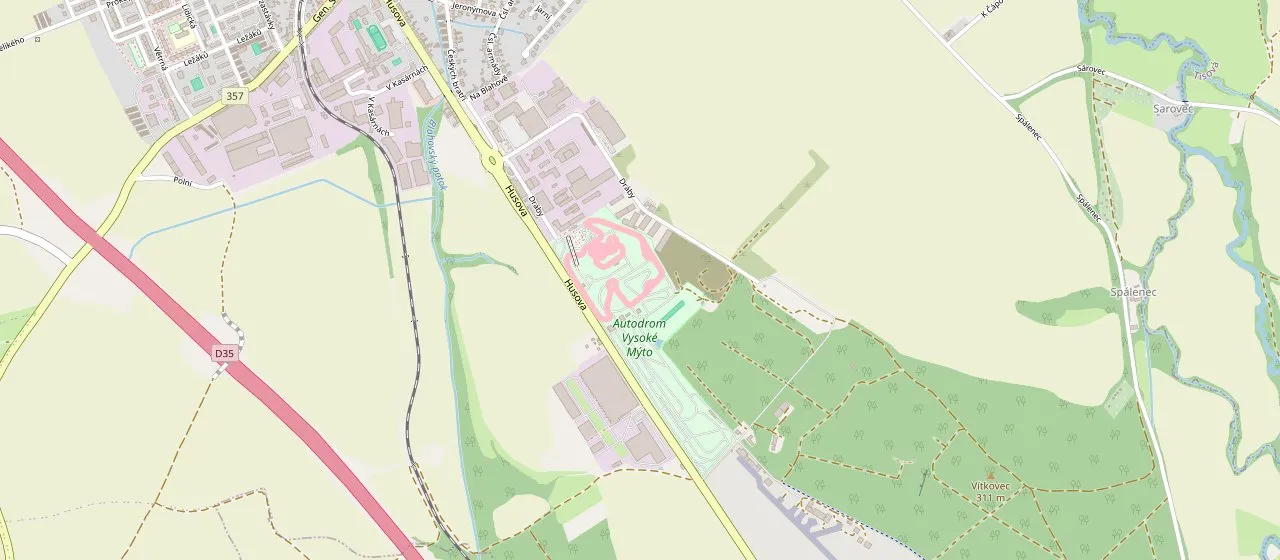
| Location | Dráby 45, Vysoké Mýto, Pardubice Region, Czech Republic; on the edge of town |
| Type | race track for karts, motorcycles (supermoto, miniracing) and cars, with a driver training centre |
| Length | 1142 m; chicane variants 1132 and 1122 m; supermoto course 1500 m, including 1150 m of asphalt and 350 m off-road |
| Width | 8–12 m |
| Elevation change | 11 m |
| Direction | clockwise |
| Beginnings | 1970s; sources disagree on the opening year |
| Operator | Autoklub Karosa, klub v AČR; subsidiary Autodrom VM s.r.o. |
| Main events | rounds of the FIM Supermoto World Championship 2021, 2022 and 2026; FIM Supermoto of Nations 2025; Czech karting and supermoto championships |
| Status | active: races, safe driving courses, hire, track days |
Karts on the square of the coachbuilding town
Vysoké Mýto has been tied to cars for a century. Josef Sodomka's family firm, which began with horse-drawn carriages in 1895, built its first car body in 1925 and its first bus body in 1928. After nationalisation in 1948 the works, under the name Karosa, turned exclusively to buses, which are still made in the town today, since 2013 under the IVECO BUS brand.
Autoklub Karosa, founded in 1922, shortly after the nationwide Autoklub of the Czechoslovak Republic came into being, draws on this tradition. It brought together owners of motorcycles and cars, and over time competitors and officials: from road and off-road motorcycle racing, through stunt riding and small-motorcycle speedway, to car hill climbs, navigation rallies and quarter-mile sprints. From 1950 to 1989 the club was part of Svazarm, and in 1990 it returned to the revived Autoklub, from which the Autoklub of the Czech Republic (AČR) emerged after the split of Czechoslovakia.
The club held its first kart races in the town centre. From 1961 the machines raced on the town's main square in an event called Vysokomýtský čtverec (čtverec is Czech for square) and ran there for thirteen years. Interest grew, the number of competitors rose, and the club began looking for a place where it could expand.
An autodrome on a tank ground
The idea came from two men. Jan Mračno, a designer and former teacher at the agricultural school, and Vladimír Kysilka, a driving instructor and member of the autoklub, were looking in the early 1970s for ground on which they could train young people on motorcycles of up to 50 cm³. Mračno recalled that they "kept pestering" the municipal national committee about it and held up neighbouring Choceň as a model, where a training ground for small motorcycles was already running above a boarding school.
The town hall pointed to a military ground used for driving tanks and off-road vehicles. Mračno also tracked down old photographs: before that there had been pastures here, and members of Sokol had held a rally here. He described the state of the ground without illusions: "The military autodrome was then a churned-up terrain. No road, just holes and bumps." The land belonged to the army, so permission had to be sought from the district military accommodation administration.
Soviet troops were stationed in the town at the time. The i60 portal, which recorded Mračno's memories, writes that the soldiers had many road accidents on the town's streets to their name, fatal ones included, and that local politicians needed to improve their image in the eyes of the residents. The commission for contacts with the Soviet troops, chaired by the head of the national committee, who was also chairman of the local aeroclub, met the initiators halfway. The soldiers, however, had to get their own part of the ground. They also helped obtain scarce building materials, and even a construction company from Prague.
The vision of the whole was Kysilka's. Besides the track, a children's traffic ground for learning to ride small motorcycles was built, along with a manoeuvring area, crossroads with traffic lights, a control tower, a roundabout and a car park. The Soviet soldiers were allotted a narrow strip closer to the airfield and, as Mračno said, were taught Czechoslovak traffic rules there; for a time the autodrome shared space with Soviet army ground. Construction took about three years, and Mračno himself designed the whole autodrome. Years later he judged it like this:
"At that time the autodrome had no comparison with anything similar in Czechoslovakia. I had seen something similar only near Vienna, where I went to take a look when I was driving for Karosa."
In the middle of the decade the karts moved from the square to the new track. From 1977 the club's activity was concentrated in containers at the autodrome; in 1990 the club got a hall, and since 1993 its seat has been its own building no. 45, known in town as the timekeepers' tower, which also houses one of the lecture rooms of the driving courses.
A loop with four chicanes
Today's loop measures 1142 m, and four ways of running the chicanes shorten it to 1132 or 1122 m. It is driven clockwise, on asphalt 8–12 m wide, with 11 m of elevation change; the starting grid is 140 m long, and 70 m of straight lead to the first corner. The longest straight is 200 m. A kart race can have 36 machines on the grid at once, a practice session 51.
For supermoto races, a motorcycle discipline that combines road racing with motocross, the track is extended to 1500 m: 1150 m of asphalt and a 350 m off-road insert with high jumps and banked corners. The world championship promoter describes it as a course famous for its fast asphalt sections, connected to a tricky and technical off-road part.
The club, which today has about 80 members, focuses above all on competitions for young people: karting, supermoto, miniracing and autoslalom. The Czech Championship and the AČR Cup in karting run together under the name Czech Kart Open; in 2026 the round in this town was scheduled for 17–19 April, and the track's calendar is completed by, among others, the Moravian Cup and the Slovak karting championship. Races of small road motorcycles, which were born in the early 1990s, have the status here of an international Czech championship under the name Miniracing Czech Republic. In autoslalom, where the direction and pace of driving are set by plastic cones, unlicensed amateurs start alongside licensed specialists: a car with a valid roadworthiness test and a helmet are enough. Juniors can race from the age of 14, with a special licence, a car of up to 1400 cm³ and an adult in the passenger seat.
In the rear part of the grounds there is a polygon, that is, a driver training centre. It has a 60 × 10 m skid pad, a slippery 140 × 8 m slope with a 9 percent gradient ending in a bend, a 50 × 5 m aquaplaning basin, a 90 × 6 m straight slippery surface, a semicircular bend with a 30 m radius and an off-road course. The club has run safe driving courses since 1998; by the end of 2022 more than 51,000 drivers had completed them and, as the club itself writes, they are today the main content of the autodrome's work. In 2026 a pilot programme for secondary school pupils started here, prepared with the Pardubice Region and schools in the region; its creators want young drivers to live through their first critical moment at the wheel on the polygon rather than on the road.
Autoklub Karosa runs the grounds as their operator. In May 2020 the club founded the company Autodrom VM s.r.o., in which it holds a 100 percent stake.
The July the world arrived
Over time supermoto racing also began at the autodrome. As Mračno recalled, such races were held at only a few places in the country back then, and in the town they drew "huge crowds". In the first half of June 2021 representatives of the FIM SuperMoto World Championship inspected the track, and on the weekend of 24–25 July the autodrome hosted a round of the supermoto world championship for the first time in its history, the second of that season. A ticket for the whole weekend cost CZK 200. Accommodation in the town and around it was booked weeks in advance; on Sunday morning overnight rain had soaked the course, and at the entrance a young man directed spectators without a covid test to the organisers' supply of antigen tests. Jiří Čáp, now the club's chairman, told „Orlický deník” at the time:
"When you get on a motorcycle and decide to race, you have to be a bit crazy. If you decide to organise an event like this, you have to have a piece of that craziness in you."
The round was won by the Frenchman Thomas Chareyre, an eight-time world champion riding for the Italian TM factory, with 77 points; the German Marc-Reiner Schmidt scored five fewer, and the Austrian Lukas Hollbacher was third. Instead of ordinary cups the best riders received trophies cast in glass in the town of Nový Bor, a glass Czech tricolour. Home rider Milan Sitnianský set the best time in Saturday's timed practice, was third in the first race and fourth in the classification of the whole round. AČR president Jan Šťovíček thanked everyone for an event prepared "in fact within a very small circle of a few people", and „Orlický deník” wrote that the small team of organisers had done what no other town in the Czech Republic had yet managed. A year later the world championship returned.
In August 2024 the FIM announced that the autodrome would host the Supermoto of Nations, a team event for national teams; Danilo Boccaldolce, head of the promoter XIEM, said the track would be changed in places to suit the needs of that event. The first Supermoto of Nations in the Czech Republic took place at the end of September 2025. The Francesco Zerbi trophy went to Austria with Lukas Hollbacher, Andreas Buschberger and Bernhard Hitzenberger, ahead of Germany with world champion Schmidt; the hosts were third, and the Czech juniors also took third place in their class.
The third round of the world championship was held here in July 2026. Riders came from 22 countries, and more than two thousand fans filled the stands and the paddock; for Sunday the organisers announced free IVECO Bus buses running between the town and the track. On Saturday Schmidt won the Superpole and the first race. In Sunday's Fast Race he led right up to the last lap, when a technical failure put him out; classified 21st, he started the Super Final from the back of the field and fought his way through to second place. In this race every rider has to take the Joker Line, a separate variant of the course, once, and the choice of moment often decides the result. The round was won by the Frenchman Steve Bonnal, Sitnianský was second and the Italian Elia Sammartin third, while Schmidt, fourth in the round classification, nonetheless returned to the lead of the championship. Jonáš Nedvěd, seventh in the round classification, told „Orlický deník”: "I was really looking forward to this race, the Vysoké Mýto track is one of my favourites"; in qualifying he improved his personal record on this track.
One hundred and three decibels
Track and town are not neighbours without friction. Since the 2016 season, after repeated complaints, inspections and administrative proceedings by the regional public health authority of the Pardubice Region and by the town, participants in all events have been randomly measured for noise, and anyone who exceeds the limits set for their discipline is excluded without a refund. The rules allow a car louder than 103 dB to be stopped, require a valid roadworthiness test and a homologated exhaust system, and from 20:00 to 07:30 no engines may be started anywhere on the grounds. For breaking the rules the club can impose a fine of up to CZK 50,000.
The rules define the drifting ban in detail: it means deliberately taking a corner in a controlled slide that the car enters already oversteering, or "burning" the tyres for as long as possible. Leaving a corner with spinning wheels after a loss of grip does not count as drifting.
In May 2025 the town hall received a request for information on the noise limits under which the autodrome had been approved after construction. It replied that it has no main construction documentation; the oldest document in its files is the project „Hygienické zařízení Autodrom Vysoké Mýto” from 1997, and later papers concern only partial structures, such as an electricity connection, speed bumps or the widening of the training area. The limits are set by Government Regulation No. 272/2011, and measuring them falls to the public health authority. So for a track built by volunteers with the help of a foreign army, the town's files hold no document from which its noise limits could be read today.
In your own car, by arrangement
In 2023 „Deník” counted the autodrome, alongside Sosnová and Písek, among the smaller tracks popular with motorsport fans, in a country with only two large circuits: in Most and in Brno. The operator itself lets cars onto its own practice days only by individual arrangement; an hour of driving in your own car then costs CZK 500, a morning or an afternoon CZK 2000, a whole day CZK 3000, including 21 percent VAT. A group can hire the loop exclusively, for at most 25 vehicles: from Monday to Thursday for CZK 4000 an hour or CZK 34,990 a day, on Fridays, weekends and public holidays for CZK 38,990. The operator warns that during this time other cars may be driving in the rear part of the grounds or courses may be taking place, and that entry is only through the front gate, on the side of the Shell station.
Since 2023 the club has organised the Time Attack Cup, a club car competition in two classes, up to 1600 cm³ and above. Over three hours of driving the time is measured continuously, the result counts a single fastest lap from the timed runs, and the top three in each class receive cups. For the round on 3 October 2026, 25 cars were accepted, for CZK 1700 in advance booking.
In autumn 2026 outside organisers also prepared days for drivers' own cars. The motoring magazine Autíčkář invited passenger cars "of all sizes and drivetrains" on 10 October in an open pit lane format, from 09:00 to 17:30: half a day for CZK 2500, a whole day for CZK 4000, a single ten-minute session for CZK 500; racing tyres were allowed. It also reminded drivers of the track rules, especially on noise and drifting, because after a clear warning the management shows offenders off the grounds "without mercy". Special Drive limited the number of cars on track to ten for 31 October and in the morning took those interested on a free walk of the loop with an instructor; the organiser describes it as a technical course "full of corners, shorter straights and brisk sections". With this organiser a helmet is compulsory in convertibles and roadsters driven without a roof, slicks are banned, and noise is measured at full throttle. The okresky.cz service announced driving for 7 November for everyone "regardless of car and experience", with a briefing before each part of the day and a ban on entering the polygon.
The part where it all began has also survived from Kysilka's plan. The children's traffic ground, built for learning to ride small motorcycles, and the whole layout of training crossroads were, according to Mračno, working in 2018 in the same form as at the start. The town reminds residents that outside race events the ground is free and open to everyone, and parents can use it to teach children to ride bicycles and roller skates.
Sources (34)
- Petr Broulík, Autodrom ve Vysokém Mýtě - pomohli i «Rusáci», i60.cz, 2018-04-13 [cs]
- Šárka Rusnáková, Vysoké Mýto je s vůní benzínu spojeno už 100 let, Český rozhlas Pardubice, 2025-05-04 [cs]
- Autodrom Vysoké Mýto, Karting [cs]
- Autodrom Vysoké Mýto, Supermoto [cs]
- Trackday Vysoké Mýto 10. 10. 2026 – už za týden!, Autíčkář.cz, 2026-10-02 [cs]
- Autoklub Karosa, klub v AČR, Provozní řád Autodromu [cs]
- Autodrom Vysoké Mýto, Polygon [cs]
- Asociace polygonů AČR, Vysoké Mýto [cs]
- Město Vysoké Mýto, OPEN MČR Supermoto se přesouvá do Vysokého Mýta, 2024-05-28 [cs]
- autodromvmyto.cz [pl]
- autoklub.cz [pl]
- Ministerstvo spravedlnosti ČR, Obchodní rejstřík, 2020-05-13 [cs]
- Město Vysoké Mýto, Závody a další akce na autodromu, 2026-04-13 [cs]
- Autodrom Vysoké Mýto, Ceník [cs]
- IVECO BUS (IVECO Czech Republic), Historie společnosti [cs]
- Supermoto S1GP (oficjalny serwis mistrzostw), Waiting S1GP show in Czech Republic for the fourth round, 2026-07-09 [en]
- Autodrom Vysoké Mýto, Miniracing [cs]
- Autodrom Vysoké Mýto, Automobilový slalom [cs]
- okresky.cz, Trackday - Autodrom Vysoké Mýto - 07.11.2026, 2026-11-07 [cs]
- Autoklub České republiky, Skvělá premiéra MS Supermoto ve Vysokém Mýtě, 2021-07-27 [cs]
- Karolína Velšová, Malý krok pro lidstvo, velký skok pro Mýto. Malé město hostilo světový šampionát, Orlický deník, 2021-07-25 [cs]
- Fédération Internationale de Motocyclisme, Vysoké Mýto to host the 2025 FIM SuperMoto of Nations, 2024-08-27 [en]
- Město Vysoké Mýto, Mistrovství světa Supermoto opět ve Vysokém Mýtě, 2026-06-29 [cs]
- Supermoto S1GP, Austria ruled the 2025 Trophy of Nations and France won in the Junior class, 2025-09-28 [en]
- Autoklub České republiky, Vysoké Mýto znovu potvrdilo, že patří mezi světovou elitu supermota, 2026-07-15 [cs]
- Radek Halva, Nedvěd o světovém supermotu: Je co zlepšovat, musím ještě zrychlit, Orlický deník, 2026-07-14 [cs]
- Supermoto S1GP, Marc-Reiner Schmidt dominates the first day of the Czech Republic GP, 2026-07-11 [en]
- Supermoto S1GP, Steve Bonnal returns to victory in the Czech Republic GP, first win in the Rookie Cup for Eemeli Astedt, 2026-07-12 [en]
- Město Vysoké Mýto, 7. 5. 2025 Hlukové limity při kolaudaci autodromu, 2025-05-21 [cs]
- Edvard D. Beneš, České autodromy a jízdy pro veřejnost. Podívejte se, kde se můžete svézt, Deník.cz, 2023-10-31 [cs]
- Autodrom Vysoké Mýto, Pronájem závodního okruhu [cs]
- Autodrom Vysoké Mýto, Time Attack Cup [cs]
- Autodrom Vysoké Mýto, Time Attack Cup 7, 2026-10-03 [cs]
- Special Drive s.r.o., TRACKDAY VYSOKÉ MÝTO, 2026-10-31 [cs]