
Klettwitz (gmina Schipkau), Germany
DEKRA Lausitzring: oval on a mine, three tragedies, saved by tests
History of the Lausitzring: a 158 million euro circuit on a former coal mine, the 2001 tragedies, insolvency, DTM and the turn into a DEKRA test centre.
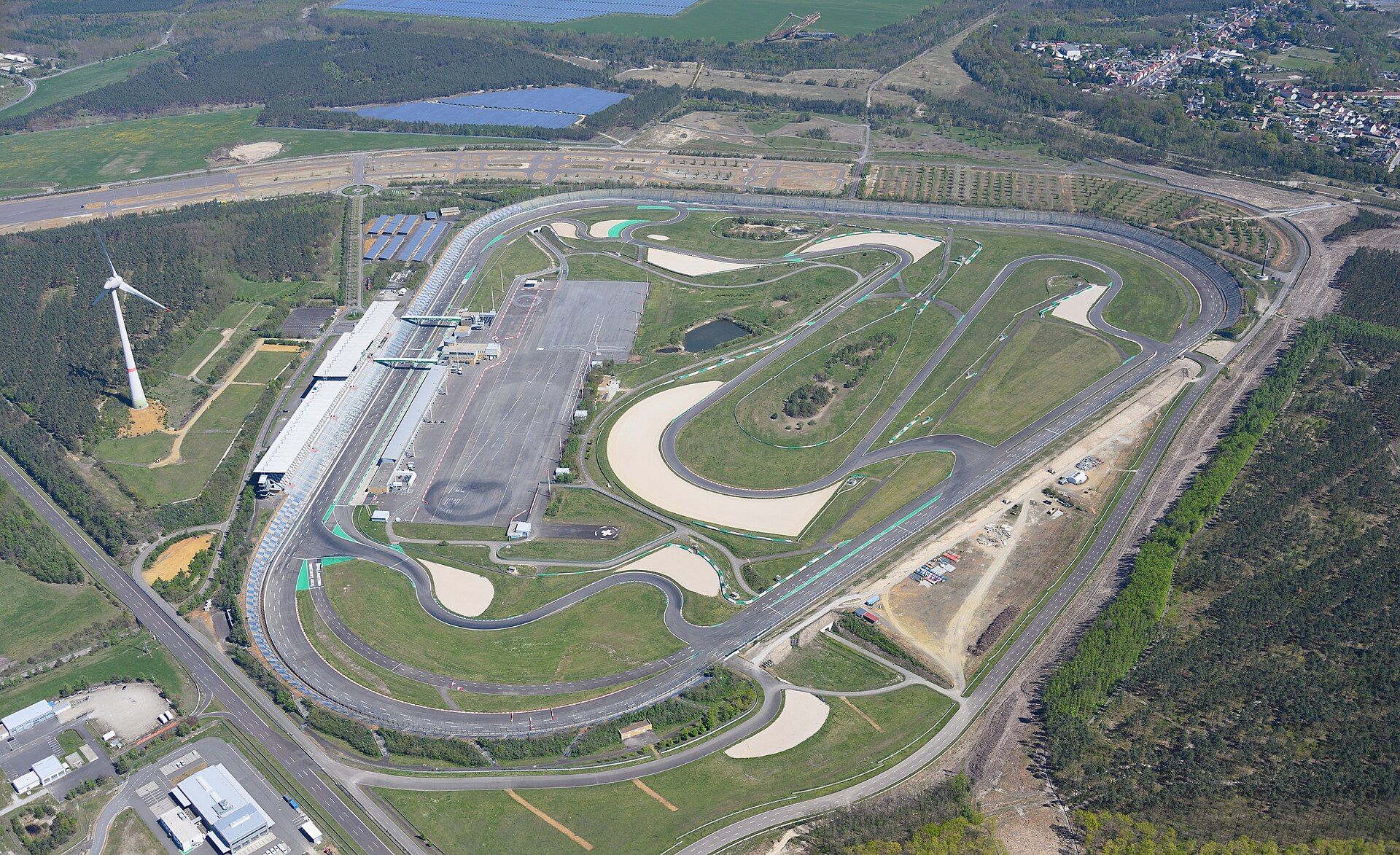
- Type
- race circuit
- Length
- 4.5 km
- Opened
- 2000
On 20 August 2000, on the former pit of a lignite mine near Klettwitz, 80,000 people watched the opening of a venue named EuroSpeedway Lausitz. Brandenburg's prime minister Manfred Stolpe spoke then of a "tangible economic prospect" for the region, and some of the guests dreamed of Formula 1 on what was at the time the most modern circuit in Europe. A quarter of a century later the venue is called DEKRA Lausitzring, during the week engineers and autonomous cars drive on it, and at weekends DTM and track day drivers. The road between those two pictures ran through three tragedies of a single season and an insolvency.
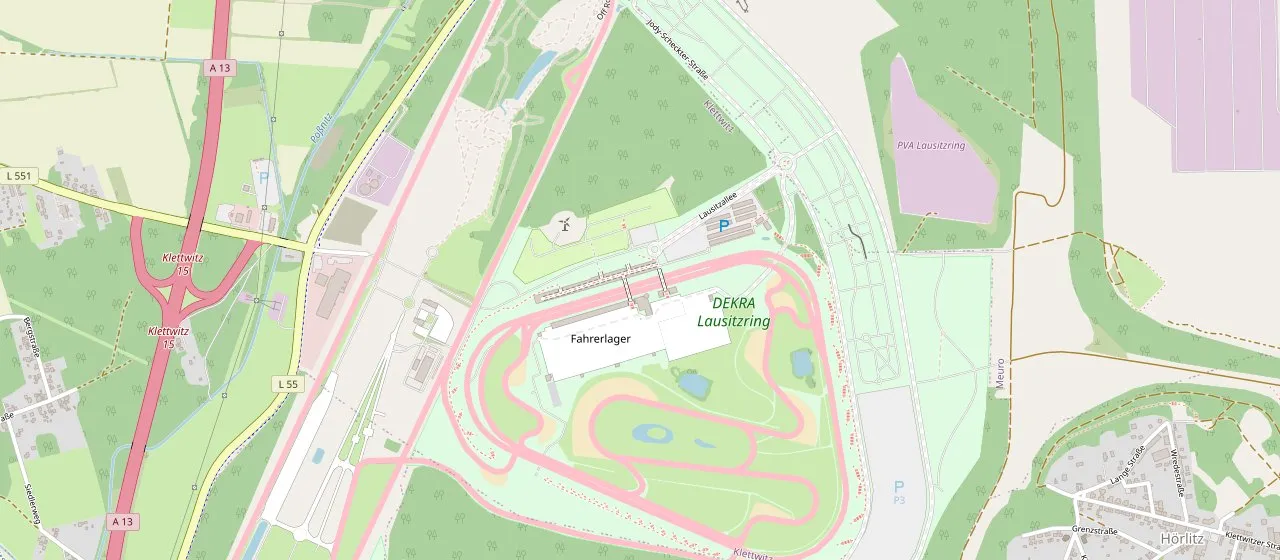
| Location | Klettwitz, Schipkau municipality, Oberspreewald-Lausitz district, Brandenburg, Germany; by the A13 motorway with its own exit |
| Type | permanent race circuit with an oval and a test ground; site of about 540 ha |
| Grand Prix circuit | 4,500 m or 3,442 m (configurable), 12 corners (5 right, 7 left), longest straight 648 m |
| Racing oval | 3.256 km, tri-oval |
| Test oval | 5,800 m, straights of 2,300 m each, maximum speed in the curve 210 km/h |
| Direction of travel | counter-clockwise |
| Opening | 20 August 2000 |
| Oval record | Tony Kanaan, Reynard 01I-Honda, 34.747 s (209.596 mph), Champ Cars, 2001 |
| GP circuit record (2.796 mi) | Heikki Kovalainen, Dallara SN01-Nissan, 1:32.215, World Series by Nissan, 2004 |
| Grandstands | 100,000 seats, main grandstand 25,000 |
| Owner | DEKRA, since November 2017 |
| Main events | DTM, IDM, CART (2001, 2003), World Superbike, A1 GP |
| Licence | FIA grade 2 (according to RacingCircuits.info) |
| Status | active; race circuit and test centre |
Asphalt on a pit left by coal
The idea of giving the Lusatian landscape, mangled by open-pit mining, over to motorsport appeared in the mid 1980s, when the region still belonged to the GDR. Off-road motorcycle racing was popular there, and the country's first permanent circuit was tempting to politicians. The plans were stopped by German reunification. A new impulse came in the 1990s from Berlin: the AVUS street circuit was living out its days because of growing traffic and safety concerns, so in 1991 a company was set up to find a successor. The site of the former Meuro open-pit mine won. In 1995 the state government gave the project its blessing.
DEKRA, an inspection organisation known to drivers mainly from roadworthiness tests, sat at that table from the beginning. According to the company itself, future DEKRA employees took part in the very first talks in 1990, and the then chairman of the board Rolf Moll, an active racing driver and president of the German motorsport commission ONS, was a determined advocate of the construction; the group also held stakes in the supporting association, the project companies and the first consortium of investors. That early presence explains why two decades later it was DEKRA that reached for the whole venue.
Earthworks started in June 1998 and stopped after two months: a group of residents was protesting. Equally loud demonstrations by motorsport enthusiasts tipped the scales and construction returned to the site. In May 1999 the foundation stone for the main grandstand was laid, in June the first asphalt was poured, and on 2 December 1999 the topping out ceremony was held. The bill for the whole thing came to 158 million euros, of which the federal state of Brandenburg put up 123 million.
A tri-oval as if from Pennsylvania
The scale of the venue had no counterpart in Europe. Its heart was a two mile long tri-oval, resembling in its drawing the Pocono circuit in Pennsylvania. Next to it lay a second oval, long and narrow, almost four miles, conceived as a test facility but able to be joined with the road course in the middle into a long loop, in German the Langstrecke. Above the oval and the infield rose a main grandstand for 25,000, and additional grandstands around the oval held another 95,000 spectators. In the view of the Motor Sport Magazine editors it was the first banked oval opened in Europe since the 1920s.
The first races came a week after the opening: first the national IDM motorcycle championship, seven days later DTM. The DTM debut, on 3 September 2000, was spoiled by a downpour. Both series stayed at the circuit for years, however, and to this day they form the backbone of its calendar.
The year 2001: three blows
The first full season began with a death. On Wednesday 25 April 2001 Michele Alboreto, the 1985 Formula 1 runner-up, was testing an Audi R8 prototype at the Lausitzring before the Le Mans 24 hour race. That day the team was driving the long loop joining the test oval with the road course in the infield. After a tyre change the left rear started slowly to lose pressure; in the slow part Alboreto did not feel it, and on the oval, at around 340 km/h at the end of the main straight, the tyre failed. The Audi took off and after a series of somersaults flew over the barrier. The driver died on the spot at the age of 44. Soon afterwards a track marshal lost his life. According to RacingCircuits.info the young marshal was struck by a touring car during a test session.
The third blow came on 15 September 2001, a few days after the attacks of 11 September. The first CART series race in Europe, the German 500, was being held on the oval. Alex Zanardi, the series champion of 1997 and 1998, spun on the exit from the pit lane, and Alex Tagliani hit his car from the side, at almost full speed. Zanardi survived, but lost both legs.
Zanardi himself described that moment in his autobiography, a fragment of which was published by Crash.net:
"Unfortunately, I did my stupid pirouette and kept spinning until Tagliani was faced with hitting my car in the side at 320kmh. [...] Part of the car stayed with me, and the other part left, with parts of me in it."
Tens of thousands of spectators watched the crash from the grandstands. Zanardi returned to that oval in 2003, when CART came to the Lausitzring for the second and last time: in a modified car he drove 13 laps, as many as the accident had taken from him.
Insolvency and the transitional years
In mid 2002 the circuit stood on the edge of a precipice. A Berlin bank (in the source: Bank of Berlin), whose subsidiary IBG was the main shareholder of the Lausitzring, fell victim to a property market scandal. The venue went into insolvency, proceedings started in September and the CART round was cancelled; the rest of the calendar survived. At the end of the year the court agreed to a fresh start and a new operating company took over the circuit. Radio Lausitz adds that for a while the venue was threatened with closure. From 2003 the DEKRA Technology Center with its own test oval operated right next door; the group opened it with a view to carrying experience from racing over into the design of production cars. In 2009 the circuit passed into the hands of Euro Speedway Verwaltungs-GmbH, which found investment needs counted in tens of millions of euros and did not manage to finance them.
The tri-oval lost importance with every season: the British ASCAR series came and went, and German Formula 3 experimented with running on the oval in 2005 and 2006. The weight shifted to the road course. In 2005 a link was added creating a short configuration 3.4 km long, which DTM used from then on; in the same year the World Superbike championship made its debut on the long motorcycle course, and the A1 GP series used the car circuit. Before the 2007 season the first corner of the road course was reprofiled into a tighter hairpin, in order to create a place for overtaking and to curb the pile-ups at the start of DTM races; the gentler original was kept for motorcycles. A year later the pit lane entry was moved to the last curves of the motorcycle course, because the previous one forced drivers to brake on the racing line after the last fast corner. In 2012 the long loop with the test oval was used in a race for the first time, when the Rundstrecken-Challenge Nürburgring endurance series left the Nordschleife for the first time; the event was not repeated.
Ghost towns instead of Formula 1
In July 2017 DEKRA signed a contract to buy the whole venue, and from November it became the owner and renamed it DEKRA Lausitzring. The group explained that its test oval was reaching the limits of its capacity, and that while looking for a place to expand it naturally looked at its neighbour. The plans announced in 2017 spoke of an "innovation centre for testing the mobility of the future": two urban courses, an out-of-town course, a motorway section on the existing test oval and large asphalt areas. The magazine Tourenfahrer commented at the time that the future of the Lausitzring as a race circuit was "at the very least more than questionable", and predicted that instead of roaring race cars the picture of the venue would be dominated by "ghost cars in ghost towns".
The ghost towns really did come into being. In 2019 Volker Noeske, head of the Technology Center, described in the trade magazine "Automobil Industrie" the mock-ups of city silhouettes and the portable buildings out of which villages, small towns, pedestrian crossings and parked cars are assembled on a strip 1.6 km long and 200 m wide. One of the recreated scenarios was Pirnaischer Platz in Dresden, a junction with four lanes, a tram track and a bus lane. Today the venue's official fact sheet lists urban courses with an area of 80,000 m² with roundabouts, motorway exits and built-in tram rails, next to the 5.8 km oval, a 2.6 km handling course, a five kilometre off-road course and an ABS section with surfaces from concrete to basalt. The staff has grown from about 70 people in 2003 to about 290, and in the autumn of 2025 a test centre for electric car batteries was due to start up next to the circuit.
The forecast of the end of racing did not come true. DEKRA does not promote events itself, but the circuit has remained available for hire to organisers and the races go on: DTM and IDM have returned. The weekends belong to racing, the week to the engineers; as Noeske put it, "DEKRA has motorsport in its DNA". Erik Pellmann, who runs the Technology Center, said in 2025 that the company had proved it can reconcile test running, at which an audience is by its very nature not welcome, with big events for spectators, and that the "funeral song" over motorsport in Lusatia that some began to intone in 2017 turned out to be out of place.
The circuit today: track days on the Grand Prix course
For an amateur driver what counts above all is the Grand Prix circuit: 4,500 m or 3,442 m in the short version, 12 corners, cross slope up to 10 percent, gradients up to 4.5 percent, straights from 12 to 24 m wide and the longest of them measuring 648 m. The operator runs its own driving programmes, including safety driving training, qualification of test drivers and racing taxi rides, and for car clubs the Club Days format, that is closed track days on the Grand Prix circuit. The calendar for September and October 2026 lists car trackdays, drift training, DEKRA Klassik Tage for classics (19 September), DMV Goodyear Racing Days (25 September) and the GRIP tuning meet (4 October). On site there are 21,000 paved parking spaces, 300 permanent toilets, 90 showers and 42,000 m² of camping ground.
A spectator standing today on the main grandstand has in front of them the same tri-oval on which in 2001 Kanaan drove a lap in 34.747 seconds. Behind their back, on the car parks that outside the racing season turn into towns made of mock-ups, cars without drivers practise crossing a Dresden junction.
Timeline
- 1980s: first plans for a circuit on post-mining land in the GDR, stopped by German reunification
- 1991: setting up of a company looking for the location of a successor to the AVUS circuit
- 1995: consent of the Brandenburg government to the project
- June 1998: start of construction; two month break after residents' protests
- 2 December 1999: topping out ceremony
- 20 August 2000: opening of EuroSpeedway Lausitz
- 25 April 2001: death of Michele Alboreto during Audi R8 testing
- spring 2001: death of a track marshal during testing
- 15 September 2001: first CART race in Europe; Alex Zanardi's accident
- 2002: insolvency of the operator, cancellation of the CART round, new company at the end of the year
- 2003: second and last CART round, Zanardi's 13 laps; opening of the DEKRA Technology Center next to the circuit
- 2005: short 3.4 km configuration for DTM; debut of World Superbike and A1 GP
- 2007: reprofiling of the first corner of the road course into a hairpin
- 2009: takeover of the circuit by Euro Speedway Verwaltungs-GmbH
- 2012: first race on the long loop with the test oval
- July 2017: contract for the purchase of the venue by DEKRA; transfer of ownership in November 2017
- 2025: 25th anniversary of the circuit; announcement of a battery test centre
Sources (10)
- Lausitzring, RacingCircuits.info [en]
- DEKRA, Test- und Rennstrecke: Vom Tagebau zum Innovationszentrum für die Mobilität von morgen, 2025-08-13 [de]
- Redaktion, Lausitzring feiert Silbernes Jubiläum – ein Rückblick, Radio Lausitz, 2025-08-20 [de]
- Thomas Günnel, Lausitzring: Teststandort der Dekra für vernetzte Systeme, Automobil Industrie (Vogel Communications Group), 2019-08-28 [de]
- DEKRA Lausitzring [de]
- Michele Alboreto, Motorsport Memorial [en]
- DEKRA Lausitzring, Streckenelemente des DEKRA Lausitzrings [de]
- Lausitzring, Motorsport Database [en]
- Alex Zanardi, Gianluca Gasparini, Alex Zanardi – My Story, 2022-03-31 [en]
- Dekra übernimmt Lausitzring, Tourenfahrer, 2017-07-19 [de]