
Taebaek (Dongjeom-dong), South Korea
Taebaek Speedway: a track on mine tailings in the mountains of Gangwon
Taebaek Speedway: a track built on zinc mine waste, an auction, the first night race in Korea, years of disputes and sessions for amateurs after a course.
- Type
- race circuit
- Length
- 2.5 km
- Opened
- 2003
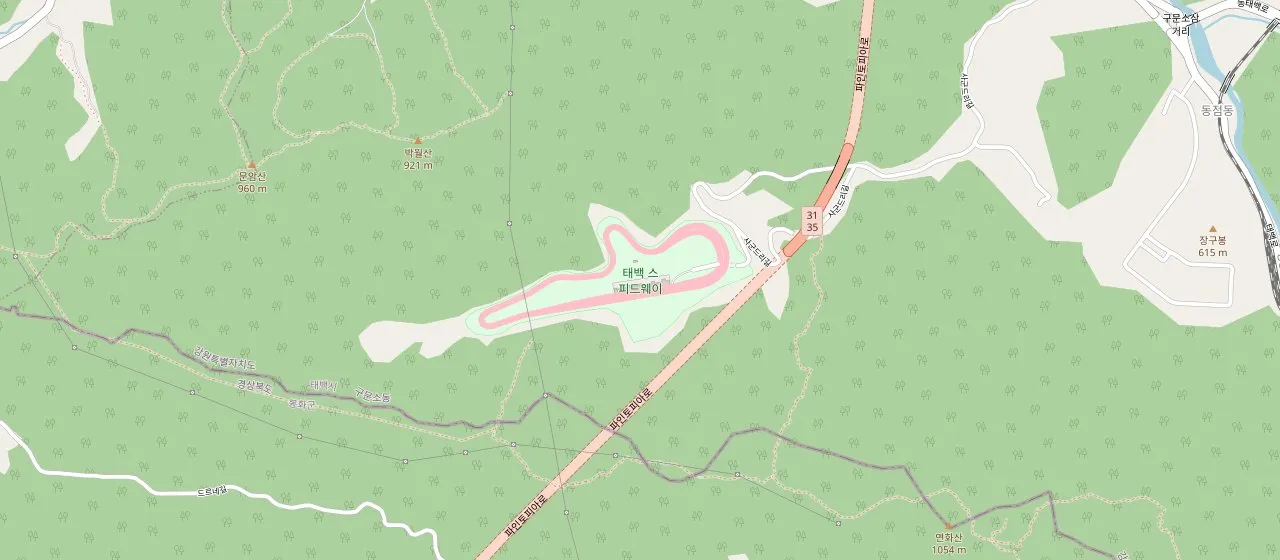
On 5 May 2003, at 13:00, about 10,000 people gathered at a new track in the Gumunso-dong district of Taebaek: competitors, residents, the mayor of the city and the vice governor of Gangwon Province. The Taebaek Junyong Circuit was being opened, and Shin Jun-yong, chairman of MJ Dream World, the company that had built it, said that the Taebaek motorsport stadium, the first project with private capital, "is winning praise as a world-class facility". Beneath the asphalt lay waste from a lead and zinc mine. The track still faced an auction, two name changes and years of legal disputes in which no car races were held here; today's Taebaek Speedway (태백스피드웨이) also lets ordinary cars onto its driving sessions, after a course for the track licence.
| Location | Sagundeuri-gil 240, Dongjeom-dong, Taebaek, Gangwon Province, South Korea |
| Type | permanent road course |
| Length | 2.5 km |
| Corners | 6 |
| Longest straight | 900 m |
| Altitude | about 700 m above sea level |
| Opening | 5 May 2003, with an opening meeting |
| Former names | Taebaek Junyong Circuit (태백준용서킷), Taebaek Racing Park (태백레이싱파크) |
| Operator | the company Taebaek Speedway ((주)태백스피드웨이) |
| Major events | Formula BMW Asia (2005), Super Race (including 2009, 2011, 2012), Nexen Speed Racing (since 2019), Taebaek Track Festival |
| Status | active; driving sessions for holders of the track licence, also in road cars |
A valley filled in by a mine
The track stands on a site that was called Gosugol (고수골). It was a mountain valley into which the company Youngpoong Mining dumped waste rock and tailings from the Yeonhwa mine, worked from 1961 for about thirty years and described by OhmyNews as the largest lead and zinc mine in Korea. The waste filled the valley until it became a plain. Youngpoong did not sell the land but handed it over to the city of Taebaek, and in 1996 the government designated the area a regional development zone for closed mines, meant to draw private capital to the former mining town.
The investor was MJ Dream World, headed by the then chairman of the Korea Motorcycle Federation; in 2000 it took over the land, covered the waste with a layer of soil and built the track on it. OhmyNews writes that it was the first facility in Korea with international dimensions for motorcycle racing. The construction cost about 30 billion won. The name of the track, Junyong, repeated the first name of the chairman, Shin Jun-yong.
How much waste exactly lies under the track has not been established. According to the city authorities' notice the complex covers 247,132 m², and in 2001 the daily Kangwon Domin Ilbo wrote of 4 million tonnes of zinc sludge; the author of the OhmyNews series on the consequences of Youngpoong's operations found no more precise data. Ministry of Environment studies from 2000–2001 found arsenic in the topsoil around the dump at a concentration about four times the intervention threshold, and in 2020 the same series stated that no authority exercised responsible oversight of the dump covered by the track.
A 900-metre straight and a huge arc
The loop is 2.5 km long, has six corners and lies at an altitude of about 700 m. RacingCircuits.info compares it to a scaled-down Fuji Speedway: the course is mostly flat, but surrounded by mountains. The longest straight measures 900 m and the operator claims that 250 km/h can be exceeded on it. It ends at corner 1, a hairpin with a radius of 25.88 m, for which one has to slow from maximum speed to minimum speed. Next come the fast corner 2, leading into the opposite straight, the technical left-right combination of corners 3 and 4, and corner 5 with reverse banking, where the entrance to the pit lane branches off. The last one, corner 6, is called a huge fast arc by the operator: it consists of three circular segments with radii from 98.58 to 126.58 m and leads onto the start straight.
Journalists who drove the track pointed out that the simple layout is misleading. In 2019 OSEN wrote that the loop is short but has several blind spots and looks easy, which is why drivers often make mistakes. After driving a Renault Clio, Kim Hak-su of Hankook Ilbo noted that this layout rewards driving down the middle of the track and using the whole surface more than attacking the kerbs. The Korea Tourism Organization stresses the plateau climate: in summer the temperature rarely exceeds 30 degrees here, and the surrounding mountains ease the noise problem.
Four seasons until the auction
The first car race, on 5 May 2003, was a round of the Korea Formula Touring Car Championship, and motorcycles raced the same day. Series from Asia also came to Taebaek: in early August 2005 Formula BMW Asia held two 20-lap races here. The second, on 7 August, was won by the Australian Michael Patrizi of the Meritus team, taking his first victory in the series; the race was stopped twice with a red flag, and six cars reached the finish.
Trouble came quickly. According to RacingCircuits.info, MJ Dream World was already struggling in 2004 because the track did not attract the interest and traffic that had been expected, and in December it was unable to repay the bank a loan of 8.4 billion won and 2 billion won in interest. The facility went to auction; in November 2006, after four years of operation, it passed into new hands, and the company Elim Leisure Development (엘림레저개발) began to run it. The new host renamed it Taebaek Racing Park, carried out a refurbishment at the end of 2006, and from 2007 the track operated in full.
Elim Leisure looked for guests abroad. In September 2007 the Japanese organiser of the Super Taikyu endurance series announced that, at the track's invitation, it would send 12 teams to the 300-kilometre race "2007 Taebaek Super 300", and the host was pressing for a regular championship round from the 2008 season. The Response website then presented the facility as the first track in Korea with international FIA certification; Hankook Ilbo also wrote about FIA certification in 2009.
The only track in the country
In 2009 Korea had two race tracks, Everland Speedway in Yongin and Taebaek, and since the former was being rebuilt, Taebaek became the only place for car racing. On 9 August 2009, before the final of the Super 3800 class of the CJ O Super Race championship, Hankook Ilbo reporter Heo Jeong-heon went as a passenger on a practice drive in the car of Yoo Kyung-woo of the EXR Team106 team. He described how before corner 1 the speed dropped from nearly 210 to 90 km/h in two or three seconds, and after three laps he heard from the driver that they had been going at roughly 80 per cent of race pace.
The Super 3800 class was contested exclusively by Hyundai Genesis Coupes, so the order was decided by the drivers, not the cars. Nineteen cars took a rolling start, in light rain, for 25 laps. About 2,000 spectators filled more than half of the grandstand, among them about a hundred Japanese fans of Ryu Si-won, who was both a driver and the team principal at EXR Team106. Hwang Jin-woo of the S-Oil team won in 26 min 27.899 s, Yoo was third and Ryu sixth. Two years later, on 26 June 2011, a downpour turned the Super Race round into a race full of off-track excursions, and in the Super 2000 class the first two places went to Chevrolet drivers, Lee Jae-woo ahead of Kim Jin-pyo.
The first floodlights
On 21 July 2012 Taebaek Racing Park hosted the fourth round of the Super Race series, run in Korea for the first time after dark. The organisers explained later that they wanted to spare fans from watching races in the heat. Pole position in the Super 6000 class, that is stock cars with 6.2-litre engines, was won by Hwang Jin-woo of Valvoline Racing with a time of 56.878 s, but the 27 laps were covered fastest by Kim Eui-su of CJ Racing, in 26 min 52.235 s. The night round stayed in the calendar permanently: according to the CJ press service it was held every year except 2020, and for 2022 it was planned at Inje Speedium.
Years of silence and the return
In 2014 Elim Leisure withdrew from running the track, and the operator became a new company, Taebaek Speedway, then headed by Jeong Young-shin. RacingCircuits.info states that from March 2014 the facility was managed by creditors, and its sale to a subsidiary of a car parts manufacturer caused a legal dispute. GPKorea described the new operator's dispute with Elim Leisure, because of which the track could not operate or host domestic competitions. According to GPKorea, domestic competitions usually draw 400 to 500 people from teams and crews alone, so the break was expected to hit the surrounding restaurants and hotels to some extent.
The disputes ended in 2019, and after repairs the track returned as Taebaek Speedway. On 5 May 2019 the second round of Nexen Speed Racing was held here, the series' first visit to Taebaek in ten years, combined with the city's motorsport festival. Mayor Ryu Tae-ho greeted the guests with the words: "Motorsport is Taebaek's new engine of growth". The years of idleness left a mark: RacingCircuits.info writes of puddles collecting on the surface, and Kim Hak-su of Hankook Ilbo in August 2019 of weathered, uneven asphalt that sent unexpected vibrations into the cabin.
The city stayed with racing. In 2020 the Nexen Speed Racing rounds in Taebaek were called the Mayor's Cup, and in September 2021 one of the two rounds was called that, with the organisers announcing that because of the pandemic the event would be held without spectators. In 2022 Hankook Ilbo observed that the relatively small track in Taebaek has limits when it comes to hosting full-scale competitions and should be better used. The operator is developing its own series, the Taebaek Track Festival; its fourth round in 2026 fell on 25 and 26 July, a weekend when the city also hosted an amateur football tournament.
A licence for a year and a tow hook
Amateurs have been driving here for a long time. In 2009 Taebaek Racing Park organised irregular track days: four or five 20-minute sessions for 100,000 won, and for the next track day the organiser announced a track licence for 55,000 won, issued after an hour of theory; with it one could buy entries also outside track days.
Today a Taebaek Speedway licence costs, according to the price list, 100,000 won including VAT and is valid for a year. One has to register by 9:20 on the day of driving, with a driving licence and a photo; after 30 minutes of theory and safety, the candidate drives five laps. A session lasts 20 minutes and costs 50,000 won, at most 20 tickets are sold for one session, and money is refunded only before it starts. The operator answers in the FAQ that the car need not be a racing car: any car that does not endanger others may enter, except buses, special vehicles and construction machinery. The driver must have a helmet and fastened seat belts, and the car a tow eye; a passenger rides after signing a declaration and only for two laps. The first session usually starts at 10:00, the last at 16:00, and on Mondays the track is closed for inspection. Whoever drives often can buy an annual pass for 1.5 million won. The declaration signed before driving has fields for the model and registration number of the car and for the Korean resident registration number; the page does not explain what a foreigner enters.
Under the complex runs a concrete channel from the early 1970s, 1.3 km long, which was used to drain water from beneath the dump. When in 2019 Son Yeong-ho of OhmyNews twice looked at its outlet at the foot of the former tailings dam, water was flowing from it although it had not rained.
Sources (32)
- 홍성배, 태백준용서킷 오픈기념 코리아로드레이스 성황, Kangwon Domin Ilbo (강원도민일보), 2003-05-06 [ko]
- 손영호 (Son Yeong-ho), 자동차 경주장 트랙 아래에서 벌어지고 있는 일, 2020-07-31 [ko]
- 남태화 (Nam Tae-hwa), 태백서킷 재개장 `모터스포츠 열풍` 다시 분다… 넥센스피드 2전 신호탄!, GPKorea (지피코리아), 2019-06-29 [ko]
- gpkorea.com [ko]
- Taebaek Speedway, FAQ [ko]
- Taebaek Speedway, 오시는길 [ko]
- Korea Tourism Organization (한국관광공사), 태백스피드웨이 [ko]
- Taebaek Speedway, RacingCircuits.info [en]
- Taebaek Speedway, 코스맵 [ko]
- BMW Group, Formula BMW Asia - Round 10 - Taebaek - Race, 2005-08-07 [en]
- 허정헌 (Heo Jeong-heon), 레포츠/ 허정헌기자의 '해 봤더니'- 카레이싱, Hankook Ilbo, 2009-08-13 [ko]
- [한국지엠] 쉐보레 레이싱팀, 크루즈로 ‘2011 티빙슈퍼레이스’ 우승 행진, Autoview (오토뷰), 2011-06-27 [ko]
- 최초의 나이트 레이스로 진행된 CJ 레이스 챔피언십 4전, Autoview (오토뷰), 2012-07-25 [ko]
- 강희수 (Kang Hee-su), 태백에 되살아난 모터스포츠 열기, 넥센스피드레이싱 2R '후끈', OSEN, 2019-05-06 [ko]
- Taebaek Speedway, 태백 트랙 페스티벌 [ko]
- Taebaek Speedway, 스포츠주행 [ko]
- 강희수 (Kang Hee-su), 넥센타이어 스피드레이싱 4라운드, 비가 와서 더 뜨거웠던 레이스, OSEN, 2019-07-22 [ko]
- 김학수 (Kim Hak-su), [서킷 시승기] 태백 스피드웨이에서 매력을 뽐내는 르노 클리오, Hankook Ilbo, 2019-08-29 [ko]
- BMW Group, Formula BMW Asia - Rounds 9 and 10 - Taebaek - Preview, 2005-07-29 [en]
- 【スーパー耐久】韓国で招待レース レギュラー化にらむ, Response.jp (レスポンス), 2007-09-27 [ja]
- CJ Newsroom, 어둠 속의 짜릿한 질주, 슈퍼레이스 나이트레이스 열려, 2022-06-02 [ko]
- 박찬규 (Park Chan-gyu), CJ슈퍼레이스, 순위예측 어려워져 '흥미진진', Sidae (시대), 2016-07-20 [ko]
- 남태화 (Nam Tae-hwa), 류태호 태백시장, 넥센스피드레이싱 프로모터에 감사패, GPKorea (지피코리아), 2019-06-29 [ko]
- 김학수 (Kim Hak-su), [현장] 르노 트위지·마스터 그리고 클리오, 태백 스피드웨이를 즐거움으로 채우다, Hankook Ilbo, 2019-08-16 [ko]
- 김희웅 (Kim Hee-woong), 2020 태백시장배 넥센스피드레이싱, 더블라운드(3&4) 성공적 마무리 [종합], Xportsnews (엑스포츠뉴스), 2020-10-19 [ko]
- 정승우 (Jeong Seung-woo), 2021넥센스피드레이싱, 11~12일 태백에서 ‘질주 쇼’ 펼친다, Xportsnews (엑스포츠뉴스), 2021-09-09 [ko]
- 김학수 (Kim Hak-su), 2022년, 대한민국 모터스포츠가 고민해볼 문제들, Hankook Ilbo, 2022-10-04 [ko]
- 오윤석 (Oh Yoon-seok), 열대야 없는 고원도시 태백, 이번 주말 스피드웨이·그라운드·야시장 동시에 달아오른다, Kangwon Ilbo (강원일보), 2026-07-24 [ko]
- Taebaek Speedway, 이용요금 [ko]
- Taebaek Speedway, 라이선스 [ko]
- Taebaek Speedway, 자동차 드라이빙 스쿨 [ko]
- Taebaek Speedway, 스포츠주행 서약서, PDF [ko]