
Yeongam (Samho-eup), South Korea
Korea International Circuit: a Formula 1 track on land taken from the sea
The history of Korea International Circuit in Yeongam: construction on reclaimed land, four Formula 1 Korean Grands Prix, the cost of the races and track days in your own car.
- Type
- race circuit
- Length
- 5.615 km
- Opened
- 2010
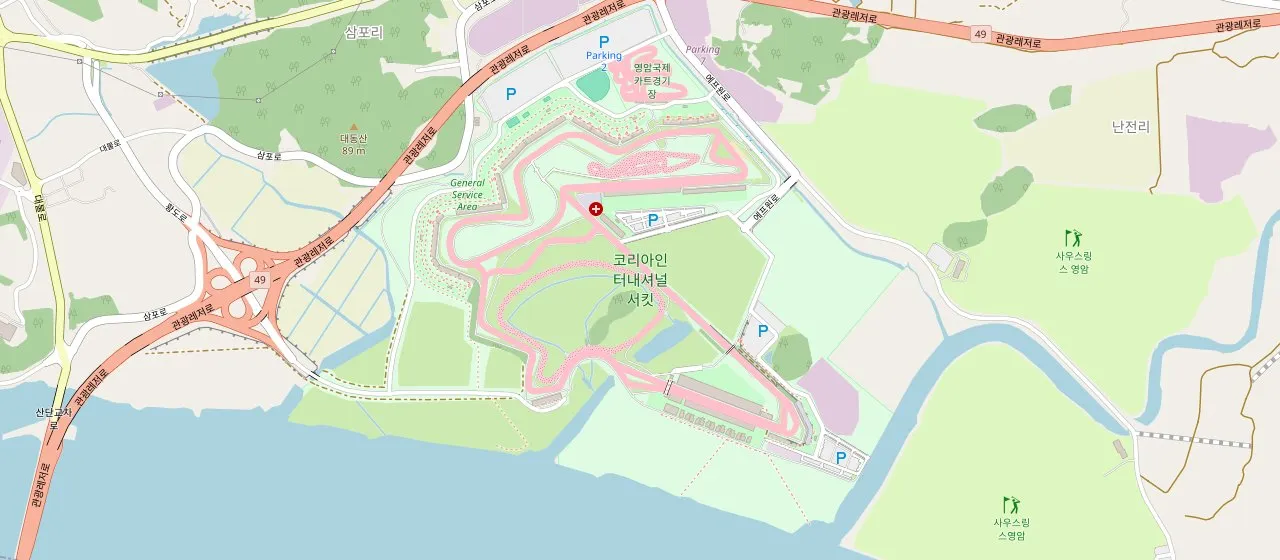
At the end of July 2010, asphalt trucks were driving along a new road across reclaimed land in Samho-eup, Yeongam County. Fewer than three months remained before the first Formula 1 Korean Grand Prix, and the surfacing of the 5.6 km loop was still under way. The circuit made it, although the FIA race director approved it only on 12 October, and the last layer of asphalt had been laid a week earlier. The story of Korea International Circuit in Yeongam is four Formula 1 races, a bill counted in hundreds of billions of won, and a second, quieter career: track days on which amateur drivers go round in their own cars on a loop that holds Sebastian Vettel's lap record.
| Location | Samho-eup, Yeongam County, South Korea; the operator's address gives the unit Jeonnam-Gwangju (전남광주통합특별시) |
| Type | permanent road circuit with three configurations |
| F1 layout | 5.615 km, 18 corners (11 left, 7 right), 13–15 m wide |
| Other configurations | permanent track (상설 트랙) 3.04 km and 10 corners; second track (제2 트랙) 3.29 km and 12 corners |
| Direction | counter-clockwise |
| Longest straight | about 1.2 km |
| Design | layout: Hermann Tilke; main grandstand and paddock buildings: Junglim Architecture |
| Opening | "Circuit Run 2010" demonstration on 4 September 2010, first Grand Prix on 24 October 2010; the whole facility was formally accepted on 28 September 2011 |
| F1 layout lap record | 1:39.605, Sebastian Vettel, Red Bull-Renault, Korean Grand Prix, 16 October 2011 |
| Permanent track record | 1:11.299, Kim Yeong-chan (김영찬), DCT Racing, eN1 class, Hyundai N Festival, 23 June 2024 |
| Main events | Formula 1 Korean Grand Prix (2010–2013), TCR Asia (2016), Jeonnam GT |
| Operator | Korea Mobility Group (KMG), contract manager (위·수탁 운영사) |
| Status | active |
The city that was meant to stand by a lake
The authorities of South Jeolla Province secured the right to host a Formula 1 Grand Prix in February 2006, when Park Joon-yung was governor. The promoter was Korea Auto Valley Operation (KAVO), in which the province joined forces with the private firm M-Bridge Holdings; the agreement provided for seven races starting in 2010 and, according to Motor Sport Magazine, an option for another five years. The site chosen was Yeongam County, a few hundred kilometres south of Seoul, near the port city of Mokpo. The land set aside for construction had been reclaimed from the sea near the villages of Sampo and Nanjeon, by Yeongam Lake.
The circuit was meant to be the seed of something bigger. On 89.9 km² of such land in Yeongam and Haenam counties, the province planned to build an international resort city for 120,000 residents between 2006 and 2025, at a cost of 3.2 trillion won; the undertaking was called the "J Project" and the circuit was its first investment. By mid-2010, with the recession and trouble finding private investors, the target population had been cut to about 50,000. Hermann Tilke designed a loop whose southern part, with the pit lane and paddock, was to be woven into a waterfront district with hotels, restaurants and a yacht marina, on the model of the street circuits in Valencia or Monaco. Hence the Korean press wrote about a "hybrid" circuit that could be divided into two configurations as needed. The district was never built, and from the start the circuit operated as an ordinary permanent facility.
The design of the support buildings was entrusted to Junglim, the authors of, among others, the World Cup stadium in Seoul and Incheon airport. In March 2007 KAVO presented the design of the main grandstand: a roof with upturned ends, recalling both the eaves of a traditional house and the rear wing of a racing car, and eight cylindrical pillars referring to bongsudae, the signal towers that had served since the Three Kingdoms period to pass messages as fast as possible. According to Junglim, the grandstand stands about 9 m from the track, and the rows were designed so that the tyres of the cars can be seen even from the lowest one. In 2009–2010 the press reported that construction cost 340 billion won.
Asphalt at the last moment
In September 2009 the grandstand and the race control tower were already standing, and compaction of the ground was being finished on the track. Then the rain came. Bernie Ecclestone, head of Formula One Management, later explained that it had rained continuously for 51 days in Yeongam, which put the work back by as many days. In July 2010 a representative of the contractor, SK건설 (SK Engineering & Construction), announced that the surface of the track and the run-off areas would be finished by the end of September. On 4 September, 50 days before the race, the public was let onto the track: at the "Circuit Run 2010" event, a Red Bull show car with Karun Chandhok at the wheel did 14 laps in front of four thousand spectators.
The FIA inspection was postponed several times. Charlie Whiting, the Formula 1 race director, declared the track ready on 12 October 2010, well after the deadline the regulations set at 90 days before the event. KAVO chairman Chung Yung-cho said at the time, quoted by Reuters, that the facility "will become the epicentre of motorsport in the country". The drivers were greeted in Yeongam by dust from the building works and a spot near corner 16 where the cars hit the asphalt with their floors. Most complaints, however, concerned the pit entry, placed at the exit of a blind corner, right on the ideal racing line. Jarno Trulli called it plainly "very dangerous".
Robert Kubica of Renault agreed with Trulli about the entry, but the circuit itself surprised him:
The first few corners are quite boring. After Turn Nine there is quite a lot of action going on; Turn Ten is quite nice, and also Eleven and Twelve and from there it's quite a nice track. I was quite surprised by the layout - it is ten times better than Abu Dhabi.
The race that ended at dusk
On Sunday 24 October 2010 it was raining over Yeongam. The start was delayed by ten minutes, and the field was then released behind the safety car; Jenson Button reported over the radio that the straight looked like a lake, and Fernando Alonso, according to Grandprix.com's account, that these were the worst conditions he had ever driven a car in. After a few laps the race was stopped for nearly an hour. After the restart the drivers did another 13 laps behind the safety car, and real racing began almost an hour and three quarters after the scheduled start. Sunset mattered: Grandprix.com noted that it would fall over the track at 17:50 local time.
Mark Webber, the championship leader, went onto the outside kerb, spun into the wall and, on rejoining the track, took Nico Rosberg's Mercedes with him. Sebastian Vettel was leading, but at the start of lap 46 the Renault engine in his Red Bull blew up. Alonso, who had earlier lost second place because of a problem with a front right wheel change, regained it when Hamilton ran wide at the first corner. Then he "edged away from Hamilton in the gloom" and won in 2:48:20.810, with a margin of 14.999 s; Felipe Massa was third. The win gave the Spaniard the lead in the championship with two races to go.
Robert Kubica finished fifth. He started from eighth place and at one point dropped to ninth. As the RMF24 portal reported, two laps from the end he passed Rubens Barrichello and moved up to seventh in the overall standings. "It was a long, difficult race that had two halves", he said afterwards; in the first he could not get heat into the tyres, in the second he looked after the intermediates and could attack at the end.
The grandstands fared worse. As JoongAng Daily reported later, five sectors of the stands, in which an inspection had found structural weaknesses, were closed on the last day, and the rain turned the unpaved areas around the track into mud. The province was criticised for giving away thousands of free tickets, and visitors lacked accommodation; some of them slept in so-called love motels, hotels rented by the hour.
Three Vettel wins and a fire truck
The circuit was formally accepted only on 28 September 2011, after the toilets, the ordinary grandstands and the footbridge had been finished; the whole came to 64 buildings, and the 2010 race had been held with partial acceptance. The footbridge over the last corner, referring to local architecture, was counted by RacingCircuits.info among the ornaments typical of Tilke. The organisers drew conclusions from the first race: tickets for 2011 became cheaper, on average from 460,000 to 315,000 won. According to RacingCircuits.info the wall at corner 17 was also moved so that drivers on a fast lap could see cars turning into the pits, and in 2013 the pit exit was routed around the exit zone of the first corner, joining the track at the second.
Sebastian Vettel won at Yeongam three times in a row: in 2011, 2012 and 2013. In 2011, a week after taking his second world title, he passed Hamilton, who had started from pole position, on the first lap. Webber's third place gave Red Bull the constructors' world title. "It was so much fun to drive", Vettel said at the press conference. In the same race he set the fastest lap, 1:39.605, which the operator still lists as the F1 layout record. The organisers counted 84,174 spectators on race day and 160,236 over the three days. A year later Red Bull took the first two places, Vettel ahead of Webber.
The last Korean Grand Prix, on 6 October 2013, is remembered for a different reason. Adrian Sutil hit Webber's Red Bull, whose rear end burst into flames. Charlie Whiting called a rescue vehicle to the fire, expecting the one from corner 3 to go. But the fire truck from corner 1 set off and drove onto the track ahead of the leaders, before the safety car had managed to slow the field. Vettel was the first to reach it. The FIA decided there would be no sanctions, because the marshals had been waving white flags, as the regulations require. Red Bull team principal Christian Horner said that, luckily, it had happened on the long straight, where the drivers had time to react. Vettel won ahead of the two Lotus drivers, Kimi Räikkönen and Romain Grosjean.
The bill
The races brought losses from the first year. The settlement for 2012, presented to the provincial councillors, spoke of costs of 74.5 billion won, of which 51 billion won went on the fee to FOM, against revenue of 35.1 billion won. The organising committee, which took over the rights to the race from KAVO in June 2012, put the loss from the four editions at 190.2 billion won. On top of that came construction itself: the circuit cost 428.5 billion won, and of that the province put in, besides money from the state budget, 300 billion, including 198 billion from municipal bonds.
The committee asked FOM to cut the hosting fee from 43.7 million to 20 million dollars. FOM refused, and on 4 December 2013 the FIA World Motor Sport Council struck Korea off the 2014 calendar. A day later Governor Park Joon-yung decided that the province would give up the race in 2014; he explained that he had judged it good to "take a year off and give ourselves time to think". The race never came back. In February 2015 Asia Economy wrote about a plan to dissolve the committee and about the fact that FOM could demand 90 million dollars in compensation for two years without a race; a civic organisation then filed a complaint with the Gwangju district prosecutor's office against the former governor and members of the committee, accusing them of breach of trust in the performance of official duties.
One object tells those years best. For five years a Formula 1 car stood in the lobby of the provincial government building, donated by LG Electronics; some media presented it as a car that had raced. The portal Autoview established that it was a carbon-fibre replica, built for the LG stand during the 2010 Singapore Grand Prix. In August 2018 the replica was moved from the government building to the circuit.
A circuit without Formula 1
The second career began before the first had ended. At the end of February 2012 the province invited ordinary drivers to a track day on 4 and 5 March. They could drive their own cars round a facility on which, as Seoul Shinmun reminded readers, Vettel and Michael Schumacher had driven. By then more than 120 cars had signed up, and taking part required buying a ticket to drive and obtaining a circuit licence. In May 2016 the circuit hosted the TCR Asia series for the first time, as part of a festival organised by the provincial company Jeonnam Development Corporation (전남개발공사). In 2017 the circuit was in use on 278 of 293 available days; the most, 122 days, went on testing of cars and parts, 101 days on club driving, and 42 on races.
Events were brought to the circuit by Yeongam County, in cooperation with the KIC team at Jeonnam Development Corporation, and visitors kept coming. In 2024 the daily Dailian described a marathon, a duathlon competition, a music festival combined with Hyundai N Festival, and a camping fair on the circuit grounds; in 2023 about 10,000 visitors came. In October 2024 Super 6000 cars and prototypes raced on the F1 layout as part of the Jeonnam GT meeting, and at the same facility the county organised a drone race. Today the circuit is managed under contract by Korea Mobility Group; in autumn 2025 the company prepared, together with Jeonnam Province, the Jeonnam Motor Festival with rides in a "track taxi" round the F1 layout.
Licence, helmet and five 25-minute sessions
Anyone who wants to drive their own car at Yeongam first needs a KIC circuit licence. It costs 100,000 won including VAT, is valid for a year and requires theory training, a written test and a check drive. It is issued only on days when driving takes place at the circuit, and from the fourth year of renewals the written test and check drive can be skipped. A full-face helmet with a D-ring fastener, gloves, an overall or long sleeves and legs, a tow hook and a fire extinguisher of at least 3 kg in a bracket are mandatory; the operator also recommends at least four-point harnesses and a HANS system.
A track day costs 250,000 won per day on the permanent track and 350,000 on the F1 layout, including VAT; for the 2026 season the operator scheduled 17 dates, two of them on the full loop. The announcement of the day on 2 October 2026 divided participants into three groups according to their lap time on the permanent track: under 1:27, from 1:27 to 1:32, and slower drivers together with novices. Each group had five sessions of 25 minutes, up to 35 cars, and insurance and lunch were included in the price. The noise limit is 105 dB for registered cars and 110 dB for unregistered ones, measured 50 cm from the exhaust outlet at 75 per cent of the revs at maximum power. For comparison: in 2018 Autoview reported that a 25-minute session at Yeongam cost 40,000 won, and that the journey from Seoul was about 360 km.
In 2026 amateurs also have competitions on the full-length circuit. KMG rebuilt its touring car race into the KIC Challenge Race series and set two of the four rounds on the F1 layout, which the local press presented as the first such case in an amateur event. For the season opener in April, more than 120 cars were entered in seven classes, from prototypes to Hyundai Veloster Ns and Toyota GT86s. In the timed classes, such as KIC-TT for the Veloster N and Avante N, the result is set by the fastest lap, and entry requires a KARA licence (in those classes at least a national D licence) and a KIC circuit licence. On the loop on which Vettel went down to 1:39.605 in 2011, amateurs were to race in 2026.
Timeline
- 2006: South Jeolla Province secures the Formula 1 Korean Grand Prix
- 2007: KAVO presents the design of the main grandstand
- 2010, 4 September: "Circuit Run 2010" demonstration with a Red Bull car
- 2010, 12 October: Charlie Whiting approves the track
- 2010, 24 October: first Korean Grand Prix, won by Fernando Alonso, Robert Kubica fifth
- 2011, 28 September: formal acceptance of the facility
- 2011, 16 October: Sebastian Vettel wins, Red Bull constructors' champions, lap record 1:39.605
- 2012: the province invites amateurs to a track day in March; Vettel wins the third Korean Grand Prix
- 2013, 6 October: last Korean Grand Prix, a fire truck on the track
- 2013, 4 December: Korea struck off the 2014 F1 calendar
- 2016: first TCR Asia round at Yeongam
- 2024: permanent track record at Hyundai N Festival; Jeonnam GT on the F1 layout
- 2026: KIC Challenge Race, two of four rounds set on the F1 layout
Sources (46)
- 최치봉 (Choi Chi-bong), [지역개발 현장]전남 영암 ‘삼포지구’, Seoul Shinmun (서울신문), 2010-07-29 [ko]
- Reuters, South Korea gets F1 green light, Khaleej Times, 2010-10-12 [en]
- Drivers admit to concerns over 'dangerous' Korean pit entry, Crash.net, 2010-10-22 [en]
- Formula 1, 2011 Korean Grand Prix, Fastest Laps [en]
- Korea Mobility Group, Korea International Circuit, 스포츠 주행 자동차 (Car Track Driving) [ko]
- Korea Mobility Group, Korea International Circuit, KMG 소개 [ko]
- Korea Mobility Group, Korea International Circuit [ko]
- Vettel wins at F1 Korean Grand Prix, Korea JoongAng Daily, 2011-10-17 [en]
- Korea Mobility Group, Korea International Circuit, KIC 소개 [ko]
- Junglim Architecture, Formula 1 Korea International Circuit [en]
- Korea International Circuit, RacingCircuits.info [en]
- Yeongam, Motor Sport Magazine [en]
- 류원근 (Ryu Won-geun), ‘꿈의 F1 경주장’베일 벗었다, Sports Kyunghyang (스포츠경향), 2007-03-26 [ko]
- 배명재 (Bae Myung-jae), 영암엔 땅 위를 나는 자동차가 있다, Kyunghyang Shinmun (경향신문), 2010-09-06 [ko]
- Formula 1, 2010 Korean Grand Prix, Race Result [en]
- 최종필 (Choi Jong-pil), 영암 F1 경주장 완공, Seoul Shinmun (서울신문), 2011-09-28 [ko]
- Korea Mobility Group, Korea International Circuit, FASTEST LAPS [ko]
- Formula 1, 2013 Korean Grand Prix, Race Result [en]
- 임의택 (Im Ui-taek), 복합 모터스포츠 이벤트, 코리아인터내셔널서킷서 열린다, Aju Business Daily (아주경제), 2016-03-08 [ko]
- Decisive TCR Asia Win in Korea for Tim Sritrai in JAS Civic, 2016-05-15 [en]
- 류지홍 (Ryu Ji-hong), 영암서 12일부터 국내 최대 모터스포츠 축제 열려, Seoul Shinmun (서울신문), 2024-10-03 [ko]
- 요동치는 순위 싸움... 2024 전남 GT [포토], Motorgraph Korea (모터그래프코리아), 2024-10-14 [ko]
- 김흥순 (Kim Heung-soon), 전남道, 조직위 5년 만에 해산 방침…시민단체, 박준영 前지사 검찰 고발, Asia Economy (아시아경제), 2015-02-09 [ko]
- Korean International Circuit, Crash.net [en]
- 국내 최초 F1경기 열리는 전남 영암에 가다, Aju Business Daily (아주경제), 2009-09-16 [ko]
- Race Notes - Webber spins, Vettel blows up, Alonso wins Korean GP, Grandprix.com, 2010-10-24 [en]
- Alonso wins, takes lead in Korea, Autosport, 2010-10-24 [en]
- Deszczowe GP Korei. Dramat Red Bulla, Alonso liderem, RMF24, 2010-10-24 [pl]
- Kubica: Wyścig miał dwie połowy, Interia Sport, 2010-10-25 [pl]
- F1 committee hopes for better 2011 event, Korea JoongAng Daily, 2011-03-02 [en]
- Formula 1, 2011 Race Results [en]
- Formula 1, 2012 Korean Grand Prix, Race Result [en]
- 2013 Korean GP: Sebastian Vettel untouchable again to close on world title, Sky Sports, 2013-10-07 [en]
- Korean GP: FIA admits it made Mark Webber fire truck call, Autosport, 2013-10-06 [en]
- 최종필 (Choi Jong-pil), 700억, 600억, 400억 적자 ‘혈세먹는 F1’, Seoul Shinmun (서울신문), 2012-11-22 [ko]
- 김우람 (Kim U-ram), [스포츠와 경제]내년 영암 개최 무산 F1 GP의 경제학, Etoday (이투데이), 2013-12-20 [ko]
- 전라남도청, F1의 악몽 잊고파(?) F1 머신 전시 중단, Autoview (오토뷰), 2018-08-28 [ko]
- 최종필 (Choi Jong-pil), 나도 F1드라이버 돼볼까, Seoul Shinmun (서울신문), 2012-02-28 [ko]
- 김태훈 (Kim Tae-hun), F1 경주장 살려낸 영암, 첨단 모터피아로 질주 중 [혁신수도 영암②], Dailian (데일리안), 2024-10-31 [ko]
- 양수녕 (Yang Su-nyeong), 영암F1경주장에서 국제 드론 스피드 레이싱을 만끽한다, Metro Seoul (메트로신문), 2024-10-10 [ko]
- 12일까지 영암 국제자동차경주장서 진행, Asia Economy (아시아경제), 2025-10-08 [ko]
- Korea Mobility Group, Korea International Circuit, 서킷 라이선스 [ko]
- Korea Mobility Group, Korea International Circuit, 10/02(금) Car Track Day - 12 참가 신청 안내 [ko]
- 인제, 영암 등 한국 서킷의 스포츠 주행 요금 비싸다?, Autoview (오토뷰), 2018-01-05 [ko]
- 김경민 (Kim Kyung-min), 11~12일 영암서 가족 참여형 모터스포츠 축제, Herald Kyungje (헤럴드경제), 2026-04-07 [ko]
- Korea Mobility Group, Korea International Circuit, KIC CHALLENGE RACE [ko]