
Utsunomiya, Japan
Nikko Circuit: a kilometre of tarmac, a school and a drifting stage
The history of Nikko Circuit in Utsunomiya: D1 rounds of 2001–2002, the 2016 accident, four-hour races on a one-kilometre loop and driving your own car.
- Type
- race circuit
- Length
- 1.027 km
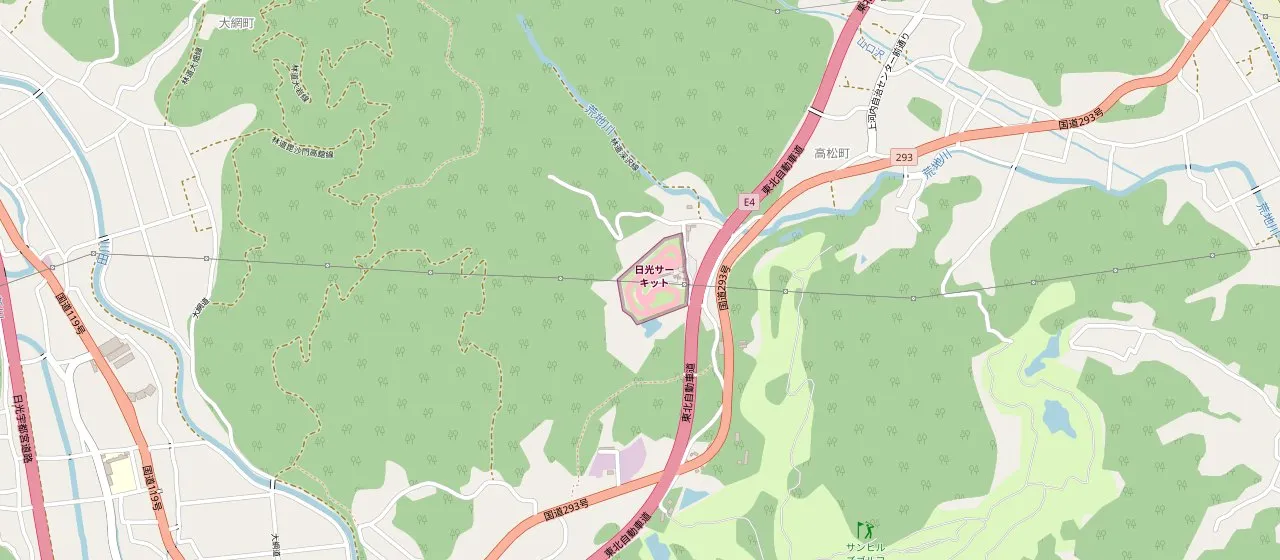
On 6 September 2026, around noon, a four-hour car race in the Nikko Yonrin Taikyū series (日光四輪耐久レース) started at Nikko Circuit. When the flag fell four hours later, the Spirits SPM Roadster team had completed 306 laps of a loop that, according to the results sheet, is a little over a kilometre long; its fastest lap took 41.826 s. The second-placed team finished ten laps behind the winner. This small circuit near Utsunomiya, named rather grandly after the city of Nikko, has for at least a quarter of a century served at once as a sports-driving school, a stage for drifting competitions and a venue for amateur racing.
| Location | Takamatsu-machi 984, Utsunomiya, Tochigi Prefecture, Japan |
| Type | mini circuit (ミニサーキット), permanent facility for cars and motorcycles |
| Length | 1027 m since the rebuild in February 2018; previously 1034 m |
| Corners | 12, with radii from 15 to 45 m where the plan gives them; start straight 138 m, back straight 250 m (plan from before 2018) |
| Track record for cars (since 8 February 2018) | 35.872 s, driver 池田糧 (Ikeda), EG6 car; the operator suspended publication of new records in April 2020 |
| Operator | Nikko Circuit Yūgen-gaisha (有限会社日光サーキット) |
| Events | D1 Grand Prix (2001–2002), D1 Street Legal, Drift Muscle and Drift Kingdom, King of Nations, FDJ2, D1 Next, four-hour Nikko Yonrin Taikyū races, Nikko Challenge Road motorcycle events |
| Noise limit | 105 dB, measured in the paddock and from the judges' post |
| Status | active; spectator access restricted |
A Nikko that is not in Nikko
The circuit bears the name of the famous city of temples, but lies on the outskirts of Utsunomiya, right next to the Tohoku Expressway. The operator's directions lead from the Utsunomiya interchange along Route 293 towards Nikko and Sakura, then twice under the line of the expressway, with a warning about the poor surface of the access road and about oncoming traffic. In 2008 Speedhunters pointed out the sheer cliffs closing the circuit off on the west side, which make an effective backdrop for the driving.
The opening date could not be established. The author of the same text admitted that he had tried to dig up the history of the circuit, including the question of whether the cliffs came about when it was built, and found nothing. The oldest traces that can be documented date from the turn of the century. On the operator's archived 2008 page there is a record on slick tyres from 19 March 2000: 38.576 s by a driver named Kameda (亀田則夫) in a Toyota AE86. In December 2001 Tetsuya Yamano (山野哲也), a gymkhana competitor and racing driver, describing the circuit in a Bridgestone series, called it "a veteran among veterans of the mini circuits". The company Sunpros, organiser of the D1 series, wrote in 2016 that many drifting events had been held at Nikko Circuit for twenty-odd years.
Second gear, tall kerbs and the S-bend by the paddock
Yamano recommended Nikko to novices for getting used to track driving: slow and medium-speed corners dominate, the loop is about a kilometre long, and a lap takes from 40 to over 50 seconds. He also set a scale of ambition: getting under 45 seconds is, in his words, "pretty good", and under 40 seconds puts you among the very fast. The first three corners form a long arc wrapping to the left, which has to be taken while braking with the steering turned; after them the right-hand fourth corner takes the car onto the section running along the paddock, where, as he wrote, the driver passes right before the eyes of the public. The fastest section is corners eight and nine, which he advised taking as a single arc in third gear to build speed for the back straight. The circuit is driven mostly in second gear, and the kerbs are so tall that a stiffly sprung car can bounce off them in an unpredictable direction; there is little run-off, and beyond some corners the ground drops straight into a hollow.
In 2010 the chairman of the Dunlop Direzza Challenge event, who had also run a training session the day before, reminded drivers at the opening that on so small a circuit a faster car cannot be let past in a corner, only on a straight, now on the right, now on the left. He therefore asked emphatically for the indicator rather than hazard lights. The circuit was described there as a loop shaped like a reversed コ with two S-bends, and one of the participants, a visitor from Hiroshima, found it faster than he had expected.
The last works recorded by the operator were completed on 8 February 2018. The tenth corner was given a radius of 32 m instead of 18 m, and the loop shortened from 1034 to 1027 m. The operator also noted earlier works: in January 2009 the opening of the rebuilt layout, in 2010 work on the short course and on the circle-driving area, in 2012 changes to corners two to four and eleven to twelve, and in February 2017 further works on part of the circuit.
When D1 came to Utsunomiya
The first season of D1 Grand Prix, the professional drifting series, began in October 2000 at Ebisu, and its second round was held on 16 February 2001 at Nikko Circuit. The series returned here for the fifth round on 29 November 2001 and for the seventh, season-closing round on 28 November 2002. Speedhunters added that over the years many memorable scenes of the Option and Drift Tengoku videos were shot here, and that in 2008 the circuit hosted the MSC Challenge, the Nikko Queen women's drifting contest and all-day practice sessions organised by workshops, such as FLUKE of D1 driver Hiroshi Fukuda. The operator's event calendar from that year confirms the MSC Challenge and the "Nikko Drift Queen" contest.
Nikko Circuit is to the Japanese drifting world what the El Mirage dry lake bed is to the hot rodding world.
In the following decades the circuit hosted series smaller than D1 GP but with leading drivers. In July 2016 a round of King of Nations, an international series overseen by Keiichi Tsuchiya (土屋圭市), was held here. There were forty entries, nearly twice as many as a week earlier at Ebisu; Daigo Saitō (斎藤太吾) won. Tsuchiya and Daijirō Inada (稲田大二郎) ran the Drift Muscle series from 2011, renamed Drift Kingdom in 2018, and Nikko Circuit was regularly its arena. The 2018 Drift Kingdom format used the shape of the circuit: a run began on the back straight, the slide started from the eleventh corner, entry speed was measured on the start straight, and judging ended after the fourth corner; the judges' stand was outside the first corner. In November 2018, in the Drift Kingdom season final, the highest entry speed, 132 km/h, was reached by a Mazda RX-7, and the round was won by Naoki Nakamura (中村直樹) in a Nissan Silvia. In March 2018 one local competitor, living a quarter of an hour's drive from the circuit, told a journalist that it was his home circuit, which he had always found difficult; this time he finished second.
Nikko also attracted the older street-drifter culture. In 2017 The Drive described the local contests in the "sanpatsu" style, meaning "three moves", straight out of the 1990s street drifting at Tokyo's Oi port. In April 2019, after a fourteen-year break, a revived BM Cup was held here, a contest of the now-defunct magazine "Battle Magazine"; professionals from D1 and Formula Drift Japan came to it at their own expense.
20 November 2016
The sixth, final round of D1 Street Legal, a lower-ranking D1 series for road-legal cars, ran at Nikko Circuit from 18 November 2016. On Sunday 20 November at around 9:00, during the second practice session, a wheel together with its mounting parts came off a car travelling down the start straight. Bouncing several times, it flew over the tyre barrier and a concrete wall about a metre high and into the spotters' area outside the first corner. Spotters are team members who watch the run alongside the judges and tell the driver how it is being scored; a dozen or so were standing there. The wheel struck a 35-year-old woman, who was taken to hospital unconscious and in critical condition; the driver suffered minor injuries. The final was cancelled the same day, and the organiser refunded ticket money. The police investigated the cause.
The injured woman died in the morning of 4 December 2016. Jalopnik described it as "the first known fatality in major-series drifting". When in March 2017 Drift Muscle opened its season at Nikko Circuit, it was the first official drifting event at the circuit since the accident. In many places there were new fences, and at the briefing the spotters were warned separately.
A licence, twenty minutes and 105 decibels
Anyone who wants to come in their own car must hold a circuit licence for cars. A new one costs 10,000 yen, including 4,000 yen of insurance, and requires an approximately half-hour briefing, held at 9:00 and 13:00 on sports-driving days; a photo, a driving licence and a personal seal (inkan) are needed. Sessions last 20 minutes each and include timing; on weekdays they cost 2,500 yen, at weekends and on public holidays 3,000 yen (the last session of the day 500 yen cheaper), with the first 15 cars admitted to each. Drivers are divided into three classes by average, not best, lap time: class A is an average of up to 42.9 s, class C from 46.0 s. In October 2026 the operator set four such days.
The remaining days of the calendar are filled by events of other organisers: in October 2026, among others, practice sessions of workshops and clubs, a meeting of owners of small kei cars, a round of the D1 Next Series and an all-day lesson for beginners. The last is run by Hokkoringo: 13 cars, 35,000 yen with insurance, in the morning driving one at a time on separated sections of the loop, in the afternoon driving in groups, plus runs with an instructor who sits next to the student or drives himself with the student as a passenger. The operator stipulates that a car louder than 105 dB will not be let onto the track, forbids burnouts on the spot and driving without a bonnet, and asks that drivers travel to and from the circuit in a car without illegal modifications, for which the police could stop the driver. Convertibles may run with the roof open only with a roll cage (in ordinary cars at least four-point, in small kei cars covering the whole cabin), in overalls, a full-face helmet and with at least four-point harnesses; the operator justifies this rule with an analysis of how rollovers and rear-end collisions unfolded.
Contestants with racing ambitions have four-hour endurance races, three a season; the entry fee in 2026 was 44,000 yen including tax. Motorcycles run from March to November, with a separate licence. The infrastructure is modest: nine pit bays with room for 36 cars, plus a small shop, a briefing room and a medical point.
In 2001 Yamano ended his description with an encouragement to stop and watch when passing nearby, because the circuit is easily seen from outside its grounds. In 2008 Speedhunters described spectators settling into deck chairs on the gravel in the middle of the first corner, right by the fence. Today the operator restricts spectator access because of the risk of accidents and prohibits photographing and filming participants and their cars without their consent.
Timeline
- 2000: oldest documented circuit record, 38.576 s in a Toyota AE86 (19 March).
- 2001: second (16 February) and fifth (29 November) round of the first D1 Grand Prix season.
- 2001: Tetsuya Yamano describes the circuit in a Bridgestone series (14 December).
- 2002: D1 Grand Prix season finale (28 November).
- 2009: end of the rebuild and opening of the new layout (31 January).
- 2016: King of Nations round (9–10 July); accident at D1 Street Legal (20 November), death of the injured woman (4 December).
- 2017: first drifting event after the accident, with new fences (25–26 March).
- 2018: rebuild of the tenth corner, length 1027 m (8 February).
- 2019: revived BM Cup (14 April).
- 2026: third round of the four-hour Nikko Yonrin Taikyū race (6 September).
Sources (37)
- Nikko Circuit, 日光四輪耐久レース 決勝, 2026-09-06 [ja]
- TheSpeedhunters, Temple Of Speed>>Nikko Circuit, Speedhunters, 2008-09-26 [en]
- Tetsuya Yamano (山野哲也), 第2回 日光サーキット <その1>, 2001-12-14 [ja]
- Sunpros Co., Ltd. (株式会社サンプロス), D1ストリートリーガルRd.6日光サーキットにおける事故について, 2016-11-21 [ja]
- Nikko Circuit [ja]
- Sunpros Co., Ltd., 2016 D1 STREET LEGAL Rd.6 at NIKKO. Event Information, D1 STREET LEGAL Official Website, 2016-11-22 [ja]
- Nikko Circuit, 四輪スポーツ走行 [ja]
- Nikko Circuit, 二輪スポーツ走行 [ja]
- Nikko Circuit, コース案内(全長 1,027m) [ja]
- Honda Racing Corporation, 日光サーキット, CBR250R Dream Cup 2013 [ja]
- Nikko Circuit, 四輪車コースレコード [ja]
- Nikko Circuit, インフォメーション [ja]
- Sunpros Co., Ltd., 2001 D1 Grand Prix Series. Event Schedule, D1 GRAND PRIX Official Website [ja]
- Sunpros Co., Ltd., 2002 D1 Grand Prix Series. Event Schedule, D1 GRAND PRIX Official Website [ja]
- Yoshiaki Aoyama (青山義明), ドリフトマッスル最後のシーズン!? さまざまな変更が発表された開幕戦, WEB CARTOP, 2017-03-27 [ja]
- Shin'ichi Takahashi (高橋慎一), Drift Kingdom 2018 Rd.7 NIKKO(ドリフトキングダム第7戦日光サーキット大会), JAF Sports [ja]
- Yoshiaki Aoyama (青山義明), King of Nationsドリフト選手権日本ラウンド終了! 斎藤太吾が日光戦を制す, WEB CARTOP, 2016-07-10 [ja]
- Nikko Circuit, 日光四輪耐久レース [ja]
- Nikko Circuit, 日光チャレンジロード [ja]
- Nikko Circuit, „地図” (wskazówki dojazdu) [ja]
- Nikko Circuit, コースマップ / コースレコード [ja]
- Tetsuya Yamano (山野哲也), 第2回 日光サーキット <その2>, 2001-12-14 [ja]
- タイムアタックイベント「DUNLOP DIREZZA CHALLENGE 2010」リポート, Car Watch, 2010-05-26 [ja]
- TheSpeedhunters, Event>>Fluke Drift Meet At Nikko Circuit, Speedhunters, 2008-06-16 [en]
- Nikko Circuit, 開催イベント選択 [ja]
- Yoshiaki Aoyama (青山義明), 【2018ドリフトキングダム第2戦】日光戦では、箕輪慎司が開幕からの2連勝達成, WEB CARTOP, 2018-03-26 [ja]
- Danny Choy, Nikko Circuit Brings '90s Style 'Sanpatsu' Street Drifting To The Track, The Drive, 2017-02-17 [en]
- Auto Messe Web編集部, 有名ドライバーを輩出!ドリフト文化黎明期の名イベントが復活, AUTO MESSE WEB, 2019-04-20 [ja]
- Stef Schrader, Professional Drifting Has Its First Known Fatality, Jalopnik, 2016-12-05 [en]
- ドリフト大会でタイヤ直撃、女性が意識不明の重体 日光サーキット, HuffPost Japan, 2016-11-20 [ja]
- Sunpros Co, Ltd, 2016-12-04 [ja]
- Nikko Circuit, 四輪スポーツ走行 平日 [ja]
- Nikko Circuit, 四輪スポーツ走行 土・日・祝日 [ja]
- Nikko Circuit, 10月 日光サーキット 2026 [ja]
- Hokkoringo (ほっこりんご), 日光サーキット 少人数ドライビングレッスン「じっくりサーキットレッスン」 [ja]
- Nikko Circuit, 四輪スポーツ走行 オープンカー規定のご案内 [ja]
- Nikko Circuit, 日光サーキットの施設案内 [ja]