
Suzuka, Japan
Suzuka Circuit: Honda's figure eight, rebuilt since 1962
History of the Suzuka circuit in Japan: a figure eight designed with John Hugenholtz, F1 since 1987, the Kato and Bianchi accidents, and driving your own car.
- Type
- race circuit
- Length
- 5.807 km
- Opened
- 1962
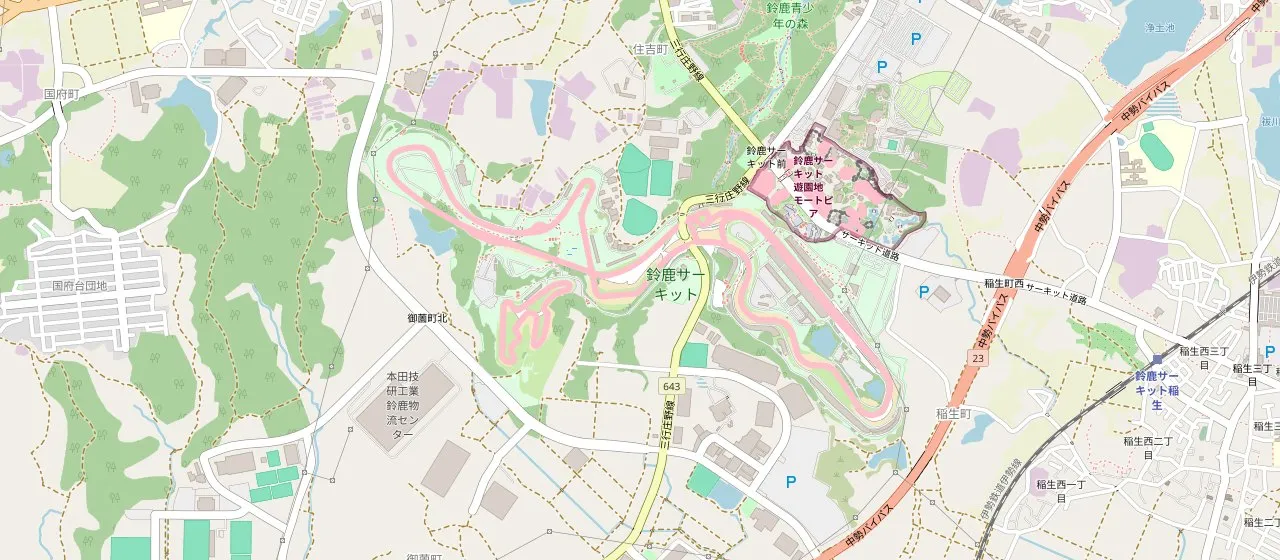
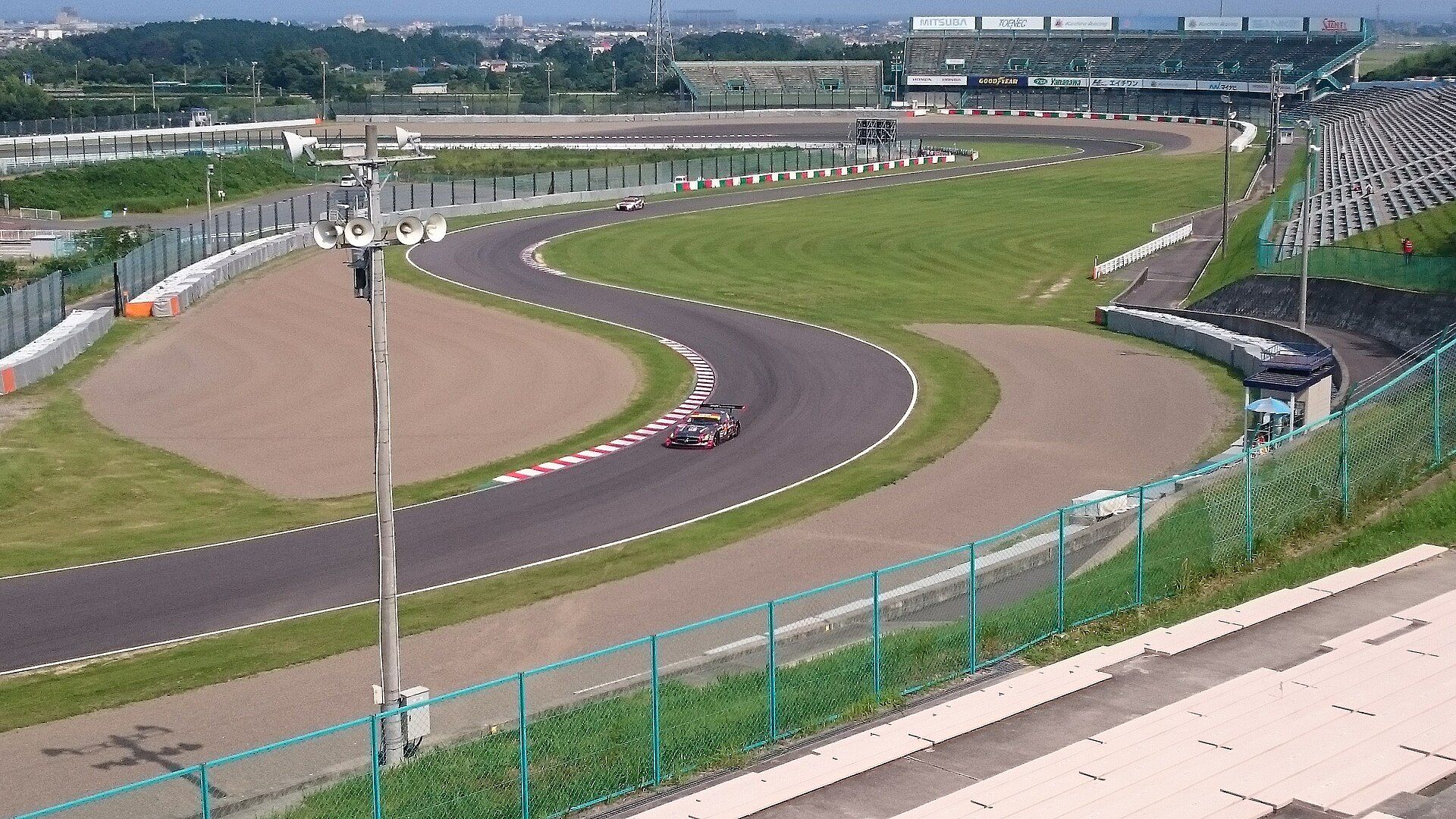
On 4 November 1962, at a circuit opened less than seven weeks earlier, Ernst Degner was leading the senior 50 cc race on his own when, on the fourth lap, a gust of wind threw him onto the tarmac in the right-hand bend before the overpass. The corner, then numbered ten, has been called Degner ever since. Suzuka, built by Honda in the hills of Mie Prefecture, has had the same skeleton since that day: a figure eight with an overpass, which successive generations of engineers shifted, split and smoothed without changing its character. The history of the Suzuka circuit is the story of how that skeleton survived six decades of rebuilds, great finales and tragic accidents.
| Location | Ino-cho 7992, Suzuka, Mie Prefecture, Japan |
| Type | permanent road circuit in a figure-eight shape with an overpass |
| Length | 5.807 km for cars, 5.821 km for motorcycles; east loop 2.243 km, west loop 3.475 km; separate South Course 1.264 km |
| Length at opening | 6,004 m (1962) |
| Corners | 18 in the car configuration, 20 in the motorcycle configuration |
| Width | 10–16 m |
| Opened | 20 September 1962 |
| Design | Sadao Shiozaki (1960 concept) and John Hugenholtz |
| Lap record (race) | 1:30.965, Kimi Antonelli, Mercedes W16, F1 Japanese Grand Prix, 6 April 2025 |
| Fastest lap overall | 1:26.983, Max Verstappen, Honda RBPT RB21, F1 Japanese Grand Prix qualifying, 5 April 2025 |
| Operator | Honda Mobilityland Corporation (ホンダモビリティランド株式会社) |
| Major events | F1 Japanese Grand Prix (since 1987; at Fuji in 2007–2008), Suzuka 8 Hours (since 1978), formerly the motorcycle Japanese Grand Prix |
| Status | active; F1 contract until 2029 |
Forest instead of rice
Honda first competed in the Tourist Trophy on the Isle of Man in 1959, and according to the company history it was the European circuits that convinced its founder Soichiro Honda that Japan urgently needed a proper racing circuit. At the time, racing in the country took place on gravel loops or on airfield runways, and the first stretch of expressway, between Rittō and Amagasaki, did not open until 1963. In 1960 Honda opened a Super Cub factory in Suzuka, and the circuit was to be built next to it. The founder summed up the aim in a sentence the company still repeats today: “if we don't race, cars won't get better”.
Originally the circuit was to sit on rice fields north-east of its present site. According to the account cited by JAF Mate and Car Watch, Soichiro Honda cut that idea short, saying that the fields where rice grows must not be destroyed, and ordered a search for wasteland in the hills. The hilly terrain turned out to be an advantage: it is what allowed the circuit to pass over itself.
Construction manager Sadao Shiozaki (塩崎定夫) drew the first version of the layout in August 1960; in December he toured European circuits and, through Honda's Dutch dealer, asked for help from John Hugenholtz, the manager of the Zandvoort circuit. The Dutchman flew in at the beginning of 1961, reworked the shape of the first and second corners and of the esses section, and along the way laid out the buildings, the spectator flows and the placement of the marshal posts. The first sketches envisaged as many as three crossings of the track over itself; in the final version, approved in January 1962, one overpass remained. The designer's son, Hans Hugenholtz, told RacingCircuits.info where the idea came from:
As there were quite a number of hills and existing roads between the rice fields, he made a design that would give the least amount of earth to be moved, including the cross-over which was, and is, very unusual for a circuit.
The circuit opened on 20 September 1962, with a loop 6,004 m long. Next to it was to come something no European model had. Takeo Fujisawa, the founder's right-hand man, wanted to build “an automobile amusement park made up solely of vehicles that offer the joy of driving them yourself”. The first stage of the park opened in January 1963 and still operates next to the circuit today.
Two hundred and seventy thousand for the opening
The official opening was a Japanese championship motorcycle meeting held on 3 and 4 November 1962. Honda invited riders from the world championship, and works machines from Honda, Yamaha and Suzuki lined up on the grid. It poured on the first day, and some races were shortened. Even so, around 270,000 people gathered in the stands over the two days, and according to Honda's company chronicle the column of cars heading to the circuit stretched back to Nagoya. Briton Jim Redman won the senior 250 cc and 350 cc races on a Honda, and his time of 2:36.4 in the 250 cc class was the first circuit record in history.
Cars arrived in May 1963 for the first Japanese Grand Prix. The international sports car class was won by Peter Warr in a Lotus 23, later head of the Lotus team in Formula 1. In November of the same year Suzuka hosted Japan's first motorcycle Grand Prix counting towards the world championship. The circuit also began to serve Honda itself: in May 1964 the S600 sports car, on sale for two months, won the GT-1 class of the second Japanese Grand Prix here.
Eight hours and the return of the world
In July 1978 the circuit hosted the first eight-hour motorcycle race, and since 1980 the Suzuka 8 Hours has counted towards the world championship. For Japanese manufacturers it became a race of enormous importance; in the 1980s works machines from three brands raced in it at once. In 1985 Kenny Roberts, three-time motorcycle world champion, started here paired with Tadahiko Hirai and led almost to the end, until a failure just before the finish robbed them of victory; five years later Hirai and Eddie Lawson won the race together.
At the beginning of the 1980s Suzuka still had a shape very close to that of 1962; the only major change was the wall separating the pit lane from the track, built in 1976. From 1983 the operator rebuilt it year after year: first a chicane before the last corner, in 1984 the Spoon corner moved inwards with a run-off area on the outside, in 1985 a new shape for the first corner. In the summer of 1987 the Degner corner, a single bend with an 80 m radius, was split into two tighter ones joined by a 137-metre straight. The same year the circuit gained new pits, a medical centre, a helipad and a renovated race control tower.
All this work had one goal: to bring Formula 1 to Suzuka. In March 1987, after a twenty-year break, the motorcycle Japanese Grand Prix returned to Suzuka as the season opener, and in November Formula 1 arrived. Grandstand tickets were allocated by lottery. Nigel Mansell, fastest in Thursday's and Friday's practice, crashed his Williams in the esses during the first qualifying session and was flown by helicopter to hospital in Nagoya with back injuries; as he could not start, his team rival Nelson Piquet became world champion. The race was won by Gerhard Berger in a Ferrari, and Satoru Nakajima, the first Japanese driver with a full-time seat in F1, finished sixth, in front of 220,000 spectators over three days.
The chicane where championships were decided
The Japanese Grand Prix came late in the season, so the title was decided at Suzuka many times. According to Formula 1, this had happened twelve times by February 2024. Two such finales went down in history because of a collision. In 1989 Ayrton Senna and Alain Prost, McLaren teammates, collided at the chicane on lap 47; Senna rejoined, won, and was then disqualified, and Prost took the title. Victory went to Alessandro Nannini and was the only one of his Formula 1 career.
A year later Prost was driving for Ferrari. Senna took pole position, but the sporting authorities (FISA) refused to move it to the cleaner side of the track, and Prost made the better start. At the first corner the McLaren hit the back of the Ferrari, both retired, and the title went to Senna. As Maurice Hamilton wrote in “Motor Sport”, a year later at the same circuit Senna admitted that he had done it deliberately.
In its description of the circuit, Honda recalls an anecdote about Sebastian Vettel, who after his first race at Suzuka is said to have remarked that the circuit looks as if God had built it. The same page points out the other side of this classic: unlike new circuits with asphalt run-off areas, at Suzuka leaving the track usually ends in the gravel.
The price of speed
Before the 2003 season the last part of the loop was rebuilt: the 130R corner was turned into a bend made up of 85 m and 340 m radii, and the chicane before the finish line was given a new shape. On 6 April 2003, on the third lap of the motorcycle Japanese Grand Prix, Honda's Daijiro Kato hit the barriers on the left before the chicane. He died on 20 April in hospital in Mie Prefecture, aged 26. An independent committee set up by Honda found that the motorcycle had been in working order. According to its conclusions, under hard braking on the exit of 130R the rear of the machine suddenly slid sideways, and after abruptly regaining grip the motorcycle threw off its rider and left the track to the left. The committee also noted that this section had been rebuilt just before the race, and that the FIM had inspected it and approved it without reservations. Reporter Satoshi Endo, who waited outside the hospital for two weeks, wrote in “Number” that Kato was losing half a second per lap at the new chicane.
In September 2003 the FIM announced that the 2004 motorcycle Japanese Grand Prix would not be held at Suzuka, because the alterations agreed with the safety commission would not be completed in time; the race was moved to Motegi. Crash.net recalled that, besides Kato's death, Marco Melandri and Alex Barros had suffered serious injuries after hitting barriers in practice before the same race. According to RacingCircuits.info the motorcycle Grand Prix moved to Motegi for good, and the eight-hour race was what remained of the world championships at Suzuka.
Eleven years later, on 5 October 2014, on a wet track and under double yellow flags, Jules Bianchi lost control of his Marussia at turn seven on lap 43 and struck a crane that was removing Adrian Sutil's Sauber, which had crashed a lap earlier. The report of the FIA accident panel found that Bianchi had not slowed down sufficiently, and that at the accident site water running onto the track had suddenly narrowed the dry line. Among its recommendations was a mandatory speed limit in every sector under double yellow flags. Bianchi died in July 2015 in hospital in Nice, without having regained consciousness.
New pits and new asphalt
In 2007–2008 the Japanese Grand Prix was held at Fuji, and Suzuka used that time for a rebuild. From November 2007 to the end of March 2009 a pond was filled in to make way for a new paddock, a new pit building was erected, and the main grandstand was roofed and expanded to 12,830 seats. The concept of the rebuild was to preserve the “traditional, fantastic shape of the circuit”. In 2009 Formula 1 returned to Suzuka for the first time since 2006.
The host changed too. The company founded in 1961 as Motorsportland was successively named Techniland, Hondaland and Suzuka Circuitland, merged in 2006 with the operator of Motegi to form Mobilityland, and has been called Honda Mobilityland since 2022. In February 2024 it extended its Japanese Grand Prix contract with Formula 1 up to and including 2029, and the race was moved to April, in time for the cherry blossom. In 2023, 222,000 spectators came to the circuit over the race weekend.
In the winter of 2024/2025 new asphalt was laid on the east loop. At the February Super Formula tests drivers complained about bumps in the first esses and at the NIPPO corner, where Sho Tsuboi went off the track on one such bump. From 22 December 2025 to 14 February 2026 the surface of the west loop was replaced, from turn seven to turn seventeen, and the catch fencing at turn 13 was raised from 4 to 6 m. On the renewed circuit, on 29 March 2026, the Japanese Grand Prix was won by Kimi Antonelli, the same driver who a year earlier had set the race lap record here.
In your own car on the 1962 loop
You can drive the full loop of the Suzuka circuit in a registered car, but only through a club. The operator runs the Suzuka Motorsport Club (SMSC): a Challenge Club licence for driving the full circuit in a car with number plates means an entry fee, an annual subscription and club insurance, 60,000 yen in total, while the driving itself costs 8,000 yen per 30 minutes, on weekdays only and with one lap behind a lead car. The cheaper Enjoy Club gives access to the South Course, 1.264 km with international karting homologation, in the gymkhana and grip-driving classes. Since the end of January 2025 the operator no longer sells sessions to guests without membership (as of 9 October 2026). For newcomers the club advertises trial sessions and training that need no licence, under the slogan “No licence needed! Take your own car onto the circuit!”.
The second route is track days run by outside organisers, which the operator lists in its calendar. The CCMC club from Nagoya invited drivers on 29 October 2026 to two hours on the full loop for 40,000 yen, with a limit of 45 drivers; everyone brings their own car and their own helmet, and drifting is prohibited. A company that wanted to hire the full circuit exclusively would pay 759,000 yen per hour (as of 9 October 2026). Honda Racing School Suzuka, a racing school whose graduates include Takuma Sato, Yuki Tsunoda and Ayumu Iwasa, has also operated at the circuit for more than thirty years.
The corner where Ernst Degner fell in 1962 has had two parts and two numbers since 1987. Honda describes the spot as one of the more difficult sections of the circuit: in practice and qualifying it happens that a driver enters Degner 1 so fast that they cannot brake in time for Degner 2, and ends up off the tarmac.
Timeline
- 1959: Honda's first start in the Tourist Trophy on the Isle of Man.
- 1960: August, first version of the layout by Sadao Shiozaki; December, invitation to John Hugenholtz.
- 1961: February, founding of the company Motorsportland, the future operator of the circuit.
- 1962: 20 September, opening of the 6,004 m circuit; 3–4 November, opening meeting attended by approx. 270,000 spectators.
- 1963: May, first Japanese Grand Prix for cars; November, first world championship motorcycle Grand Prix in Japan.
- 1978: July, first Suzuka 8 Hours race.
- 1983–1987: chicane before the last corner, new Spoon, new first corner, Degner corner split in two.
- 1987: March, return of the motorcycle Japanese Grand Prix; November, first Formula 1 Grand Prix at Suzuka.
- 1989 and 1990: collisions between Senna and Prost deciding the world title.
- 2003: new 130R and rebuilt chicane; 6 April, accident of Daijiro Kato, who died on 20 April.
- 2004: motorcycle Japanese Grand Prix moved from Suzuka to Motegi.
- 2006: merger of the Suzuka and Motegi circuit operators into Mobilityland.
- 2007–2009: Japanese Grand Prix at Fuji, rebuild of the paddock and pits, F1 returns to Suzuka in 2009.
- 2014: 5 October, Jules Bianchi's accident.
- 2024: Japanese Grand Prix contract until 2029, date moved to April.
- 2025–2026: new surface on the east loop, then on the west loop.
Sources (32)
- Honda, 独創技術で世界に挑んだ60年代, honda.co.jp [ja]
- Hirohiko Okugawa (奥川浩彦), 第5回:日本のサーキットの変遷その2「鈴鹿サーキット」, Car Watch (Impress), 2020-05-28 [ja]
- Honda, 日本のモータースポーツの聖地 鈴鹿サーキットの魅力 [ja]
- Honda Mobilityland, 会社概要 [ja]
- Suzuka Circuit, コースガイド [ja]
- Formula 1, Japanese Grand Prix 2026, formula1.com [en]
- Honda Mobilityland, 会社沿革 [ja]
- Formula 1, Formula 1 to race in Japan until 2029 after new five-year extension, formula1.com, 2024-02-02 [en]
- 本田宗一郎の夢が現実になった日。鈴鹿サーキットが日本を世界へ導いた, JAF Mate Online, 2026-09-20 [ja]
- Suzuka Circuit, 鈴鹿サーキット コースレコード: レーシングコース 4輪, 2026-10-03 [ja]
- Suzuka, RacingCircuits.info [en]
- Miasto Suzuka (鈴鹿市), 特別企画展 モータースポーツのまち・鈴鹿発~世界へ羽ばたく SUZUKA の歴史~, 2024-06-26 [ja]
- Mobilityland, Suzuka Circuit, 鈴鹿サーキット 50周年アニバーサリーデー 開催概要のご案内, 2012-05-15 [ja]
- Honda, 鈴鹿サーキット, global.honda [ja]
- Honda, 高速バトルと日本人ライダーの台頭, honda.co.jp [ja]
- Honda, 予選クラッシュでシーズン終了。2年連続で栄冠を逃す, global.honda [ja]
- Honda, Senna's Career Vol.3, global.honda [en]
- Maurice Hamilton, 1990s, „Motor Sport” [en]
- Satoshi Endo (遠藤智), 加藤大治郎の鈴鹿、ストーナーの早すぎる引退、ロッシの“キック, 2026-01-29 [ja]
- Honda Racing, 加藤大治郎選手の逝去について, honda.co.jp [ja]
- Honda Racing, 加藤大治郎選手事故調査委員会の報告を受けて, honda.co.jp, 2003-11-28 [ja]
- Suzuka scrapped from 2004 calendar, Crash.net, 2003-09-19 [en]
- FIA, Accident Panel, fia.com [en]
- Jules Bianchi, 1989-2015, formula1.com, 2015-07-18 [en]
- Toyota F1 Team, Arai Report – Rd.15 Japanese Grand Prix [en]
- Mobilityland, Suzuka Circuit, 鈴鹿サーキット改修計画のご案内, 2008-03-01 [ja]
- 新タイヤと新舗装に戸惑い含む多くの反響「S字のなかで跳ねる」「検証してほしい」/SF鈴鹿テスト, 2025-02-20 [ja]
- Honda Mobilityland, Suzuka Circuit, Round1 Driver’s Briefing [ja]
- Suzuka Circuit, 入会区分・料金・資格 [ja]
- Suzuka Circuit, SMSC 鈴鹿モータースポーツクラブ [ja]
- Suzuka Circuit, 各種走行会のご案内 [ja]
- CCMC (klub z Nagoi), 2026年10月29日(木) 9:00~11:00 経験者向走行会, ccmc.gr.jp [ja]