
Shimotsuma, Japan
Tsukuba Circuit: two kilometres by which Japan measures its cars
History of Tsukuba Circuit in Ibaraki: an amateur track from 1970, Formula 3, production car racing, time attack, Kobayashi's record and driving your own car.
- Type
- race circuit
- Length
- 2.045 km
- Opened
- 1970
On 4 December 2016, Kamui Kobayashi took a Super Formula SF14 out onto Tsukuba Circuit with one task: to bring the lap time below 44 seconds. He stopped the clock at 43.304 s, more than three and a half seconds better than the record of Juichi Wakisaka in a Formula Nippon car, which a year earlier was still the fastest time in the track's history. On a lap 2045 m long that is a gulf, and Japanese motoring magazines do not need to explain it to their readers: they set this result beside the records of roadster races and touring cars, because the Tsukuba time has long served there as a common yardstick. The history of Tsukuba Circuit, however, begins with something more modest than records, with the idea that amateurs around Tokyo should have somewhere to race.
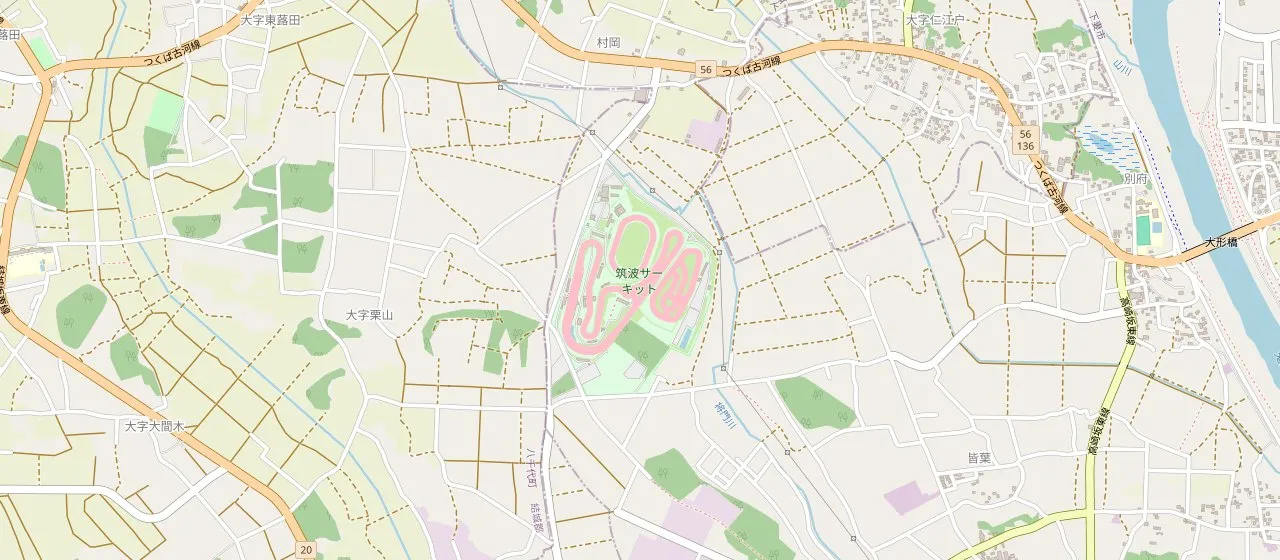
| Location | Muraoka-otsu 159, Shimotsuma, Ibaraki Prefecture, Japan |
| Type | permanent road course with two loops (Course 2000 and Course 1000) and a gymkhana pad |
| Length of Course 2000 | 2045 m for cars, 2070 m for motorcycles |
| Straights | start 282 m, back straight 437 m |
| Width | from 10.10 to 19.75 m depending on the section |
| Opening | June 1970 |
| Fastest lap ever | 43.304 s, Kamui Kobayashi, Super Formula SF14 (Toyota), "Speed × Sound Trophy" demonstration, 4 December 2016; the operator lists it in the reference records column |
| Formula 3 race record | 51.312 s, Darren Manning, TOM'S F399, Japanese F3 Championship, 17 April 1999 |
| Operator | Japan Auto Sports Center (一般財団法人日本オートスポーツセンター, JASC), a foundation |
| Events | a round of the All Japan Road Race Championship (on the 2026 calendar), Taste of Tsukuba, the four-hour roadster race with media participation (35th edition in 2024), time attack events |
| Status | active |
A track for those who had nowhere to drive
In February 1966 the Minister of Education and the Minister of International Trade and Industry approved the establishment of the Japan Auto Sports Center foundation. The foundation's chronicle gives the reason outright: compared with Europe and America, Japan then lacked places where ordinary people could come into contact with motor sport, so a real track was needed to spread it. The foundation secured 212,300 m² of land in the village of Chiyokawa, today part of the city of Shimotsuma, and in 1968 began building a circuit that met the FIA requirements of the day, including a length of at least 2000 m.
The work took about two years, and the track opened in June 1970. Photographs of demonstration runs by cars and motorcycles survive from the first day. An aerial photograph from that time shows forest and fields around the asphalt; the control tower was fully glazed, and between the track and the service road there was as yet neither a concrete wall nor a barrier. Drivers and motorcyclists from the region around Tokyo got a track close at hand. According to a history review prepared in 2020 with the cooperation of the track's operations department, races were held here almost every week, and after a few years Tsukuba was called the venue that hosts the most club races in Japan.
Production cars on the grid and night races
In 1971 the Tokyo Production Race series began here, in which only unmodified production cars could start. In a time when racing was associated with a modified machine, this was an idea against the grain; the GAZOO site regards the series as an important link on the road to today's JAF N1 races. In the second half of the 1970s energy-absorbing barriers and new grandstands appeared at the track, and for the tenth anniversary, in 1980, a medical office, a drivers' canteen, a meeting room, changing rooms and showers were built, which are still in use today. Among the photographs from the 1980s is a shot from a Formula Pacific race with Satoru Nakajima at the wheel; Nakajima later became the first Japanese driver to complete a full Formula 1 season.
In 1985 a night endurance race started, which became the track's summer tradition; GAZOO says it is regarded as the root of the later N1 Endurance races and of today's Super Taikyu series. In the same year the operator opened the gymkhana pad, and in December 1986 a separate loop for minibikes. At the end of the decade it rebuilt the facilities: a new control tower, starting signals, a scoreboard, a VIP room, a petrol station and additional grandstands were ready in 1989, and after the modernisation the track gained the nickname PARK CIRCUIT TSUKUBA.
The year 1989 also brought the debut of the first Mazda Roadster, and motoring journalists then lined up at Tsukuba for the first four-hour roadster race run between editorial teams. The event has survived. After its 35th edition, held at Tsukuba on 21 September 2024, Guinness World Records recognised it as the longest-running series of single-make car races; over those years roadsters have lined up on the grid a total of 820 times.
Two loops under one arch
Course 2000 has the shape of a letter U, bent back toward the start straight by several hairpins. The start straight is only 282 m long, and its end is the steepest climb on the track, which is otherwise fairly flat. The first corner joins an arc of 55 m radius with a tighter one of 35 m, and falls away downhill, so the driver cannot see its exit. Next come the esses, the first hairpin, the right-hand Dunlop corner, the fast left-hand 80R arc, the second hairpin and the longest straight on the track, the 437 m back straight. Both hairpins have marked banking, according to the operator's table up to 8.8 per cent in the first and up to 9.7 per cent in the second. The lap closes with a corner of 100 m radius passing into 90 m, which the operator describes as the place where speed is felt most and where every mistake strongly affects the lap time.
Since the opening a Dunlop advertising arch has hung over the track, renovated several times. In July 1990 a chicane for motorcycles only was added behind it: since then motorcycles turn right behind the arch into the tight MC corner, while cars go gently left, and the motorcycle loop measures 2070 m. In January 2000 the operator replaced the surface of the whole loop, and in October of that year the former minibike track was rebuilt as Course 1000, open to motorcycles and cars. The old loop was then named Course 2000; both names come from the length in metres. According to GAZOO, Course 1000 measures 1039 m in the car version and 952 m in the motorcycle version.
Formula 3 on a clubmen's track
Despite its small size, Tsukuba hosted rounds of the Japanese Formula 3 Championship and of the Japanese touring car championships. In qualifying for the second F3 round in 1996 Tom Coronel was the only one to go below 54 s, with Juichi Wakisaka lining up beside him; the Motorsport.com correspondent then described the venue as a tiny and twisty circuit, about 30 miles northeast of the Tokyo metropolitan area. A year later, on 20 April 1997, Coronel won an F3 race here over 45 laps. From that era the operator's records table retains the 51.312 s of Darren Manning in a Formula 3 car from 1999, the 56.933 s of a Group A Skyline from 1993 and the 58.830 s of Steve Soper in a BMW 318i from the Race de Nippon event in 1994.
Both car series eventually moved elsewhere. The motorcycles stayed: the calendar of the All Japan Road Race Championship for 2026 provided for a fourth round at Tsukuba on 21 June. The track also has its own tradition of amateur motorcycle racing. In October 1990 the Spirit of Single race held here changed its name to Taste of Freelance, and since 2007 the event has been called Taste of Tsukuba. It features mainly motorcycles on steel frames from thirty and forty years ago, raced with no concessions, twice a year, in spring and autumn.
The stopwatch as currency
According to GAZOO the drive from Tokyo takes about 70 minutes, and the operator also rents the track to manufacturers and editorial teams for tests. Among the photographs from the 1980s are tests by the magazine CARトップ, which still does them on Course 2000 today. At the magazine's anniversary in 2017 its editor-in-chief spoke about the times from those tests like this:
At some point the times from the "Tsukuba attack" took on a life of their own, and car makers began checking their cars at Tsukuba even before launch.
At the same meeting a former member of Mazda's press department recalled that after the introduction of the first RX-7 in 1978 the company began to care about a decent track time for its sports cars.
At the same time tuners took over Tsukuba. RacingCircuits.info writes that Japanese workshops tested their modifications here almost from the opening, and in the mid-1990s time attack events began to be organised, that is, runs against the clock over a single lap. The magazine Option ran its own "Tsukuba Super Lap", in which workshops from all over Japan fought over thousandths of a second; in December 2017 the best time in that competition belonged to the Silvia Scorch Advan, driven by the driver who competes as Under Suzuki, and was 50.746 s. In 2024 the tuned-car ranking was already topped by a Lancer Evolution driven by the driver known as Fire Ando with a time of 49.897 s, ahead of Suzuki's Silvia. At Attack Tsukuba 2024 third place in that list went to a driver from Texas in a Corvette C6 with a time of 51.231 s, even though he ran without full power because of boost problems. RacingCircuits.info also notes that the time attack modes in games such as Gran Turismo made Tsukuba known to people who will never see it.
Above all this stands Kobayashi's time. The first edition of "Speed × Sound Trophy", a joint event of more than ten Japanese motoring magazines, had his attack on the track record in its programme in December 2015. Wakisaka's record, 46.935 s, fell already on the second lap of the morning familiarisation run, and in the afternoon session Kobayashi went down to 44.008 s.
I really wanted to record 43-plus seconds but maybe next year if we have a chance to try again! [...] It was really tough to shorten 0.1 second in this circuit but Tsukuba Circuit is an extremely fun track to do a time attack like this.
A year later he came back and went down to 43.304 s. The operator lists this result in a separate column of reference records (参考記録), beside the race records of individual classes. For comparison, autosport web reported in 2015 that the fastest tuned cars lapped here in about 51 s, and GT3 cars in 52–53 s.
Your own car at Tsukuba
On days without competition the track opens to the Tsukuba Motor Sports Members club, that is, holders of the track licence, and the operator also rents it for tests by manufacturers and editorial teams, for track days run by outside organisers and for other events. For cars there are two licences: the restricted Family licence, which entitles the holder to drive a car with registration plates on Course 2000 and to drive on Course 1000, and the full Tsukuba licence, which also opens the sport sessions, including those for race cars and single-seaters. Family sessions are divided by average lap time: class Y for cars lapping from 1:09 upward, class E for faster ones; minivans, SUVs and cars on temporary plates are not admitted. The registration fee for both licences is 10,000 yen, plus insurance, handling fees and an annual fee. A driver holding a licence from another track recognised by JAF, the Japan Automobile Federation, can drive without a course in the "1DAY" programme, for example in a Family Y session for 6000 yen for 20 minutes on a weekday plus 500 yen for insurance.
The simplest way in is a familiarisation run in your own car: five laps behind a marshal car, without a track licence and without special equipment, with only a valid driving licence. The operator states plainly, in English as well, that a foreigner can drive in it if they understand Japanese, hold a driving licence valid in Japan and arrive in their own car; the track does not rent out cars. Loud cars may not be admitted to the track, although the page gives no decibel limit.
Track days for owners of plated cars are organised by outside companies, and the operator directs registrations to them. Procrews charges 18,700 yen including tax for three twenty-minute sessions on Course 2000 and has set further dates for 28 November and 13 December 2026. Pro-iz charges 21,000 yen for its 28 November 2026 day on Course 2000, but accepts only residents of Japan with a Japanese driving licence who speak Japanese. The same page reveals the track's seasonal rhythm: from November to March so many fast drivers come at weekends that Pro-iz does not then accept people without track experience on Course 2000, and the prices for 2027 are still being set, because fees for the use of tracks are due to rise markedly.
An operator representative explained in 2020 that manufacturers and editorial teams come back here with new cars not only because of the easy access but also because the layout does not change. A modern aerial photograph, which GAZOO published beside the one from 1970, shows the loop without major changes since the opening.
Timeline
- 1966: the Minister of Education and the Minister of International Trade and Industry approve the Japan Auto Sports Center foundation
- 1968: construction of the track begins
- 1970: the track opens, 2045 m long
- 1971: the first Tokyo Production Race series for production cars
- 1980: new facilities for the track's tenth anniversary
- 1985: gymkhana pad and the first night endurance race
- 1986: loop for minibikes
- 1989: new control tower and VIP room; the first roadster race with media participation
- 1990: chicane for motorcycles, motorcycle loop of 2070 m; the first Taste of Freelance
- 2000: new surface and opening of Course 1000; the former loop becomes Course 2000
- 2011: the operator becomes a general incorporated foundation (一般財団法人)
- 2015: Kamui Kobayashi beats Wakisaka's record in an SF14
- 2016: Kobayashi sets the fastest lap in the track's history, 43.304 s
- 2024: the roadster race with media participation is entered in the Guinness World Records
Sources (26)
- 筑波にこだまする全開サウンドを体感せよ『スピード×サウンド トロフィー』は今週末開催, 2016-12-01 [ja]
- Japan Auto Sports Center, Tsukuba Circuit, 4輪コースレコード(2,045m) [ja]
- WEBベストカー編集部, 可夢偉、シューマッハが樹立 鈴鹿、富士、筑波……驚速のコースレコード, Best Car Web, 2017-02-24 [ja]
- [ENG] Breathtaking Course Record by Kamui Kobayashi at Tsukuba Circuit «Speed & Sound Trophy», 2015-12-06 [en]
- Masakatsu Endo, 筑波フェスティバルで語られた雑誌CARトップ秘話!, WEB CARTOP, 2017-05-02 [ja]
- Japan Auto Sports Center, 法人概要 [ja]
- Kenichi Itoi, 50周年を迎えた「筑波サーキット」。その歩みを振り返る, GAZOO (Toyota), 2020-11-10 [ja]
- Japan Auto Sports Center, Tsukuba Circuit, アクセス [ja]
- Japan Auto Sports Center, Tsukuba Circuit, 施設概要 [ja]
- Japan Auto Sports Center, Tsukuba Circuit, コーススペック [ja]
- Tsukuba, RacingCircuits.info [en]
- レジェンド5人が若手クラスに集結。世代を超えたバトル企画『SDGマスターズ50』始動へ/全日本ロード第4戦筑波, 2026-06-02 [ja]
- Redakcja, Taste of Tsukuba & Freelance FUNBOOK, „旧車レースに1万人近くが熱狂!? 「テイスト・オブ・ツクバ」はなぜこれほど愛されるのか”, 2026-08-15 [ja]
- Mazda Motor Corporation, 「メディア対抗ロードスター4時間耐久レース」がギネス世界記録TMを獲得, 2024-09-24 [ja]
- アメリカから筑波Attackに初参戦でいきなり歴代3位! 衝撃の51秒台を記録したコルベットの秘密に迫る, Response, 2024-03-06 [ja]
- Tsukuba qualifying, Motorsport.com [en]
- Tsukuba results, Motorsport.com, 1997-04-20 [en]
- 筑波サーキットの人気イベント「テイストオブツクバ2021」開幕【5/8〜9開催分前売券発売開始】, WEBヤングマシン, 2021-04-21 [ja]
- Jun Kurihara, 【スピード×サウンドトロフィー2017】有名チューニングカーや貴重な旧車が「つくば」を走る!, GAZOO (Toyota), 2017-12-14 [ja]
- 「初の筑波アタックで51秒台!」話題沸騰のC6型コルベットは想像以上に“普通, だった!?” [ja]
- Japan Auto Sports Center, Tsukuba Circuit, 筑波サーキットのライセンス制度 [ja]
- Japan Auto Sports Center, Tsukuba Circuit, コース2000 4輪の走行クラス [ja]
- Japan Auto Sports Center, Tsukuba Circuit, ライセンス取得料金 [ja]
- Japan Auto Sports Center, Tsukuba Circuit, コース2000の走行 [ja]
- Procrews, プロクルーズサーキット走行会|筑波サーキット コース2000 [ja]
- Pro-iz, 筑波2000 プロアイズ走行会, 2026年11月28日(土) [ja]