
Sodegaura, Japan
Sodegaura Forest Raceway: the former minister's circuit in a forest near Tokyo
The history of Sodegaura Forest Raceway in Chiba: a politician with a racing past, 14 corners in a forest, historic car and EV races, and driving days for amateurs.
- Type
- race circuit
- Length
- 2.436 km
- Opened
- 2009
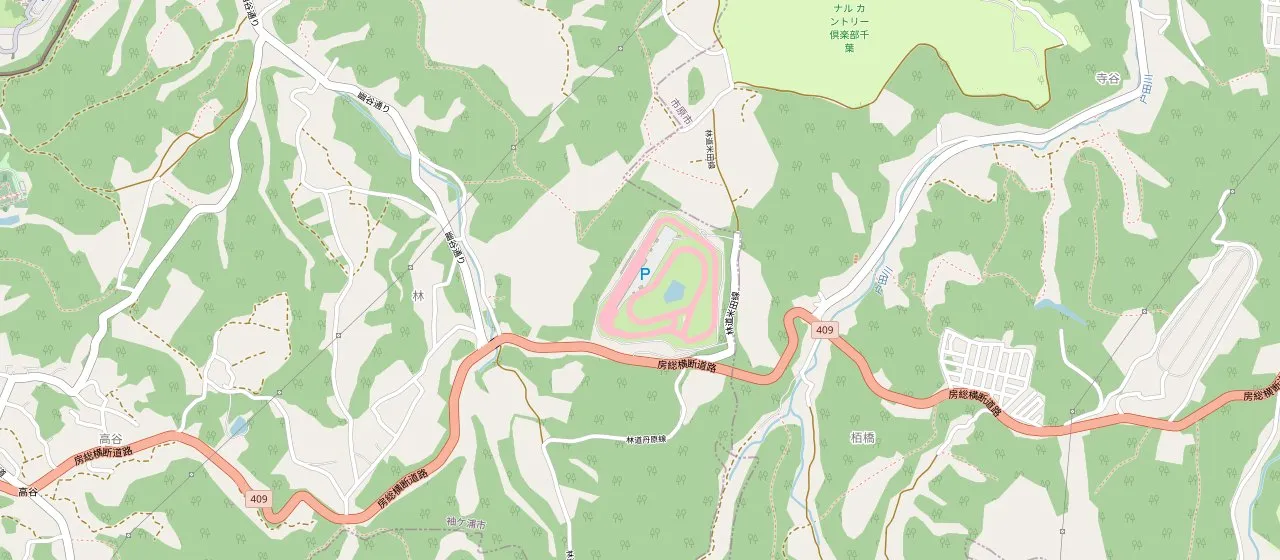
On 14 November 2009, violent downpours with a gale passed over Sodegaura in Chiba Prefecture at times, while the guests cut the ribbon on the start straight of the new circuit. Among them stood Kunimitsu Takahashi, head of Team Kunimitsu, and Aguri Suzuki, head of Super Aguri. Suzuki said then that when he first heard of the plan to build a circuit, he did not quite believe it, until he looked at the hands of the man behind the idea: his fingertips were black with oil, because he still assembled engines himself. That man was Shōzaburō Nakamura, a former Minister of Justice, who at the opening of Sodegaura Forest Raceway appeared as the owner and the author of the track layout.
| Location | Hayashi 348-1, Sodegaura, Chiba Prefecture, Japan |
| Type | permanent road circuit with a national licence from the Japan Automobile Federation (JAF) |
| Length | 2436 m according to the operator |
| Direction | clockwise |
| Corners | 14, with radii from 25 to 220 m |
| Width | from 15 to 18 m |
| Start straight | 400 m |
| Steepest gradient | 4.2 percent |
| Pits | 35 |
| Opening | JAF licence from 18 September 2009, official opening on 14 November 2009 |
| Designer | Shōzaburō Nakamura, owner of the circuit in 2009 and according to a 2019 account |
| Noise limit | 95 dB |
| Events | a round of the All Japan EV-GP series (electric cars), the Festival of Sideway Trophy historic races, the One Day Smile festival |
| Status | active |
The minister with oil under his fingernails
Nakamura, a native of Chiba Prefecture, entered the House of Representatives in 1979, in 1991 became head of the Environment Agency, and in July 1998 Minister of Justice; he sat in parliament for nine terms and left politics in 2005. The webCG site presented him at the opening of the circuit as a longtime enthusiast and one of the pioneers of amateur racing, who in the 1960s took part in many competitions, the Japanese Grand Prix foremost among them. According to a caption under a photo from the ceremony, he then wrote for the magazine "Car Graphic" about his impressions of driving the editorial Lotus Europa S1 around the track, and afterwards took over that car, modified it himself and raced it. Ten years after the circuit opened, the musician Ken Yokoyama of Crazy Ken Band, in a conversation published on Toyota's site by the writer Tsuneyoshi Noji, likewise recalled that the owner of the circuit had driven in the Japanese Grand Prix in the 1960s.
The site was not accidental. The forest there had been cleared earlier and the plot lay fallow; Nakamura planned the circuit on it as a new use of the land, won the support of the then mayor of Sodegaura and, as webCG reported in 2009, construction began five years earlier. He summed up his motivation like this: Japan is the world's largest car producer, and yet has the fewest circuits among the developed motoring nations, so people must be given a place to drive, also so that they do not race on public roads. The name of the facility comes from the forest: a belt of trees 30 m wide was left around the track, and 10,000 new ones were planted on the site.
JAF entered the circuit in its register as a permanent national facility valid from 18 September 2009. The licence permitted races of touring cars up to and including class N1, 36 cars on the grid and driving clockwise. The circuit opened during a crisis that, as webCG wrote, was said to happen once in a hundred years; the author of that report reached it from the editorial office in Tokyo through the Tokyo Bay Aqua-Line in exactly an hour. Shōzaburō Nakamura died on 1 September 2023, aged 89.
Fourteen corners in a forest
According to the operator the loop measures 2436 m; it has 14 corners and a width of 15 m to 18 m in front of the main grandstand. The federation describes it as a track on which, after a 400 m straight, comes a right-angle corner with a 40 m radius, then a hairpin with a 25 m radius, a complex sequence of arcs of 100, 70 and 60 m, and at the end a blind last corner. Akihiko Nakaya, a professional racing driver who in 2022 laid out a first drive around this circuit for WEB CARTOP, judged the second corner the fastest, although on the plan the gentlest arc has a radius of 220 m. After the second corner, at the crest of a rise, the track begins to fall towards a blind section before the third corner, which Nakaya called the most difficult on the whole circuit: you brake in it while turning and downhill, over bumps that unload the rear wheels.
Further on Nakaya takes the reader through two hairpins with a 25 m radius, the fourth and ninth corners, and through the sequence of the fifth, sixth and seventh corners with reverse camber of the road surface. He described the eighth, an arc with a 55 m radius just past the pits, as a place where the car easily goes into a controlled slide. A gentle, rising arc with a 220 m radius leads from the ninth to the last corner, and the last corner itself is blind, has reverse camber, high kerbs and little room on the outside at the exit. The driver also cited a common rule of thumb: a lap at Sodegaura is supposed to be roughly ten seconds slower than at the Tsukuba circuit, which is over two kilometres long.
According to the operator the steepest gradient of the track is 4.2 percent, and the corner radii lie between 25 and 220 m. The federation recommends spectators the places by the main grandstand, from where you can see the exit of the blind last corner, the straight and the first corner.
A circuit without major championships
In 2022 WEB CARTOP noted that no major event at the level of the Japanese championships had yet been held at Sodegaura, and that the circuit owes its popularity, among other things, to good access from the Tokyo metropolitan area. Its calendar is filled with other activities. In mid-March 2015 Honda showed journalists a prototype of the S660 roadster here; the Response editors wrote that three or four laps were enough to feel an unusual pleasure of driving. In October 2018 the journalist and rally driver Yasuo Kusakabe hired the whole circuit for a smooth-driving course organised with Yokohama. He noticed that the participants got lost on the wide track, because they could choose many different lines, which does not happen on an ordinary road.
Since 2010 the Japan Electric Vehicle Race Association (JEVRA), led by Masanori Sekiya, has run the EV-GP series. In 2022 it held two of its seven rounds at Sodegaura: on 26 June over 55 km and on 6 August over 60 km. For the June round 11 cars were entered, from the Tesla Model 3 and the Nissan Leaf to the Mazda MX-30 and the fuel-cell Toyota Mirai. The fourth round of the series was announced here for 28 June 2025; a spectator ticket, from high-school students up, cost 1000 yen.
Tweed, bias-ply tyres and the year 1969
The circuit's most peculiar event is the Festival of Sideway Trophy, held in spring and autumn since November 2012. Its model is British historic racing. Cars, motorcycles and sidecar motorcycles produced, as a rule, up to 1969 take part, without modifications that spoil the original character, and only on Dunlop bias-ply racing tyres. In December 2018 Yokoyama started in it, in a black BMW 2002tii with the number 6. The regulations quoted by Noji expect drivers and mechanics to dress in the spirit of the era and do not allow colours that did not exist in the 1950s and 60s. Yokoyama warned that the dress code is also enforced among spectators: British elegance of the 1960s applies. He described the event itself like this:
In Goodwood in England they hold an event that recreates races from the good old days, and this is its Japanese version.
Noji, who arrived in a made-to-measure glen check suit, recorded an account from one of the fans, according to which Yokoyama spun on the track already on the familiarisation laps. The spring 2020 edition was lost to the pandemic. At the winter edition, on 28 November 2021, the forty-minute Sebring 40m Trophy race, with a compulsory driver change and a handicap, began with a Le Mans-style start. It was won by a 1959 Austin-Healey Sprite Mk1, in which the second driver was Ken Okuyama, a designer known for his work at Pininfarina on the Enzo Ferrari. The ten-lap touring car sprint was won from pole position by a 1967 Alfa Romeo 1300 GT Junior, with a margin of over 24 seconds. The best-style award went to the owner of a 1962 Ford Falcon; according to webCG, this car stood on the assembly line in the scene from the Ford factory in the film "Le Mans '66".
Licence, cash and blood type
For sessions organised by the circuit itself its licence is required. According to the price list on the operator's website in October 2026, it cost 10,300 yen as an entry fee and 15,500 yen per year, and 30 minutes of driving cost 3600 yen on weekdays and 4200 yen at weekends, with a limit of 35 cars on the track. The licence course takes place in the morning and includes noise measurement, a lecture and a trial run, so the first solo session falls in the afternoon. The candidate brings a photo and a driving licence, states their blood group with the Rh factor and pays in cash only; the operator does not run its own compensation fund and requires insurance to be bought before the day of driving.
The federation explains the 95 dB limit by the surroundings: houses and farms are scattered around the circuit. The vehicle regulations admit sedans, coupés, estates and compact cars, but not minivans, vans, SUVs or trucks, because after leaving the track or rolling over, rescuing them would be difficult or impossible; one can ask the circuit in advance about a minivan or an SUV. Also excluded are cars with a height of 160 cm or more, ground clearance of 17 cm or more, or a mass of 2.3 t or more; a convertible without at least a four-point roll bar runs with its roof closed, and the driver in a full-face helmet with a visor.
Without the circuit's licence one can drive during the festival, which the company One Day Smile, run by Keita Sawa, has organised here since the facility opened; the fiftieth edition took place on 24 May 2026, and the fifty-first is announced for 15 November. For driving in the "drive-through" format, charged by laps driven, a driver without a licence pays a basic fee of 8000 yen and 600 yen for each lap, and the class for debutants at 16,000 yen includes a coach tour of the track with Sawa, driving behind a lead car and 20 minutes of free driving. In September 2026 the operator also announced licence courses by KINTO with a driver appearing as Racer Kashima, with three familiarisation laps in one's own car behind an instructor. The same driver started in the EV-GP in 2022 in an electric Nissan Leaf.
In autumn 2026 typhoon number 25 made access harder. On 22 September the operator announced that the track had not suffered and sessions were taking place normally, but some access roads were closed. As late as 9 October it published a detour from the Ichihara exit of the Tateyama expressway, about 25–30 minutes' drive, with advice to check road conditions before setting out.
Sources (17)
- 田沼哲 (Tanuma), 都心から1時間のJAF公認サーキット 〜「袖ケ浦フォレスト・レースウェイ」がオープン, webCG, 2009-11-16 [ja]
- Sodegaura Forest Raceway, コース概要 [ja]
- Japan Automobile Federation, 袖ヶ浦フォレスト・レースウェイ, JAFモータースポーツ [ja]
- Japan Automobile Federation, 国内レーシングコースの新規公認について, 公示No.2009-107 [ja]
- Akihiko Nakaya (中谷明彦), 首都圏のクルマ好きには最高の立地! 袖ヶ浦フォレストレースウェイの走り方をプロが徹底解説, WEB CARTOP, 2022-04-13 [ja]
- Tsuneyoshi Noji (野地秩嘉), 「カーレース入門~Let's go to the Circuit!」#4 横山剣さん(クレイジーケンバンド)/野地秩嘉さん, Toyota Motor Corporation, 2019-01-24 [ja]
- Sodegaura Forest Raceway, スポーツ走行案内 [ja]
- Japan Electric Vehicle Race Association (JEVRA), 第3戦│全日本 袖ヶ浦 EV 55kmレース大会, 2022-06-26 [ja]
- 沼田亨 (Numata), ヒストリックカーレース「2021冬 フェスティバル・オブ・サイドウェイ・トロフィー」の会場から, webCG, 2021-12-01 [ja]
- One Day Smile, 2026年11月15日 第51回袖森フェスティバル [ja]
- Sodegaura Forest Raceway, 台風25号の影響について, 2026-10-09 [ja]
- Kyodo News, 中村正三郎元法相が死去 89歳、衆院議員9期, „Ryukyu Shimpo” (wydanie cyfrowe), 2023-09-02 [ja]
- 【ホンダ S660 プロトタイプ 試乗】軽であることを忘れるほどの存在感と、痛快で唯一無二の個性, Response, 2015-03-26 [ja]
- 袖ヶ浦フォレストレースウェイ(千葉県)で3月中旬に開催された試乗会にて [ja]
- Yasuo Kusakabe (日下部保雄), 【日下部保雄の悠悠閑閑】PROSPEC Driving Park, Car Watch, 2018-11-12 [ja]
- Sanyo Trading Co., Ltd. (三洋貿易), EV レース大会の「2025 ALL JAPAN EV-GP SERIES Rd.4 袖ケ浦」に協賛, 2025-06-25 [ja]
- Sodegaura Forest Raceway, スポーツ走行の走行車両について [ja]