
Brno (Žebětín) / Ostrovačice, Czechia
Automotodrom Brno: nine decades of the Masarykův okruh
The Brno circuit: from the 29 km Masarykův okruh of 1930, through the world championship street course, to the 1987 autodrome and MotoGP's return in 2025.
- Type
- race circuit
- Length
- 5.403 km
- Opened
- 1987
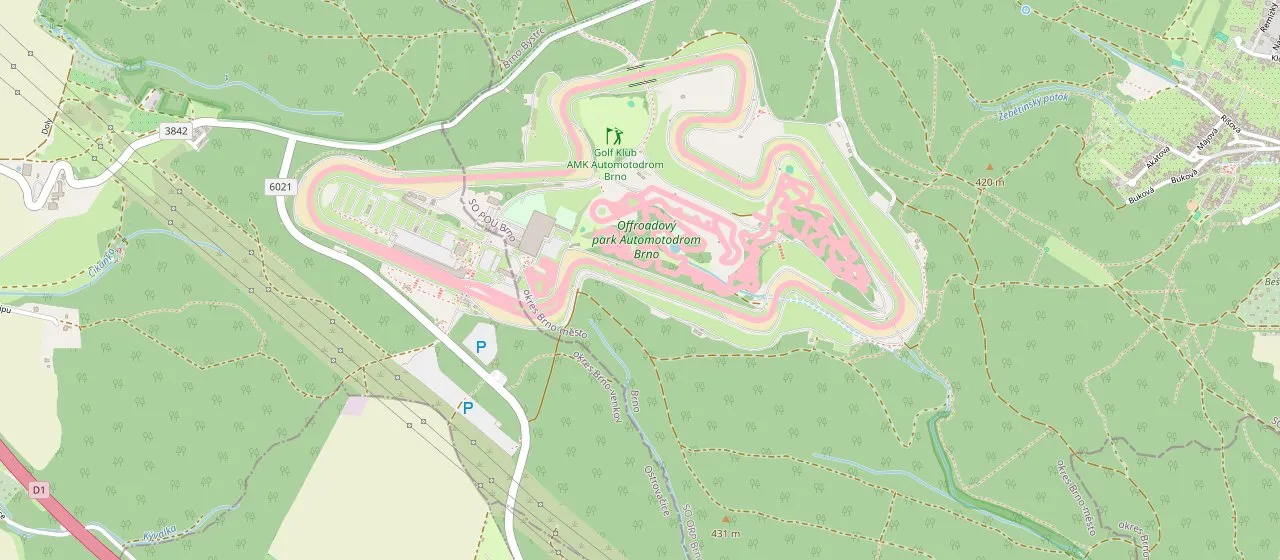
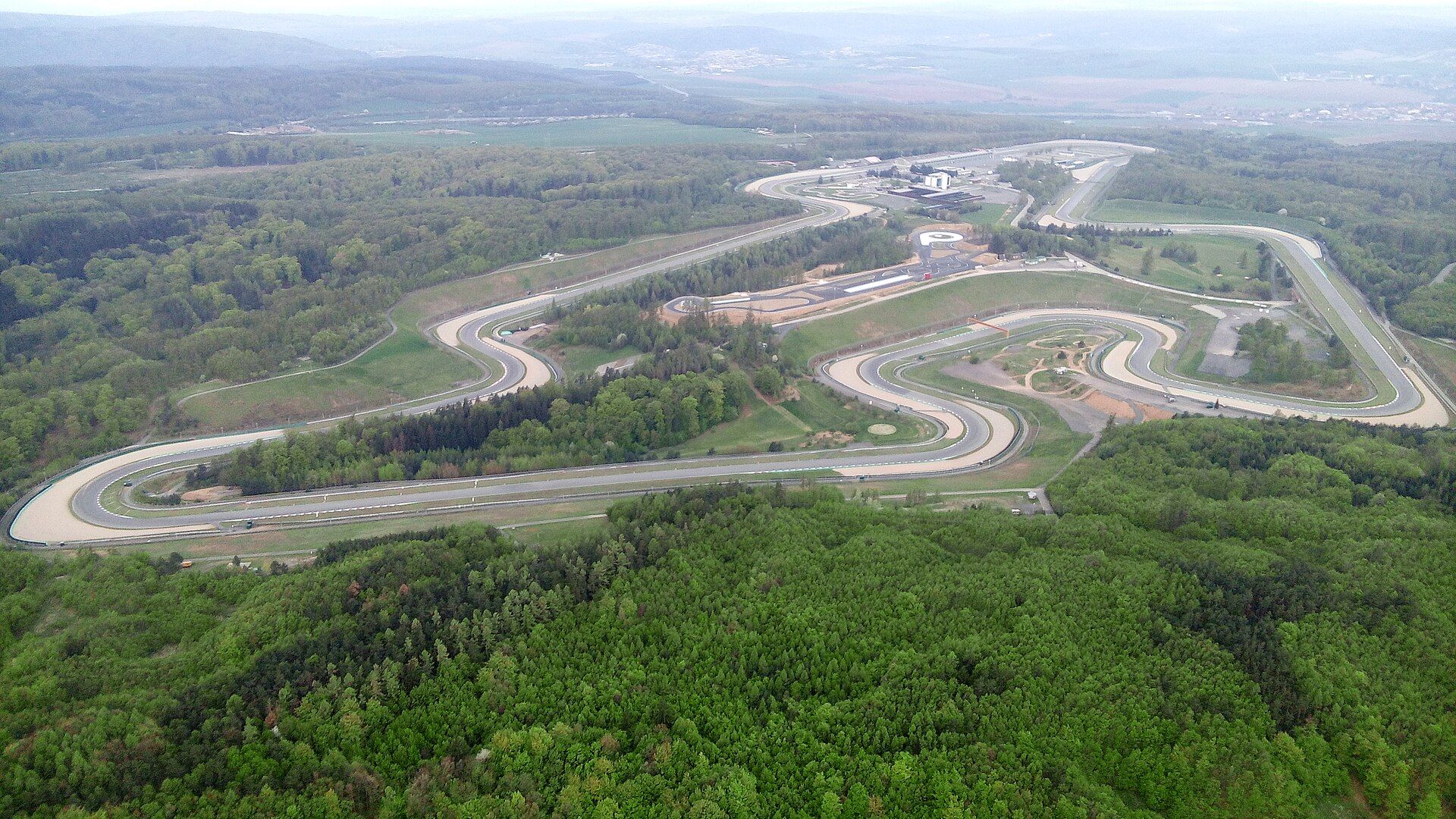
On Sunday 17 September 1933 a fine, unceasing rain had been falling over Brno since midnight. Spectators walking to their places along the edge of the 29-kilometre course carried clay from the fields onto the road, and the organisers spoke of 220,000 tickets sold. At 10:30 Louis Chiron set off in an Alfa Romeo for seventeen laps of the Masarykův okruh, led from the first to the last and after 4 hours 50 minutes and 22.8 seconds won for the third time in a row. The same area west of Brno is today home to a circuit 5.4 km long, on which MotoGP raced again in 2025 after a five-year break. Between those two images lies the history of four successive street courses, a dozen or so fatal accidents, the building of an autodrome in a forest under communist rule and a dispute over nine million euros.
| Location | Brno-Žebětín and Ostrovačice, South Moravian Region, Czech Republic; operator's address: Masarykův okruh 201, Ostrovačice |
| Type | permanent racing circuit (earlier, in the years 1930–1986, a street circuit) |
| Length and configuration | 5,403.19 m, 14 corners (6 left, 8 right), 15 m wide |
| Year of opening | 1987 (first race on 18 July 1987) |
| Elevation difference | 73.75 m; longest climb 7.5 percent over 917 m |
| Lap record (outright) | 1:36.065, Ingo Gerstl, Toro Rosso STR1 (F1), BOSS GP, 2017 |
| Lap record (MotoGP) | 1:53.691, Marc Márquez, Ducati, 2025 |
| Owner and operator | the CREDITAS group (since September 2025); operator Automotodrom Brno, a.s. |
| Most important events | Czech MotoGP Grand Prix (1987–2020, again from 2025, contract until 2029), Masaryk Racing Days, 24H Series |
| Status | active; since April 2026 under the name CREDITAS Autodrom Brno |
Twenty-nine kilometres on district roads
The idea for the circuit was born among drivers, not officials. According to Sylvie Dyková of the Technical Museum in Brno, behind the effort stood a group of racers gathered around the Junek couple, and three variants of the route were considered. Eliška Junková, at the time the most famous Czech woman driver, joined the organising committee, and the model for the organisers was the Nürburgring. President Tomáš Garrigue Masaryk had already agreed in 1929 to lend his name, and the presidential office took financial patronage over the investment, worth six million crowns. Construction started on 10 April 1930.
The course measured more than 29 km and was made up of state and district roads: from Nový Lískovec through Pisárky, Kohoutovice and Žebětín to Ostrovačice, and from there along almost straight roads through Popůvky, Veselka and Bosonohy back again. The first 18 km were winding, narrow and hilly district roads, the last 11 km could be driven flat out, apart from a section of a few kilometres with long waves in the surface which made that impossible. They raced to the left, through 36 left-hand and 47 right-hand corners, with a maximum gradient of 7 percent uphill and 9.5 percent downhill. Asphalt, poorer concrete and cobblestones were mixed here. The circuit's operator writes today that the Masarykův okruh was longer than the Nordschleife; the entry in the Motor Sport Magazine database adds that at the moment of its opening it was the longest circuit in use in the world.
The first race took place on 28 September 1930, on Saint Wenceslas' day. It was won by the German Heinrich-Joachim von Morgen in a Bugatti, in a time of 4:54:13.6, at an average exceeding 101 km/h; cars of the class up to 1.5 litres faced 15 laps, the more powerful ones 17. More than 100,000 spectators stood along the course, and among the starters were Rudolf Caracciola and Tazio Nuvolari. After that race Jaroslav Ježek composed "Bugatti step", inspired by the winning cars and by Junková.
The next three editions were won by Chiron. In 1933 the prize for the winner came to 80,000 crowns, and the Baťa company from Zlín put up a further 140,000 crowns for drivers running on its tyres. From 1934 the Silver Arrows ruled in Brno: Hans Stuck and Bernd Rosemeyer won for Auto Union in 1934 and 1935, and after a break of a year, in 1937, Caracciola for Mercedes. Rosemeyer took his first Grand Prix victory here. In 1936 there was no race because of organisational trouble, and the 1937 edition turned out to be the last one before the war.
The circuit claimed its first victim on 28 September 1934. Josef Brázdil, born in Všetuly near Holešov, failed in the morning, still before official practice, to control his new Maserati 6C-34 before the entry into Ostrovačice and was killed. In 1937, in the forests between Ostrovačice and Žebětín, two spectators died after Hermann Lang's accident and eleven were injured; Lang himself came out without injuries. Chiron later got a street named after him in the Bosonohy district.
Farina's corner
A year after the war there were demonstrations in Brno in favour of a return of racing, but because of post-war shortages and the necessary repairs the first race took place only in 1949. The course was shortened to 17.8 km, bypassing Ostrovačice, and the direction of travel was reversed. On 25 September 1949 the Velká cena Československa was run under the rules of the time for Grand Prix cars: hundreds of thousands of people stood along the course. It was the only race of that rank in the country's history, because Brno was no longer included in the Formula 1 world championship from 1950.
The race was overshadowed by an accident on the first lap. Giuseppe Farina, who a year later became the first F1 world champion, lost control of his Maserati by the quarry in the wooded part before Kohoutovice, and the car went into the spectators: there were fatalities, and fourteen people were injured. According to the Garáž.cz site, at the same place Reg Parnell crashed, and his car threw Farina ten metres. The corner bears the Italian's name to this day, and opposite its apex stands a stone monument to the victims. The winner was the Briton Peter Whitehead in the only Ferrari in the field, while the Maserati of Chiron, the crowd's favourite, could not withstand the fast pace in the heat. Traffic chaos and an inefficient press centre later served politicians as an argument for not organising such a race again. That same weekend two Czech drivers were killed, Václav Uher and Jaroslav Jonák.
From 1950 the circuit was taken over by motorcycles. On 10 September 1950 the first motorcycle Velká cena Československa was run: 15 laps, 267 km, and in the 500 cm³ class Antonín Vitvar won on a Norton. In 1952, for political reasons, the event was given the name "Závod družby národů", which it carried until 1963. The course of the years 1949–1963 had 35 left-hand and 38 right-hand corners and 171 m of elevation difference. At the end of the decade well-known names returned to the circuit that the West had managed to forget, and in 1954 František Šťastný, the leader of the home field of those years, won in the 250 cm³ class for the first time.
The nineteen-fifties were also bloody. On 26 August 1956 Hans Baltisberger, leading the 250 cm³ race on an NSU Sportmax, slid on a wet section beyond Žebětín and was killed; on the same day the Frenchman Michel Mouty died in the 500 cm³ race, his Norton hitting a tree between Lískovec and the corner by the petrol station. Baltisberger's death was described by Bohumil Hrabal in the story "Smrt pana Baltisbergera", and in 1978 a boulder with a plaque by Adolf Söhnlein was placed at the site of the accident; in the spring of 2007 a wreath from the city of Reutlingen lay beneath it. In 1957, despite new safety measures, the Swede Waldemar Lundberg was killed in Friday practice, and a year later the French sidecar driver Jacques Drion and his German passenger Inge Stoll, when their sidecar ran off the road on the descent from Žebětín.
Three Hailwood wins in one day
In order to get into the world championship calendar, the organisers had to raise the safety of the street course. In 1964 they cut out of it the loop through Žebětín; the okruh shrank to 13.941 km, got coarse-grained asphalt, white stripes along the edges, underpasses for spectators, and dangerous objects were removed from the surroundings. The new right-hand corner before Farinova zatáčka was named after Baltisberger. The authors of RacingCircuits.info write that this variant created a characteristic section of fast corners on country roads lined with ditches.
In 1965 the Masarykův okruh entered the world championship calendar for the first time. A year later Mike Hailwood won three classes in one weekend: 250, 350 and 500 cm³ on Hondas, and afterwards Giacomo Agostini dominated. Bohumil Staša from Strakonice stood twice on a Grand Prix podium here, which according to the promoter makes him the most successful Czech competitor in the circuit's history. The motorcycle race was the country's biggest sporting event, and in the spring touring and sports cars came, first in the FIA European Cup, then in the European championship.
The circuit remained a public road with all its infrastructure. In 1969 at Veselka, on softened asphalt, there was a collective fall in the 350 cm³ race, after which František Boček died. In 1972 the Italian Luigi Rinaldi aquaplaned on the wet circuit and hit the wall on the start straight; he and a track marshal were killed. The iHNed newsroom wrote years later that it was precisely this death that gave the impulse to build the new autodrome. That same summer, on the section in Nový Lískovec, the German Lutringhauser lost control of his sidecar and hit a telephone box; his passenger Cusnik died on the spot.
The last street circuit of the world championship
In 1975 the course was rebuilt once again: the sections through Kohoutovice, Pisárky and Nový Lískovec disappeared, and the length fell to 10.925 km. Beyond the exit from the forest the circuit turned right onto a newly built road, ran in a long left-hand curve through the Kohoutovice housing estate and came back to the start in Bosonohy down a steep descent by Myslivna. The new road was built up on both sides with double barriers with cars in mind, and among motorcyclists the descent to the corner before the finish was not popular. Straw bales awaited the motorcycles, steel barriers the cars. In 1977 the 500 cm³ class raced on the old okruh for the last time, because for those machines the circuit was too dangerous.
In 1982 Brno, together with the Finnish Imatra, was the last natural circuit in the world championship calendar; that year it lost its homologation for such races. From 1983 only a round of the European championship was run here, but again with the 500 cm³ class. The cars lasted longer. In the European Touring Car Championship, after years of BMW dominance, three editions in a row, from 1982 to 1984, were won by Tom Walkinshaw's Jaguar XJS, and afterwards turbocharged Volvos slipped between the barriers. The circuit's operator lists among the stars of the time Hans-Joachim Stuck, Gerhard Berger, Dieter Quester and Walkinshaw, and people watched them from the windows of their own houses. The last race on the street circuit took place in 1986.
Concrete in Podkomorských lesích
Several designs for a closed circuit had already appeared in the nineteen-seventies: one near Bosonohy, two in the forests around Farina's corner. After the race in 1974, however, it was decided to build a new road shortening the old okruh, and talk of an autodrome stopped. The final decision to build in the forests between Ostrovačice and Žebětín was taken in 1982; the start was still planned for that year, but it slipped by three years.
The driving force behind the undertaking was Miroslav Čada, a former motorcyclist from Brno who in the nineteen-fifties and at the beginning of the sixties stood four times on a Grand Prix podium in Brno, losing to lighter rivals by kilograms: at 185 cm in height and 80 kg in weight he loaded the motorcycle with twenty kilograms more than the others. "I went after it like a ram. Putting it all together was a downright superhuman task", he told Brněnský deník in 2011. He even asked prime minister Lubomír Štrougal for support, and the construction was held back by ecologists' protests against the felling of part of the forest. Just before the works began the project was stopped by the then minister of agriculture, because of which it was completed with a year's delay. Construction started in the winter of 1984 and lasted two and a half years. "Today something like that is unthinkable, but such fast construction was incredible even then", recalled František Tranda from the organising team of the time.
The author of the design was the engineer Jaroslav Suchý, who worked into the new course the shapes of well-known fragments of the old okruh: the corner at the end of grandstand D, later named after Schwantz, repeats the entry from the old "dálnice" into the climb up to Kohoutovice, in front of grandstand F there is an imitation of Farina's left-hander, and the stadium section before grandstand C resembles an oval. The circuit, 5.394 km long, was built in the forests near the settlement of Kývalka, on the border of Brno and Ostrovačice, less than ten kilometres from the pits of the old okruh, inside the loop of the pre-war course, but without using its roads. Thousands of trees were cut down on the site and replanted elsewhere. The first race, the Moravian motorcycle championship, took place on Saturday 18 July 1987. That same year the motorcycle world championship returned (the first winner of the 500 cm³ class was Wayne Gardner on a Honda) and the World Touring Car Championship arrived, and a year later the prototypes of the World Sports-Prototype Championship: the 360 km of Brno on 10 July 1988 was won by Jochen Mass in a Sauber-Mercedes C9 in front of 78,000 spectators.
The new circuit did not change much. In 1993 Wayne Rainey took here the last victory of his career; in the next race at Misano he crashed and never stood on his feet again. In 1996 the pit lane entry was rebuilt and the length grew to 5.403 km; on 18 August of that year Valentino Rossi won his first world championship race in the 125 cm³ class. Between the 1997 and 1998 seasons the paddock was modernised, the pit lane widened and new garages built. From 1987 to 2020 the world championship left Brno only once, in 1992.
In the winter of 2007/2008 the circuit got a completely new surface. Karel Abraham, a Brno developer who from the end of 2005 controlled the Automotodrom Brno company, told MF DNES that the investment exceeded 150 million crowns and that "to the last crown" it was financed by the operator from its own funds and from credit. In the same interview he complained that "here in Brno too there are plenty of people who hate the circuit", even though the Grand Prix is the country's biggest sporting event. The Grand Prix promoter states that in 2007 245,039 spectators passed through the gates, and in 2012 a record 248,434.
Nine million euros
From 2016 the race was organised by an association (spolek) of the city of Brno and the South Moravian Region, which had a contract with the promoter Dorna for five editions. In September 2019 Brno councillors were adding a further 7.5 million crowns towards paying off the obligations left after that year's race: the licence fee (zalistovací poplatek) came to 111 million crowns, the association still owed Dorna almost 20 million, and the previous edition had ended with a loss of 31 million, because the state gave 39 million instead of the expected 100. Dorna announced that from 2021 it would double the fee to nine million euros.
The 2020 season finished the arrangement off. The race on 9 August 2020 was held without spectators, as the last one of that cycle. After it Dorna demanded a repair of the surface, which the riders had complained about, estimated at about 100 million crowns; the city and the region had no money because of the fall in revenue during the pandemic. On 8 December 2020, 36 Brno councillors passed a resolution that the Grand Prix would not take place in 2021, seven abstained from the vote. The mayor Markéta Vaňková explained that Dorna's terms, that is nine million euros a year, would mean 1.4 billion crowns over five years. Dorna agreed not to collect the six-million fee for the edition that was not run, but from 2022 it insisted on nine million and on the repair. The operator's spokesman Petr Boháč said at the time: "Once a tradition is broken, it is difficult to come back". The German Speedweek wrote about the same dispute more sharply: that the authorities in Prague, Brno and South Moravia never managed to agree, that they kept falling behind with the fees and in the end turned off the tap, officially because of covid.
A new owner, new asphalt
The change was brought by the sale of the circuit. Karel Abraham first, as MF DNES established in December 2022, sold to the investor from Olomouc, Karel Hubáček, more than 110,000 m² of land, including the plot under the pits, the pit lane and the paddock, and on 2 August 2023 it was announced that Hubáček's company Shakai had taken over the whole Automotodrom Brno company together with the circuit, the polygon and the hotel. Hubáček is a cousin of the billionaire Pavel Hubáček, the owner of the Unicapital group and the Creditas bank. Since 1 August 2024 the operator's director has been Miroslav Bartoš, who replaced the previous director Ivana Ulmanová.
In August 2024 the return was already being sought by Autoklub České republiky with its president Jan Šťovíček, and the governor Jan Grolich stipulated that this time the region and the city would only be financial partners. On 28 August 2024 prime minister Petr Fiala announced at a press conference that MotoGP was returning to Brno; Dorna signed a five-year contract with the circuit for the years 2025–2029. The Autoklub and the Automotodrom became co-organisers, the city and the region promised 35 million crowns each, the state "higher tens of millions", and the amount of the licence fee was not disclosed. Šťovíček called the earlier estimates of a hundred million for the repair "a duck", and Hubáček announced that the main investments in the circuit would come from private funds. Vaňková admitted that she considered the end of MotoGP one of her greatest failures, and that the main problem at the time was the lack of an agreement with the previous owner.
The repair began in the spring of 2025. In the course of five days 82,000 m² of the old surface was milled to an average depth of 65 mm, which gave about 14,000 tonnes of material for recycling; the works were led by Strabag, and the measurements and the 3D model by the company Topcon, which had scanned the circuit beforehand. The permissible unevenness of the new asphalt is 2 mm over 4 m, measured lengthwise and crosswise. One third of the kerbs was replaced, part of the run-off areas was widened in accordance with FIM requirements and light panels supplementing the marshals' flags were installed. The whole thing, valued at over six million euros, was financed exclusively privately, with the participation of the Creditas group. The Grand Prix came back on 18–20 July 2025. Pole position was taken by Francesco Bagnaia (1:52.303), the race was won by Marc Márquez ahead of Marco Bezzecchi and Pedro Acosta, and his time of 1:53.691 is the official MotoGP record at the circuit.
In September 2025 the Creditas group of Pavel Hubáček's family took over the Shakai company, and with it the circuit; according to E15 it had earlier invested 180 million crowns in the facility, and Karel Hubáček remained chairman of the board of the operating company. On 29 April 2026 the facility changed its name to CREDITAS Autodrom Brno and got a new logo based on the shape of the circuit; according to the B tým studio, which designed it, its author Jakub Buček saw in that shape a motorcycle on its rear wheel. The 2026 Grand Prix, moved to 19–21 June, drew 171,230 spectators over three days; in the heat Márquez won in Brno for the fifth time in the premier class, and Filip Salač became the first Czech to stand on a Moto2 podium, finishing the race in third place.
Three weeks later the circuit killed again. On 11 July 2026, at the start of the superbike race of the Alpe Adria championship, the Austrian Philipp Steinmayr did not move off from the front row because of a machine failure and raised his hand; when the lights went out, the Romanian Adrian Rus, starting from the last row, hit him at high speed. Steinmayr died on the spot, Rus died in hospital. The organisers cancelled the whole remaining programme of the weekend, including the races of the Supersport 300, Supersport 600 and Superstock 1000 European cups. Michal Filla, a Brno rider who started alongside Steinmayr and helped him buy that Ducati in the winter, told Brněnský deník: "It cannot be said that this collision was anyone's fault. It was a chain of stupid coincidences and circumstances". The event was investigated by the police.
Track days at the Masarykův okruh
The circuit today measures 5,403.19 m and is 15 m wide, has 14 corners with radii from 50 to 300 m and 13 straights, the longest of which is 636.56 m; it lies at an altitude of 450 m above sea level, the elevation difference amounts to 73.75 m, and the longest climb has a gradient of 7.5 percent over 917 m. The organisers of BOSS GP, a series for former F1 and GP2 cars, write that it is the longest circuit in their calendar and that in the last third the "Czech roller coaster" climbs steeply; it was in this series that Ingo Gerstl set on 10 September 2017 the outright record of 1:36.065 in a Toro Rosso STR1 with a three-litre Cosworth V10, "faster than anyone in the 30 years since the circuit opened". The operator itself also lists in its table of records unofficial times from F1 tests: 1:34.700 by Jérôme d'Ambrosio from 2010 and 1:35.974 by Marc Gené from 2009.
An amateur driver has two ways onto the circuit. The first is the "jízdy veřejnosti", that is rides for the public, which the operator usually schedules from May to August between 18:00 and 20:00, exceptionally also as whole-day events. Only ordinary, registered cars and motorcycles with number plates and without modifications going beyond homologation are let in. A session lasts 25 minutes, 45 vehicles may be on the circuit at the same time, sales take place online until the places run out, and before entering one has to sign a contract in two copies and collect a sticker at the ticket office at the latest a quarter of an hour before the start. The operator "recommends" 90 km/h as the maximum speed, reserves the right to random sobriety tests, forbids entering the paddock and the area by the pit wall, and charges 900 crowns for a ride cancelled by the customer. Cars park in front of the GRID restaurant, and a passenger in a car must be of age or have the written consent of a guardian. Gift vouchers for the 2026 season have sold out; new ones are due to go on sale in December 2026.
The second way is the rental of the circuit by organisers of training courses and track days as well as test sessions, for which the operator keeps a separate calendar and rental rules; on the site there is also Polygon Brno with a skid driving school, a track for go-karts and minibikes, and a hotel. Already in 2007 ČTK listed in the circuit's programme test drives, driver and racing courses, the German and Swiss motorcycle championships and the Alpe Adria Cup, and a special minibike track was in constant use as a "hatchery of future motorcyclists". To this day, besides MotoGP, the circuit hosts the September Masaryk Racing Days with BOSS GP and Formula 4 and, since 2015, the twelve-hour and twenty-four-hour races of the 24H Series. In the years 2006–2011 the WTCC World Touring Car Championship came here, and from 2000 the FIA GT and in 2006 A1GP. The season lasts from the beginning of April to the end of October, which Abraham spoke about with regret in 2008: "Unfortunately we are a circuit in the Czech Republic, not in Spain".
Little is left of the old okruh, but what is left can be seen from the road. Whoever drives from Brno to the autodrome passes in Bosonohy the former pits and two marshals' towers: the pits between the towers are bricked up, part of them was broken through to make an entrance to the former paddock, and in the western tower, as the Badatelna site noted in 2008, a concrete company had its offices. The operator writes that from whichever side one approaches today's circuit, one always drives on fragments of that original one. Baltisberger's boulder stands on the right-hand side of the road a little below Farina's corner, driving from the old "dálnice" towards Kohoutovice; in 2007 a wreath from Reutlingen, flowers and a photograph of the rider hung on it.
Timeline
- 1929: president Masaryk agrees to the use of his name in the circuit's name.
- 1930: on 10 April construction starts; on 28 September the first race, won by von Morgen (Bugatti).
- 1931–1933: three victories of Louis Chiron in a row.
- 1934: on 28 September the first fatality, Josef Brázdil.
- 1934–1937: victories of Auto Union (Stuck, Rosemeyer) and Mercedes (Caracciola); in 1936 the race does not take place.
- 1949: on 25 September the Velká cena Československa on the 17.8 km course; Farina's accident, Whitehead's victory.
- 1950: on 10 September the first motorcycle Velká cena Československa.
- 1952–1963: the race under the name Závod družby národů.
- 1956: the deaths of Hans Baltisberger and Michel Mouty.
- 1964: shortening of the course to 13.941 km, new surface.
- 1965: the first round of the motorcycle world championship.
- 1966: Mike Hailwood wins 250, 350 and 500 cm³.
- 1972: the deaths of Luigi Rinaldi and a track marshal.
- 1975: shortening to 10.925 km, new section through the Kohoutovice housing estate.
- 1977: the last race of the 500 cm³ class on the street circuit.
- 1982: the last world championship round on the old okruh; the decision to build the autodrome.
- 1984: in the winter construction of the new circuit starts.
- 1986: the last race on the street circuit.
- 1987: on 18 July the first race at the autodrome (5.394 km); the return of the motorcycle world championship, a WTCC round.
- 1988: the 360 km of Brno, a round of the World Sports-Prototype Championship.
- 1996: rebuilding of the pit lane entry, 5.403 km; the first victory of Valentino Rossi.
- 2005: Karel Abraham takes control of the Automotodrom Brno company.
- 2007–2008: replacement of the surface for over 150 million crowns.
- 2017: the outright record of the circuit, Ingo Gerstl, 1:36.065.
- 2020: on 9 August the Grand Prix without spectators; on 8 December Brno councillors decide that there will be no race in 2021.
- 2023: on 2 August the announcement of the sale of the circuit to Karel Hubáček (Shakai).
- 2024: on 28 August the announcement of the return of MotoGP, a contract for the years 2025–2029.
- 2025: in the spring a new surface; on 18–20 July the return of the Grand Prix, won by Marc Márquez; in September the circuit is taken over by the Creditas group.
- 2026: on 29 April the new name CREDITAS Autodrom Brno; on 19–21 June the Grand Prix with 171,230 spectators; on 11 July the deaths of Philipp Steinmayr and Adrian Rus.
News from this circuit
Sources (40)
- Hans Etzrodt, Chiron's third victory at the Masaryk Circuit, The Golden Era of Grand Prix Racing (red. Leif Snellman) [en]
- Jiří Punčochář, Marek Osouch, ČTK, Masarykův okruh v Brně má nového majitele, koupil jej podnikatel Hubáček, iDNES.cz, 2023-08-02 [cs]
- CREDITAS Autodrom Brno (Automotodrom Brno, a.s.), Kontakt [cs]
- CREDITAS Autodrom Brno (Automotodrom Brno, a.s.), Historie [cs]
- CREDITAS Autodrom Brno (Automotodrom Brno, a.s.), Dráha [cs]
- Brno, RacingCircuits.info [en]
- ČTK, Masarykův okruh slaví dvacáté narozeniny, Sport.iHNed.cz, 2007-07-19 [cs]
- CREDITAS Autodrom Brno (Automotodrom Brno, a.s.), Track Records [en]
- BOSS GP Racing Series, Tag Archive for »Lap record« [en]
- Ondřej Souček, Masarykův okruh nově vlastní Creditas. Koupila ho od Hubáčkova bratrance, E15.cz, 2025-10-14 [cs]
- MotoGP-Rückkehr nach Brünn perfekt: Fünfjahresvertrag ab 2025, de.motorsport.com, 2024-08-28 [de]
- Automotodrom Brno / motogpczechia.com, History [en]
- 24H Series, Automotodrom Brno [en]
- CREDITAS Autodrom Brno, Závodní okruh v Brně představuje nové logo a mění název na CREDITAS Autodrom Brno, 2026-04-29 [cs]
- Miroslav Mazal, Historie Masarykova okruhu: Od české severní smyčky po MotoGP, Auto.cz, 2020-04-07 [cs]
- Encyklopedie dějin města Brna, 28. 9. 1930 I. ročník automobilových závodů Masarykův okruh [cs]
- Encyklopedie dějin města Brna, Automotodrom Grand Prix Brno – profil stavby, areálu [cs]
- Brno, Motor Sport Magazine Database [en]
- Brno, Moto.cz, 2010-03-22 [cs]
- Motocyklový obr vybudoval Masarykův okruh, Brněnský deník, 2011-11-12 [cs]
- FIA World Sports-Prototype Championship 1988, Round 6: 360 km Brno, Automotodrom Brno, 10.7.1988, World Sports Racing Prototypes (wsrp.cz), 1988-07-10 [en]
- LEGENDY GP: Poslední výhru má Rainey z Brna, po nehodě je na vozíku, 2012-08-19 [cs]
- Majitel automotodromu: Masarykův okruh si na sebe vydělá, 2008-04-21 [cs]
- ČTK, Poplatek za MotoGP by se mohl zdvojnásobit, podle primátorky to může znamenat konec závodů, iROZHLAS.cz, 2019-09-18 [cs]
- ČTK, Promotér nechce poplatek za motocyklovou Velkou cenu v Brně, která se příští rok nepojede, iROZHLAS.cz, 2020-12-14 [cs]
- MotoGP in Brünn: Neuer Asphalt bis Mitte Mai, SPEEDWEEK.com, 2025-04-16 [de]
- Michal Hrabal, Oldřich Haluza, Motocyklová Velká cena v Brně: definitivní konec. Za závod navíc hrozí pokuta, Brněnský deník, 2020-12-08 [cs]
- Závody MotoGP se po pěti letech možná vrátí do Brna. Usiluje o to nový vlastník Masarykova okruhu, iROZHLAS.cz, 2024-08-09 [cs]
- Jakub Tručka, Václav Petrů, Potvrzeno! MotoGP se příští rok vrátí do Brna, co oprava dráhy?, Brněnský deník, 2024-08-28 [cs]
- Brünn macht sich bereit für MotoGP: Große Investition, SPEEDWEEK.com, 2025-02-28 [de]
- MotoGP Czech GP: Marc Marquez wins at Brno as title rival Alex Marquez crashes, Motorsport.com, 2025-07-20 [en]
- CREDITAS Autodrom Brno, Monster Energy Grand Prix České republiky skončila pódiovým úspěchem domácího Salače. Vítězství v MotoGP obhájil Marc Marquez, 2026-06-21 [cs]
- Masterful Marc Marquez beats Ogura and Bagnaia for mammoth Brno win, MotoGP.com, 2026-06-21 [en]
- FIM Europe, Statement regarding the event at Automotodrom Brno, 2026-07-11 [en]
- Jiří Punčochář, Mrazivé svědectví: Motorku jsem Philippovi zařizoval já, hlesl brněnský jezdec, Brněnský deník, 2026-07-12 [cs]
- CREDITAS Autodrom Brno, Oficiální sdělení: Alpe Adria International Motorcycle Championship, 2026-07-11 [cs]
- CREDITAS Autodrom Brno, AUTO jízdy veřejnosti [cs]
- CREDITAS Autodrom Brno, MOTORCYCLE Public Rides [en]
- CREDITAS Autodrom Brno, Aktuality, 2026-08-06 [cs]
- FIA WTCR Race of the Czech Republic, Wikipedia (ang.) [en]