
Orechová Potôň, Slovakia
Slovakia Ring: the circuit that grew on a maize field in a year
Slovakia Ring near Dunajská Streda: built in a year, Hans Roth's design, WTCC as cover for Argentina and a chicane for the FIA licence.
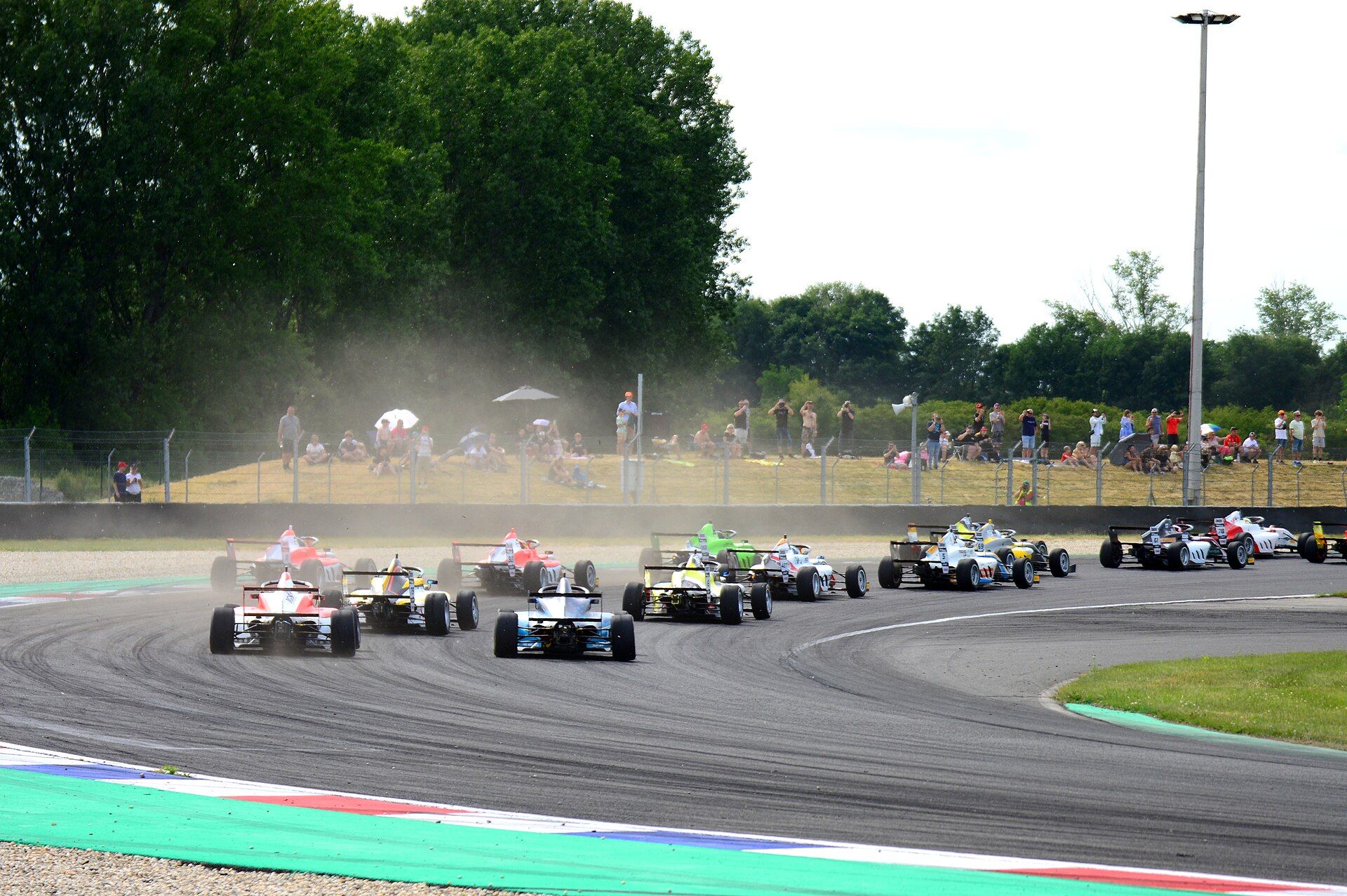
- Type
- race circuit
- Length
- 5.922 km
- Opened
- 2009
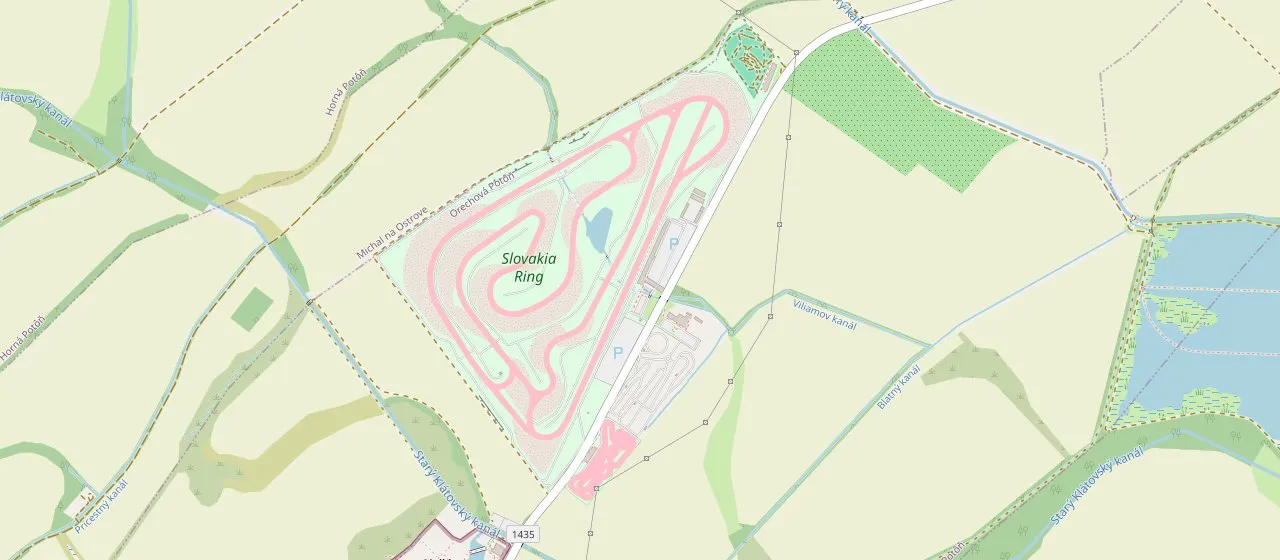
On 1 October 2008 excavators drove onto a maize field near Orechová Potôň, a few kilometres from Dunajská Streda. The circuit opened in 2009. A group of investors and local enthusiasts from Žitný ostrov received from the Austrian architect Hans Roth a design for a loop of almost six kilometres, and Slovakia, a country of Volkswagen, Peugeot and Kia factories, got its first permanent racing circuit. Three years later the same venue entered the calendar of the world touring car championship as a stand-in for the cancelled round in Argentina.
| Location | Orechová Potôň, Dunajská Streda district, Trnava Region, Slovakia |
| Type | permanent racing circuit, the only one of its kind in Slovakia |
| Length | 5,922 m (layout 4, the main configuration); 5,935 m (layout 4b with the chicane) |
| Configurations | 6 layouts in both directions, from 2,632 to 5,922 m |
| Opening | 2009 (construction from 1 October 2008) |
| Designer | Hans Roth, architect from Austria |
| Start straight | 900 m long, 20 m wide; track width 12 m |
| Licence | FIA grade 2 (layout 4b), grade 3 (layout 4) |
| Fastest measured lap | 1:39.002, Klaas Zwart, Jaguar R5 F1, Maxx Formula 2019 qualifying (layout 4) |
| Fastest race lap | 1:43.115, Andy Zuber, Dallara GP2/05, EuroBOSS 2010 (layout 4) |
| Operator | Slovakia Ring Agency |
| Main events | FIA WTCC 2012–2016, WTCR 2018–2020, FIA GT1 2012, Blancpain GT 2014, FIA ETRC since 2017, FIM EWC 2017–2019 |
| Status | active |
A year from the excavator to the opening
According to the venue's official history the idea was born at the turn of 2005 and 2006, when the authors of the project were looking for a place that would meet four conditions: access, distance from buildings because of the noise, a good climate and a reasonable distance from Bratislava, Vienna and Budapest. They found it near Orechová Potôň, and the operator stresses the support of the Trnava Region self-government and of the municipality itself. Construction started on 1 October 2008 to plans by Hans Roth, who, as the circuit's website states, had similar projects in Austria and Hungary to his name.
The money came from outside. Zoroslav Kollár, a lawyer known in Slovakia for insolvency cases and an entrepreneur, told the daily „Hospodárske noviny” (the quote is cited by the daily „Štandard”): "In 2008 my current partners approached me with a proposal to enter this project. It was already ready for implementation at that time. That means that only the money was missing to build it". The Hungarian portal Origo reported that the first stage of construction and the technical equipment cost 750 million Slovak korunas, about 24.9 million euros, and that the whole venue covers about 85 hectares. The circuit's operating company was Slovakia Ring Agency, later renamed Výcvikové zariadenie pre vodičov.
The operator treats 2009 as the first official season and 2010 as the year of the first big events.
Four horizons on a flat island
The terrain around the village of Orechová Potôň is, as Origo wrote, as flat as a board, so Roth designed artificial rises. The operator calls them horizons and counts four of them; from grandstand F you can see the braking into turn 3 just after the car is unloaded on the crest. The Origo journalist wrote after the opening about artificial hillocks placed so that a corner comes right behind them, which makes it harder to pick the braking point and the speed in the curve. The start straight is 900 m long and 20 m wide; the Origo journalist compared its invisible end to a stretch of motorway before it is opened to traffic and pointed out that the wide asphalt offers many places to overtake.
The shape is simple to describe: a triangular outer loop surrounds a set of inner curves that can be combined into six layouts, and the safety barriers were installed so that it is possible to drive in both directions, which gives twelve configurations. Layout 4, that is the full 5,922 m, is used most often; if needed, the circuit can be split into two separate courses (layouts 3 and 5) and two events can be run at the same time. Races usually go clockwise on layout 4.
The rises quickly showed their other side. During the first international event, a round of the FIA GT3 European Championship in 2011, concerns appeared that the cars were coming off the surface on the crests, especially between turns 2 and 3. When the FIA GT1 world championship arrived a year later, a temporary chicane made of tyres was set up before that rise; according to RacingCircuits.info it was clumsy, was not liked and was dropped in the following years.
Europe's reserve circuit
On 6 February 2012 the WTCC promoter Marcello Lotti announced that the world touring car championship would race on 29 April at Slovakia Ring instead of in Córdoba, where the round planned for 8 July had been cancelled because of drawn-out negotiations with the local authorities. Lotti argued that the circuit is demanding, has modern facilities and lies only 170 km from the Hungaroring, where the series raced a week later. The circuit's executive director Tomáš Vranka spoke of pride in hosting one of the few world championships in motorsport. According to the operator, around 30,000 spectators watched the WTCC premiere, and the venue counts it among the most memorable events in its history.
That role of a stand-in was repeated. In the same year 2012 the SRO series put Slovakia Ring into the calendar after events in China were cancelled, the circuit stayed in the FIA GT Series calendar in 2013 and in the new Blancpain GT Series in 2014, and the German ADAC GT Masters came in 2013 and 2014. The WTCC returned every year until 2016, and from 2018 to 2020 the circuit hosted the series' successor, the WTCR World Cup.
The race of 11 May 2014 showed how this circuit behaves in the rain. The downpour began an hour before the start, eased, and then came back exactly at the moment of the start. Sébastien Loeb in a Citroën took the lead from the second grid slot, Yvan Muller got a drive-through penalty for a jump start, and further drivers, among them Dušan Borković, John Filippi and Mehdi Bennani, ended up in the gravel. After six laps the safety car came out, many drivers demanded a stoppage, and after nine laps the race was ended. Loeb won for the second time in his WTCC career, ahead of José María López and Norbert Michelisz.
The chicane nobody needed
For nine years the layout of the circuit did not change. For the 2018 season a chicane was added at the ninth corner of layout 4, which lengthened the loop to 5,935 m (layout 4b). The operator states that, together with the expansion of the safety infrastructure, this brought a higher FIA grade 2 licence on 9 April 2018, while the version without the chicane holds a grade 3 licence. RacingCircuits.info adds that, as things stand today, the new chicane has not been used in any race, because the events on the calendar require only the lower licence. The only time recorded on layout 4b is the qualifying lap of Klaas Zwart in a Jaguar R5 from Formula 1 during Maxx Formula 2019: 1:45.932.
The same Zwart in the same car drove layout 4 in 1:39.002, which the operator regards as the fastest lap in the circuit's history; the fastest official race lap belongs to Andy Zuber in a Dallara GP2/05 from the EuroBOSS series in 2010 (1:43.115). Among touring cars the record is held by Yvan Muller (Citroën C-Elysée WTCC, 2015, 2:05.748), among GT cars by Thomas Jäger (BMW Z4 GT3, Blancpain GT Sprint 2014, 2:00.132), and the fastest Slovak is Miroslav Konôpka in a Ligier LMP2 from 2017 (1:52.309). On a motorcycle the fastest was Patrick Hobelsberger on a Honda CBR 1000 RR during Alpe Adria 2025 (2:02.444).
Trucks and the public
Since 2017 the FIA ETRC European Truck Racing Championship has come to the circuit and the operator counts it among the best attended events. The circuit record for tractor units was set in 2017 by Norbert Kiss in a Mercedes-Benz Actros: 2:42.803. In the years 2017–2019 the venue also hosted the FIM EWC Endurance World Championship for motorcycles, and in 2015 a separate rallycross course was built for the FIA Central European Zone in rallycross: 65 percent asphalt and 35 percent unpaved surface. The biggest national event, the Veľká cena Slovenskej republiky, that is the Grand Prix of Slovakia for racing cars on the circuit, has closed the summer at Slovakia Ring since 2010; the event itself has a tradition going back to the 1970s.
A whole complex has grown around the loop. The first stage, completed in May 2010, included 33 pit boxes, a control tower, grandstands, a restaurant and a fuel station; in the second stage a driving school was built, today the Safe Driving Centre; in the third, by May 2012, an off-road area and the Hotel Ring; in the fourth the Malkia animal park (2016), the Military Museum (2018) and the Slovak Karting Centre (2019) with a track homologated by the CIK-FIA. The operator gives the capacity of the grandstands as 6,500 seats; the main grandstand A is the only covered one.
A season for amateurs
For an amateur driver Slovakia Ring is above all a circuit you can come to in your own car. The operator sells public track days for cars and motorcycles, race taxi rides, rental of track cars, a track school and courses at the Safe Driving Centre, and the karting track with an outer loop 1,170 m long works all year round. The racing season runs from April to October: in 2025 it was opened by a two-day hillclimb race of the Slovak championship on a 3,200 metre section of the circuit, in June the ETRC trucks raced, in August the Grand Prix of Slovakia, in September the Alpe Adria motorcycles and the Histo Cup, and in October the FIA CEZ rallycross. The circuit's general advertising partner is OMV Slovensko.
Alpe Adria also returns every year, a motorcycle series present here since 2010. On the first weekend of September 2026 it is precisely its motorcycles that are on the circuit, and the operator's weather station on the home page shows 25 degrees.
Timeline
- 2005/2006: start of the project, choice of the location near Orechová Potôň.
- 1 October 2008: start of construction to the design of Hans Roth.
- 2009: opening of the circuit.
- 2010: first Grand Prix of Slovakia and first Alpe Adria round; race record of Andy Zuber in a Dallara GP2.
- 2011: FIA GT3 European Championship, the first international event.
- 29 April 2012: first FIA WTCC round, a stand-in for Argentina; around 30,000 spectators.
- 2012: FIA GT1 World Championship with a temporary chicane made of tyres.
- 2013–2014: FIA GT Series, ADAC GT Masters, Blancpain GT Series.
- 2015: construction of the rallycross course for the FIA CEZ.
- 2017: first FIA ETRC European Truck Racing Championship and FIM EWC.
- 9 April 2018: FIA grade 2 licence for layout 4b with the new chicane.
- 2018–2020: FIA WTCR.
- 2019: circuit record of Klaas Zwart (1:39.002); opening of the karting centre.
Sources (10)
- Slovakia Ring, História, slovakiaring.sk [sk]
- Slovakia Ring, SLOVAKIA RING je 15 rokov na scéne, slovakiaring.sk, 2024-03-19 [sk]
- Attila Nógrádi, Felvidéken csapatni – Slovakia Ring-bemutató, Origo, 2010-05-01 [hu]
- Slovakiaring, RacingCircuits.info [en]
- Slovakia Ring, Okruh, slovakiaring.sk [sk]
- Peter Mills, World Touring Cars adds Slovakia Ring to schedule to replace cancelled Argentinian round, Autosport, 2012-02-06 [en]
- Neil Hudson, Sébastien Loeb wins rain aborted race in Slovakia, TouringCarTimes, 2014-05-11 [en]
- Za schránkami okolo Slovakia Ringu sa skrýva eseťák a ľudia okolo Z. Kollára, Denník Štandard, 2021-01-25 [sk]
- Erik Poroknovec, A Slovakia Ring pereskedése miatt került a vádlottak padjára, a bíróság végül felmentette Zoroslav Kollár vállalkozót, Paraméter, 2025-02-10 [hu]
- Štartuje 16. sezóna okruhu SLOVAKIA RING! [sk]