
Plainfeld / Koppl, Austria
Salzburgring: the track in Nesselgraben saved by a signature campaign
The history of the Salzburgring: from Rindt's last race and the May Day motorcycle GPs to the noise dispute, the lease until 2045 and track days near Salzburg.
- Type
- race circuit
- Opened
- 1969
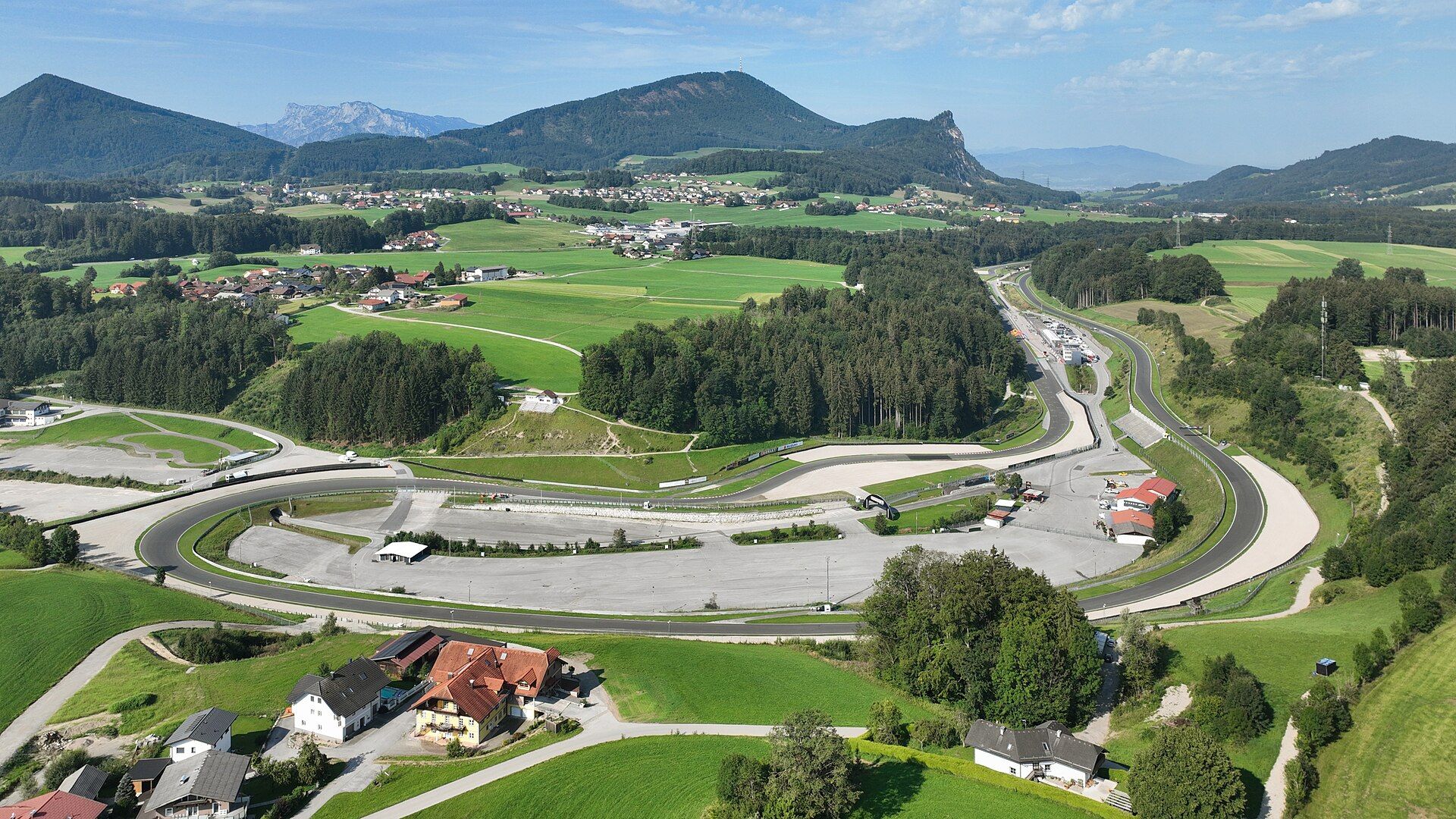
On 1 May 1977 the sun shone over the Nesselgraben, some 70,000 people stood on the slopes above the track, and the entire elite of the motorcycle world championship gathered in the paddock. The anniversary Austrian Grand Prix was meant to be a celebration; it ended with the death of the Swiss rider Hans Stadelmann, a series of serious injuries and a boycott of the 500 cc race by the stars. That day is the key to understanding the Salzburgring: a track as fast as almost any in Europe, squeezed into a valley so tightly that every safety zone had to be wrested from rock and meadow. The track, which the provincial government wanted to close in 1981 and which the residents of Koppl would like to quieten today, has a lease signed until the end of 2045 and a calendar filled from March to November.
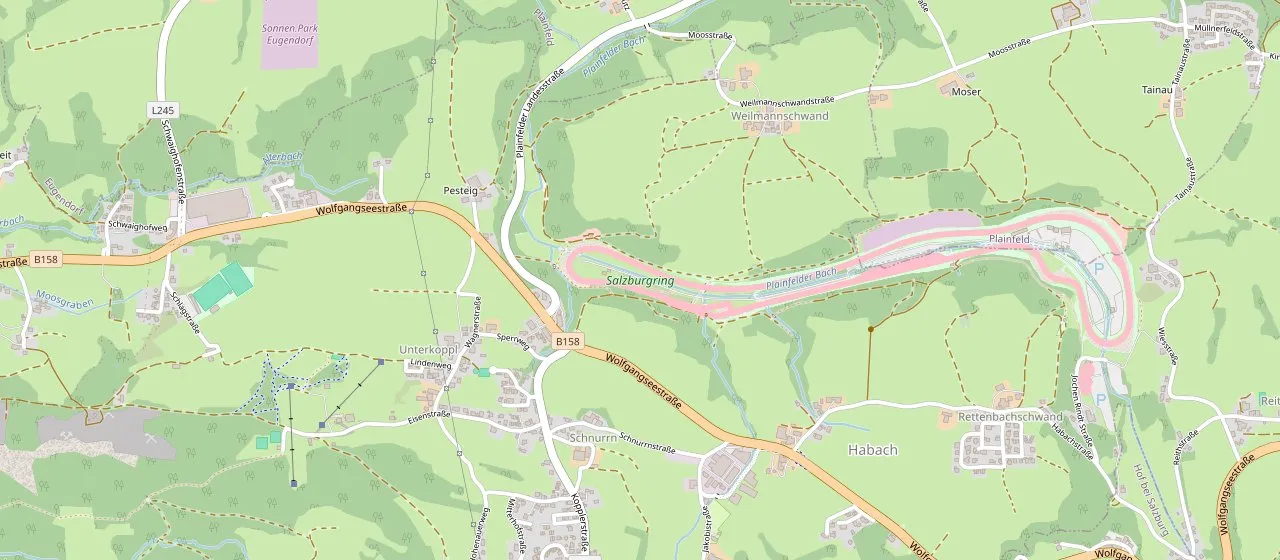
| Location | Nesselgraben between Koppl and Plainfeld, province of Salzburg, Austria; address Salzburgring 1, 5325 Plainfeld |
| Type | permanent race track |
| Length | more than 4.2 km |
| Gradient | max. 3.8 percent uphill, 1.8 percent downhill; 648.3–670.6 m above sea level |
| Longest straight | start/finish, 750 m |
| Opening | 20–21 September 1969 |
| Owner / operator | province of Salzburg / the IGM Salzburgring association (Internationaler Gemeinnütziger Motorsportverein Salzburgring), director Ernst Penninger |
| Fastest GT3 lap | 1:17.768, Leo Pichler, Porsche 911 GT3 R, ADAC GT Masters, 5 September 2026 |
| Most important events | Austrian motorcycle GP 1971–1994, Formula 2 (1970s), World Sportscar Championship 1976–1977, ETCC, DRM, DTM, STW, WTCC 2012–2014, TCR, ADAC GT Masters from 2025 |
| Status | active; lease until 31 December 2045 |
The conductor on a test lap
Before the track was officially opened, it was tested by Herbert von Karajan. On 25 August 1969 the conductor drove the not yet handed over Salzburgring in a Porsche 908/02 „Flunder”, reaching speeds of about 200 km/h; among those watching were the engineer Herbert Kaes, a nephew of Ferdinand Porsche, and Fritz Stengl, the head of timekeeping at Salzburg events. The same Stengl, a year earlier, on Wednesday 4 September 1968, together with Willy Löwinger signed the construction orders as co-manager of the company Salzburg-Ring Ges.m.b.H.; the works started in mid-September.
Löwinger, president of the Österreichischer Automobil-Sport-Club and the originator of the European Hill Climb Championship, was the driving force here. The company that built the track was formed by the province and the city of Salzburg, the municipalities of Koppl and Plainfeld, the clubs ARBÖ, SAMTC and ÖASC and the companies Porsche Austria, Mercedes-Benz Österreich, Ford Austria and Semperit. The land belonged and still belongs to the province. The track was built in parallel with the Österreichring in Spielberg, which started as early as May 1969.
The Salzburgring was opened on the weekend of 20–21 September 1969. The Formula V race was contested among others by Niki Lauda, Helmut Koinigg and Dieter Quester, and the race of the big prototypes was won by Kurt Ahrens in a Porsche 908. The RacingCircuits.info database adds that Helmut Marko, Quester and Johann Abt started in the inaugural touring car races, and that the track already used both the long and the short loop at that time. The company did not bid in 1970 for a Formula 1 Grand Prix: such an event would have cost 2.5 million schillings.
Jochen Rindt's last race
On 30 August 1970 the Festspielpreis, a Formula 2 race in two heats, was run at the Salzburgring. „Motor Sport” wrote that despite the criticism of the barriers which surrounded the track and made several of the corners almost completely blind, a good field turned up: three works BMWs and both Lotus 69s of Jochen Rindt's team. In the warm-up before the first heat Rindt's engine fell ill, water was found in the oil, so the mechanics hurriedly changed the unit. In the second heat the Austrian, although he lost several places after being blocked by a lapped car, commanded the race from start to finish and came in, as the correspondent wrote, thoroughly elated. The combined classification was won by Jacky Ickx in a BMW ahead of Vittorio Brambilla and Quester. Six days later Rindt was killed in practice at Monza.
Michael Steffny, today the organiser of the Histo-Cup series, watched that race as a teenager. This is how he recalled it in 2019: „To experience Jochen Rindt in his last race at the Salzburgring, that was madness for us boys. He started from the last row and came in first”. In the same race Patrick Depailler crashed his Pygmée at the end of the straight so heavily that the car was written off. According to Salzburgwiki it was in 1970, on Rindt's initiative, that the first club of track marshals was founded, out of which the Internationaler Streckensicherungs Club Austria emerged in 2000.
The May Day races
After the war the Austrian motorcycle Grand Prix was run on the motorway near Salzburg: from 1947 to 1965 at Liefering, then on a branch at Anif-Grödig, and in 1970 for the first time at the Salzburgring, still without world championship status. The premiere with points for the championship fell on 9 May 1971 and was the opening of the season. The organiser, the ARBÖ club, assumed 20,000 spectators to break even; 35,000 came. The budget amounted to 900,000 schillings, of which 630,000 went to entry fees and prizes for a hundred riders from 19 countries. The largest sum, 25,000 schillings, went to Giacomo Agostini, who won the 350 and 500 classes.
The races held around 1 May became a brand. Salzburgwiki lists the stars who drew the crowds here: Agostini, Toni Mang, Kenny Roberts, Randy Mamola, Freddie Spencer, Eddie Lawson, Wayne Rainey, Wayne Gardner, Kevin Schwantz. Between 1971 and 1994 the Grand Prix dropped out of the calendar only twice: in 1980, when at the end of April almost a metre of snow covered the track and ARBÖ asked the FIM for later dates, and in 1992, when after the takeover of the commercial rights by Dorna and Bernie Ecclestone the club gave up the organisation for financial reasons.
Mick Doohan, the winner of the last Grand Prix in 1994, called the Salzburgring his favourite track. RacingCircuits.info quotes him thus:
„Sure, it was fast and dangerous, but also enormously fun. For me that is what motorcycle racing is all about”.
The last round of the world championship, 20–22 May 1994, was run by a different organiser, Franz Rau of the German company MotoMotion; alongside Doohan the winners were Loris Capirossi (250) and Dirk Raudies (125). In 1995 the Superbike World Championship came once more, on a one-off basis, and in 1996 the Austrian motorcycle Grand Prix moved to the rebuilt A1-Ring in Styria. The reason was prosaic: the growing requirements for safety zones, which the narrow valley was unable to accommodate.
The first of May 1977
The disaster began on the seventh lap of the 350 cc race that opened the day. The Italian Franco Uncini, running second behind John Ekerold, entered the Fahrerlagerkurve too fast and at about 190 km/h hit the barriers lined with straw bales. The motorcycle bounced back onto the track, and Johnny Cecotto, Dieter Braun and Patrick Fernandez, riding right behind him, no longer managed to avoid it. About ten seconds later Hans Stadelmann, having slipped on a patch of oil and petrol, rode his Yamaha straight into the scene of the accident.
The thirty-five-year-old Stadelmann, a multiple Swiss champion, died on the way to hospital. Fernandez was operated on until the evening, Braun suffered a concussion and a cervical spine injury, Cecotto broke his left hand, a track marshal was injured as well. The management stopped the race, and the jury decided not to repeat it; it did not count towards the championship. That afternoon it was said in the paddock that the signalling had come too late, that the riders had not slowed under yellow flags and that the rescue services had failed. Max Wiener summed up the mood of the field in one sentence: „If I brake, five will pass me, so what for?”. Some of the spectators at the corner lost their nerve and threw stones at the rescuers.
The riders of the 125 and 500 classes demanded that the organiser retrain the marshals, criticised the medical care, the helicopters and the too small Salzburg hospitals. The 125 race started with a delay, but in the 500 class the stars refused to start: the whole first row was missing, 15 riders started and six saw the finish. Wiener from Bad Ischl led for 17 laps before the veteran Jack Findlay passed him. That is what a partial boycott of the most popular class of the motorcycle world championship looked like, described the next day by „Salzburger Nachrichten”.
Safety had forced alterations even earlier. According to RacingCircuits.info, concerns about the last, wide curve meant that a chicane was put in there in 1976, in practice a series of fairly fast corners. In 1986 a real chicane appeared at the end of the start straight, slowing cars before the Emco corner, initially only for motorcycles. Salzburgwiki gives the background: with the expiry of the licence in 1985 the FIM and FISA imposed changes to the layout of the track and to the safety installations, and from October 1985 to April 1986 the operator invested about 2.8 million schillings in a chicane at 0.6–0.8 km, the straightening of the section at 2.7–2.9 km, run-off areas, a new surface and repositioned barriers.
The list of victims did not end in 1977. In May 1989 the Austrian Heinz Hutter was killed in a motorcycle race. On Saturday 16 July 1994, in practice before the ADAC-Bayernpreis race in the small division of the Deutsche Tourenwagen Trophy, a forty-year-old driver of an Opel Astra lost control of the car at the exit of the Fahrerlagerkurve. The car was thrown onto a barrier, fell behind it and killed three track marshals from Bad Goisern: Christian Pfandl and the brothers Hermann and Alfred Lahnsteiner, who had worked at the Salzburgring for years. The races of that weekend were cancelled.
Two straights and a curve that does not end
The shape of the track was dictated by the valley. The start straight, 750 metres long, the longest of the four, runs along one slope, the back straight returns along the other, slightly uphill, and at the bottom they are joined by a long right-hand curve above the paddock. The operator gives a maximum climb of 3.8 percent on the back straight and a fall of 1.8 percent in the Fahrerlagerkurve; the track lies between 648.3 and 670.6 m above sea level. The difference in height is about 22 m, the minimum width 10 m, and by joining the two straights before the Nockstein-Kehre it is possible to drive a shorter loop of 2910 m. The pit complex has 31 garages, the paddock inside the loop 24,900 m².
The operator itself describes the corners in the language of an instructor. The Bridgestone-Schikane after the start is the slowest and tightest point of the track; the Nockstein-Kehre, a slightly banked hairpin, tends to be underestimated, because it has a very late apex. The back straight is, strictly speaking, a sequence of gentle curves which ideally is driven flat out, and in a race „real slipstream battles” take place here. The Fahrerlagerkurve, as the operator writes, „is loved and hated among the drivers in equal measure”: it is turned in at the fastest point of the track, the line leads from the left edge to the right and back to the left, and the legend that one can overtake around the outside here is true. The Reiner S which closes the lap is in fact three corners in which one has to think „like a skier, always one gate ahead”. The name Reiner S was given in 2021 in honour of Alexander Reiner, for many years the president and director of the track; in the same year Friedrich Lehensteiner became president of the IGMS.
The speed at that „fastest point” was given by the drivers themselves. Before the ADAC GT Masters premiere in September 2025 Jannes Fittje said about the Fahrerlagerkurve: „We have a speed of about 245 km/h there. It is one of the fastest corners I have ever driven”. Jakob Schober of the BMW Challenge series compared it in 2019 to riding on a razor's edge: „We have respect for the notorious Fahrerlagerkurve, but we love it. We know that there is time to be gained there, if you stay on the throttle”.
In 1998, according to RacingCircuits.info, new pits were built and the Emco chicane was tightened, obligatory from then on for cars and motorcycles. Of that old track there is no longer, among other things, the „Kurier” timekeeping tower, which burned down in 1999.
The year the track was to disappear
Eleven years after the opening the Salzburgring was still making losses. On 25 November 1980 the Salzburg Landtag took up the track, which had already cost the province 30 million schillings, and threatened closure if the occupancy did not improve. The provincial government considered changing the use of the site, even building an open-air stage for Karl May spectacles. On 23 March 1981 the decision to close the track was taken.
Two days later the „Ja zum Salzburgring” campaign started. The club of track marshals, IG Salzburgring, the Motor Veteranen Club Salzburg, the karting club and ARBÖ Salzburg joined in; signatures were also sent from New Zealand, the USA, Chile and South Africa. The argument for those who were not fans went: it would be nonsense to bury 70 million schillings in the Nesselgraben and to add another 20 million for the demolition.
Helmut Krackowizer, an economist, motoring journalist and president of the Salzburg veterans' club, negotiated in August 1981 with the provincial councillor for finance Anton Bonimaier the terms of the takeover: giving up public subsidies, taking over the company's liabilities, a rent of 150,000 schillings payable when a world championship round was organised. Bonimaier had initially demanded 600,000 schillings a year. In September 1981 the IGMS association was founded, entered in the register on 16 September, which has run the track since 1 January 1982. It closed its very first year in the black: 2.6 million schillings of income against 2.1 million of expenditure.
In December 1984 Alexander Reiner, a former technical director of British Leyland Austria and a touring car driver, became president of the IGMS and led the track until 2018. A letter of the provincial government office of 30 July 1985 states plainly that without Krackowizer's initiatives the lease to the IGMS „would either not have come about at all, or only much later”. The critics did not disappear: in January 1983 the „Aktionsgemeinschaft gegen die Weiterführung des Salzburgringes” tried to get the authorities to close the facility, and in 1988 the Salzburg Bürgerliste commissioned an architect to draw up a concept for turning the site into an industrial and residential zone; the provincial planners rejected it in 1993, because the estate would have had more inhabitants than the whole municipality of Plainfeld.
Noise was an argument even then. The Oldtimer Grand Prix, nine editions since 1974 with hundreds of historic motorcycles and cars, with Juan Manuel Fangio in a Mercedes W 196 in 1979 and John Surtees, Luigi Taveri and Niki Lauda in 1981, could not be held in 1989 because of the tightened provincial noise protection regulations.
Cars: from the Bavaria-Rennen to GT Masters
On four wheels the Salzburgring was for decades the „second division” alongside the Österreichring, but a full one. In 1971 the two-litre sports cars of the European championship came within the Tauernpokal, in 1976 and 1977 the World Sportscar Championship: the winners were Jochen Mass in a Porsche 936 and Vittorio Brambilla in an Alfa Romeo T33/SC/12. The „Motor Sport” database records Brambilla's lap from 1977 as 1:12.45. From 1971 to 1982 the ADAC organised the Bavaria-Rennen here within the Deutsche Rennsport Meisterschaft, with Porsche 935s, Ford Capri Turbos and BMW M1s in the hands of Stefan Bellof, Klaus Ludwig or Hans-Joachim Stuck. The European Formula 2 Championship visited regularly from 1972 to 1976, the European Touring Car Championship through the 1970s and the first half of the 1980s. Later came the DTM, the STW of the 1990s and V8-STAR.
On 20 May 2012 the world championship returned: a WTCC round. The event cost the organiser about half a million euros, of which 160,000 euros went to the series; the first edition, according to Reiner, was supported by Dietrich Mateschitz. The WTCC came back until 2014, in 2013 as the only round in the German-speaking countries. A year earlier the operator had spent three million euros on the direct truck access behind the pits required by the FIA and on a retention basin. After the WTCC the „international hobbyhorse”, as Reiner put it, became the TCR series, present here from 2015 to 2017.
The contemporary chapter began on 21–22 September 2024 with the first Motorsport Salzburgring Festival with more than 250 starters and about 5000 spectators; the Formula 4 title was won then by Oscar Wurz, the son of Alexander. On 5–7 September 2025 the ADAC GT Masters came for the first time in its nineteen-year history, and Salzburgwiki noted about 10,000 spectators. On 5 September 2026, in a rainy race of that series, Leo Pichler of the razoon team drove a lap in 1:17.768, the fastest in the field.
The three million euros that were not
In September 2015 it became clear that Dietrich Mateschitz, the owner of Red Bull, wanted to buy the track for three million euros; the contract was signed in January 2016. At the beginning of July 2016 the transaction collapsed. Mateschitz explained to „Salzburger Nachrichten”, and after them to Motorsport-Magazin.com and Speedweek: „We could not reach an agreement with one landowner. For a few metres of gravel access he wanted a huge sum, 10,000 euros of rent a month. I have to say: at some point it is over, it no longer makes any sense”. The second problem was the legal structure: the permits were held by the IGMS association, not by the track itself, so after a purchase all the rights would have had to be negotiated anew. „Some evidently already saw a chance in that to bring the ring down”, he added.
The purchase came with plans for a new media centre, a different truck access to the narrow Nesselgraben and corrections to the track, and Reiner quietly counted on the return of MotoGP for the fiftieth anniversary in 2019. Instead, in August 2019 he told the ORF about the return of the DTM in 2021, for which the run-off area at the chicane after the start would have to be enlarged. The fiftieth anniversary was celebrated on 3–4 August 2019 with a festival in the paddock and in September with a Histo-Cup round with a parade of racing motorcycles from the 1960s, 1970s and 1980s.
Decibels in the Nesselgraben
The conflict over noise has a chronology of its own. In 2015, on the initiative of the provincial environmental ombudsman, a council of the track's neighbours, the Anrainerbeirat, was set up. Since the end of May 2021 the provincial immission protection department has been measuring the sound level from a station placed 60 m from the track. In the very first season the highest peak, 99.3 dB, was recorded on 19 July 2021 during a test day; a track day gave 96.8 dB, while the general limit for the track was 98 dB. „Cars with a flame tube or a valved exhaust are unbelievably loud”, said the council's spokesman Norbert Schlager, adding that the limits in Germany and the Netherlands are stricter, so the „noisemakers” from there come to Salzburg. In 2021 the operator installed a permanent measuring station and lowered the upper limit itself.
In May 2022, after another Histo-Cup round whose previous edition had produced peaks of 102 dB, the deputy governor Heinrich Schellhorn of the Greens declared that without a serious noise reduction concept he would not sign the extension of the lease. Director Ernst Penninger replied that the concept had been in preparation since 2018, that the test days no longer took place at weekends and that limits had been introduced for cars. Schlager specified what the residents were concerned about: „It is not at all about killing the track. It is about the drives for the public between the races. Unfortunately they are in part louder than the races”.
The decision came in October 2023, already under the ÖVP and FPÖ coalition. The lease, in force since 1 January 1991 and expiring on 31 December 2025, was extended until 31 December 2045. The Salzburg-Umgebung district authority drew up an acoustic and sanitary opinion, according to which the present operation neither endangers health nor is an unacceptable nuisance; the politicians set no noise conditions. The track is governed by the events act, and the permit is open-ended. The council of neighbours dissolved itself at the beginning of 2023 in protest. „We are fighting not against the ring or the operators, but against private drivers who rent the track and turn their laps at up to 135 decibels”, said Schlager; between 2021 and 2022 the province measured maxima of up to 104 dB. The Koppl councillor Wolfgang Hyden called the extension a „fossil retro project” and claimed that about 80 clubs from southern Germany, Switzerland and the Czech Republic come to the track, and that instead of five race weekends a year there are „about 180 days of continuous noise”. The Greens demanded an upper decibel limit and a statutory number of race days; they stated that in 2022 there had been 25 race days, nine more than the year before, and 224 days of operation. The office of the deputy governor responsible for the environment, Marlene Svazek of the FPÖ, replied that the track serves for racing and that there is no reason for restrictions as long as the events stay within the law.
The operator answers with figures. In 2023 noise was measured on 249 days; track days, that is drives by road-legal vehicles, gave an average of 66.3 dB, and there were 59 of them, against 54 in 2022 and 51 in 2021. The category „other”, mainly safe driving courses and company presentations, fell on 125 days with an average of 57.8 dB; days with racing cars gave 73.1 dB, and the Electric Love festival 77.2 dB by day and 80.4 dB at night. From April to October 2023 the track had 27 Sundays and public holidays without motorsport. In the spring of 2023 the operator also carried out an internet survey with 2500 participants: 84 percent rated the track positively, in the municipalities of Koppl, Hof and Plainfeld about 70 percent. Salzburgwiki points out that not quite 30 percent of the participants came from neighbouring municipalities, and about 15 percent not from Austria at all.
President Lehensteiner told the ORF in December 2023 that the profile of the customers is changing: there are only three races a year, the number of track days is falling, safe driving courses are increasing, and from 2024 driving on Sundays and public holidays was limited to six days. The most visible investment after the extension of the lease is a solar power plant. In November 2024 Salzburg AG broke ground for an installation on 2.1 ha on a slope in Plainfeld: 3264 modules, a capacity of 1.9 MWp, about 2.25 GWh a year, as much as the consumption of 560 households, at a cost of 1.6 million euros; the meadow under the modules is still grazed by sheep. Salzburgwiki states that the installation was put up in 2025 above the back straight, and that the flock numbers about 30 animals.
A track day near Salzburg
The operator is an association: IGM Salzburgring, register entry ZVR 597 921 287, with its seat at the address Salzburgring 1 in Plainfeld and with director Ernst Penninger, who has led the track since 2018, after Alexander Reiner. Penninger said in 2023 that the main field of activity today is driving safety: the track runs training for motorcycle and plain-clothes police from all over Austria, including training at high speeds, and since that year the Bavarian police have been practising here as well; at least 100 days a year are of that character. In 2023 the track had 185 days of operation, of which only twelve were motorsport days.
The calendar for September 2026 shows what this looks like in practice: after the ADAC GT Masters weekend with a limit of 105 dB a maintenance day, then three days of safe driving courses, a company day, the ACF Liechtenstein club, the European Speed Club, a Histo-Cup round, courses again, and at the end of the month GP Days and GT Days, that is track days for amateurs on motorcycles and in cars. Sundays are marked „KEIN STRECKENBETRIEB”. External organisers apply various noise thresholds. On 30 April 2024 the Pistenclub was able to hold a „loud” test day with a limit of 105 dB for the first time, but had to keep two hours of engine silence, which it filled with a walk along the track. Motortag, a motoring festival with drives for the public, admits cars, motorcycles and mopeds up to 50 cc in separate groups, without a requirement for road registration, with a limit of 105 dB and enrolment through a registration form. On site there is a petrol station with 100 and 98 octane petrol, seven fast chargers of 150 kW each, two grandstands with 2800 and 300 seats and the Gasthaus am Ring.
The calendar is also filled by what has nothing to do with motorsport: Electric Love, the largest festival of electronic music in Austria, celebrated its tenth anniversary at the track in 2023 and attracts up to 180,000 participants; the Frequency Festival was held here until 2008 with an attendance of up to 70,000. In June 2026 the track was given over for three days to the army and to the municipality of Plainfeld: 200 recruits took their oath, the riflemen of Plainfeld celebrated their 225th anniversary, and Penninger spoke of a „publicly accessible multifunctional arena”.
Matthias Gumpold from Golling has been a track marshal for forty years and started right here, after he came with a friend and heard that they were looking for people. This is how he remembers the old May Day weekends: „The motorcycle races at the Salzburgring were hell in the old days. There were so many people that in the Fahrerlagerkurve you could not see a single green patch any more”.
Timeline
- 1968: on 4 September the signing of the construction orders by Löwinger and Stengl, start of construction in mid-September.
- 1969: 25 August Karajan's test in a Porsche 908/02; 20–21 September the opening of the track.
- 1970: the first Austrian motorcycle Grand Prix without world championship status; 30 August Jochen Rindt's last race.
- 1971: 9 May the first round of the motorcycle world championship; Tauernpokal with two-litre sports cars.
- 1976–1977: rounds of the World Sportscar Championship.
- 1977: 1 May the death of Hans Stadelmann and the boycott of the 500 class race.
- 1980: Grand Prix cancelled because of snow.
- 1981: 23 March the decision to close the track; the „Ja zum Salzburgring” campaign; in September the founding of the IGMS.
- 1982: 1 January the IGMS takes over the running of the track.
- 1985–1986: rebuilding at the demand of the FIM and FISA, a new chicane after the start.
- 1989: the end of the Oldtimer Grand Prix because of the noise regulations; the death of Heinz Hutter.
- 1994: 20–22 May the last motorcycle Grand Prix; 16 July the death of three track marshals.
- 1995: the only round of the Superbike World Championship.
- 1998: a new pit complex, a tightened Emco chicane.
- 2012–2014: WTCC rounds.
- 2013: the first Electric Love festival.
- 2016: the failure of the sale of the track to Dietrich Mateschitz.
- 2021: the beginning of the noise measurements; the naming of the Reiner S.
- 2023: the extension of the lease until 31 December 2045.
- 2024–2025: construction of the solar power plant; the ADAC GT Masters premiere.
Bibliography
- Florian T. Mrazek, „Legende Salzburgring. Tradition mit Innovation”, Verlag Anton Pustet, Salzburg 2019 (anniversary edition; the item is listed in Salzburgwiki and on the track's website, not read in this session).
- „15 Jahre Rennstrecke Salzburgring”, commemorative print, ed. Peter Bertschinger in cooperation with Helmut Krackowizer and Ernst Kussin (quoted after Salzburgwiki).
Sources (43)
- Joachim Glaser, Othmar Behr, Salzburger Nachrichten, 1977-05-02 [de]
- Salzburgring, Salzburgwiki (Salzburger Nachrichten), 2026-05-15 [de]
- Salzburgring: Pachtvertrag wird bis 2045 verlängert, 2023-10-05 [de]
- sn.at [de]
- IGM Salzburgring, Die Strecke, salzburgring.com [de]
- Salzburgring, RacingCircuits.info [en]
- ADAC GT Masters, Round 5 (ADAC Racing Weekend), Race 1, Result List (Provisional), Salzburgring, 2026-09-05 [en]
- IGM Salzburgring, Impressum, salzburgring.com [de]
- Salzburgring map, history and latest races, Motorsport Database [en]
- Karajan und der Motorsport, Salzburgwiki (Salzburger Nachrichten), 2026-01-29 [de]
- 50 Jahre Salzburgring: Was bringt die Zukunft?, salzburg.ORF.at, 2019-08-03 [de]
- M. G. D., Formula Two Review, Motor Sport [en]
- Jochen Rindt, Salzburgwiki (Salzburger Nachrichten) [de]
- 50 Jahre Salzburgring: Histo-Cup mit vielen Oldtimern, salzburg.ORF.at, 2019-09-21 [de]
- Allen Brown, Salzburgring, 30 Aug 1970, European Formula 2 (1600cc), OldRacingCars.com [en]
- Gerhard Kuntschik (red.), Salzburgring 1971: Stars und Preisgelder der Premiere, Speedweek.com, 2021-08-20 [de]
- Chronologie der Veranstaltungen am Salzburgring, Salzburgwiki (Salzburger Nachrichten) [de]
- dpa/ND, Beim Training auf dem Salzburgring drei Tote, Neues Deutschland (nd-aktuell.de), 1994-07-18 [de]
- IGM Salzburgring, Geschichte, salzburgring.com [de]
- ADAC Motorsport, Frischer Wind: Premiere auf dem Salzburgring, adac-motorsport.de, 2025-09-01 [de]
- Internationaler Gemeinnütziger Motorsportverein Salzburgring, Salzburgwiki (Salzburger Nachrichten) [de]
- Alexander Reiner, Salzburgwiki (Salzburger Nachrichten) [de]
- Oldtimer Grand Prix für historische Automobile und Motorräder am Salzburgring, Salzburgwiki (Salzburger Nachrichten) [de]
- 1977 Salzburgring 300Kms, Motorsport Database [en]
- Markus Zörweg (red.), Verrückte Forderungen schrecken Red-Bull-Boss ab: Mateschitz kauft Salzburgring doch nicht, Motorsport-Magazin.com, 2016-07-01 [de]
- Salzburgring: Verkauf an Didi Mateschitz gescheitert, Speedweek.com, 2016-07-11 [de]
- Salzburgring: Histo-Cup-Rennen wieder zu laut, salzburg.ORF.at, 2022-05-03 [de]
- IGM Salzburgring, 2023 im Rückspiegel und 2024 im Vorwärtsgang, salzburgring.com, 2023-12-20 [de]
- Susanna Berger, Lärmmessung am Salzburgring: Anrainer hoffen auf mehr Ruhe an der Rennstrecke, „Salzburger Nachrichten”, 2021-08-16 [de]
- Salzburgring mit neuem Lärmkonzept, salzburg.ORF.at, 2021-06-12 [de]
- Salzburgring: Für Anrainer:innen ist »Schmerzgrenze erreicht«, Salzburg24.at, 2023-10-05 [de]
- Die Grünen Salzburg, Salzburgring: Anrainer*innen werden im Stich gelassen, 2023-10-05 [de]
- IGM Salzburgring, Großes Jubiläumswochenende, 12.–14. Juni 2026, salzburgring.com, 2026-06-03 [de]
- Salzburgring: Betreiber wollen groß investieren, salzburg.ORF.at, 2023-12-21 [de]
- Startschuss für Solarkraftwerk am Salzburgring, Salzburg24.at, 2024-11-15 [de]
- IGM Salzburgring, Solar.Kraftwerk am Salzburgring, salzburgring.com, 2024-12-16 [de]
- Mein Österreich: Salzburgring ist ein Teil der Geschichte Österreichs, 2023-10-14 [de]
- IGM Salzburgring, Kalender, September 2026, salzburgring.com [de]
- Pistenclub e.V., Ein Trackwalk über den Salzburgring, pistenclub.de, 2024-04-30 [de]
- Freies Fahren am Salzburgring, Motortag.at, 2026-04-24 [de]
- IGM Salzburgring, E-Mobilität, salzburgring.com [de]
- Seit 40 Jahren Streckenposten: »es fasziniert mich immer noch«, 2026-05-29 [de]
- IGM Salzburgring, Legende Salzburgring, salzburgring.com [de]