
Spielberg, Austria
Red Bull Ring: Österreichring, A1-Ring, a track rebuilt after the 2004 decision
Red Bull Ring in Spielberg: the race for Austria's first permanent circuit, Donohue's crash, Tilke's shortening, the 2004 Environmental Senate decision and driving your own car.
- Type
- race circuit
- Length
- 4.326 km
- Opened
- 1969
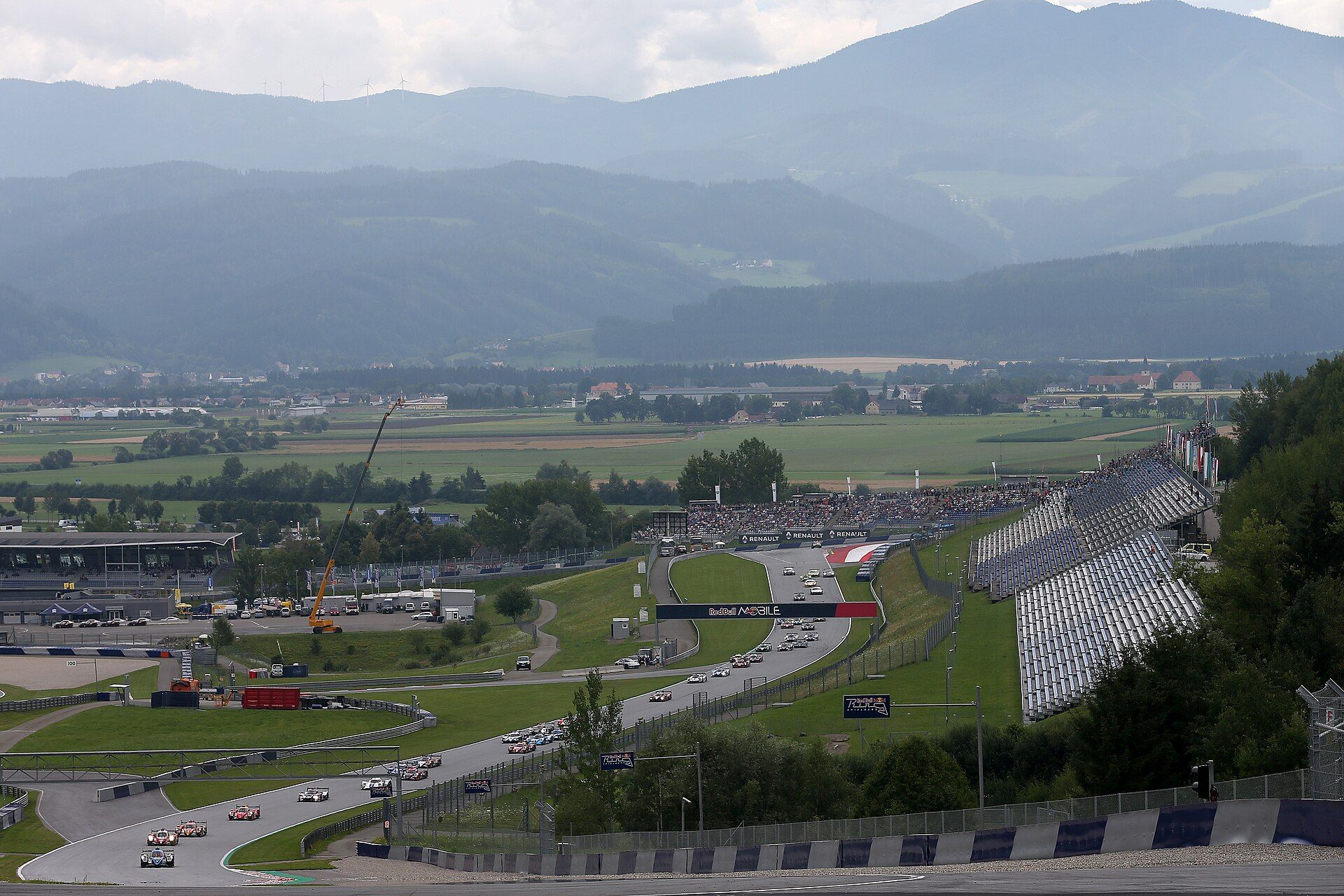
On Sunday 16 August 1970 a crowd estimated at 100,000 people gathered on the slopes above Zeltweg. They had come to see Jochen Rindt win at home. Rindt started from pole position, but after 21 laps his Lotus stopped with engine failure, and the race went to Jacky Ickx and Clay Regazzoni in two Ferraris. The circuit where this happened was then just over a year old; for a time it was considered the fastest in Formula 1, in 1996 it was shortened to 4.3 km, in 2004 it stood partly demolished when the Austrian Environmental Senate rejected the new owner's plans, and since 2011 it has been called the Red Bull Ring.
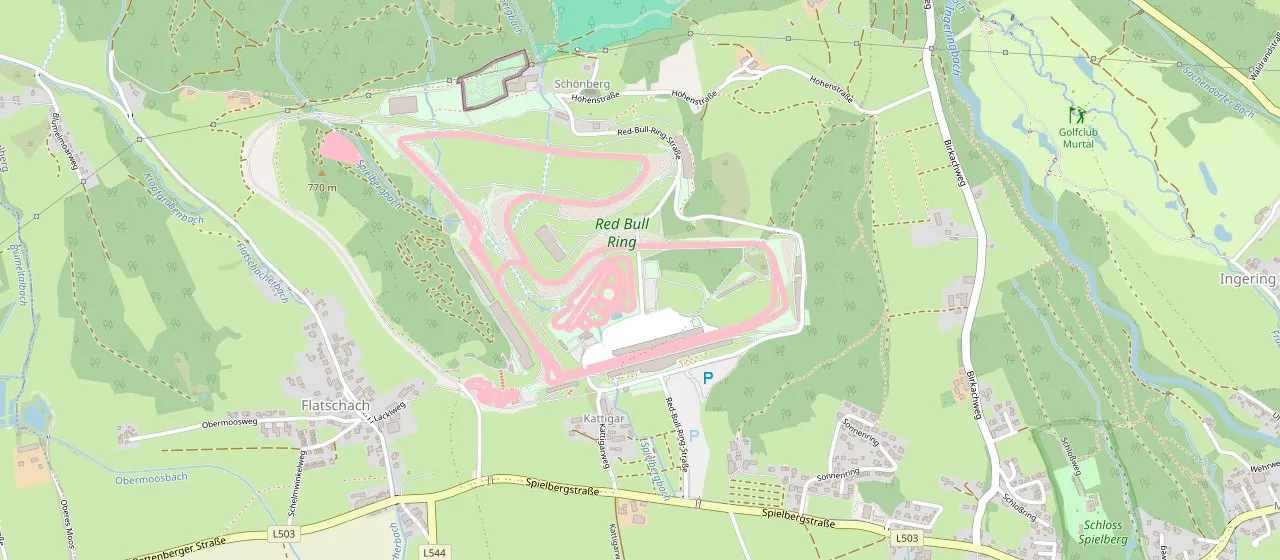
| Location | Spielberg, state of Styria, Austria; the circuit was built on land belonging to the municipalities of Spielberg and Flatschach, a few kilometres from the military airfield at Zeltweg; address Red Bull Ring Straße 1, 8724 Spielberg |
| Type | permanent racing circuit |
| Length | 4.326 km in the Formula 1 version (FIA measurement along the track centreline, as of summer 2024); 4.348 km in the motorcycle variant with the Münzer chicane |
| Corners | 10 |
| Terrain | 65 m difference in elevation, maximum climb 12 percent, maximum descent 9.3 percent |
| Former layouts | Österreichring: 5.911 km (1969–1975), about 5.94 km after a chicane was added in 1977; since 1996 a shortened loop designed by Hermann Tilke |
| Opened | Österreichring: weekend of 26–27 July 1969; A1-Ring: 1996; Red Bull Ring: 15 May 2011 |
| F1 race lap record | 1:05.619, Carlos Sainz, McLaren-Renault, Styrian Grand Prix, 12 July 2020 |
| Operator | Projekt Spielberg GmbH & Co KG |
| Main events | Formula 1 Austrian Grand Prix in 1970–1987, 1997–2003 and since 2014; motorcycle Grand Prix in 1996–1997 and since 2016; DTM |
| Status | active; contract with Formula 1 until 2041, with MotoGP until 2030 |
The race with Salzburg
Before a permanent circuit was built in Styria, racing took place a few kilometres lower down, on the runways of the Zeltweg military airfield. In 1964 it hosted the first Austrian Grand Prix to count towards the Formula 1 World Championship. The loop was 3.2 km long and ran over the flat, bumpy airfield, which broke almost the entire field. Among those who did not see the finish were Jim Clark, Graham Hill, John Surtees, Dan Gurney and Bruce McLaren; the winner was Lorenzo Bandini in a Ferrari ahead of Richie Ginther, and Bob Anderson in third was three laps behind them. Also out was Jochen Rindt, who that day started a World Championship race for the first time. In 1965 Formula 1 did not return to Zeltweg, and Austrian motorsport drew from this defeat the lesson that a real circuit was needed for the next Grand Prix.
In Styria the driving force behind this idea was Dr Gustav Tiroch, a lawyer from Knittelfeld and president of the local motor club. He wanted to build a circuit in the Aichfeld-Murboden area, and the project was initially called the “Aichfeld-Ring”. In Salzburg a circuit of its own was being pushed by Willy Löwinger, president of the ÖASC club (Österreichischer Automobil Sport Club), convinced that the better location lay closer to Germany, in the city where most Austrian car importers were based. Helmut Zwickl, a journalist who reported on more than 560 Grand Prix races, described this rivalry as a cold war with a network of informants reporting on the opponent's progress. In autumn 1968 the Salzburg side offered to reimburse the Styrians for the cost of the work so far, by then about 5 million schillings, if they abandoned the project. Tiroch called the offer “sheer cynicism, not worth a single thought” and replied that he also wanted to give an impulse to an economically weak region.
The Styrians held the better cards. The club raised a million schillings, the state covered the rest of the costs in the form of grants and guarantees, and the national federation OSK guaranteed that for ten years the Formula 1 World Championship round, if it was held in Austria at all, would go to Styria. By the time Löwinger lost the plot he had picked out in Thalgau and had to squeeze his circuit into a narrow valley between Plainfeld and Koppl, bulldozers were already at work in Styria. The Österreichring was opened on the last weekend of July 1969 with races for touring cars and Formula V; it was opened by the head of the Styrian government, Josef Krainer, according to the ÖAMTC account with his leg in plaster. The Salzburgring started eight weeks later. Construction cost more than 20 million schillings. For years the circuit was attributed to Zeltweg, although it lies in Spielberg; ÖAMTC writes that the neighbouring village was simply ignored at the time.
The first major event was the 1000 km race on 10 August 1969, a round of the International Championship for Makes. It was won by Jo Siffert and Kurt Ahrens in a Porsche 917. Eighth place went to Helmut Marko and Richard Gerin in a Porsche 910, and in 21st place was classified another Porsche 910, in which Niki Lauda drove.
Five blind crests
Denis Jenkinson, correspondent of the British “Motor Sport”, came to the first Grand Prix and described the circuit as cut into a grassy, fir-covered hillside above Zeltweg and the old airfield. He noted that on each of the crests there were signal lights that could warn drivers of an incident beyond the brow, and that if the course lacked anything, it was a slow corner or a sudden change of direction that would call for maximum braking.
It follows the contours of the land so that it abounds in steep climbs, sharp descents, falling-away curves and has five completely blind hill-brows, beyond which are fast curves, so that a driver must know exactly where he is going and be precisely “on line”.
Every corner was taken in at least third or fourth gear; Formula 1 drivers needed first and second only at the start and when leaving the pit lane. From the start line the road climbed to the fast right-hander Hella-Licht, then dropped to the Dr.-Tiroch-Kurve, taken in fifth gear, and rose again to the highest point of the loop. Next came the Bosch-Kurve, a fourth-gear right-hander with no run-off area, because a grandstand stood on the outside, and finally a long right-hand corner which in the circuit's second year was named after Jochen Rindt. Dieter Quester, who also raced touring cars here, recalled: “The Österreichring was a 5.9-kilometre circuit for the brave. Full throttle from the start to the end of the Schönberg straight. Even with touring cars we easily reached 300 km/h”. Speed remained the circuit's calling card until the end of its first era: in 1987 Nelson Piquet took pole position here with a time of 1:23.357, at an average speed of 256.621 km/h, a whisker faster than a month earlier at Silverstone.
The first Grand Prix showed how much Austria had been waiting for this event. According to Jenkinson, around 20,000 people came to Saturday practice, and times were taken with hand-held stopwatches, which ended in a dispute over a grid position between Jackie Stewart and Ignazio Giunti. On Sunday, when Ickx and Regazzoni crossed the finish line, thousands of Italians with Ferrari club flags ran down from the stands, and the podium ceremony was swamped by the crowd. Two years later Jenkinson recalled that one seasoned Grand Prix follower had compared that siege of the paddock to a medieval war. Two weeks after Spielberg, Rindt also raced in Formula 2 at the Salzburgring, and six days later, on 5 September 1970, he was killed in practice before the Italian Grand Prix at Monza; he became world champion posthumously.
Warm-up, 17 August 1975
The proximity of the barriers and the high speeds caused concern from the start. In May 1970, in practice before a touring car race, a car whose driver had lost control killed a marshal; his name was not made public. Five years later, on the morning of the Austrian Grand Prix, an accident cost two men their lives.
Mark Donohue, who had qualified the Penske team's March in twentieth place, went out for the warm-up, came in after four laps for a routine check and set off again at around 9:45. On his second lap, at about 260 km/h, a rear tyre burst before the first corner after the start straight. The car left the track, tore down about 60 metres of catch fencing, jumped the barrier and landed in a ravine a few metres beyond an underpass in which people were standing. Debris, above all a wheel, hit three marshals and a police officer. Donohue was struck on the head by a fence post or an advertising hoarding support and lost consciousness; the first to stop by him were Emerson Fittipaldi, Bob Evans and Hans-Joachim Stuck, and after a few minutes the injured driver regained consciousness and exchanged a few words with them. From the hospital in Knittelfeld he was taken to the university clinic in Graz, where he underwent surgery; he died on 19 August as a result of a blood clot on the brain. The 21-year-old marshal Manfred Schaller from Klagenfurt also died in the hospital in Knittelfeld.
The race went ahead. It was stopped in a downpour after 29 laps; Vittorio Brambilla took the only win of his career and, raising his arms in joy at the finish, crashed his March into the pit lane wall. Half points were awarded for the shortened race. After the tragedy the circuit began to change: in 1976 the Hella-Licht corner was tightened, and in 1977 a full chicane was installed there, which lengthened the loop to about 5.94 km.
The following years brought unexpected winners. In 1976 John Watson gave the Penske team its only win in Formula 1, and in 1977 Alan Jones took his first win, the only one in the history of the Shadow team. Austrians waited a long time for a home win by Niki Lauda. He started here from pole position in 1974, 1975 and 1977, but did not win until 1984, at his tenth attempt, in the season in which he won his third world title. Gerhard Berger made his Formula 1 debut in the same race and finished twelfth. Two years earlier Elio de Angelis had won here from Keke Rosberg by 0.050 seconds.
A deer on the track and three starts
The 1987 Grand Prix was the last on the old loop. On Friday morning Stefan Johansson was driving his McLaren onto the blind crest before the fast Rindt corner when a deer ran out of the forest, jumped the fence and ended up on the track. The car hit it with its left front and crashed into the barriers; the Swede climbed out of the wreck bruised. Jenkinson noted that spectators stole valuable parts from the wreck, and that McLaren boss Ron Dennis gave the organisers a dressing-down when he learned that the animal had already been seen in the forest earlier. During the night before the race a van brought a spare chassis, driving from Woking to Zeltweg non-stop for 24 hours.
On Sunday the race had to be started three times. The first time, on the climb after the start line, Martin Brundle's Zakspeed veered into the barriers and a pile-up stopped the race; the second time Nigel Mansell made a poor start and drivers from the middle of the field, swerving around him, crashed into each other. The circuit operator writes of a twelve-car pile-up on the start straight and of a start two hours after the scheduled time. The start straight was only about nine metres wide, and there had already been a collision at the start there in 1985. Mansell won. For the FIA the pile-ups on the narrow straight were the last straw and the Österreichring dropped off the calendar; according to Motorsport-Magazin.com the infrastructure was also outdated.
Without Formula 1 the circuit did not fall silent. The run-off areas were widened, the Bosch-Kurve was tightened slightly to fit a gravel trap, and the start straight was widened by three metres; in 1988–1994 the Superbike World Championship raced here. In 1993 local rider Andreas Meklau won his only World Championship race here on a Ducati. In the final of the Austrian touring car championship on 15 October 1994, 29-year-old Hannes Wustinger was killed. His BMW M3 crashed in the most remote part of the loop, later left out in the rebuild, where nobody saw the accident; the drivers refused to restart the race, and the remaining races of the weekend were cancelled. According to RacingCircuits.info the rebuild was settled in 1995 by an accident in the first corner during a round of the German STW cup, when Hans Stuck's Audi ran high up an earth bank.
Tilke shortens the loop
The circuit that today bears the name Red Bull Ring was in practice created in the winter of 1995 into 1996, when Hermann Tilke turned the Österreichring into a shorter and more modern facility. He bypassed the section from Hella-Licht to the Dr.-Tiroch-Kurve with a new road ending in a tight hairpin, put a second hairpin in place of the Bosch-Kurve and tightened the corners in the middle section; new pits and grandstands were also built. The loop was widened, shortened to 4.3 km and surrounded by new run-off areas. The money came from a large Austrian telecommunications company, hence the name A1-Ring. In 1995 ÖAMTC built a driver training centre on the circuit grounds and became the operator of the facility. RacingCircuits.info notes that many regretted the fast curves, but the tighter corners gave more overtaking opportunities, which was what Tilke was after.
The first major event on the new loop was the motorcycle Grand Prix in 1996, and a year later Formula 1 returned. The race on 21 September 1997 was won by Jacques Villeneuve, and Gerhard Berger raced in front of his home crowd for the last time in his career. The A1-Ring era was marked by two races with Ferrari team orders. In 2001 Rubens Barrichello heard over the radio “Let Michael pass for the championship!” and gave second place to Michael Schumacher. A year later he led the whole race, but in the last corner, on the orders of team boss Jean Todt, he let Schumacher through, who won by 0.182 seconds. The podium ceremony was drowned out by whistles, and fans shouted “Schiebung”, meaning “fix”. The Grand Prix of 18 May 2003, again won by Schumacher, turned out to be the last. The organisers ran out of money when the European Union banned tobacco advertising at sporting events.
Excavators before the decision
The site was taken over by Dietrich Mateschitz, founder of Red Bull, born in 1944 in St. Marein im Mürztal in Styria, who, as ORF wrote, caught the motorsport bug in the 1970s from the events at the nearby Österreichring. The first vision was to cost 700 million euros: the VIENNA.AT portal wrote of a “Motorsport & Aviation Academy”, the weekly “profil” of a new circuit with a motorsport academy, an aviation centre, a private university and luxury hotels. To make room, the state bought ÖAMTC out of its lease, reimbursing it for investments worth 16.5 million euros, and immediately after the agreement was signed Mateschitz sent demolition crews onto the site. The pit building and the main grandstand were torn down, and a trench was dug across the start straight, cutting the circuit in two.
Red Bull filed its application for environmental approval on 1 September 2003. The “Motorsportzentrum beim A1-Ring” project included, among other things, the former western loop of the Österreichring, which would have given a longest course of 6.42 km, a motocross track, karting tracks, a helipad, a car museum and an off-road driving area with routes totalling about 25 km over roughly 80 hectares. The Styrian government granted approval on 1 June 2004. From the start of the procedure local residents protested against the plans, above all against the off-road routes; “profil” wrote of about a hundred protesters as early as 2003. Appeals were lodged by neighbours and two citizens' initiatives.
The Environmental Senate (Umweltsenat), which hears appeals against such decisions, overturned the approval on 3 December 2004 and dismissed the application. In its reasoning it cited an expert in environmental medicine, according to whom, apart from events within the 65 dB limit, at most three or four large events a year would be acceptable. It also pointed to expected exceedances of the limits for PM10 dust and nitrogen dioxide, and to the fact that forestry law does not allow a forest to be fenced off, while without a fence, according to the game expert, there would be collisions with deer on the off-road routes. Mateschitz withdrew. With strong backing from Styrian politicians the project returned, again with Mateschitz, as “Spielberg Neu”: in September 2005 Red Bull, KTM, Magna and Volkswagen signed a letter of intent on a test track costing 100 to 150 million euros. In 2007 Volkswagen pulled out of the venture, and “profil” calculated that the state had already put almost 21 million euros of public money into it. In January 2008 the Environmental Senate upheld the positive decision for “Spielberg Neu”, and on 4 February 2008, after talks between the Styrian government and the investors, the project was called off.
Less than two months later Red Bull announced the construction of a scaled-down variant. Work began on 10 October 2008, and the operator gives 20 October 2008 as the day the “Projekt Spielberg” venture got the green light. The rebuild was designed by Tilke's office.
A ring with a bull
The Red Bull Ring was presented on 15 May 2011, and in June the first major series, DTM, arrived. A year later the facility's landmark went up in the middle of the loop: a steel bull which, together with its arch, measures 17.2 metres and weighs 68 tonnes. The noise dispute did not go away. The neighbours' spokesman Karl Arbesser said in November 2011 that the rules were observed on event days, but that the average annual noise level was 62.4 dB instead of 61 dB. There were no penalties, because the daily and maximum levels had been respected. The permit also limited the number of spectators on an event day and the number of such days; when the return of Formula 1 was announced on 23 July 2013, an official of the Murtal district authority said he expected applications to change the conditions, and before the race ten residents filed complaints.
Formula 1 returned on 22 June 2014 after eleven years away; Nico Rosberg won. In 2016, on completely new asphalt, the motorcycle Grand Prix returned after nineteen years, and according to the operator more than 200,000 spectators came to the first weekend. In 2018 Max Verstappen gave Red Bull Racing its first win at its owner's circuit. In 2020, during the pandemic, Spielberg opened the championship for the first time in Formula 1 history, and with two races without spectators: the Austrian Grand Prix and the Styrian Grand Prix. In the second of them Carlos Sainz set the race lap record that still stands, 1:05.619.
Motorcycles changed the circuit too. After the serious crash involving Franco Morbidelli and Johann Zarco in the 2020 MotoGP race, riders and those responsible for racing demanded that the fast corner number 2 be slowed down. Tilke designed the Münzer chicane there, two right-angle corners chosen from 15 proposals; only motorcycles use it, and the loop is 30 metres longer with it. In 2022 the four biggest events at the circuit, Formula 1, MotoGP, DTM and GT Masters, drew more than 540,000 spectators, and in October that year Dietrich Mateschitz died at the age of 78. The MotoGP contract until 2030 was signed in 2024 by Carmelo Ezpeleta and Mark Mateschitz, and in 2025 Formula 1 extended its contract until 2041. In June 2026 George Russell won here in a Mercedes.
Your own car on a Formula 1 circuit
For an amateur the Red Bull Ring has several ways in. The operator sells the “Driver Training mit eigenem Fahrzeug” course: the Bronze package is three hours on the Driving Center area, Silber is an hour and a half on the area and an hour on the track, Gold four and a half hours on the area and two on the track, where you drive in a “Lead & Follow” session, that is, behind a lead car. In autumn 2026 the Silber package cost 384 euros including 20 percent VAT. There is also “Freies Fahren mit eigenem Fahrzeug”, 20-minute sessions at 66 euros each, for drivers with a category B licence and cars no louder than 98 dB; the operator points out that road traffic rules apply on the premises, except for the speed limit.
Classic track days, with free driving for most of the day, are run by outside organisers. GT Days sold 25 May 2026 from 699 euros including VAT: driving from 08:30 to 17:00 in groups, in 30-minute sessions, with a 100 dB limit, a helmet for driver and passenger, and road tyres in the first two groups. Reischl Speed Academy charged 690 euros for 26 September 2026, a day on which noise was accounted for with a noise quota at a 100 dB limit, and insuring the car was up to the participant. Schnelle Schwaben presents its October day as a safe driving course for 799 euros, admits only cars with regular registration and without slicks, and forbids racing and driving for top speed. The same rules contain the requirement not to exceed an LAeq value of 61. This is the same figure the neighbours' spokesman gave in 2011 as the permissible average annual noise level.
Timeline
- 1964: first Austrian Grand Prix in the Formula 1 World Championship, at Zeltweg airfield
- 1969: opening of the Österreichring (26–27 July) and the 1000 km race (10 August)
- 1970: first Formula 1 Grand Prix at the Österreichring, won by Jacky Ickx
- 1975: deaths of Mark Donohue and marshal Manfred Schaller after a crash in the warm-up
- 1977: chicane at the Hella-Licht corner
- 1984: Niki Lauda's only home win
- 1987: three starts and the last Grand Prix on the old loop
- 1996: opening of the shortened A1-Ring
- 1997–2003: Formula 1 at the A1-Ring
- 2004: the Environmental Senate rejects Red Bull's project (3 December)
- 2008: collapse of “Spielberg Neu” (4 February) and start of the rebuild (10 October)
- 2011: opening of the Red Bull Ring (15 May)
- 2014: return of Formula 1
- 2016: return of the motorcycle Grand Prix
- 2020: two Formula 1 races to open the season
- 2022: Münzer chicane for motorcycles
- 2025: contract with Formula 1 until 2041
Sources (54)
- Denis Jenkinson, 8th Austrian Grand Prix, „Motor Sport” [en]
- Helmut Zwickl, GP Österreich-Historie: Startplatz war ein Flugplatz, Speedweek.com, 2016-06-29 [de]
- Formula 1, Austrian Grand Prix 1970. Race Result, formula1.com [en]
- Formula 1, Austrian Grand Prix 1970. Starting Grid, formula1.com [en]
- Chronik: Als der Motorsport in Österreich landete, sport.ORF.at, 2019-06-27 [de]
- Projekt Spielberg GmbH & Co KG, Red Bull Ring Geschichte. Meilensteine der Geschichte, redbullring.com [de]
- Red Bull Ring, RacingCircuits.info [en]
- Umweltsenat, Bescheid US 5B/2004/11-18, Red Bull GmbH, Motorsportzentrum Spielberg, Grundsatzgenehmigung gem. § 18 UVP-G 2000; Berufungen, 2004-12-03 [de]
- Projekt Spielberg GmbH & Co KG, Impressum, redbullring.com [de]
- Spielberg NEU Projektentwicklungsgesellschaft, Spielberg NEU. Projektbeschreibung [de]
- Formel 1 in Spielberg: Die Geschichte des Österreichrings, Motorsport-Total.com, 2013-07-23 [de]
- Projekt Spielberg GmbH & Co KG, Red Bull Ring. Formula 1 Circuit 2026, redbullring.com [en]
- Formula 1, Austrian Grand Prix 2026, formula1.com [en]
- Sarah Göpfert, Spielberg: Neue Schikane wartet auf ersten Einsatz, Speedweek.com, 2022-08-10 [de]
- Manfred Schaller, Motorsport Memorial [en]
- Jubiläum! Red Bull Ring in Spielberg feiert 10. Geburtstag, LAOLA1.at, 2021-05-11 [de]
- Formula 1, Styrian Grand Prix 2020. Fastest Laps, formula1.com [en]
- Chronik: Mateschitz-Erfolg eng mit Sport verbunden, sport.ORF.at, 2022-10-23 [de]
- Projekt Spielberg GmbH & Co KG, Formel 1 am Red Bull Ring: Starkes Bekenntnis zu Österreich mit Vertrag bis 2041, redbullring.com [de]
- Markus Steinrisser, So wurde Österreich Formel-1-Nation: Flugplatz bis Verstappen, Motorsport-Magazin.com, 2023-06-26 [de]
- Formula 1, Austrian Grand Prix 1964. Race Result, formula1.com [en]
- August Kargl, 50 Jahre Österreichring, ÖAMTC „auto touring”, 2019-06-25 [de]
- Wettlauf um die erste Rennpiste, „Vorarlberger Nachrichten”, 2017-07-04 [de]
- Helmut Zwickl, Zur Red Bull Ring Eröffnung: Der Rennstreckenkrieg der 60er Jahre, Ennstal-Classic, 2017-05-18 [de]
- 27. Juli 1969: Der neue «Österreichring» bei Zeltweg wird offiziell mit einem Tourenwagen und einem Formel-V-Rennen eröffnet, SN.at („Salzburger Nachrichten”, kalendarium), 2024-07-27 [de]
- Zeltweg 1000 Kilometres 1969. Race Results, RacingSportsCars.com, 1969-08-10 [en]
- Niki Lauda. Results, RacingSportsCars.com [en]
- Denis Jenkinson, Formula One: Austrian GP, „Motor Sport” [en]
- «Medieval war at the Osterreichring». From the archives, „Motor Sport” [en]
- unknown, Motorsport Memorial [en]
- Mark Donohue, Motorsport Memorial [en]
- Formula 1, Austrian Grand Prix 1975. Starting Grid, formula1.com [en]
- Formula 1, Austrian Grand Prix 1975. Race Result, formula1.com [en]
- Formula 1, Austrian Grand Prix 1984. Race Result, formula1.com [en]
- Formula 1, Austrian Grand Prix 1982. Race Result, formula1.com [en]
- Formula 1, Austrian Grand Prix 1987. Race Result, formula1.com [en]
- Hannes Wustinger, Motorsport Memorial [en]
- Vom Ö-Ring zum Projekt «Spielberg Neu». Chronologie, VIENNA.AT, 2008-02-05 [de]
- Formula 1, Austrian Grand Prix 1997. Race Result, formula1.com [en]
- Formula 1, Austrian Grand Prix 2002. Race Result, formula1.com [en]
- Formula 1, Austrian Grand Prix 2003. Race Result, formula1.com [en]
- Ins Jenseits gefördert, „profil”, 2007-08-04 [de]
- Tilke Engineers & Architects, Red Bull Ring, Austria, tilke.de [en]
- Anrainer: Red-Bull-Ring in Spielberg zu laut, steiermark.ORF.at, 2011-11-01 [de]
- Beschränkungen bei Zuschauerzahlen und Lärm in Spielberg, „Tiroler Tageszeitung” (tt.com, APA), 2013-07-23 [de]
- Spielberg: Beschwerden von Anrainern, steiermark.ORF.at, 2014-06-10 [de]
- Formula 1, Austrian Grand Prix 2014. Race Result, formula1.com [en]
- Projekt Spielberg GmbH & Co KG, Neue MotoGP-Schikane ist fertiggestellt, redbullring.com, 2022-08-10 [de]
- Formula 1, Austrian Grand Prix 2026. Race Result, formula1.com [en]
- Projekt Spielberg GmbH & Co KG, Driver Training mit eigenem Fahrzeug [de]
- Projekt Spielberg GmbH & Co KG, Freies Fahren mit eigenem Fahrzeug [de]
- GT Days, Red Bull Ring Trackday am 25. Mai 2026, gt-days.com [de]
- Reischl Speed Academy, Trackday Red Bull Ring Samstag 26. September 2026, reischl-speed-academy.de [de]
- Schnelle Schwaben, Redbullring Trackday 04.10.2026, schnelleschwaben.de, 2026-10-04 [de]