
Lang, Austria
ÖAMTC Lang/Lebring: a driving technique centre born of the A1-Ring
The ÖAMTC centre near Graz: successor to the A1-Ring centre, Austrian drift championship rounds, a rally world champion in charge and a 1 km loop for amateurs.
- Type
- motorsport venue
- Length
- 1 km
- Opened
- 2004
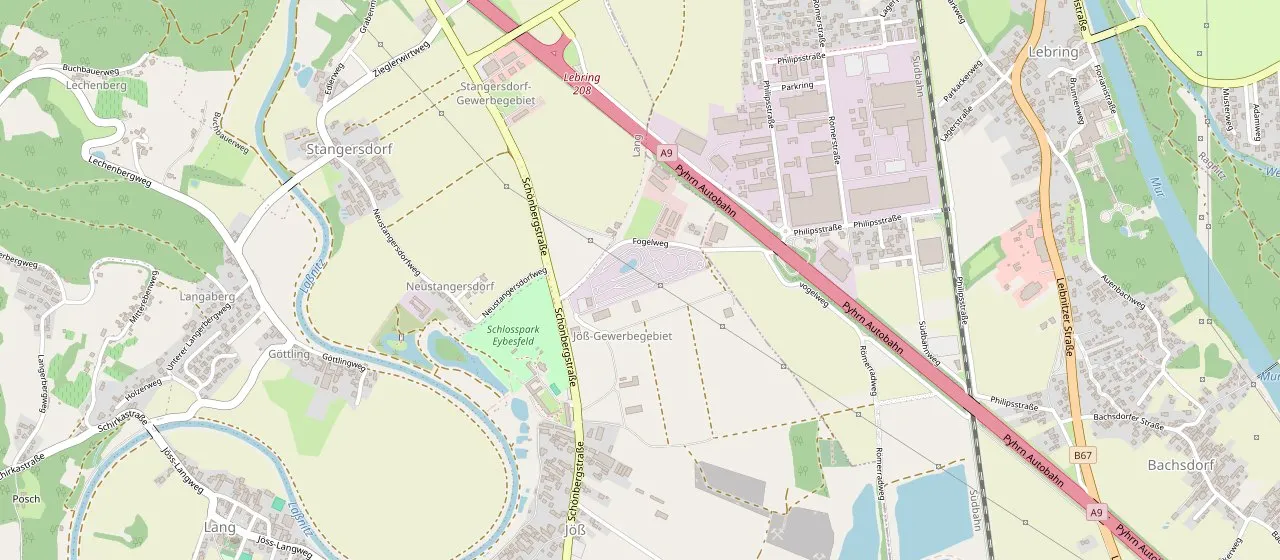
On 10 June 2003 the Austrian automobile club ÖAMTC announced the end of driving safety training at the A1-Ring in Spielberg: the circuit was being taken over by Red Bull owner Dietrich Mateschitz, and the club had to move its centre elsewhere. The first of two new Styrian centres opened on 20 July 2004 in the municipality of Lang, about 20 km south of Graz, on the western side of the A9 motorway. Today the ÖAMTC Fahrtechnik Zentrum Lang/Lebring has six hectares of asphalt and a one-kilometre loop called the Handlingparcours, and amateur drivers practise here in their own cars. Since 2025 it has been run by a rally world champion whose career began with selection rounds held at that same A1-Ring.
| Location | Jöß, Gewerbegebiet 1, 8403 Lang, Leibnitz district, Styria; approx. 20 km south of Graz, Lebring exit of the A9 motorway |
| Type | driver training centre (Fahrtechnik Zentrum) of the ÖAMTC automobile club |
| Opened | 20 July 2004, after seven months of construction |
| Construction cost | approx. EUR 6 million according to the June 2003 plan |
| Area | approx. 60,000 m², five practice tracks |
| Loop | Handlingparcours, 1 km, for cars and motorcycles |
| Facilities | computer-controlled water obstacles, hydraulic skid plate, aquaplaning pool, downhill sections, low-grip surfaces, off-road area |
| Participants | 150,095 in the first twenty years; planned capacity 14,000 people a year |
| Operator | ÖAMTC Fahrtechnik GmbH; centre manager Andreas Aigner (since 1 January 2025) |
| Events | rounds of the Austrian drifting championship (seven up to 2015), special stage of the Südsteiermark Classic historic car rally |
| For amateurs | Dynamik Training PKW in your own car, ending with a run on the loop; EUR 279 (as of 4 October 2026) |
| Status | active |
The circuit that had to be given up
The Lang centre is the offspring of a circuit that no longer exists in that form. In 1996 the Österreichring in Spielberg was rebuilt: it got new run-off areas, was shortened to 4.3 km and renamed the A1-Ring. ÖAMTC undertook to run the circuit so that it covered its own costs and set up a driver training centre next to it, and in the years 1997–2003 Formula 1 returned to the A1-Ring. According to the chronicle of ÖAMTC Fahrtechnik, operations at the A1-Ring began in 1997. After the last Grand Prix the site was sold to Dietrich Mateschitz; in 2004 Red Bull took over the circuit, ÖAMTC ceased to be its leaseholder, and the old A1-Ring was demolished that same year.
The June 2003 press release left no illusions. Erich Sedelmayer, who at the time ran the ÖAMTC driving safety centres together with Franz Wurz, said in it:
“The construction of the new centres became necessary after the takeover of the A1-Ring by Red Bull owner Dietrich Mateschitz. Until both of the club's Styrian centres are completed, training will still take place at the A1-Ring; after that there will be no more driving safety training there”.
The club then announced an investment worth more than EUR 8 million. In Lebring-Jöss a 5.8 ha centre was to be built, with a seminar and office building and five practice tracks, designed for 14,000 trainees a year and worth around EUR 6 million; a second one, of 3.2 ha with two practice tracks, was planned in St. Peter-Freienstein near Leoben. There was also a second reason. Since January 2003 Austria had had multi-phase driver training (Mehrphasenausbildung): in the second phase, after passing the driving test, a young driver had to complete two advanced driving sessions and a driving safety course. At the beginning of 2025 ÖAMTC explained that the fact that as many as three of its centres, Kalwang, Lang and Marchtrenk, were built in 2004 was linked precisely to this reform.
The second Styrian centre was ultimately built not in St. Peter-Freienstein but in Kalwang, and it too opened in 2004. Two decades later the mayor of Kalwang, Mario Angerer, recalled the “hard fight” for this investment, which St. Peter-Freienstein had also sought. Hubert Trattner, the former manager of the Kalwang centre, judged that instead of one centre in Spielberg, Styria got two, and that young drivers could from then on complete their mandatory training much more easily.
Jöß, a field by the Roman road
The municipality of Lang in the Leibnitz district consists of six cadastral communities, one of which is Jöss. The municipality's website recalls that in Roman times a first-class road from Celeia to Flavia Solva ran across the Jößer Feld, the field of the village of Jöß, and that at the crossroads in Jöß there still stands a stone regional court cross (Landesgerichtskreuz) from 1625, right next to the former “Roman road”. The municipal coat of arms shows strips of meadows and fields as seen from the Langaberg; according to the municipality, such a landscape was typical of Lang until the middle of the 20th century.
Around the turn of the century industrial estates began to grow in the area: in 2000 the Impulszentrum was founded in neighbouring Lebring and development of the site in Stangersdorf began. On the website of Impulspark Lang-Lebring, the joint industrial park of the municipalities of Lang and Lebring-St. Margarethen, the year 2004 is described in these words: with the construction of the ÖAMTC centre on the western side of the motorway an important company settled there, and the area became better known. The club hoped for more. In 2003 it wrote that the surroundings of the new centre were suitable as a further location for the Styrian automotive cluster, and that Sensordynamics, a company developing automotive sensors, among others for ABS and ESP, had already settled in the immediate vicinity. The centre's address is Lang, but the A9 exit used to reach it is called Lebring.
Opening after seven months
The June 2003 plan assumed construction would be completed by the end of the year. The centre, then named ÖAMTC-Fahrsicherheitszentrum Steiermark, opened on Tuesday 20 July 2004, after seven months of construction. It was opened by the President of the Styrian state parliament Reinhold Purr, the president of ÖAMTC Styria Helmut Fallada and the club's deputy secretary general Christoph Mondl. The director of the Styrian branch, Paul Fernbach, explained the point of the investment as follows: “ÖAMTC's road safety work starts with better training of drivers, in order to combat the number one cause of accidents, human error”.
Five practice tracks were laid out on almost 60,000 m². The press release from opening day listed computer-controlled water obstacles, a hydraulic skid plate, a downhill section, low-grip surfaces, lighting of the whole site, speed measurement on individual modules and an off-road area. Young drivers received a free trial membership of the club, and members taking the multi-phase training who had no vehicle of their own could, after booking, get a car or motorcycle for the exercises free of charge. The club announced the opening of its Marchtrenk centre in Upper Austria for 27 July, and in the whole of 2004 around 90,000 people were expected to pass through its centres in Austria.
In the years for which data are available, the Lang centre did not come close to the planned 14,000 trainees a year. In 2015 it received 6,550 participants, in 2016 7,750, in 2018 7,700, in 2019 7,800 and in 2022 more than 8,000; for 2023 ÖAMTC reported more than 5,600 people, including 1,695 trainees on multi-phase training. In the first twenty years 150,095 people passed through the centre. On its website the operator speaks of around 8,000 participants a year and up to 60 trainees practising at once.
Racing drivers as instructors
ÖAMTC's training grew out of motorsport. In 1984 the club began working with three-time European rallycross champion Franz Wurz; the idea was that training previously reserved for competitors should serve road safety, and that the instructors should be competitors with motorsport successes behind them. In 1987 the first Austrian driver training centre opened in Teesdorf. The company's website today puts it briefly: ÖAMTC Fahrtechnik grew out of rallying.
In Lang this lineage is most visible in drifting. ÖAMTC centres had been running courses in controlled sideways driving since the summer of 2004. In 2009 the club organised the first Austrian drifting championship, the Dunlop Drift Challenge Austria: four rounds at its centres, including the second, on 12 and 13 June, in Lang-Lebring. The judges assessed slip angle, line and elegance, which the press release compared to “»Dancing Stars« for cars”, and the best of three runs counted towards the classification.
The best-documented round in Lang took place on 14 and 15 June 2013, at 35 degrees. The favourite was local four-time Austrian champion Alois Pamper, but after a minor mistake in his first run he was only sixth. Before the deciding series the second local favourite, Austrian runner-up Martin Köllinger, who no longer had a chance of a top place, offered him his stock of tyres. “At least the win was supposed to stay in Styria,” wrote the motorline.cc reporter. On fresh tyres Pamper received the maximum score, drove the fastest lap and won the day's classification ahead of Mario Schopper and Thomas Graf.
The championship also had a man inside the centre itself. From 1 July 2013 it was run by Gerald Beirer, years earlier a freelance ÖAMTC instructor, who had raced in various series since 1992 and was then race director of the Austrian drifting championship. In May 2014, 50 drifters entered another round in Lang, and “Gery” Beirer himself announced he would fight for victory in the large production car class. In the spring of 2015 the championship came to Lang for the seventh time; at the centre one could train with Pamper, and Porsche and Ferrari drivers were taught high-speed driving by Herbert Pregartner, introduced as European hill climb runner-up. In 2021 Pregartner was the chief instructor in Lang. The operator still stresses that participants in the Austrian drifting championship are “particularly active” here. It has not been possible to establish whether and when championship rounds returned to Lang after 2015.
A world champion in the manager's office
In 2003 nineteen-year-old car mechanic Andreas Aigner entered the selection rounds of the Red Bull Driver Search. “I hadn't done karting or circuit racing. And back then I had never even seen a rally live,” he said later. The selection rounds were held at the A1-Ring, which Aigner called a stroke of luck, because the circuit lay not far from his home. In the first round 400 candidates drove a Volkswagen Lupo GTI around a course marked out with cones; after the second round, psychological and fitness tests and three days of driving a Skoda Octavia WRC on the Erzberg, Red Bull chose two drivers, him among them.
Five years later, in Wales, in the final round of the 2008 season, Aigner won the world title in the P-WRC classification, which covers cars close to production models. He drove a Mitsubishi with co-driver Klaus Wicha, was six points behind the leader before the rally, and at the finish was second in his class, although third place would have been enough for the title.
From 2019 Aigner ran the ÖAMTC centre in Kalwang, and on 1 January 2025 he took over Lang as well. He replaced Franz Kleewein, who had worked for the company for 21 years, more than ten of them as manager in Lang, and stayed on with it as a freelance instructor. ÖAMTC presents the new head as a former rally world and European champion. When both Styrian centres celebrated their twentieth anniversary in September 2024, it was Aigner who presented the club's figures: according to ÖAMTC, the number of car accidents with personal injury in the 17–24 age group fell in Styria by 65.8 percent, comparing the averages for 2000–2002 and 2021–2023. This story comes full circle: at the A1-Ring, which ÖAMTC had to leave after Red Bull took over the circuit, Red Bull's selection rounds opened the way for a young man who more than twenty years later took charge of the centre built in its place.
A proving ground for the automotive cluster
The 2003 hope of having the automotive industry as a neighbour returned years later in a different form. In 2018 the centre worked more closely with companies of the Styrian mobility cluster ACstyria on testing complete vehicles and autonomous cars, and according to its management it was increasingly used by car manufacturers as a test site, including for component trials. On Tuesday 18 August 2020 the Linz company Kontrol tested software here that is meant to make sure an autonomous car obeys the Austrian highway code. The car, with a driver on board, recognised the 50 and 30 km/h limits and drove around a dummy car, and Daniel Watzenig of Graz University of Technology described the test as a step towards approving such systems for production cars. Aigner now says plainly: “Thanks to the proximity of Graz, our centre has become the vehicle testing hub of the Styrian automotive cluster”.
The site has also served less serious purposes. In 2015 a Jaguar and Land Rover roadshow was based here, and in 2016 and 2018 the regional portal MeinBezirk, quoting the centre's manager, wrote of the longest outdoor karting track in Styria and of company go-kart races. On today's list of ÖAMTC centres offering Kart Experience are Teesdorf, Melk/Wachauring, Saalfelden/Brandlhof and Innsbruck; Lang/Lebring is not on it.
A kilometre of grippy asphalt
There is no race track in Lang. Instead there is the Handlingparcours, a 1 km loop that the operator describes as “Rundkurs, griffiger Asphalt, herausfordernde Kurvenkombinationen”, that is, a closed circuit with grippy asphalt and challenging combinations of corners. For drivers with their own car ÖAMTC offers the Dynamik Training PKW here, a course for those who have already completed the basic Intensiv Training. It covers reacting to a sudden obstacle, sliding in a corner and aquaplaning, which in practice is trained at only five centres, Lang among them; the instructor stays in radio contact with the trainee. The course description, common to all centres, promises at the end a run on a “selective loop” on which all manoeuvres are performed at a brisk pace, one after another.
ÖAMTC counts the Dynamik Training among the courses taken in your own vehicle. The group comprehensive (autocasco) insurance included in the course price is subsidiary and covers only cars registered in Austria, up to EUR 3,000 compensation, with a EUR 400 deductible. The one-day course in Lang cost EUR 279 at the beginning of October 2026, and the next dates were set for 25 October, 22 November and 13 December 2026 and 23 January 2027, each for at most ten people. It is a safety course with an instructor, not free driving. ÖAMTC runs its standard Drift Training only in Teesdorf, Melk, Saalfelden and Innsbruck, but drifting in the form of individual sessions is possible at all centres. On the centre's website the operator also advertises car hire for the duration of a course, from production upper-class saloons to cars built for motorsport.
Three of six laps in the rain
Cars several decades older than the centre regularly take to the loop in Lang. According to the operator, classic car meetings are a fixture of the programme here, especially during the Südsteiermark Classic. The rally, based in Gamlitz, began in 2001 as a small event for enthusiasts and today has around 160 historic cars built in 1920–1972 at the start; in 2025, on the first day of driving, from 15:00, a special stage called “Rundkurs ÖAMTC” was held in Lang/Lebring.
Thursday 24 April 2025 brought a downpour. Some roads were closed, so the crews did not follow the road book but navigated to the ÖAMTC centre on their own. There, as in previous years, they had to drive three of six laps in a precisely set time, which on a wet surface and in poor visibility the organisers called “a real test of nerves”. According to them many crews managed this with remarkable precision, and the pre-war class of the whole rally was won by Erich and Alexandra Hemmelmayer in a 1929 Ford coupé.
Sources (37)
- ÖAMTC, ÖAMTC baut in der Steiermark zwei Fahrsicherheitszentren, 2003-06-10 [de]
- ÖAMTC, 20 Jahre ÖAMTC Fahrtechnik in Kalwang und Lang-Lebring, 2024-09-20 [de]
- ÖAMTC, ÖAMTC eröffnet Fahrsicherheitszentrum Steiermark in Lang-Lebring, 2004-07-20 [de]
- Impulspark Lang-Lebring, Historie & Vision [de]
- ÖAMTC Fahrtechnik, Zentrum Lang/Lebring [de]
- ÖAMTC Fahrtechnik, Dynamik Training PKW [de]
- ÖAMTC Fahrtechnik, Versicherungsbedingungen [de]
- ÖAMTC, Andreas Aigner wird neuer Leiter des ÖAMTC Fahrtechnik Zentrums Lang-Lebring, 2024-12-11 [de]
- Fünf Jahre voller Höhen und Tiefen – Weltmeister Andi Aigner im Portrait, motorline.cc, 2008-12-07 [de]
- ÖAMTC Fahrtechnik, ÖAMTC Fahrtechnik Zentrum Lang/Lebring (STMK). So finden Sie zu uns [de]
- Waltraud Fischer, Über 8000 Besucher: ÖAMTC Fahrtechnik Zentrum Lang-Lebring bleibt Besuchermagnet, MeinBezirk (Leibnitz), 2023-01-22 [de]
- ÖAMTC Fahrtechnik, ÖAMTC Fahrtechnik im Überblick [de]
- Sarah Konrad, Seit 20 Jahren mit Sicherheit zu mehr Fahrspaß, MeinBezirk (Leoben), 2024-09-20 [de]
- ÖAMTC, ÖAMTC: Der Kampf um die Krone der Quertreiber - Start frei für die erste österreichische Staatsmeisterschaft im Driften, 2009-05-06 [de]
- Waltraud Fischer, 6.550 Teilnehmer im Fahrtechnik Zentrum Lebring, MeinBezirk (Leibnitz), 2016-01-21 [de]
- Südsteiermark Classic, Das war die Südsteiermark Classic 2025, 2025-05-31 [de]
- ÖAMTC Fahrtechnik, system rezerwacji szkoleń, PKW Dynamik Training [de]
- August Kargl, 50 Jahre Österreichring, „auto touring” (magazyn ÖAMTC), 2019-06-25 [de]
- Der lange Weg zum Red-Bull-Ring, oe24.at, 2011-05-10 [de]
- ÖAMTC, ÖAMTC Fahrtechnik: Rekord im Jubiläumsjahr - 1,5 Millionen Teilnehmer in 25 Jahren, 2012-04-26 [de]
- ÖAMTC, ÖAMTC Fahrtechnik: 113.100 Personen trainierten 2024 für mehr Sicherheit auf der Straße, 2025-01-28 [de]
- Gemeinde Lang, Zahlen & Fakten [de]
- Eva Heinrich-Sinemus, ÖAMTC Fahrtechnik Zentrum Lang-Lebring – 7.750 Teilnehmer im Jahr 2016, MeinBezirk (Leibnitz), 2017-01-27 [de]
- Eva Heinrich-Sinemus, ÖAMTC Fahrtechnik Zentrum Lang-Lebring – 7.700 Teilnehmer im Jahr 2018, MeinBezirk (Leibnitz), 2019-01-20 [de]
- Waltraud Fischer, 7.800 Teilnehmer in Lang-Lebring im Jahr 2019, MeinBezirk (Leibnitz), 2020-02-06 [de]
- ÖAMTC, ÖAMTC organisiert erste »Ice Night Drift Challenge«, 2005-02-21 [de]
- Alois Pamper gewinnt DCA Lang-Lebring, motorline.cc, 2013-06-18 [de]
- Eva Heinrich-Sinemus, Neuer Chef im Fahrsicherheitszentrum Lang-Lebring, MeinBezirk (Leibnitz), 2013-07-16 [de]
- Fahrtechnik Zentrum Lang-Lebring hat neuen Leiter, AUTO & Wirtschaft, 2013-07-17 [de]
- Eva Heinrich-Sinemus, Drift Challenge im ÖAMTC Fahrtechnik Zentrum Lang, MeinBezirk (Leibnitz), 2014-05-08 [de]
- Waltraud Fischer, Zum Saisonstart: ÖAMTC Fahrtechnik-Zentrum Lang-Lebring erweitert Zweirad-Fuhrpark, MeinBezirk (Leibnitz), 2021-03-10 [de]
- Andreas Aigner P-WRC-Weltmeister, derStandard.at [de]
- Andreas Neumayer, ÖAMTC: Neuer Leiter für das Fahrtechnik-Zentrum Lang-Lebring, MeinBezirk (Leibnitz), 2024-12-11 [de]
- Autonomes Fahren: Testlauf für neue Software, steiermark.ORF.at, 2020-08-18 [de]
- ÖAMTC Fahrtechnik, Kart Experience [de]
- ÖAMTC Fahrtechnik, Drift Training PKW [de]
- Waltraud Fischer, Die Südsteiermark Classic 2025 nimmt volle Fahrt auf, MeinBezirk (Leibnitz), 2025-04-22 [de]