
Örkény, Hungary
Euro-Ring Örkény: the circuit that grew on a field by the M5
The story of Euro-Ring in Örkény: built with private money in 2004, the opening, Talmácsi and Formula 3000 tests, and today track days 52 km from Budapest.
- Type
- race circuit
- Length
- 2.75 km
- Opened
- 2004
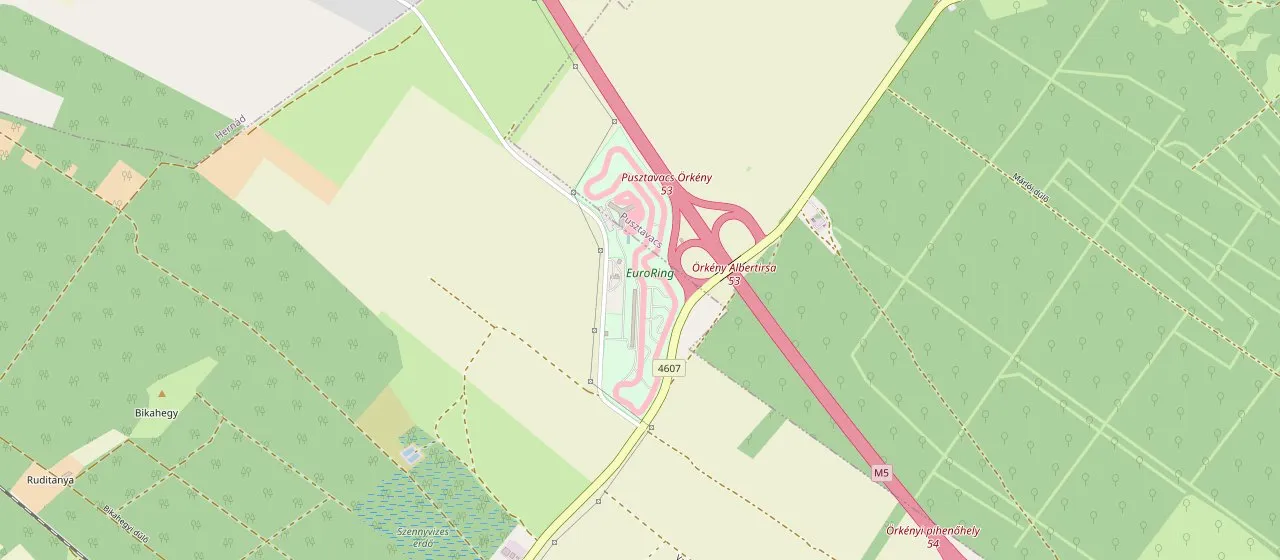
In the summer of 2004, drivers on the M5 motorway heading from Budapest towards Kecskemét could see, halfway along, a crew building a road that led nowhere: a concrete ribbon that turned back and bit its own tail. That is how a journalist from the Hungarian outlet Totalcar described the building site by the Örkény exit, where Hungary's third serious racing circuit was taking shape on former farmland. A few weeks later, on 26 September 2004, a white, red and green ribbon was cut here. Euro-Ring still operates 52 km from the capital, and for Hungarian amateurs it is, as Totalcar put it twenty years later, the "golden mean" between the small circuits and Pannónia-Ring.
| Location | Örkény, Pest County, by the M5 motorway exit at kilometre 52, about 52 km from Budapest |
| Type | permanent racing circuit for cars, motorcycles and karts |
| Length | 2750 m in the full configuration, main straight 330 m; in 2004 the press quoted 2300 m, in 2005 the operator 2400 m |
| Width | 12 m on the main straight, 10 m on average elsewhere |
| Elevation change | 2.5 m (according to the circuit's director in 2004) |
| Number of corners | 21 in the 2004 configuration |
| Year opened | 2004 (official opening on 26 September) |
| Fastest known lap | László Szász, Formula 3000, 1:06.765 on the 2400 m configuration, May 2005; the operator called it the official best result at the time |
| Site operator | Racetrack Kft. |
| Status | active; track days, rental, karting, training |
The road that turns back
When the Totalcar reporter arrived on site in August 2004, there was a petrol station on a side road, then a strip of asphalt, workers bolting down a barrier and an unfinished fence. The host was András Csaba, the director of the facility, who had previously run Pannónia-Ring for eight years. The conversation took place on the upper floor of a former agricultural trade centre, a building left over from a supermarket, which stood behind the circuit.
The numbers the director gave explain the character of the place to this day. The 2300 m of the time held 21 corners; by way of comparison, the journalist recalled that on the 4381 metre Hungaroring a driver turns only fourteen times. The width ranged from 10 to 14 m, so that the circuit would suit both motorcycles and cars. The difference between the highest and the lowest point was a mere 2.5 m. The asphalt was laid by Strabag; Csaba initially wanted a coarser grain, but the owners insisted on the more expensive one, smoother and offering better tyre grip. Several sections had to be relaid during the works.
The most interesting part, however, is the financial structure. According to Totalcar this was the first circuit in Hungary that the owners conceived from the outset as a profit-making venture. The whole thing, with buildings, safety features, a paddock and a fence, was to cost around 1–1.2 billion forints, and the money came from a group of investors connected with motorsport, without support from companies or the state. The plan called for motorcycle, car and kart races, open days and rally super special stages, and the numerous link roads allowed loops of different lengths and shapes to be put together. The journalist ended his visit with a few laps of the dusty asphalt and a sentence that captures the character of the place well:
"Euro-Ring is a very, very, very technical circuit!"
The ribbon at kilometre 52
The official opening had originally been planned for after all the works were finished, perhaps only in 2005. It turned out otherwise. On 26 September 2004 András Csaba, together with the mayors of Örkény and neighbouring Pusztavacs, István Kovács and Sándor Mihályi, cut the ribbon and Euro-Ring formally started operating. From 7 October the circuit was open from Monday to Friday to anyone willing to pay a full-day or half-day fee; in mid-October the facility closed for two days, because only then were the kerbs being laid.
The first months show what the new circuit was used for. In November 2004 Volkswagen held a two-day test here, and in December the operator announced that the motorcycle rider Gábor Talmácsi, then preparing for the 2005 season with the factory KTM team, would train here on a supermoto over the winter.
In May 2005 László Szász spent two days testing a Formula 3000 car at Euro-Ring, tuning the wing settings. At the end of the straight he reached 210 km/h, and he lapped the 2400 metre loop in 1:06.765; the operator called that time the circuit's official best result. That same month the first MAMS (the Hungarian motorcycle federation) race of the season was held in the junior, scooter and historic motorcycle classes, the race was opened by a safety car with a doctor on board, and Avon chose what the operator called "Hungary's newest circuit" for a presentation of its Viper tyres to journalists from neighbouring countries. In August 2005 Robert Lechner, from the Austrian family known for the Porsche Supercup and a racing school, brought a Formula BMW Junior here for two days; in November BMW held a presentation of the xDrive drivetrain here with 38 cars, and the circuit was closed for a week to anyone without an invitation.
In February 2006 footage was shot at Euro-Ring for the Discovery Channel, in which Hungary's first Formula 1 driver Zsolt Baumgartner and Talmácsi made their debut as presenters of a motoring programme. The price list from that season gives a sense of the scale: a whole day cost 20,000 forints for a car, 12,000 for a motorcycle and 5000 for a kart.
Twenty years later
The operator today gives a full length of 2750 m with a 330 metre main straight, on which speeds reach about 180 km/h. The asphalt layer is 9 cm thick, and the circuit, as the facility's website assures, requires "a great technical knowledge" and, thanks to its layout, offers many alternative driving lines. Where the 2750 m came from, in place of the 2300 m of 2004 and the 2400 m of 2005, the sources available while this text was being written do not explain; all that is known is that link roads allowing the shape of the loop to be changed were planned from the start.
The facility was expanded gradually. According to the operator's website the main entrance was moved, the bar was rebuilt, the conference rooms of 180 and 130 m² were refurbished, a VIP area was arranged, and competitors are met by 24 refurbished garages, a new tower for the officials and a terrace from which the whole circuit can be seen. In the 2019 calendar of the Hungarian car federation MNASZ, Euro-Ring appears as the venue of the amateur RaceTaxi.hu endurance races.
For the amateur driver Euro-Ring is, according to Totalcar in 2023, a circuit that is still small, but faster and longer than Kakucs Ring or M-Ring; on the straight one "easily" reaches 160–180 km/h, so, as the author notes, here you can already have a serious crash. A day of driving cost 45,500 forints per person at the time. A helmet is required in a car with a roll cage and in an open convertible, a tow hook is required without a cage, and the exhaust system must have a silencer; there is no separate noise limit, but an exceptionally loud car may be sent away if it disturbs others. The exit from the motorway leads straight to the gate, and the circuit is open every day from 9 to 18 with a lunch break, provided that no closed event is under way. The concrete ribbon that in 2004 led nowhere still turns back in the same place.
Sources (10)
- grubi, Magyarország legjobb útja, Totalcar, 2004-08-03 [hu]
- Megnyílt az EURO-RING, 2004-09-26 [hu]
- 6 hely, ahol kinyomhatod az autód szemét, Totalcar, 2023-02-17 [hu]
- Euro-Ring Versenypálya, Rólunk [hu]
- Euro-Ring Racetrack, Racetrack [en]
- Laszlo Szász - Formul 3000, „Mams” (11.05.2005), 2005-05-10 [de]
- Pályamunkálatok, „Nyílt nap az EURO-RINGen” (8. i 11.10.2004), 2004-10-08 [hu]
- A Lechner Racing Team tesztelt az Euro-Ringen, 2005-08-12 [hu]
- Autósműsort forgatott Talma és Baumgartner, 2006-02-23 [hu]
- Magyar Nemzeti Autósport Szövetség, Naptárak 2019 [hu]