
Mogyoród, Hungary
Hungaroring: built behind the Iron Curtain, rebuilt at 40
Hungaroring history: construction in 1985–1986, the first Hungarian GP in 1986, rebuilds in 1989 and 2003, the 2023–2026 reconstruction and corner names.
- Type
- race circuit
- Length
- 4.381 km
- Opened
- 1986
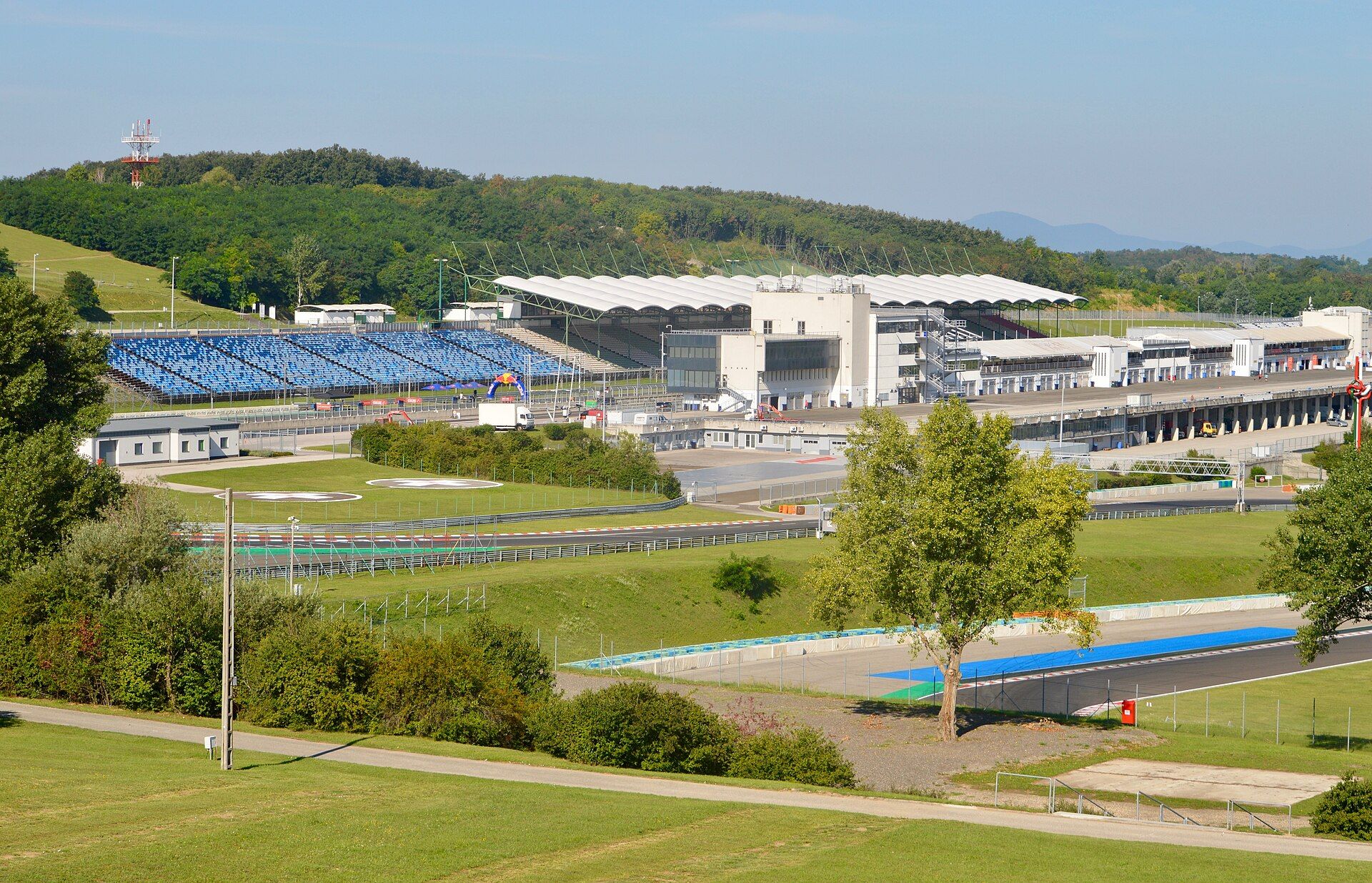
Bales of straw stood at the marshal posts, and the marshals learned how the race was going from a Szokol transistor radio. That is how Péter Faluvégi, today the race director and back then a marshal at post number five, remembered the first Hungarian Grand Prix in August 1986. Forty years later the same circuit has a new building with 36 garages for the teams, a covered grandstand for 10,000 spectators and two tunnels under the start straight, and the corners have been given drivers' names. Between those two images lies the history of the only Formula 1 circuit built behind the Iron Curtain.
| Location | Mogyoród, Pest county, about 20 km north east of Budapest, by the M3 motorway |
| Type | permanent race circuit, FIA grade 1 licence |
| Length | 4.381 km in the configuration in use since 2003 |
| Former configurations | 4.014 km (1986–1988); 3.975 km (1989–2002) |
| Opening | 1986 (the János Drapál memorial race); first Formula 1 Hungarian GP on 10 August 1986 |
| Fastest race lap | Lewis Hamilton, Mercedes F1 W11, 1:16.627, 2020 Hungarian GP |
| Owner and operator | Hungaroring Sport Zrt. (since 1995) |
| Main events | Formula 1 Hungarian Grand Prix (without a break since 1986, contract to 2032), FIA WTCR, European Le Mans Series, truck European championship |
| Status | active; infrastructure rebuild completed in April 2026 |
Rohonyi, Ecclestone and the valley near Mogyoród
Racing in Hungary did not begin with Formula 1. As early as the 1930s cars raced on a street circuit in Budapest's Népliget park, where in 1936 Tazio Nuvolari won the Budapest Grand Prix in an Alfa Romeo. After the war the events moved to an improvised layout at Ferihegy airport, and then back to Népliget, where racing continued into the 1970s.
In the mid 1980s Bernie Ecclestone decided that Formula 1 had to go behind the Iron Curtain. His plans first involved the Soviet Union, above all Moscow, then China and Yugoslavia. On the advice of a friend of Hungarian origin, Tamás Rohonyi, he turned his attention to Budapest. The Hungarian authorities wanted to use the races to promote tourism and the country's image, and the first idea was a Monaco style street race on a layout in Népliget. That option was dropped in favour of a permanent venue.
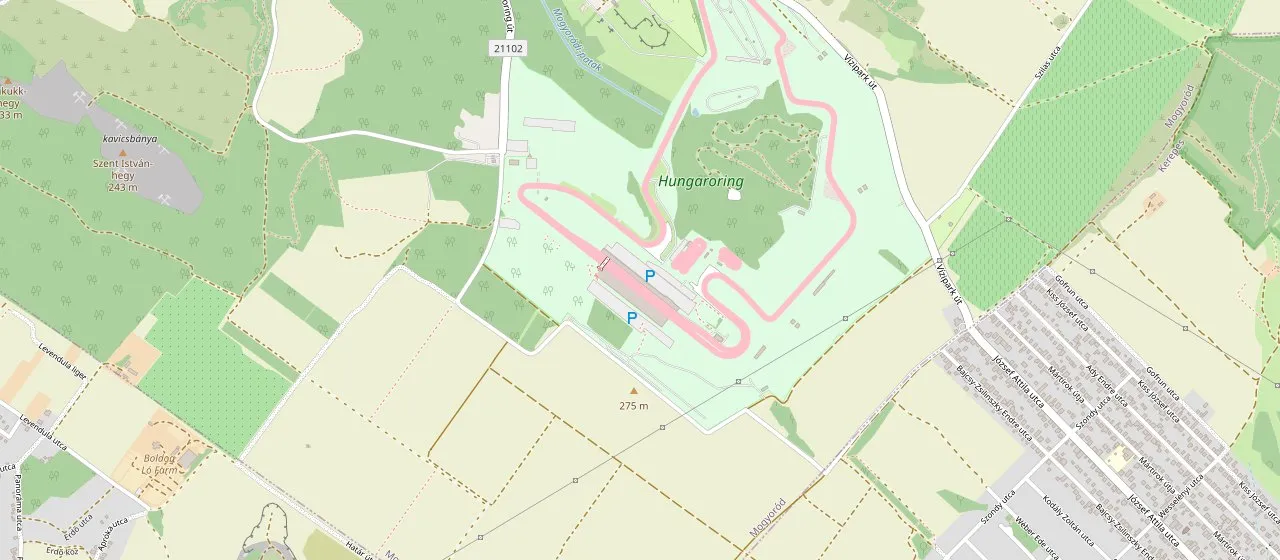
The site was found near Mogyoród, about 20 km north east of the capital, right by the motorway. It lay in a natural bowl, so most of the circuit is visible from almost anywhere. The contract was signed on 10 September 1985, work started on 1 October, and in 1986 the circuit opened with a memorial race for János Drapál, a four time winner of motorcycle Grands Prix who had died a year earlier in a race in Czechoslovakia. There was some improvisation: during the works an underground spring was found and the planned layout had to avoid it with a series of tight esses, which noticeably lengthened the lap.
The first Hungarian Grand Prix was held on 10 August 1986. Nelson Piquet won in a Williams-Honda ahead of his compatriot Ayrton Senna in a Lotus-Renault and Nigel Mansell in the second Williams. Crowds of spectators came to the race from Eastern Bloc countries, Germany and Austria. The race itself entered the circuit's history thanks to Piquet's move on Senna at the first corner, made in a controlled slide; in 2026 the operator named that corner after him.
Dust, esses and alterations
The event was a success, the circuit less so. Drivers complained about the tight, twisty layout and the slippery surface: the venue stood unused for most of the year, and the shape of the bowl meant dust was a constant problem. Some liked driving here, others could not stand it, but all agreed that overtaking was almost impossible. The operator itself admits: „our circuit is dusty, our race is hot”, and for the drivers it is one of the hardest tests of the season.
Mansell contradicted that opinion twice, though the first time to his own cost. In 1987 he was leading by a large margin when, five laps from the finish, the nut of his right rear wheel came loose, which television caught in close up; he had to park on the grass. Two years later he started a Ferrari from twelfth place. He passed rival after rival until he was second behind Senna, and when the Brazilian hesitated while lapping a backmarker, Mansell used it on the run to the fourth corner and won. In 1992 it was here that he celebrated the world championship title.
The circuit has been rebuilt twice. In 1989, once the spring problem was finally solved, the awkward esses behind the paddock, officially the „third chicane”, were cut out. Before the 2003 season the start straight was lengthened and the first, twelfth and fourteenth corners were changed; the new, tighter first corner gave a little more room for overtaking. The lap length went from 4014 m through 3975 m to the 4381 m in use since 2003. In the winter of 2015/2016 the top layer of asphalt was replaced around the whole circuit, to a depth of three to five centimetres, and the kerbs in corners 4 and 11 were changed at the same time with motorcycle racing in mind.
To this catalogue of alterations comes the ownership history. The circuit was built by the company Formula 1 Gazdasági Társaság, whose head held the management rights for the first five years. The end of that cycle coincided with the change of political system and, in order to survive financial trouble, the venue was leased for five years to Ecclestone, who in return undertook to organise five more races. The arrangement did not work for either side. In 1994 negotiations started between Ecclestone and János Berényi, president of Hungaroring Sport Zrt., and since 1995 it is that company which exercises the ownership rights.
First wins and a Hungarian debut
The Hungaroring became the circuit of first wins: for Damon Hill (1993), Fernando Alonso (2003), Jenson Button (2006), Heikki Kovalainen (2008), Esteban Ocon (2021) and Oscar Piastri (2024). Michael Schumacher secured his fourth title here in 2001, and won four times in total. The record holder is Lewis Hamilton with eight wins and nine pole positions. Sebastian Vettel needed nine years to win for the first time, in 2015; he repeated it in 2017.
In 1997 Hill lost victory on the last lap because of a failure, which the Hungarian public remembered in the phrase „Where has Damon Hill gone?!”; in turn 1995 and Jean Alesi's race meant that fans and the Hungarian motorsport community had for years called corner 11 the Alesi corner, before the name became official in 2026.
The Hungarian thread is short, but important for the venue. The first Hungarian behind the wheel of a Formula 1 car at this circuit was Csaba Kesjár, who tested a Zakspeed here in 1987; he later died in a racing accident. In 2003 Zsolt Baumgartner made his debut at the Hungarian Grand Prix in a Jordan after the crash and injury of Ralph Firman, and in the following year he drove a full season with Minardi. The operator calls him the first and still the only Hungarian Formula 1 driver.
For Polish fans, the Hungaroring is the circuit of one more debut. In August 2006 Robert Kubica, until then BMW Sauber's test driver, replaced Jacques Villeneuve at the Hungarian Grand Prix, as Villeneuve could not start after his crash at the German Grand Prix; the team billed him as the first Pole in the history of Formula One Grand Prix racing. Kubica finished seventh, but at the technical check after the race his car turned out to be two kilograms too light, so he was disqualified and lost two world championship points. The team's technical director Willy Rampf explained that the intermediate tyres on Kubica's car had been in use for 51 laps and had worn more than expected. The same race brought Jenson Button his first win.
The Hungarian Grand Prix, as the operator stresses, was never under threat. In 2002 it received the race of the year award at the federation's gala, and the broadcast of the 2020 race, held without spectators, was the most watched of the season. After Monza it is the second circuit that has appeared without a break in the world championship calendar.
The smallest paddock in the championship
In the summer of 2023 the contract to host the race was extended by five years, to 2032. The previous contract ran to 2027. The condition of the extension was a modernisation of the venue. Gergely Gulyás, the minister heading the Prime Minister's Office, said in February 2024 that the government's decision had been taken in April 2023, after which a tender was called, and work started at the end of the year.
„The Hungaroring has played a great role in the Hungarian sporting history of recent decades; if someone looks back at the years around the change of system, then alongside Coca-Cola, McDonald's and the world passport it was the Hungaroring that meant the opening and a breath of freedom.”
Zsolt Gyulay, president of Hungaroring Sport Zrt. and a two time Olympic champion, explained the need for the investment simply: the Hungaroring had the smallest paddock in the entire championship, one that barely fitted the teams' motorhomes, and a modern Formula 1 weekend is a four day festival which circuits have to accommodate. The programme begun in 2022, whose first stage was a new main entrance, an operations centre and a cafe, moved into a second, much bigger one.
The consortium of Market Építő Zrt. and Bayer Construct Zrt. took over the building site on 18 December 2023 and over the holidays demolished five thousand cubic metres of buildings in order to start piling. Some 1500 piles with a total length of 22.5 km were drilled. By the 2024 Grand Prix the paddock had been widened to 8000 m², two tunnels under the start straight and 450 m of retaining walls behind the grandstand had been built; 1500 people passed through the site, and at the peak work went on around the clock. The start straight was cut through in two places, and the circuit got the site back sixty days before the race and handed it over ten days after it.
The hardest was stage two: making a complete 280 m long building disappear and putting up a new one in ten and a half months so that the garages could be used normally during the 2025 Grand Prix. Zoltán Juhász, technical director of Market Építő, compared that task to fighting for victory in a Formula 1 race. It worked: for the 40th Hungarian Grand Prix in August 2025 a building stood with 40 garages (36 for the teams and four technical ones), a catering and VIP zone, offices and a roof terrace, though the press centre was still not ready and the whole investment was due to finish in April 2026.
Corners with names
The renewed circuit was officially opened on Sunday 26 April 2026 with an event for four thousand people. The new covered main grandstand has 13,000 m² and holds 10,000 spectators, next to the commentary boxes it got a VIP terrace, and two tunnels at the beginning and the end of the straight link it to the new main building. The building houses 36 racing garages and four technical ones, a restaurant, a VIP zone, a press centre and a new race control centre. The operator presents the venue as an events centre operating 365 days a year, open to testers, drivers, conferences and the public. The state secretary for sport Ádám Schmidt spoke in June 2025 of 300,000 spectators over the race weekend, 80 percent of them from abroad.
On 15 June 2026 the operator celebrated the circuit's fortieth anniversary with a photography exhibition in Budapest's Millenáris park. Faluvégi talked about a six month course at which the event doctor showed the marshals bloody footage to see who would not cope.
At the 2026 Grand Prix the circuit announced the names of the corners, chosen in a fan vote in 2025 and approved by a team of experts. The first corner is Piquet, the second Hamilton (the Briton had himself said earlier that he would choose number two), the third Forrás, that is Spring, from the Valley of Three Springs in which the circuit lies. The fourth carries Mansell's name, the fifth the name of the Mogyoród municipality, the sixth and seventh commemorate the Driving Center, the first driving technique centre in Hungary, opened on the circuit grounds in 1998. The eighth and ninth are Buda and Pest, the tenth Duna, the eleventh Alesi, the twelfth Schumacher, the thirteenth Senna, and the fourteenth Szisz, after Ferenc Szisz, an engineer of Hungarian origin who in 1906 won the first Grand Prix in history and whose statue stands in the sculpture park by the circuit. Mansell, Hamilton and Alesi made handprints; the concrete casts are to go to the circuit's safety zones.
Timeline
- 1936: Budapest Grand Prix on the street circuit in Népliget park, won by Tazio Nuvolari.
- 10 September 1985: signing of the contract to build the circuit; work started on 1 October.
- 1986: opening of the circuit with the János Drapál memorial race.
- 10 August 1986: first Formula 1 Hungarian Grand Prix, won by Nelson Piquet.
- 1987: Csaba Kesjár tests a Zakspeed as the first Hungarian in an F1 car at this circuit.
- 1989: removal of the esses (the third chicane) after the underground spring problem was solved; Mansell's win from 12th place.
- 1992: Mansell secures the world championship title.
- 1995: ownership settled; the ownership rights are exercised by Hungaroring Sport Zrt.
- 1998: opening of the Driving Center, the first Hungarian driving technique centre.
- 2001: Schumacher takes his fourth title.
- 2003: lengthening of the start straight and change of corners 1, 12 and 14; lap of 4.381 km; debut of Zsolt Baumgartner.
- 2006: debut of Robert Kubica, the first Pole in an F1 Grand Prix; seventh place and disqualification for an underweight car.
- winter 2015/2016: resurfacing of the whole circuit.
- 2020: Hamilton's fastest race lap, 1:16.627.
- 2023: extension of the contract with F1 to 2032; government decision on the rebuild; handover of the building site on 18 December.
- 2024: completion of the first stage of the rebuild: 8000 m² paddock, two tunnels.
- 2025: 40th Hungarian GP in the new pit building.
- 26 April 2026: official opening of the renewed venue.
- July 2026: naming of the corners.
Sources (12)
- Hungaroring Média, Negyvenéves a Hungaroring!, Hungaroring Sport Zrt, 2026-06-15 [hu]
- Hungaroring Média, Nevet kaptak a Hungaroring kanyarjai, Hungaroring Sport Zrt, 2026-07-24 [hu]
- MTI, Hivatalosan is megnyitott a felújított Hungaroring, Magyar Nemzet, 2026-04-27 [hu]
- Hungaroring Sport Zrt., A pálya története [hu]
- Hungaroring, RacingCircuits.info [en]
- A Hungaroring históriája: 25 éve épült a pálya, Múlt-kor, 2011-07-28 [hu]
- Hungaroring, Motorsport Database [en]
- Hungaroring Média, Formula 1-es tempóban zajlik a Hungaroring felújítása, Hungaroring Sport Zrt, 2024-02-12 [hu]
- Phase one of Hungaroring redevelopment complete, Formula1.com, 2024-06-11 [en]
- Christian Nimmervoll, Huge renovation work almost complete at Hungaroring ahead of F1 Hungarian GP, Motorsport.com, 2025-06-21 [en]
- BMW Sauber F1 Team: Test driver Kubica replaces Villeneuve in Budapest, BMW Group PressClub, 2006-08-02 [en]
- BMW Sauber F1 Team: GP Hungary Statement, BMW Group PressClub, 2006-08-07 [en]