
Wietze (Jeversen), Germany
Contidrom: Continental's Oval, Ghost Car and Motorcyclists' Rally
The Contidrom in Jeversen: Continental's tire test track of 1967, the driverless car of 1968, huge motorcycle rallies and ADAC courses for amateurs.
- Type
- test track
- Length
- 3.8 km
- Opened
- 1967
A driverless car that Continental showed at the Contidrom in 1968 was driven during its trials at night as well. Hans-Jürgen Meyer, then a young engineer at the company, stood in the control room by the track and watched the headlights of the Mercedes appear and disappear again and again; sometimes the car did not come past, because it had lost the wire fixed to the road surface and had stopped by itself. The tire test track, built by the Hanover manufacturer in the area known as the Südheide, among fields and pine forests, had by then been running for a year. Over almost sixty years a ghost car has driven on it and motorcycle rallies for more than 25,000 people have been held there; today a robot brakes in a hall on its grounds. An amateur driver can enter this track in their own car on courses run by the ADAC centre.
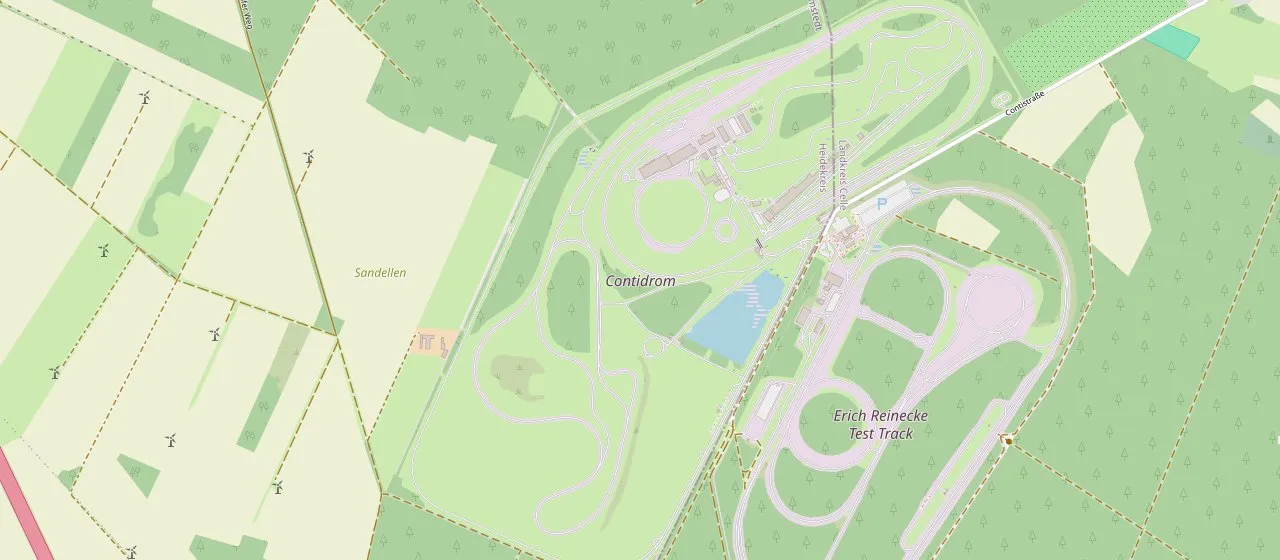
| Location | Jeversen, part of the municipality of Wietze in the Celle district, Lower Saxony; the extension site lies in the neighbouring municipality of Buchholz (Aller), Heidekreis district |
| Type | fenced tire test site of Continental, closed to the public |
| Opened | 1967 |
| Oval | 2.8 km, two measuring straights, two banked curves of 900 m each; banking up to 58° according to Continental |
| Wet handling loop | 1.8 km, since 1972 |
| Dry handling loop | 3.8 km, since 1995, width 7–10 m |
| Area | approx. 160 ha |
| Owner | Continental |
| AIBA braking hall | since 2012, length 300 m |
| For amateurs | ADAC Fahrsicherheitszentrum Hannover courses in your own car or motorcycle |
| Status | active |
Tires Away from the Street
Before 1967 Continental tested braking and avoidance manoeuvres on public roads, at airports and on closed mountain passes. Its own track was meant to bring these tests together in one place, provide surfaces that matched the research standard and make it possible to reproduce speeds that were rising fast. The most widespread car of the 1960s was, admittedly, the Volkswagen Beetle, but the Opel Kapitän, the Ford 20m and the Mercedes W108/W109 with engines of up to three litres needed tires for speeds of up to 200 km/h. Meyer, a test engineer from the early days of the Contidrom until 2002, explained years later: “We wanted to be able to do without tests in ever denser traffic. That is why the oval was conceived as a device for testing tires without lateral forces, so that the results would not be falsified by wear in corners”.
Jeversen, a village in the municipality of Wietze, had 656 permanent residents in 2000. The municipality had become known earlier for oil: in 1858 Professor Hunäus drilled a well here which, according to the municipality's study, was the beginning of German oil history. The track's postal address is Contistraße in Wietze, but the land for its extension lies in the neighbouring municipality of Buchholz (Aller) in the Heidekreis district.
The oval came first. It is 2.8 km long and has two measuring straights with sections of asphalt, concrete, cobblestones and a straight sprayed with water for aquaplaning tests. Both banked curves are 900 m long, and according to Continental's data their banking reaches 58 degrees. The company states that up to 180 km/h the curves are driven without lateral forces, so at that speed the driver can let go of the steering wheel, and the top speed on the oval exceeds 250 km/h. At the beginning eight people worked here.
A Mercedes on a Wire
On 11 September 1968 Continental presented its first electronically controlled driverless car in public at the Contidrom. It was a Mercedes-Benz 250 with an automatic gearbox, from the series known as “Strich-Acht”. The engineers fitted it with electromechanical control of the steering and the throttle and a radio set for transmitting measurements; they fitted the bumpers with antennas and found room in the boot for the electronics and an electropneumatic braking system. The systems were developed for Continental by Siemens, Westinghouse and researchers from the technical universities in Munich and Darmstadt. The car followed a wire fixed to the road surface: measuring coils sensed its magnetic field, and commands to brake, accelerate and sound the horn went the same way from the control room by the track. The results, as engineer Herbert Ulsamer recalled, travelled by radio and ended up on magnetic tape.
More than 400 newspapers, magazines, radio and television stations covered the demonstration under headlines such as “Mit dem Geisterfahrer durch die Steilkurve” (“With the Ghost at the Wheel Through the Banked Curve”) and “Die Zukunft hat schon begonnen” (“The Future Has Already Begun”). But the point was tires: removing the human considerably increased the accuracy of the measurements. “It was in essence a car that drove on a wire”, said Meyer fifty years later. Klaus Weber, in 1968 a mechanic and electrician in the electronics group, recalled that the steel structure in the concrete surface probably deflected the magnetic field from time to time. On the straight everything worked, but the engineers were interested in lateral aquaplaning in corners on a wet road, and there the car often lost the wire for a fraction of a second and stopped. A pane of glass was also built into the road, under which a camera took 10,000 pictures a second to show how the tread blocks worked; the wire had to be laid so that the tire hit the pane exactly, which often failed.
Until 1974 the driverless car was one of the main attractions of events at the Contidrom, but automated tire testing was not achieved at that time. “The limits were recognised very quickly and the project was allowed to go to sleep”, said Ulsamer in 2018, who in 1968 had been a young vehicle engineer.
Wet Loop, Dry Loop, a Circle for Shedding Tires
The first section intended solely for driving at the limit of grip was a loop 1.8 km long, completed in 1972. It has several right-angle corners, including one where you have to slow down hard, and the whole route can be evenly sprayed with water. It was used chiefly by drivers who assess steering response and stability in the wet by feel, and by the motorcycle tire team. In 1985 the tracks with a rail guide opened for braking and aquaplaning tests; the rail guides the car so that differences in surface grip affect the measurement as little as possible.
In the summer of 1995 driving began on the large dry loop. It is 3.8 km long, 7 to 10 m wide and allows speeds well above 160 km/h; a connector lets you leave the oval for it. As “Reifenpresse” wrote in 2012, frequent guests here were journalists testing tires and cars, and film crews valued the spectacular passes through the corners. Since 2003 there has been a 600-metre off-road course with rises, an axle articulation track, a steep ramp and a pool of water. Two sprayed circles, one of them 200 m in diameter, are used for tests in the wet, including aquaplaning in a corner. Another test on a circle has the nickname “Abwurfkreis”, that is, the drop circle: a passenger car or a truck drives round it at 55 km/h, and after every lap the tire pressure falls by 0.1 bar until the tire literally jumps off the rim. Rolling noise is measured on two separate sections where the engine, gearbox and drive of the car are encased so that only the tire can be heard.
Continental calls the Contidrom the prototype and model of all its tire testing tracks. In Uvalde, Texas, on the General Tire test grounds, the wet loop, both circles and the rail tracks were reproduced exactly so that results from the two places could be transferred. The staff grew: from the end of the 1980s it numbered about 60 people, in 2015 nearly 100. In December 2000 Continental presented here, in a tent 600 m long, an experimental “30-metre car” which stopped from 100 km/h in under 30 m.
A Rally That Outgrew the Track
Ten times, the last in 1985, the Contidrom turned into a motorcyclists' campsite. The Bundesverband der Motorradfahrer (BVDM), the motorcyclists' association, organised the International Motorcyclists' Rally here together with Continental Gummi-Werke AG, known for short as the Conti-Treffen. The eighth rally, in 1983, attracted more than 25,000 guests and, according to the organisers, broke the attendance record; it was prepared by Emanuel Rode of Continental and Günter Wuttke of the BVDM. Everyone entering received a plastic snap-on wristband, and how it worked, as the association's magazine “Ballhupe” wrote, had to be explained twenty-five thousand times.
The invitation to the 1984 rally announced “the largest motorcyclists' meeting in Europe”, admission at 15 marks per person and limited places for tents. The programme included runs round the handling loop on your own motorcycle, a skill tournament, tire testing demonstrations, demonstration runs by dragsters, regularity trials for vintage machines, a drive-in service, a bonfire and a “Miss Contidrom” contest. The last of these was not a beauty pageant: the candidates rode a special course on their own and on someone else's motorcycle, and the title was won by Petra Schwiete on a Suzuki DR 500. The longest journey from abroad, 1,090 km, was made by two motorcyclists from Toulon.
Inge Keuser, who collected the admission money at the gate, described in “Ballhupe” a rainy Friday, an enormous influx of guests, alcohol smuggled in against the bans and drunks whom helpers had to stop from riding a motorcycle, without a helmet, of course.
“The question stayed with us whether this rally will stay as it is, it seemed too big to me. If I had not had a task there, I would certainly not have come as a participant”.
The answer came the following year. In 1984 the rally reached the limit of its accommodation capacity, so in 1985 it was shortened on the same area to two days, 27 and 28 April. The minutes of the BVDM leadership meeting of 30 March 1985 recorded that this would be the tenth and last Conti-Treffen: the crowds were destroying the vegetation and leaving rubbish, so for reasons of environmental protection the rally was not to take place again. As late as 2007 a description of the track recalled that motorcycle rallies had been a thing of the past since the mid-1980s. In 1986, since a large event could not take place at the test track that year, Continental and the BVDM moved the meeting to Whitsun at the Hockenheimring.
The Hall Where a Robot Brakes
In 2012 the Automated Indoor Braking Analyzer, AIBA for short, went into operation. It is housed in a hall 300 m long and up to 30 m wide, in which up to 100,000 braking tests a year can be carried out on dry, wet and even icy surfaces. Unmanned cars guided by a rail are accelerated by an electromagnetic linear drive borrowed from roller coasters, and they brake by themselves over a 75-metre section; the surfaces are moved into place hydraulically. According to the trade portal “Reifenpresse”, Continental invested about 20 million euros in the hall. By February 2024 more than a million test runs had been made in it, and about two thirds of all of the company's tire braking tests take place there.
Continental itself links this hall with the Mercedes of 1968. “Ultimately, you can draw a straight line from the test pioneers at the end of the 1960s all the way to our test systems today”, said Thomas Sych, head of global tire testing for passenger cars and light trucks, in 2018. The newest building on the site houses a driving simulator in which engineers put virtual tires on virtual cars and drive on digitised routes of the Contidrom or on purchased data of other tracks, for example the Nürburgring. Since Continental parted with its automotive supplier division, now operating under the name Aumovio, it is once again solely a tire manufacturer, and the competences developed at the Contidrom are, as the SP-X agency writes, more important to it than ever.
The oval is also used for demonstrations of another kind. In 2021 the Swiss company Futuricum, DPD Switzerland and Continental drove a 19-tonne Volvo FH truck converted to electric drive round it for 1,099 km without charging. Two drivers took turns every four and a half hours, made 392 laps at an average speed of 50 km/h, and the result was to be submitted to the Guinness World Records.
A Second Wet Track and a Forest for Building
In 2015 the local press, and after it “Reifenpresse”, wrote about the largest extension of the Contidrom in twenty years. The wet loop was the “bottleneck” of the whole site, with almost 11,000 tire tests a year, so Continental bought 20 ha of the neighbouring forest for a second loop 1.8 km long, which was to be ready preferably for the track's 50th anniversary. The environmental impact study of 2018–2019 describes it as an almost one hundred per cent copy of the existing one, connected to the present site by a road and a bridge over the oval. Clearing more than 10 ha of forest meant a mandatory environmental impact assessment, and the site holds a water permit for six wells and abstraction of up to 900,000 m³ of water a year until 2027. According to the same document, all traffic serving the Contidrom and the neighbouring test track of the company WABCO Testbahn GmbH goes through Bahnhofstraße in Jeversen to the B214 federal road.
The council of the municipality of Buchholz (Aller) adopted development plan no. 22 “Erweiterung Contidrom” for 25.6 ha in Marklendorf on 14 July 2020. Because of a procedural error the plan was announced again in November 2023 and came into force retroactively from 10 May 2022. It was not possible to establish whether the second loop is already in operation.
Behind the Gate with an Instructor
The site is fenced and closed to the public. A car driver can enter the track on courses of the ADAC Fahrsicherheitszentrum Hannover, which describes the Contidrom as a “very modern, professional test track of Continental AG, 3.8 km long”. The courses are intended for experienced drivers of cars and motorcycles, some require earlier ADAC training, and the centre recommends your own sporty vehicle. The four-hour training, at which you get to know the track, has no entry requirements or limits on the car and costs 229 euros; the eight-hour Sportfahrer-Training for 449 euros requires only a car with a power of at least 200 hp. Additional insurance is not available, and a passenger may ride along if registered in advance. In 2007 “Reifenpresse” listed among the track's regular events safe-driving trainings with editors and readers of “auto motor und sport” and the “ContiTuningTage” of the magazine “AutoBild sportscars”.
For both courses the centre's website currently shows the same address, Contistraße, 29323 Wietze, and the same message: “Keine Termine für 2026 verfügbar”, that is, no dates available for 2026.
Timeline
- 1967: opening of the Contidrom with a 2.8 km oval.
- 1968: 11 September, public demonstration of a driverless car guided by a wire in the road.
- 1972: completion of the 1.8 km wet loop.
- 1983: the eighth Conti-Treffen motorcyclists' rally, more than 25,000 guests.
- 1985: tracks with a rail guide; the tenth and last Conti-Treffen at the Contidrom.
- 1995: first runs on the 3.8 km dry loop.
- 2003: off-road course.
- 2012: AIBA braking hall.
- 2021: run of an electric truck, 1,099 km without charging.
- 2022: development plan no. 22 “Erweiterung Contidrom” comes into force retroactively from 10 May.
Sources (24)
- Continental AG, The «Ghost Car» [en]
- SP-X, Die Südheide macht den Unterschied – Reifenentwicklung bei Continental, Costa Nachrichten, 2026-06-17 [de]
- Horst Orlowski, Contitreffen – ein Sommerfest, „Ballhupe” (Bundesverband der Motorradfahrer) [de]
- Continental AG, Continental Celebrates One Million Trips on Its Unique, Fully Automated Tire Braking Test Facility, 2024-02-08 [en]
- ADAC Fahrsicherheitszentrum Hannover, Contidrom: High-Performance Trainingsstrecke in Wietze [de]
- Gemeinde Wietze, InfraPlan Celle, Gemeindeentwicklungsplanung Wietze, 2006-02-10 [de]
- Gemeinde Buchholz (Aller), Erneute Bekanntmachung zum Inkrafttreten des Bebauungsplanes Nr. 22 «Erweiterung Contidrom», Amtsblatt für die Samtgemeinde Schwarmstedt, 2023-11-10 [de]
- Thomas Kaiser, Sandra Grimm i in., Erweiterung des Reifenversuchsgeländes Contidrom in Jeversen um einen Nasshandlingkurs. Umweltverträglichkeitsstudie mit integriertem Artenschutzbeitrag [de]
- Continental Reifen Deutschland, Reifentests bei Continental [de]
- Geburtstag einer Versuchsstrecke: Das Contidrom wird 40, Reifenpresse.de, 2007-06-06 [de]
- 50 Jahre Contidrom von Continental: Alles zur Hightec-Strecke, 2017-07-04 [de]
- Tiago da Costa Hofmann, Reifentest unter Extrembedingungen: Ein Blick hinter die Kulissen des Contidroms, PROFI-Werkstatt, 2026-06-08 [de]
- Continental will Contidrom deutlich ausbauen – Mehr Nasshandlingkapazitäten, Reifenpresse.de, 2015-10-16 [de]
- Martin Schachtner, Auf der Teststrecke: Daten treffen auf Bauchgefühl, Gummibereifung, 2026-06-04 [de]
- 45 Jahre Contidrom: Seit 1967 fast zwei Millionen Reifen getestet, Reifenpresse.de, 2012-11-07 [de]
- ADAC Fahrsicherheitszentrum Hannover, Pkw-4h-Training Contidrom [de]
- Thomas Strünkelnberg (dpa), Autonomes Fahren: Erstes fahrerloses Auto schon vor 50 Jahren, 2018-09-22 [de]
- ContiTreffen ’84. Das Internationale Motorradfahrer-Treffen im Contidrom, „Ballhupe” [de]
- Protokoll zur Gesamtvorstands-/Bundesbeiratssitzung am 30. März 1985 in Riesenbeck [de]
- Inge Keuser, Conti 84 aus meiner Sicht [de]
- Horst Orlowski, Conti-Treffen ’86, „Ballhupe” [de]
- Futuricum, DPD und Continental auf Rekordfahrt: Fast 1.100 Kilometer mit dem Elektro-Lkw, 2021-09-08 [de]
- Langstreckenrekord: E-Lkw von Futuricum fährt 1.099 Kilometer mit einer Ladung, emobilitaet.online, 2021-09-01 [de]
- ADAC Fahrsicherheitszentrum Hannover, Sportfahrer-Training Contidrom [de]