
Embsen, Germany
ADAC Fahrsicherheitszentrum Hansa: Lupos, Karts, a Noise Row
The ADAC centre in Embsen near Lüneburg: racing Lupos from the 2003 cup, charity rounds for supercars, a club kart track and a won dispute over noise.
- Type
- motorsport venue
- Opened
- 2004
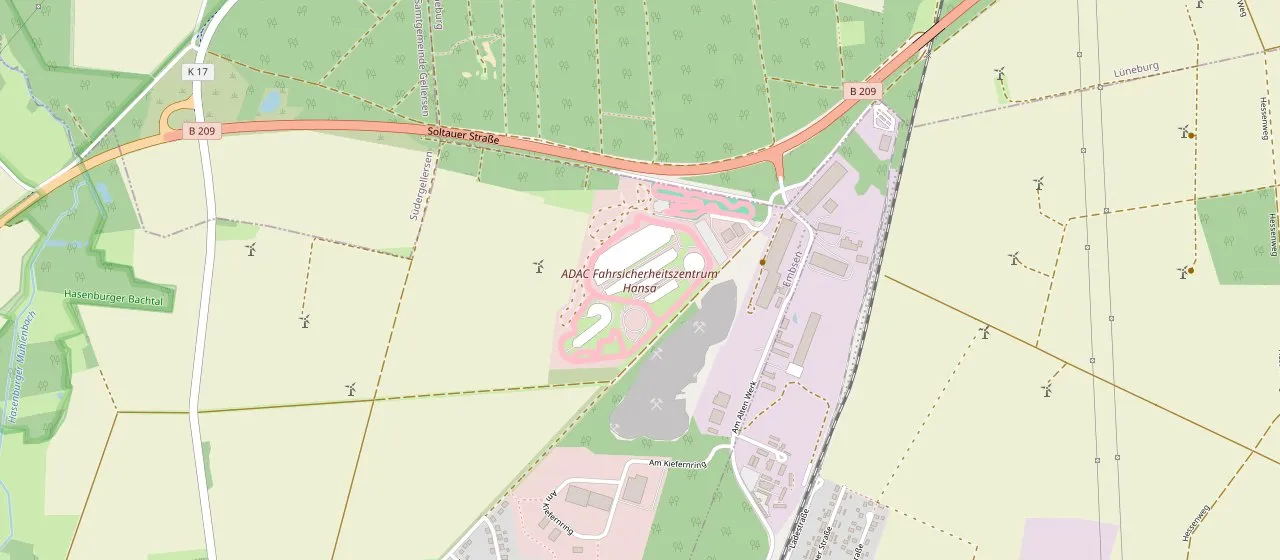
“Do you think a small VW Lupo can’t go fast? Ours can!” That is how the ADAC Fahrsicherheitszentrum Lüneburg advertised a course for drivers with sporting ambitions in 2006: first exercises in your own car, then laps of the centre’s loop in racing Lupos from the 2003 ADAC VW Lupo Cup, under a trainer with a racing licence. There is no race track in Embsen. There is a driving safety centre, opened in 2004 on the B209 south of Lüneburg: 21 hectares of skid pads, circles, descents and one long loop. For eighteen years the centre’s grounds also held a club go-kart track, and a dispute over its noise was settled by an administrative court in 2024.
| Location | ADAC-Straße 1, Embsen (Samtgemeinde Ilmenau, Lüneburg district), Lower Saxony; directly on the B209 |
| Type | driving safety centre (Fahrsicherheitszentrum) operating under the ADAC brand |
| Operating since | 2004 |
| Area | 21 ha, including a 3.5 ha off-road area |
| Modules | 12, among them two skid circles (60 and 80 m in diameter), dynamic plates, a braking strip, a 7% descent, serpentines, a loop, a kart track, an off-road area |
| Longest route | module 10 “Handlingstrecke”, a loop 1200–1600 m long and 6–12 m wide, with rumble strips on the edges |
| Kart track | 810 m long, 8 m wide, 13 corners; the former RSG-Hansa-Ring, owned by the centre since 2023 |
| Operator | ADAC Fahrsicherheitszentrum Hansa GmbH & Co. KG, managing director Carsten Bohnensack |
| For amateurs | Pkw-Sportfahrer-Training in your own car: 269 euro for ADAC members, 279 euro for others (as of 4.10.2026), after completing the Pkw-Intensiv-Training |
| Status | active |
Twenty-One Hectares by the B209
Arno Reglitzky, then a board member of ADAC Hansa, the regional ADAC club, was generous with praise at the opening of the centre in 2004: “It is sensational what the authority has achieved here.” Sixteen years later the “Landeszeitung für die Lüneburger Heide” recalled those words as a trace of times when the automobile club’s relations with local politics were still in order. The site lies in the municipality of Embsen, on the B209 towards Soltau and Amelinghausen. In the draft plan for a new industrial zone south of the centre, municipal planners described the surroundings as a landscape of fields, pine forest, wind turbines, the ADAC grounds and the Embsen-Melbeck industrial zone; between that zone and the centre lies “a striking gypsum heap”. In 2006 the centre counted 55 km to Hamburg, “in little more than half an hour”, and 120 km to Bremen.
The description of the centre changed faster than the centre itself. In November 2005 its website presented, in its metadata, “the largest and most modern driving safety centre in Europe”, with 14 modules on about 25 hectares. In June 2006 the same site spoke of 12 modules on 21 hectares and of one “of the largest and most modern in northern Germany”. Today ADAC writes of the largest and most modern centre of its kind in northern Germany, with 12 modules on 21 hectares and a 3.5-hectare off-road area.
The exercises take place on numbered modules. The two skid circles are 60 and 80 m in diameter. For the smaller one the operator gives a friction coefficient of the wet skid surface of about 0.2, against about 0.6 for wet asphalt on the braking strip. On module 4 a dynamic plate measuring 9.2 by 4.8 m throws lorries and cars into a skid on a slippery surface 118 m long. Module 5 is a braking strip with asphalt, a skid surface, concrete and cobblestones, and a run-up that allows emergency braking from 100 km/h. Module 8 is a 7% descent with a slippery bend, module 9 serpentines driven uphill and downhill, and the off-road area has a 20 m high rise with climbs of up to 45% gradient.
The most important module for drivers with sporting ambitions is module 10, which the operator calls the “Handlingstrecke” or simply the “Rundkurs”: a loop combining tight and long bends, described in 2007 as a route running around the whole centre. In 2006 its length was given as 1.2 km. The operator’s current brochure speaks of 1200–1600 m and a width of 6–12 m, with rumble strips marking the edges, markings for lane-keeping assistants and the possibility of dividing it into sections.
Cup Lupos and Supercars for Children
In the first years the centre was run by the Dutchman Sybe Schaap. In autumn 2007 he was replaced by Bernd Fischer, for two years head of sales, a banker by training, earlier the owner of two motorcycle shops and an organiser of motorcycle expeditions in Namibia. The press release on his appointment listed the events he had started, among them the Charity Challenge, the spring Motorrad StartUp Day and a nostalgia day on the holiday of German unity.
The 2006 sports course joined two worlds. In the first part of the day participants practised, in their own cars, seating position, steering and eye-guidance technique, a slalom as preparation for the racing line, and a run over a hydraulic dynamic plate. Then they switched to original cars of the 2003 ADAC VW Lupo Cup and drove the loop “at racing pace”. The day cost 395 euro with full catering. In 2013 the centre split this programme in two. “With our earlier sports course, participants sat in their own car for only half a day and spent the other half in our centre’s racing Lupos. The wish to sit at their own wheel was, however, greater among sporty drivers,” explained head trainer Gerd Schulz. The new sports course took place exclusively in participants’ own cars and ended with 90 minutes of guided driving on the loop, while the Volkswagen Cup-Lupo GTI 1.6 16V got a separate format.
The loudest days, though, were those when supercars drove onto the loop. In August 2006 about a hundred owners of sports cars, from Ferraris and Lamborghinis to Wiesmanns, took spectators around the 1.2-kilometre handling track. For a donation of 10, 20 or 30 euro, depending on the category of the car, one could ride as a passenger, and efficient organisation allowed 8 to 10 laps. More than 1,500 people watched the event, and more than 4,150 euro went to the association “eigenes Leben” to help children suffering from pain or from illnesses that shorten life. A year later the money was collected for the NCL foundation, which funds research into an incurable childhood disease. In the operator’s announcement the list of cars included a Porsche Carrera GT, a Dodge Viper, a Lamborghini Murciélago and an Isdera Imperator, and from 14.30 Thorsten Laussch, known to viewers of the Hamburg station Hamburg 1 as “Hausmeister Rudi”, was to host the event and sell raffle tickets. A sixth edition, with more than 150 cars, was announced for 14 August 2011.
The summer meetings looked similar. For the fourth sports car meeting, on 1 July 2007, the centre announced more than 200 participants, among them a Ferrari F40, a Lamborghini Murciélago, a Bentley Continental GT and a Mercedes SLR McLaren, and a training programme prepared specially for them. The press release encouraged with a simple argument:
On the FSZ handling track there is neither a speed limit nor oncoming traffic, as there is in everyday traffic.
The centre also hosted footballers. In October 2006, for the first fan day of Hamburger SV, the Dutch international Rafael van der Vaart came; about 500 fans were waiting for him, and the event drew about a thousand people, who could, among other things, ride around the loop with a professional. The spring motorcyclists’ meeting, the Motorrad StartUp Day, drew more than 12,000 people in April 2013, which Mai-Britt Kähne, responsible for the event, called an attendance record.
It was not calm at the helm either. In December 2015 ADAC announced that the shareholders’ meeting had dismissed managing director Bernd Beer with immediate effect. Carsten Bohnensack temporarily led the company, and Sybe Schaap again took over operational matters. At the beginning of March 2016 ADAC announced that the management of the centre was being taken over by 55-year-old Paul Droßard, earlier managing director of the Schumacher’s Motodrom kart centre in Bispingen. Today the company is run by Bohnensack, and the centre by Andreas Baus as authorised signatory.
RSG-Hansa-Ring: 810 Metres of a Club’s Dream
Rennsportgemeinschaft Hamburg, RSG for short, was founded on 7 January 1972, when 22 members left the Bundeswehr-Motor-Club. It started with car slaloms, later organised kart races, and according to the club it was RSG that in 1995 prepared the first car race on the motorcycle circuit in Assen. In 2004, as the club writes, “our dream finally came true”: on the grounds of the centre in Embsen RSG built its own kart track, the RSG-Hansa-Ring, 810 m long and 8 m wide. The first kart training took place on it on 14 August 2004, and the first car slalom on 18 September. The rallysprint announced for that year was cancelled because too few crews had signed up by the first entry deadline. The centre described the track as its module 11, with a paddock and a building, run by the club. Today’s leaseholder counts 13 corners on it.
In 2010 the ADAC-Hansa-Slalom was held on the kart track and the centre’s areas as a round of the German championship, prepared jointly with AC Ilmenau and MC Elbe. In 2014 the club noted the last edition of this event in Embsen, and in 2019 it held the last kart race on its track. In January 2021 the long-time treasurer Dieter Baguhn died, and in March 2022 Ingo Meyer, the club’s chairman for fifty years. On 13 October 2022 the members unanimously decided to dissolve RSG, and on 1 January 2023 the track passed into the centre’s ownership. Since 2023 the track has been leased by the Lüneburg entrepreneur Alexander Diercks; according to the “Landeszeitung”, guests at children’s birthday parties and company events like to drive here. According to former RSG members, on 21 October 2024 the centre informed them by e-mail that it was ending, with immediate effect, training for racing go-karts; the club stresses that this was the centre’s decision, not the leaseholder’s.
Blue Sky over Ilmenau
Noise had been an issue in Embsen for a long time. In 2015 the Automobilclub Ilmenau wanted to hold slaloms on the kart track, and because the local plan did not provide for such a use, the change had to be approved by the municipal council. The citizens’ initiative “Blauer Himmel über Ilmenau”, that is “Blue Sky over Ilmenau”, distributed a leaflet with the slogan “Hansaring planned in Embsen!” and a photo of a Formula 1 car, and by its own account collected almost 400 signatures. The mayor of Embsen, Anne-Carin Büttner, called the allegations untrue. By the day before the “Landeszeitung” article was published, the municipality had received three letters on the matter, two against the slaloms and one in favour. In 2017 the district considered the centre’s application to change the way the kart track operates; objections were received, and the authority set a public discussion of them for 25 September 2017.
In November 2020 the “Landeszeitung” wrote that the centre was making losses and that ADAC wanted to rent out the grounds also for events unrelated to training, for which the Samtgemeinde Ilmenau and the municipality of Embsen would have to change their development plans. In 2021 the district banned the use of go-karts louder than 105 dB(A) and the simultaneous running of more than six go-karts of that loudness, judging that the 2004 permit had never covered such operation of the track. ADAC lodged an objection and, after it was rejected, a lawsuit in 2022. On 20 September 2024 the 2nd Chamber of the Administrative Court in Lüneburg overturned the ban. According to the court, no restriction on the type or number of go-karts could be read from the application, the acoustic expert reports of the time or the wording of the decision, and nothing indicated that permissible values were exceeded at the nearest houses. At the time of announcement the ruling was not final; the district could apply for leave to appeal.
The nearest house stands 750 m from the track, and ADAC’s lawyer Franziska Rode explained that the daytime limit of 55 dB for residential areas was and is being met, as successive expert reports confirmed. Diercks listed that when the original permit was issued, his predecessor’s fleet ran here at about 90 dB per go-kart, later a fleet of 83 dB, and his 28 new go-karts, bought for 180,000 euro, reach 75 dB. The environmental association “Blauer Himmel über Ilmenau”, which was allowed to speak at the hearing, did not want to talk to the press. Peter Rowohlt, mayor of the Samtgemeinde Ilmenau, told the newspaper that for two summer seasons there had not been a single noise complaint.
In Your Own Car Around Module 10
For an amateur driver the way onto the loop today is a course. The first step is the ADAC Pkw-Intensiv-Training: 8.25 hours, at most 12 participants, 199 euro for ADAC members and 209 euro for others, with braking on various surfaces, a slalom and mastering a skid on the dynamic plate. Only after it can one sign up for the Pkw-Sportfahrer-Training, for which, according to the operator, all cars are welcome, “from GTI to Ferrari”. It also lasts 8.25 hours, takes at most 10 participants and costs 269 euro for ADAC members and 279 euro for others. The programme includes braking to a marked point from higher speeds, stabilising a car that is starting to skid, driving the serpentines and the so-called Swiss slalom, and at the end of the day participants transfer the learned skills to the loop. The courses also take place in winter and in the rain. On 4 October 2026 the booking system showed two dates in that month: 14 October with four free places and 30 October with eight. Asked about wear on the car, the operator answers that a full-day course corresponds roughly to an hour of full-load driving on the motorway, and that on the sports course the wear is “a little higher”.
The centre did not sell free driving on the loop even when it used the word trackday. In 2013 its “Track-Day-Training” was an evening course from 16.45 to 21.00 for 129 euro, in at most two groups of ten, finishing on a “loop with an elevation profile”. A completed Pkw-Intensiv-Training was a condition, and the announcement stipulated: no race-track training, no free driving, and cars could not exceed 92 dB. In the same year, on 22 March and 27 September, the centre ran courses for 495–525 euro, after which a participant with a positive assessment received the certificate needed for an application for a national A licence of the German motorsport federation DMSB. The rules stipulated that neither the exercises nor free driving on the loop serve to achieve top speeds.
The loop is also used by outside organisers. For 13 August 2021 Oldtimer Trackdays invited people here to a second evening for registered cars from 2000 and older, because the first date sold out quickly: four groups of 12 cars were to alternate every half hour between the loop and a set of the skid circle, the descent and the serpentines, ADAC trainers were to guide drivers by radio, and participation cost 119 euro with a barbecue. The organiser stressed that it was not a race but an “extended safety training with free driving”, for which no licence is needed. In June 2017, at the “Track & Safety Days” supported by the federal transport ministry, 40 tuning enthusiasts arrived with lowered cars on wide tyres. Runs over a water-flooded surface were combined with workshops with police officers and experts. “The participants are not meant to learn here how to take a corner particularly fast, but particularly safely,” said Jan Henning Klapper of the “Tune it! Safe!” initiative.
The kart track, on which RSG held its first training in August 2004, today serves in the morning as a manoeuvring ground. Only a passenger car may drive on it, from the age of 16, with a supervisor who has held a driving licence for at least three years and may not leave the car, at a speed of at most 30 km/h and according to road traffic rules. The operator’s page lists four exercises: priority to the right, turning round, starting off and reverse parking.
Timeline
- 2004: opening of the centre; RSG builds the RSG-Hansa-Ring kart track on its grounds, first training on 14 August
- 2006: sports course with racing Lupos from the 2003 cup; in August the Charity Challenge with about a hundred sports cars
- 2007: Charity Challenge for the NCL foundation; in autumn Bernd Fischer becomes managing director
- 2010: ADAC-Hansa-Slalom as a round of the German championship on the kart track and the centre’s areas
- 2013: sports course exclusively in participants’ own cars, Lupo drives as a separate format; evening “Track-Day-Training”
- 2014: last ADAC-Hansa-Slalom in Embsen
- 2015: dispute over slaloms on the kart track; in December Bernd Beer is dismissed
- 2016: Paul Droßard takes over the management
- 2017: 25 September, discussion of objections to changes in the operation of the kart track
- 2019: opening of the manoeuvring ground; last RSG kart race
- 2021: district ban on go-karts louder than 105 dB(A)
- 2022: ADAC lawsuit; 13 October, decision to dissolve RSG
- 2023: 1 January, the kart track passes into the centre’s ownership
- 2024: 20 September, ruling of the Administrative Court in Lüneburg in the centre’s favour; 21 October, end of racing go-kart training
Sources (44)
- ADAC Fahrsicherheitszentrum Lüneburg, ADAC Pkw-Sportfahrer-Training, 2006-06-13 [de]
- Fahrsicherheitszentrum: Kurse alleine reichen nicht, „Landeszeitung für die Lüneburger Heide”, 2020-11-19 [de]
- Neues Sportfahrertraining im ADAC Fahrsicherheitszentrum Hansa/Lüneburg, auto.pr-gateway.de, 2013-05-02 [de]
- ADAC e.V., ADAC Fahrsicherheitszentrum Hansa [de]
- ADAC Fahrsicherheitszentrum Hansa, Anfahrt nach Embsen bei Lüneburg und Bad-Oldesloe [de]
- In Erinnerung an die RSG-Hamburg [de]
- Verwaltungsgericht Lüneburg, Immissionsschutzrechtliche Beschränkung des Kartbetriebs rechtswidrig, 2024-09-20 [de]
- ADAC Fahrsicherheitszentrum Hansa GmbH & Co. KG, Impressum [de]
- Gemeinde Embsen, Samtgemeinde Ilmenau, Bebauungsplan «Gewerbegebiet Lüneburg-Süd» [de]
- Kartbahn Lüneburg, Strecke [de]
- ADAC Fahrsicherheitszentrum Hansa, Anlagendetails Embsen [de]
- ADAC Fahrsicherheitszentrum Hansa, Herzlich Willkommen im größten Fahrsicherheitszentrum Norddeutschlands [de]
- Meike Richter, Verwaltungsgericht Lüneburg: Kartbahn auf ADAC-Gelände in Embsen darf betrieben werden, „Landeszeitung für die Lüneburger Heide”, 2024-09-25 [de]
- ADAC Fahrsicherheitszentrum Hansa, Team [de]
- ADAC Fahrsicherheitszentrum Hansa, Pkw-Sportfahrer-Training [de]
- ADAC Fahrsicherheitszentrum Hansa, Buchung Training: Pkw-Sportfahrer-Training [de]
- Ortsclub Lüneburg e.V. im ADAC, Embsen: Off-Road des Fahrsicherheitszentrums [de]
- ADAC Fahrsicherheitszentrum Lüneburg, Daten und Fakten, 2006-06-13 [de]
- ADAC Fahrsicherheitszentrum Lüneburg, 2005-11-03 [de]
- ADAC Fahrsicherheitszentrum Lüneburg, Über uns, 2006-06-13 [de]
- ADAC Fahrsicherheitszentrum Lüneburg, Modul 10: Rundstrecke, 2007-12-15 [de]
- ADAC Fahrsicherheitszentrum Lüneburg, «Charity Challenge 2006» brachte mehr als 4.150 Euro an Spenden, 2006-08-22 [de]
- FSZ Embsen: Paul Droßard übernimmt Leitung, „Landeszeitung für die Lüneburger Heide”, 2016-03-01 [de]
- ADAC Fahrsicherheitszentrum Lüneburg, Bernd Fischer neuer Geschäftsführer, 2008-04-01 [de]
- ADAC Fahrsicherheitszentrum Lüneburg, Pressemitteilungen, 2007-10-16 [de]
- ADAC Fahrsicherheitszentrum Lüneburg, Rennlupo-Experience BASIS und PREMIUM, 2013-03-26 [de]
- ADAC Fahrsicherheitszentrum Lüneburg, «Hausmeister Rudi» unterstützt Charity Challenge im FSZ, 2008-04-01 [de]
- ADAC Fahrsicherheitszentrum Lüneburg, 6. Charity Challenge, 2010-11-21 [de]
- ADAC Fahrsicherheitszentrum Lüneburg, Mehr als 200 Super-Sportwagen in Lüneburg, 2007-06-26 [de]
- ADAC Fahrsicherheitszentrum Lüneburg, HSV-Star van der Vaart im Mittelpunkt, 2006-10-09 [de]
- Biker begrüßen den Frühling, „Landeszeitung für die Lüneburger Heide”, 2013-04-22 [de]
- RSG-Hamburg, Chronik [de]
- ADAC Fahrsicherheitszentrum Lüneburg, Modul 11: Kartbahn, 2007-12-16 [de]
- RSG Hamburg löst sich auf, Hamburger Motorsport Club, 2022-10-23 [de]
- Kartbahn-Ärger auf ADAC-Gelände, „Landeszeitung für die Lüneburger Heide”, 2015-10-07 [de]
- Landkreis Lüneburg, Bekanntmachung des Erörterungstermins zur Änderung des Betriebs der Kartbahn des ADAC Fahrsicherheitszentrums Hansa GmbH & Co. KG, „Amtsblatt für den Landkreis Lüneburg” nr 14/2017, 2017-09-07 [de]
- ADAC Fahrsicherheitszentrum Hansa, ADAC Pkw-Intensiv-Training [de]
- ADAC Fahrsicherheitszentrum Hansa, FAQ: Antworten auf häufig gestellte Fragen [de]
- ADAC Fahrsicherheitszentrum Lüneburg, Track-Day-Training, 2013-03-29 [de]
- ADAC Fahrsicherheitszentrum Hansa/Lüneburg, DMSB Lizenzlehrgang National A (Sportfahrerlehrgang), 2013-03-21 [de]
- Oldtimer Trackdays, 13.08.21 Fahrsicherheitszentrum ADAC Embsen / Lüneburg [de]
- Sicher getunt, „Landeszeitung für die Lüneburger Heide”, 2017-06-27 [de]
- ADAC Fahrsicherheitszentrum Hansa, Unser Verkehrsübungsplatz [de]
- ADAC Hansa, Fahrpraxis ohne Führerschein: Verkehrsübungsplatz Hansa eröffnet, presse.adac.de, 2019-03-22 [de]