
Old Beach (Hobart), Australia
Baskerville Raceway: the track near Hobart on land leased for a shilling a year
The history of Baskerville Raceway in Old Beach near Hobart: opening in 1958, the Longford bridge, the club's debts, new asphalt from donations, and practice days for amateurs.
- Type
- race circuit
- Length
- 2.01 km
- Opened
- 1958
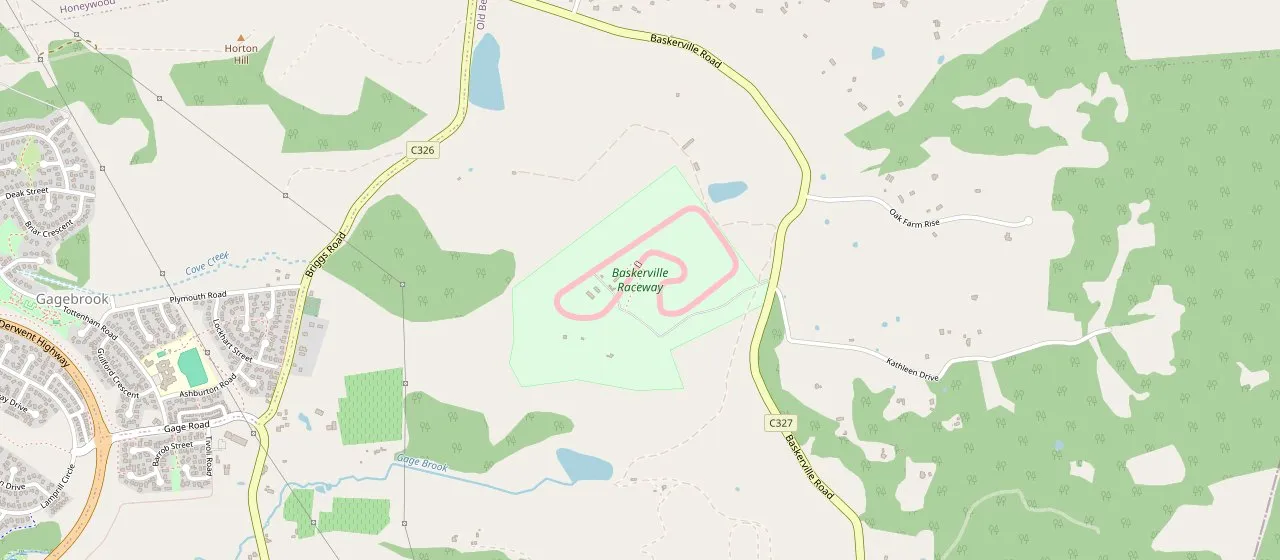
In February 1958, an estimated 20,000 people came to the new track north of Hobart, and Tasmanian premier Robert Cosgrove announced the track's opening. The crowd was one of the largest a sporting event had drawn in Tasmania up to that point. The venue itself was modest: an asphalt road around a grassy paddock, with no facilities for spectators and no pit lane; competitors came off the last corner down a dirt track into a rope-fenced paddock. Baskerville Raceway has operated without interruption ever since, and its survival was secured first by a symbolic lease, then by the club's mortgage, and in 2013–2018 by donation drives run by volunteers.
| Location | 473 Baskerville Road, Old Beach, a northern suburb of Hobart, Tasmania, Australia |
| Type | permanent road course in a natural amphitheatre |
| Length | 2.01 km; RacingCircuits.info gives the same length for every version of the track since 1958 |
| Opened | February 1958 |
| Builder | Hobart Sporting Car Club (HSCC) |
| Owner and operator | Motorsports Tasmania Pty Ltd, a non-profit organisation, since October 2000 |
| Sponsor name | Bulk Nutrients Baskerville Raceway (since 2023), previously Pepsi Max Baskerville Raceway (since 2015) |
| Fastest lap | 48.8269 s, Josh Kean, Benetton B186 (Formula 1), 23 September 2018, per HSCC's lap records list |
| Key events | Baskerville Historics, Baskerville 1000, rounds of the Tasmanian championships |
| Status | active; operator practice days for licensed drivers |
A Pasture with a View
After the war, Tasmanian clubs raced on temporary circuits at the Valleyfield and Quorn Hall airfields, and from 1953 on the street circuit at Longford, which attracted international names. The island had no permanent circuit, so in 1954 the Hobart Sporting Car Club decided to build one and began raising money. According to the operator, members of the young club drove around the area looking for a plot of land; after finishing one of their speed events, they found themselves at a spot with a view of Calvin Morrisby's rural property, named Baskerville. Morrisby agreed to lease the club the land for around a hundred years, for a symbolic rent of one shilling a year. In gratitude, the club named one of the corners after him, Calvins.
The design made use of the terrain. The roughly 2 km loop ran up a slope, along it and back down; it had about 500 m of straight dropping away from the hill, a series of corners and a short, steep climb. The paddock was placed in the middle, where the ground levelled out, and spectators watched the racing from a rise south of the track. The project's designers promised, in a description from the time, that „The competitors are catered for by a course which will maintain their interest and provide never a dull moment”. Construction took place in 1957.
The first meeting featured sports cars, sedans and motorcycles. Alan Burrell rolled his Fiat 1100 and walked away from the crash unhurt. The fastest lap among the cars went to Don Gorringe in a Javelin Special, in a time of 1 min 21.5 s, but in one of the motorcycle races Max Eaves on a Norton shaved half a second off that. Today the operator describes the track as tight and demanding, with a fast straight, an off-camber corner and a nearly blind corner at the top of a steep rise; from the natural amphitheatre, spectators can watch the whole lap while sitting in their own cars.
A Tram, a Trolleybus and a Bridge from Longford
According to the operator, the first race control tower, from the late 1960s, was an old tram that had previously served at the Longford circuit. In the early 1970s it was replaced by a retired trolleybus from the Hobart City Council fleet, and in 1973 the HSCC commissioned the current tower, which, after a 2014–2015 rebuild, is still in use today. RacingCircuits.info describes the race officials' building from that era as an old bus set on top of a wooden structure, with a commentary point right at the top, reachable only by ladder.
More arrived from Longford after that circuit's demise. HSCC founding member Donald Gorringe acquired a used steel structure and had it made into a pedestrian footbridge, which was erected at Longford next to the control tower ahead of the 1965 Australian Grand Prix. In 1969, when the Longford circuit ceased to exist, Gorringe handed the footbridge to the HSCC and, together with another club founder, Don Elliott, financed its move to Baskerville; for many years it carried his name. Wooden grandstands were also brought from Longford and set up along the start straight.
In the 1970s, armco barriers began to go up around the track; Baskerville was fortunate, because wide grassy verges ran along much of the loop. A makeshift pit lane appeared, still grassed, entered through a gap in the barrier. In mid-1975 the footbridge was moved closer to the first corner and its staircase rotated 90 degrees, allowing the pit lane to be significantly extended. Today's longer pit entry, which drivers turn into just after entering the last corner, was built in 1986. In March 1984, a briefing room named the Kelly Room was opened next to the tower, honouring Terrance Kelly, Tasmania's director of road safety, who in 1972 helped secure a government grant to pave the pit area.
Stars from the Mainland
According to the operator, through the 1960s and into the early 1970s racing at Baskerville stayed largely local; the biggest names raced at Longford, until 1968, and afterwards at Symmons Plains. Symmons Plains hosted a round of the Australian Touring Car Championship (ATCC) continuously from 1969 to 1999. In the 1970s Baskerville got its own annual meeting, the Tasmanian Ten Thousand, held, according to the Companion to Tasmanian History, from 1975.
The operator also lists national-level events: rounds of the Australian Sports Sedan and GT championships from 1976 to 1982, the last of which saw Peter Brock in Bob Jane's team Chevrolet Monza race against Alan Jones's factory Porsche 935 and local driver Tony Edmondson in Don Elliot's Alfa-Chevrolet V8. In December 1979, at the Winfield 25s meeting, Brock, according to the operator, started a Holden Torana A9X for the last time, and in November 1984 the Touring Car Cup race closed out Baskerville's era of Group C touring cars. The operator also states that in 1977 the grid here was set based on individual car qualifying, a year before Bathurst adopted a similar format.
Motorcycles have shared the track since 1976. The Sidecar Racing Club of Tasmania (SRCT) split off that year from the local motorcycling association, which was turning towards off-road riding. In 1979 the SRCT organised an event called the Tasmanian Grand Prix, and from 1984 to 1999 Baskerville repeatedly hosted rounds of the Australian Road Racing Championship (ARRC).
John Bowe, later a winner of the Bathurst 1000 in 1994 and 1998, was also connected to the track. In 2014 he recalled: „My dad raced there and I've been going to Baskerville since I was a little boy. I had my first ever race meeting when I was 15 in a Formula Vee”.
A Mortgage Instead of a Lease
In the early 1980s Calvin Morrisby died, and the land was bought by a consortium of local businessmen involved in motorsport. The HSCC gave up its lease in exchange for a 25 percent stake in the company that took over the land and track. A few years later the consortium decided to sell the venue, and the club bought it outright, saddled with a heavy mortgage; thanks to fundraising, the debt fell over several years from around $275,000 to $150,000.
Until the mid-1990s the HSCC brought in national-level events, including Truck Grand Prix races and national sports sedan events. Towards the end of the decade the club bought the island's second permanent circuit, Symmons Plains, which soon lost its most important event, the V8 Supercars round; the HSCC's finances could not withstand that. In October 2000 a new company, Motorsports Tasmania Pty Ltd, began operating, backed by investment from 35 clubs and individuals; it bought the HSCC's assets, paid off its debt and took over running the track. Shareholders included the Light Car Club of Tasmania, the MG and Mini clubs, and John Bowe. The company today also owns Symmons Plains, and on 2 April 2015 the shareholders amended the constitution and Motorsports Tasmania became a non-profit organisation, run by a volunteer board.
Motorcycling had its own troubles too. In 2003 the Motorcycling Australia federation withdrew the track's motorcycle licence because the gap between the asphalt and the barriers was too small. SRCT members organised a series of volunteer working bees, and the licence was reinstated in 2004. The club changed its name to the Sports Riders Club of Tasmania, keeping the SRCT abbreviation, and today runs riding days and motorcycle races at the track.
Seven Years On from Talk of Closure
The Baskerville Foundation was formed in June 2013, setting itself the goal of raising $600,000 over five years for a new surface, paving the access road, drainage and refurbishing the tower. The asphalt was in poor condition: patched, made up of many different surfaces, with hidden drainage problems, and the foundation blamed its deterioration on one of the truck meetings. In February 2014 V8 Supercars management announced a charity evening for the foundation on 26 March at the Wrest Point complex in Hobart. Bowe said at the time: „If you ask me it's the best little race track in Australia. It's got fantastic elevation, blind corners”, „it really is a mini Bathurst”.
The foundation's first major project was the rebuild of the race control tower, begun in late 2014 and completed before the first round of the state championship in February 2015, largely through volunteer labour. In 2014 the access road to the track and paddock was paved. In mid-2016 the Gorringe footbridge was rebuilt; the HSCC contributed $75,000 towards it. From 2014 the foundation's main source of money was the Baskerville Historics meeting, held since 2010.
In September 2016 the foundation launched the Flying Finish campaign, a final round of $5,000 donations meant to secure the start of the resurfacing work in December. Work began in December 2016, and in March 2017 the whole loop got new asphalt. The foundation wrote on social media at the time: „From 7 years ago listening to talk of abandoning the circuit to now seeing a new surface going down”. Mark de Jong of the SRCT said, after the first motorcycle races on the new asphalt, that most riders had taken around two seconds off their lap times. By July 2018, according to the operator, $1,080,000 had been spent on improvements to the track.
A naming-rights deal also supported the project. From 2015 the track was called the Pepsi Max Baskerville Raceway, and in 2023 the naming rights were bought by Bulk Nutrients, a Tasmanian company that makes its products in the Huon Valley. Its founder, Ben Crowley, spent many hours at Baskerville as a teenager, watching local and national races.
A Benetton on the Hill
At the meeting marking the track's sixtieth anniversary, in 2018, Aussie Racing Cars ran the season's opening round at Baskerville for the first time in 12 years; qualifying took place in torrential rain, and the round was won by Kel Treseder. On 23 September that same year the outright lap record fell: according to HSCC's records list, Josh Kean lapped the circuit in a Formula 1 Benetton B186 in 48.8269 s. A year earlier, the headline attraction of the Historics, the first held on the new asphalt, was the Holden Commodore VL in which Allan Moffat and John Harvey had won the opening round of the World Touring Car Championship at Monza in 1987.
In January 2021 Race Tasmania, an Australian Racing Group event, came to Baskerville: the Trans Am series ran a $10,000 race here under the name Roadways Tasmanian Ten Thousand, while TCR Australia and Touring Car Masters contested non-championship races. The winner was Aaron Seton in a Ford Mustang, visiting the track for the first time. After the race he said: „It's kind of a tight and technical track to get it right, but it's very rewarding”. In 2023 the organisers extended Race Tasmania and announced a return to Baskerville; a one-day prelude with demonstration runs by TCR and Trans Am cars, plus drifting, was scheduled here for 10 March 2024. According to the operator, the proceeds from the Historics go towards maintaining the track; in 2023 the event drew more than 150 entries across 11 categories.
From an Amateur Driver's Perspective
The main way to bring your own car onto the Baskerville track is during the practice days run by Motorsports Tasmania. The operator announces them at the start of every month on its Facebook page; a date outside the calendar is sometimes possible on request. According to the operator's website (as of 23 October 2026), a day costs AUD 150 per driver, driving runs from 9:00 to 16:00, and the gates open at 7:00. A driver must hold a Motorsport Australia Speed licence (L2S) or higher and current membership of a club affiliated with the federation, wear flame-resistant clothing covering wrists, neck and ankles, and a helmet meeting the AS1698 standard; they are responsible for their own car's roadworthiness, and racing is forbidden.
Without a racing licence, it is possible to drive with Evolve Driving, a training operator which, as part of its Tassie Tour of Tasmania, runs instructor-led driving days at Symmons Plains and Baskerville (the 2027 edition's schedule was still being finalised at the time of checking); an ordinary driving licence is enough, and the car must be roadworthy with brake pads and fluid suitable for fast driving. The HSCC, meanwhile, organises the Baskerville 1000, a six-hour regularity event for teams of at least three drivers in cheap, production-based cars, and Time Attack Tasmania, a timed single-lap event; both require a Speed licence and club membership.
In late 2018 a low wall with permanent plaques on the track's history was erected at the bottom of the main paddock. A footbridge leads from the paddock over the start straight, which, after its 2016 rebuild, again carries the name of Donald Gorringe, the man who brought it from Longford.
Timeline
- 1954: the Hobart Sporting Car Club decides to build a permanent circuit.
- 1958: Baskerville Raceway opens in February.
- 1969: the footbridge from the Longford circuit arrives at Baskerville.
- 1973: the current race control tower is commissioned.
- 1976: SRCT motorcycle racing begins at the track.
- 1984: the first round of the Australian Road Racing Championship (ARRC) at Baskerville.
- 2000: Motorsports Tasmania Pty Ltd takes over the track.
- 2003–2004: the motorcycle licence is withdrawn and reinstated.
- 2013: the Baskerville Foundation is formed.
- 2015: Motorsports Tasmania becomes a non-profit organisation.
- 2017: new surface laid over the whole loop.
- 2018: the track's fastest lap, Josh Kean, Benetton B186.
- 2021: Race Tasmania at Baskerville.
- 2023: new sponsor name, Bulk Nutrients Baskerville Raceway.