
Winton (k. Benalli), Australia
Winton Motor Raceway: the club circuit near Benalla where Hunt won
Winton Motor Raceway near Benalla: from a 10,000-pound circuit in 1961, through James Hunt and the ATCC, to the end of Supercars and Fun Day.
- Type
- race circuit
- Length
- 3 km
- Opened
- 1961
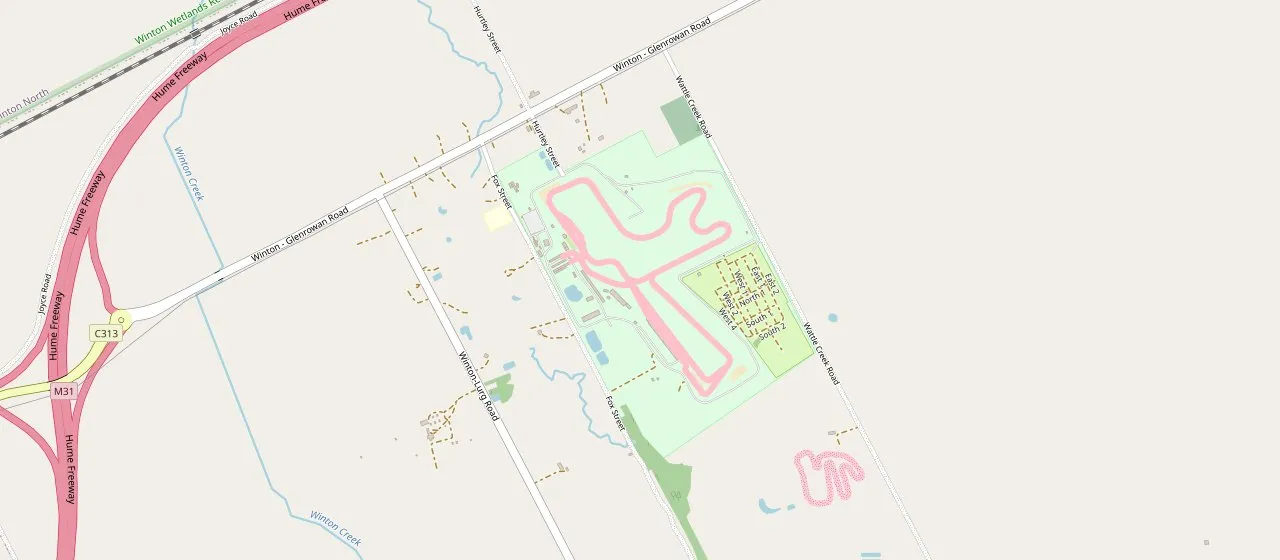
In February 2016, Barry Stilo, president of the Benalla Auto Club, together with MP Jaclyn Symes, officially opened the new surface of the Winton circuit near Benalla in north-eastern Victoria. After the ribbon was cut, fifty racing and classic cars, plus a bus, drove the first laps at no more than 60 per cent of their speed, to spare the fresh asphalt. In the 1960s Stilo had been part of the crew that cut the original track with bulldozers, and at the first meeting in November 1961 he set the first lap record: 1 min 24.2 s in a car called Faux Pas. His life story ties together the history of Winton Motor Raceway, a club circuit on rural recreation land where a Formula 1 world champion once won, where Australian touring cars raced for almost four decades, and where beginners now drive their own cars at eighty per cent of their ability.
| Location | Huntley Street, Winton, Victoria; by the Hume Freeway, about 15 minutes’ drive from the centre of Benalla |
| Type | permanent road circuit with two configurations and a skid pan for motorkhana |
| Length | National Circuit: 3.0 km, 12 corners (since 1997); Club Circuit: 2.03 km (the original loop from 1961) |
| Opened | 26 November 1961 |
| Lap record | 1:14.3058, John Magro, Dallara F308/11, Australian Formula 3, March 2019 (National Circuit) |
| Club loop record | 52.99 s, Mark Larkham, Reynard 90D, April 1992 |
| Owner and operator | Benalla Auto Club Inc (as of June 2026); the company Winton Motor Raceway Pty Ltd |
| Main events | ATCC and Supercars rounds (1985–2022, with breaks), Historic Winton (since 1977), Winton 300, Victorian Motor Racing Championship |
| Facilities | 118 garages, 56 shelters, a fuel station, a campsite |
| Status | active; no Supercars round since 2023 |
The boulder on the straight at Barjarg
Cars raced near Benalla long before Winton. On Easter Monday 1936, as part of the town’s centenary celebrations, the Victorian Sporting Car Club and the jubilee committee ran a 100-mile race on a triangular course of roads around the town airport. According to The Race Torque, it was the first official motor race on public roads in mainland Victoria, and it was watched by 15 to 20 thousand spectators. It ended in a dispute over lap counting. Barney Dentry, accompanied as mechanic by his wife Bessie, was first declared the winner, but after the records were checked the win went to Vin Maloney in an MG Magna, by a margin of 46 s.
The Benalla Auto Club built its own circuit twice. The first was at Barjarg, at the foot of the Strathbogie Ranges, between Benalla and Mansfield. The surface was earth hardened with oil, and a huge boulder stuck out of its middle, on the main straight. Despite many attempts it could not be removed, so it stayed as an extra obstacle for drivers. According to The Race Torque, the first races were held there on 25 January 1959, with 50 entries, and the last event on 9 April 1961.
Ten thousand pounds on a recreation reserve
The club wanted a permanent venue closer to Benalla. In June 1960 it announced a plan for a 10,000-pound circuit on the Winton Recreation Reserve. The Race Torque relates a legend according to which Ken Cox, a well-known local speedway figure, and Barry Stilo, working a bulldozer, took part in marking out the first outline of the track in the pasture. Building a loop about two kilometres long took roughly a year. The inauguration, planned for April 1961, could not be held on schedule and the April meeting was still held at Barjarg; the final layer of asphalt at Winton was laid a few days before the first races. They took place on 26 November 1961.
Mick Ronke, later the head of the circuit, was a child then; his father belonged to the club that was building the track. “I can remember coming around to the site as a kid, running around on the dirt before the bitumen was laid,” he recalled on the 50th anniversary of the opening. And he added: “The track survives with a lot of hard work. Three years after it started it almost went bankrupt.” The first championship round, the Victorian Formula Junior championship, was run at Winton on 9 December 1962, and on New Year’s Day 1963 motorcycles took to the track.
RacingCircuits.info calls Winton the oldest continuously operating circuit in Victoria; The Race Torque points out that the first races here were held before the Calder Park and Sandown circuits opened in 1962. The driver Dick Johnson is said to have remarked that driving Winton is “like running a marathon around your clothes line”. RacingCircuits.info explains this by a layout in which one corner follows another and there is no time to catch your breath.
A world champion at an Elfin
In the 1970s Winton rose from a club circuit to the national front rank: rounds of the Australian drivers’ and sports car championships came here, and the Rose City 10,000 race drew powerful Formula 5000 cars. The circuit’s chronicle says the first edition, in 1976, was won by Graeme McRae.
In 1978 the organisers talked James Hunt, the 1976 Formula 1 world champion, into racing. The Englishman was given an Australian-designed Elfin MR8B-C with a Chevrolet V8 engine, took pole position and won the 30-lap race by more than 40 s over Alfredo Costanzo in a Lola T400B; third was Kevin Bartlett in a Brabham. It was Hunt’s only start in a race in Australia. The race was still run on the original, short loop. According to the circuit’s chronicle, about 10,000 spectators came on the day of the race, and “Classic & Sports Car” wrote years later that local enthusiasts remembered how long and loudly Hunt celebrated the win.
A year without Holden
On 10 February 1985 Winton hosted a round of the Australian Touring Car Championship (ATCC) for the first time. It was also the first race of the series run under the international Group A rules, that is, for less heavily modified production cars. The Holden Dealer Team skipped the round, because Peter Brock preferred to debut the new Commodore in the second round at Sandown, and for the first time since the championship’s inaugural edition in 1960 there was no Holden on the grid. Fifteen cars of seven makes lined up for the 50-lap race. Jim Richards in a BMW 635 CSi of JPS Team BMW, run by Frank Gardner, won with a lap in hand over his team-mate Neville Crichton. It was the first BMW win in ATCC history. Fourth was the Formula 1 world champion Alan Jones in an Alfa Romeo GTV6.
This race also began the many years of ATCC broadcasts on Channel 7. The circuit’s facilities did not cope with the number of spectators, and according to RacingCircuits.info the ATCC round quickly replaced the Rose City 10,000 as the biggest event of the year and drew more crowds year after year. Richards also won at Winton in 1986.
In 1987 the ATCC skipped Winton, but the circuit hosted the Australian motorcycle Grand Prix, for the only time in its history, because Bathurst could not take it. The promoter Bob Barnard treated the event as a school for the marshals who were to staff the Grand Prix at Phillip Island in 1989. Kevin Magee won on a Yamaha.
A wheel over two fences
Popularity had its price. On 10 April 1988, on lap 24 of an ATCC round, a wheel came off the Holden Commodore of the New Zealander Tony Hunter on the exit of the second corner. According to the Motorsport Memorial database, based on the press of the time, the rim with its tyre jumped a ditch and two protective fences and landed among the spectators about 80 m from the car. A nine-year-old girl from Lavington in New South Wales, who was watching the race with her parents, was killed; five other spectators were treated on the spot by ambulance crews. It was the first death of a spectator in the circuit’s 26-year history. The race was not stopped.
A year and a half later, on 7 October 1989, at the end of an interclub meeting, as the same database reports, a Formula 5000 Lola T332 reportedly lost grip on a surface wetted by a sudden shower and left the track by the start/finish line. It hit David Crowder, a marshal who was waving the chequered flag, standing about a metre inside the track. The 54-year-old member of the Benalla Auto Club died. According to the database, a tower intended to improve safety was built after his death. Motorsport Memorial also records two drivers who died of heart attacks at the wheel at Winton, in 1984 and 1994. In February 2011, during a club motorcycle meeting, a 49-year-old rider was killed; according to Speedcafe he lost control of his machine on the wet track and hit a barrier.
A fist through the window
A scene that V8 Sleuth counts among the most often shown in the history of Australian touring car racing was seen at Winton in 1994, during a round of the new series for two-litre cars. The factory BMWs were run by a team co-owned by the driver Tony Longhurst and Terry Morris, father of the second driver, Paul. In the second race Morris was leading. On the penultimate lap Longhurst attacked him in the esses before the start straight, on the straight the cars hooked wheels and both hit the wall. Longhurst got out, pushed away a marshal standing in the road and punched Morris through the window. The race was stopped with a red flag, the result was set as of the previous lap and the win was given to Morris. Longhurst was disqualified from both races that day, fined 10,000 dollars and given a suspended six-month ban on racing, on probation. According to Repco, the scene reached every news service in Australia, and also went abroad.
The kilometre that saved the circuit
In 1995 the club spent 500,000 dollars on a new surface and on widening part of the track. Two years later, after Winton fell off the ATCC calendar for 1996, the club added a one-kilometre section with a new pit lane for 1.1 million dollars. The new line branches off the old loop before the old corner number 9 onto a new straight, passes through a short link and returns along a second long straight to join the old track in the esses. That created the 3-kilometre National Circuit, while the original loop continues as the Club Circuit, used for club events. In the following years came garages in the pit lane (1999), a three-storey race control tower (2000) and a two-storey media centre (2001). According to the circuit’s chronicle, in June 2000, five weeks before a V8 Supercars round, someone set fire to the old control tower; the culprits were never found.
The extension was supervised by Mick Ronke, and “The Border Mail” later called it key to the circuit’s survival. Ronke began working for the club at 18; he later became club secretary and head of the circuit. In 2007 he brought about the purchase of a second circuit, Wakefield Park, and he was president of the Australian Auto-Sport Alliance (AASA), an organisation overseeing competition, an alternative to CAMS, today’s Motorsport Australia; AASA had belonged to the club since 2003. In March 2013 he announced a modernisation worth 723,000 dollars, of which 300,000 came from the Victorian government. The money paid for a paved area of 14,400 m² on which events can be held all year round, and the circuit got a better power supply. He died a few weeks later, after a heart attack.
The last Supercars round
At the end of 2015 the surface was so worn that, according to “The Border Mail”, the circuit risked falling outside Australian and international safety standards, and with it the V8 Supercars round. The Victorian government gave a million dollars for a new surface, and the club paid the rest. In February 2016 the work was finished: all the old asphalt was stripped and corners 10 and 12 were reprofiled. Wayne Williams, the circuit’s operations manager, then called the new surface “the best surface in Australia”.
The series did not enjoy the new asphalt for long. In 2020 the Supercars round was first postponed and then cancelled; in 2021 it was cancelled two days before the start, when some of the participants were waiting at the New South Wales border. Supercars returned in May 2022, for the last time. In November 2022 they announced a shortened calendar for 2023 and for the first time since 2005 Winton was missing from it; the last free slot went to the circuit at Tailem Bend, and Winton got only tests of the new-generation Gen3 cars. Stephen Whyte, the club’s chief executive, said then that it was “disappointing”, and hoped for a return in 2024. According to RacingCircuits.info the circuit no longer hosts rounds of the series, but remains a popular testing venue for Victorian Supercars teams.
The year 2026 brought a dispute over AASA. In June the organisation announced that it had been taken over by a group of investors, including Whyte, then its chief executive. The Benalla Auto Club challenged the validity of the transaction and announced legal steps, and Motorsport Australia assured the club of its support. On 6 August 2026 the AASA race series moved the penultimate round of the season from Winton to Calder Park. On 20 August V8 Sleuth reported that the dispute was going to the Supreme Court of Victoria, and AASA cancelled the remaining rounds of the series; as of the access date the sources give no resolution. In its statement of 23 June 2026 the club assured that it was still the owner and operator of Winton.
At eighty per cent
Winton’s calendar today is filled with Victorian and New South Wales championships, track days, drifting, time attack and driver training. Historic Winton, an event for historic cars and motorcycles run since 1977, gathered more than 200 cars and 100 motorcycles in 2021, after a year’s break caused by the pandemic. The Winton 300 endurance race, which from the mid-1980s to the early 1990s was a round of the Australian production car championship, was won in 2026 by a Class B Honda Civic, by 91 s over a BMW M3.
The simplest way onto the track for an amateur is the Winton Fun Day, which the operator aims at beginners. You can come in a road car, a modified one or an unregistered one; open-wheel cars are excluded. An adult driver needs only a driving licence, their own helmet compliant with the AS1698 standard or with ECE 22.05 or 22.06, and non-flammable cotton clothing from the wrists and neck to the ankles. The rule is 80 per cent of the car’s and driver’s ability: whoever breaks it gets a black flag, and after a second offence goes home. In 2026 participation cost 130 Australian dollars, a passenger 25, and the last dates of the year were set for 1 and 29 November.
Whoever wants to go at a hundred per cent can move on to the Winton Super Sprints, a four-round timed series for road and racing cars; entry cost 195 dollars in 2026, a Motorsport Australia licence is needed, and the fourth round is scheduled for 31 October. On Fridays, depending on the competition calendar and public holidays, the operator runs an untimed Test & Tune, for 295 dollars with a place in a garage or under a shelter, but not for beginners in road cars. Track days with instructors are also organised, in cooperation with the circuit, by the company Trackschool, from 295 dollars. Drivers go in their own car or a rented one prepared for racing, in no more than five groups matched by pace and experience; a Motorsport Australia licence is required (AASA licences are not recognised here), and the noise limit is 95 dB(A) measured at 30 m.
During the Fun Day lunch break the track belongs to the youngest. The operator then provides parade laps for children under 14: the cars follow a safety car at a speed of 40 to 80 km/h, nobody has to wear a helmet, everyone has their seat belt fastened, and passengers may also sit in the back.
Timeline
- 1936: 100-mile race on roads around the airport at Benalla
- 25 January 1959: first Benalla Auto Club races at the Barjarg circuit
- June 1960: announcement of a circuit on the Winton Recreation Reserve
- 26 November 1961: first meeting at Winton; Barry Stilo sets the first lap record
- 9 December 1962: first championship round (Formula Junior)
- 1 January 1963: first motorcycle meeting
- 1977: first Historic Winton
- 1978: James Hunt wins the Rose City 10,000 in an Elfin MR8B-C
- 10 February 1985: first ATCC round at Winton and first race of the series under Group A rules; Jim Richards wins in a BMW
- 1987: Australian motorcycle Grand Prix at Winton
- 1988: death of a nine-year-old girl spectator hit by a wheel during an ATCC round
- 1989: death of the marshal David Crowder
- 1994: Longhurst’s brawl with Morris after the collision of the team BMWs
- 1997: one-kilometre section added; the 3-kilometre National Circuit is created
- 2007: Benalla Auto Club buys the Wakefield Park circuit
- 2013: modernisation worth 723,000 dollars; death of Mick Ronke
- February 2016: new surface on the whole circuit
- 2019: John Magro sets the National Circuit lap record
- 2020–2021: Supercars rounds cancelled because of the pandemic
- May 2022: last Supercars round at Winton
- 2026: Benalla Auto Club's dispute over ownership of AASA
Sources (39)
- Shana Morgan, Motorists get set and go on new Winton Raceway track surface, „The Border Mail”, 2016-02-07 [en]
- Winton Motor Raceway, History [en]
- RacingCircuits.info, Winton [en]
- Winton Motor Raceway, About Winton Motor Raceway [en]
- Winton Motor Raceway, Facilities and Maps [en]
- Speedcafe.com, Winton celebrates 50th birthday today, 2011-11-26 [en]
- Speedcafe.com, AMRS WRAP: Magro breaks lap record in F3 round win, 2019-03-10 [en]
- Connor O'Brien, AASA sale disputed by Benalla Auto Club, V8 Sleuth, 2026-06-23 [en]
- Winton Motor Raceway, Terms & Conditions [en]
- Supercars.com, Saturday Sleuthing: Jim Richards' BMW Winton winner, 2015-05-08 [en]
- James Kleeman, Winton Motor Raceway left off Supercars 2023 calendar, „Country News”, 2022-11-27 [en]
- Historic Winton, Media Release: 44th Historic Winton: A Big Success for Historic Motorsport Enthusiasts [en]
- Winton Motor Raceway, Viola Private Wealth Winton 300 [en]
- Mark Walker, A time before Winton: the Benalla street race, The Race Torque, 2024-07-27 [en]
- Mark Walker, Year-by-Year: Winton's Awesome History, The Race Torque, 2022-05-18 [en]
- Mark Bracks, Winton Motor Raceway: A stroll down Memory Lane, ASBK (Australian Superbike Championship), 2019-08-29 [en]
- Allen Brown, Rose City "10,000", Winton, 28 Oct 1978, OldRacingCars.com [en]
- Graeme Hurst, Hunt's racer to star Down Under, „Classic & Sports Car”, 2011-08-03 [en]
- Repco, When the international formula debuted, Repco The Garage, 2023-03-06 [en]
- James Pavey, Blast from the past: the very first Winton winner, Supercars.com, 2021-05-21 [en]
- Motorsport Memorial, 1988-04-10 [en]
- Motorsport Memorial, David Crowder [en]
- Motorsport Memorial, Doug Byrne [en]
- Motorsport Memorial, Paul Collins [en]
- Speedcafe.com, Club motorcycle racer killed at Winton, 2011-02-05 [en]
- Aaron Noonan, Saturday Sleuthing: The Dude's Diet Coke biffo BMW, V8 Sleuth, 2020-08-29 [en]
- Repco, When teammates punched on, Repco The Garage, 2026-04-30 [en]
- Darryl Starr, Sport loses one of its greats in Ronke, „The Border Mail”, 2013-05-01 [en]
- Stefan Bartholomaeus, Motorsport Australia responds to controversial AASA sale, Speedcafe.com, 2026-06-25 [en]
- Peter de Kruijff, Millions secured to keep Winton track up to V8 Supercars standard, „The Border Mail”, 2015-12-18 [en]
- James Kleeman, Benalla Auto Club reacts to Winton's Supercars snub, „Kyabram Free Press”, 2022-11-29 [en]
- Jack Fletcher, AASA sold to investment group, Speedcafe.com, 2026-06-21 [en]
- Connor O'Brien, AASA Race Series omits Winton from 2026 calendar, V8 Sleuth, 2026-08-06 [en]
- Connor O'Brien, Australian Auto-Sport Alliance makes comment after Victorian Supreme Court case goes public, V8 Sleuth, 2026-08-20 [en]
- Winton Motor Raceway, Winton Fun Day [en]
- Winton Motor Raceway, Winton Super Sprints [en]
- Winton Motor Raceway, Winton Test & Tune [en]
- Trackschool, Winton Motor Raceway Track Days by Trackschool. Your Car or Ours [en]
- Winton Motor Raceway, Trackschool Track Days [en]