
Ventnor, Australia
Phillip Island: from a 1928 gravel loop to a farewell to MotoGP
Phillip Island GP Circuit history: the first Australian GP on gravel, the club that built the track, Gardner, Stoner and the year MotoGP and WorldSBK leave.
- Type
- race circuit
- Length
- 4.48 km
- Opened
- 1956
Before the car race on Phillip Island in March 1928, Bill Scott borrowed a horse and cart, nailed a strip of rubber to the inside of a wheel and drove around the country roads, counting how many times the rubber flicked against his boot. Multiplied by the wheel's circumference, that came to 6.569 miles to the lap. That is how the course of the 1928 race was measured, the race that later came to be called the first Australian Grand Prix. Almost a hundred years later the permanent circuit a few miles away, the Phillip Island Grand Prix Circuit, is saying goodbye to both world motorcycle championships, and its owner's family insists that the land “will definitely remain a racetrack”.
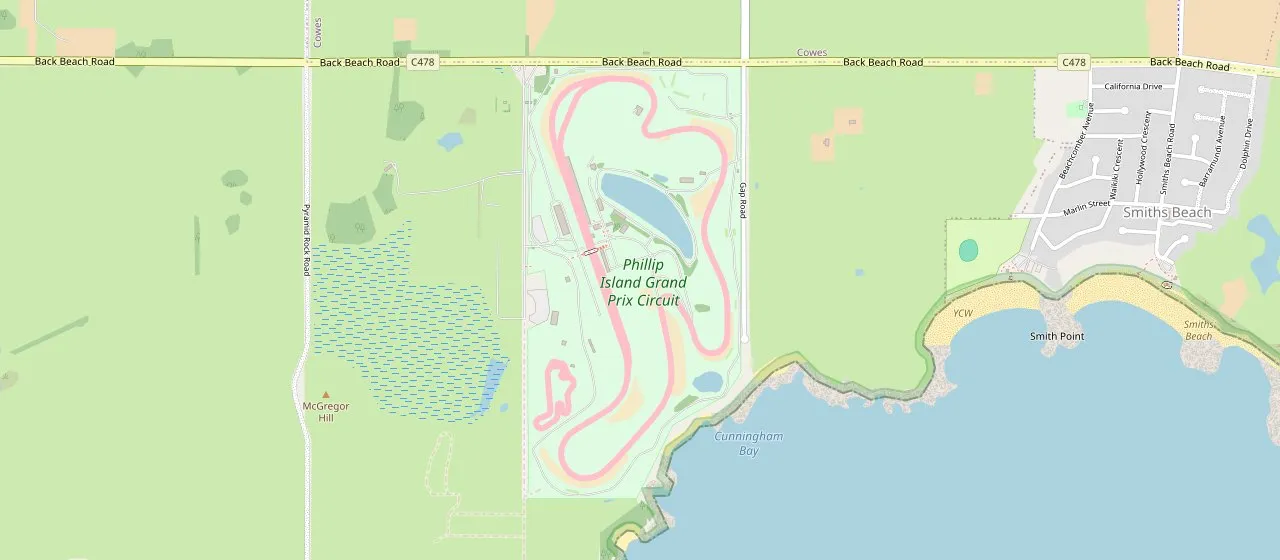
| Location | Back Beach Road, Ventnor, Phillip Island, Victoria, Australia |
| Type | permanent circuit, opened on a site other than the 1928–1935 road course |
| Length | 4.48 km according to the FIA licence |
| Direction | anticlockwise |
| Corners | 12 |
| Opened | 15 December 1956 |
| Lap record | 1:24.0607, Tim Slade, Brabham BT62, 15 May 2022 |
| FIA licence | grade 3 |
| Owner | Linfox Property Group (since 2004); circuit operator: PI Operations Pty Ltd |
| Major events | Australian motorcycle Grand Prix (1989, 1990, 1997–2026, except 2020 and 2021; last edition scheduled for October 2026); WorldSBK (since 1990, last round in February 2027); Armstrong 500 (1960–1962) |
| Status | active |
A hundred miles in the dust
In the 1920s Victorian law banned racing on public roads, and cars and motorcycles could race only on closed speedways. In 1927 the residents of the island's tiny community in Westernport Bay voted to separate their local council from the mainland shire, and that opened a loophole. A delegation of the Victorian Motor Cycle Union, joined by the Light Car Club of Victoria, proposed a meeting for March 1928. The council president, Sambell, had no trouble persuading the residents that racing would benefit the island. In February 1928 the council formally agreed to the club's event.
The course was a rectangle of country roads: narrow, cambered and gravel, only in places surfaced with crushed stone rolled into the gravel. According to a study by historian Mark Bisset, Commonwealth Oil Refineries and Castrol supplied 5,000 gallons of used oil, which was poured on the road to keep the dust down. Scott named the corners. A lunch at the Isle of Wight hotel reminded him of the Melbourne pub Young and Jackson's, hence the first name; then came Gentle Annie, the narrow cutting Needle's Eye, Hell, a little bridge named the Bridge of Sighs because after crossing it he breathed a sigh of relief, and finally Heaven Corner. Heaven, Hell, Young and Jacksons and Gentle Annie are also named by Fergus Cameron in an oral history recorded by the island's historical society.
The regulations required a mechanic to ride in every car, the driver and mechanic to wear approved helmets, the tyres to be Australian-made and everyone to drive clockwise. The hundred-mile race was set for Monday 26 March, the Eight Hour Day holiday. The day before, it poured, and the start was moved to Saturday 31 March. Even so, around a thousand people came over to the island on the Monday, a record for visitors to Cowes in a single day; speed trials were organised for them. Seventeen cars of up to 2 litres started the race, in four classes and two heats.
The afternoon heat was led for a long time by Arthur Terdich in a Bugatti, with nine minutes in hand at the start of the 15th lap. Then the car stopped, apparently out of fuel. Terdich got a lift to the pits and came back with fuel cans, and there it turned out that his mechanics had already brought the car into the pit lane. The winner was Captain Arthur Waite in a supercharged Austin 7. Waite had served at Gallipoli, then worked for Austin, and returned to Australia in 1927. The factory sent him a Sports version with a Cozette supercharger and a four-speed gearbox instead of the special Brooklands car he wanted, because that one had already been sold. Five thousand spectators went home caked in dust.
The name Australian Grand Prix had appeared earlier, in 1927, for an event at Goulburn in New South Wales. When it turned out that nobody had taken up the rights to the name, the island's organisers began using it, and it stuck. Victoria Police threatened the organisers with prosecution if any spectator was hurt. The dispute was settled through official channels: in September 1930 a delegation including the island council president A.K.T. Sambell won an amendment to the Motor Car Act, which had prohibited councils from closing roads for racing.
The master of this loop was Bill Thompson from Sydney. He won the Grand Prix in 1930 in a Bugatti, again in 1932, and in 1933 in a Riley, in rain and hail. The dust was such that, in his words, he navigated by “watching the tree tops”. In 1932 Albert Edwards in an Alvis swerved sharply as another car was leaving the pits, went off the road and overturned in a prohibited area where the club official Dick Wilkinson was standing. Wilkinson's leg was amputated on the spot. The last Grand Prix on the island's roads was held in March 1935; after that the race was to rotate between the states, and in 1936 it went to Victor Harbor in South Australia. On a shorter course cars kept racing until 1938, motorcycles until 1940.
The club from the café
In 1951 six local businessmen decided that racing had to be brought back to the island. They met in a café, and on 26 March 1952 the founding meeting of the Phillip Island Auto Racing Club, PIARC for short, took place. They bought the land from P.D. Whitlock, owner of the Brighton Beach Motors dealership in Melbourne and a racing enthusiast. The club offered 7,000 shares at 10 pounds each. The new circuit was to lie a few miles south of the old road loop.
The length was measured with an Alfa: three miles were needed for an international circuit certificate. Surveying and rotary-hoeing the ground began in January 1953. Construction took four years, ran into serious engineering problems, and the club had to ask its shareholders for more money. According to the club's history, the construction alone cost PIARC about 50,000 pounds.
The grand opening, a one-day combined car and motorcycle meeting, took place on 15 December 1956. Jack Day, one of the founders, drove a car through the ribbon. The first race, for racing cars up to 1500 cc, contained a second one for 500s, so the first chequered flag was seen by Murray Rainey in a Cooper. The full eight-lap distance of 24 miles was won by Lex Davison in a supercharged Vincent-engined Cooper prepared by engineer Phil Irving, one of the club's founders. The race for the Bill Thompson Memorial Trophy was won by a young Jack Brabham in a Cooper-Climax ahead of Bib Stillwell in a Jaguar D-type. Brabham also set the lap record: 2 minutes 26 seconds. Among the motorcyclists was Keith Campbell, who a year later became Australia's first world champion.
The race that moved to Bathurst
The shock absorber maker Armstrong came up with a 500-mile race for production cars, and it was first held on the island in 1960. It was organised by the Light Car Club of Australia. The winners were Frank Coad and John Roxburgh in a Vauxhall Cresta, after more than eight hours of driving, ahead of the favoured Bob Jane and Harry Firth in a Mercedes. Formally, only class placings were awarded at the time. It was not until an inquiry in 1992 that the Coad and Roxburgh crew was established as the first to complete the full distance. Jane and Firth won the next two editions, in 1961 and 1962.
The third edition damaged the surface so badly that it had to be relaid. The bridge at San Remo, linking the island with the mainland, could not have carried the hot-mix asphalt equipment, however, so the race needed a new home. The Sandown promoter wanted to keep it in Victoria but intended to sell half of the naming rights to another brand. The organisers chose Bathurst. That is how the race known today as the Bathurst 1000 was born. The club had no money for repairs or to pay off its loans; it closed the circuit and put the land up for sale.
It was bought in the mid-1960s by Len Lukey, a Melbourne exhaust manufacturer and racing driver, who in 1959 had won on the island the last race of the Gold Star series and the title of Australia's best driver. The agreement allowed the club to rebuild the circuit and keep running meetings. Lukey fenced the property and built water tanks, a swimming pool and gardens, while the club added drainage and finished the race control tower. The rise named Lukey Heights honours him. In the 1960s and 1970s Pete Geoghegan, Norm Beechey and Bob Jane raced here, and later Peter Brock, Allan Moffat and Dick Johnson. Lukey died in 1978, and the arrangement with the club ended with him. PIARC's last meeting of that era was the fiftieth anniversary of the first Grand Prix, with runs over the old road loop at Cowes. After that the land went back to being a farm.
Farmers and motorcyclists
In the mid-1980s the circuit was bought by the company Placetac, backed by the local Cameron and Henderson families and other shareholders. Years later Fergus Cameron recalled: “We bought it for the farm”. The investors and everyone around them, however, kept talking about the island's racing history. In 1988 Barfield, the company of engineer and promoter Bob Barnard, was awarded a round of the world motorcycle championship. The circuit owners went into a fifty-fifty partnership with Barnard, with the right to rebuild the venue.
According to Cameron, the old circuit was so well laid out that its shape hardly needed changing, but so badly built that there was a huge amount of engineering work. It was done mainly by locals, the earthworks above all by the contractor Peter Blom. According to RacingCircuits.info, the loop was shortened by roughly half a kilometre, and 5 million Australian dollars were spent on the redevelopment.
The motorcycle Grand Prix took place on 9 April 1989. Wayne Gardner on a Honda won the 500 cc race by less than half a second from Wayne Rainey, and according to the circuit operator more than 90,000 spectators watched. A year later Gardner won again, even though from the second lap his fairing was scraping along the asphalt after a broken mounting; Mick Doohan was second, and it was the first Australian one-two ever in the 500 cc class. The official MotoGP website counts both races among the best in the history of the premier class. In 1990 the Superbike World Championship also came for the first time; the Australians Peter Goddard and Rob Phillis won.
Sporting success was not financial success. Cameron recalled that the first Grand Prix made a huge loss, and sponsors were hard to find because John Cain's government banned cigarette advertising. The ban on tobacco and alcohol advertising in Victoria cost the island the Grand Prix for seven years. In 1991–1996 the motorcycles raced at Eastern Creek near Sydney. They came back in 1997: Doohan was leading comfortably, crashed on the 17th lap, and Àlex Crivillé won. A year later Doohan won here and sealed his fifth world title. The operator says 75,000 people watched.
Gardner's straight, Stoner's corner
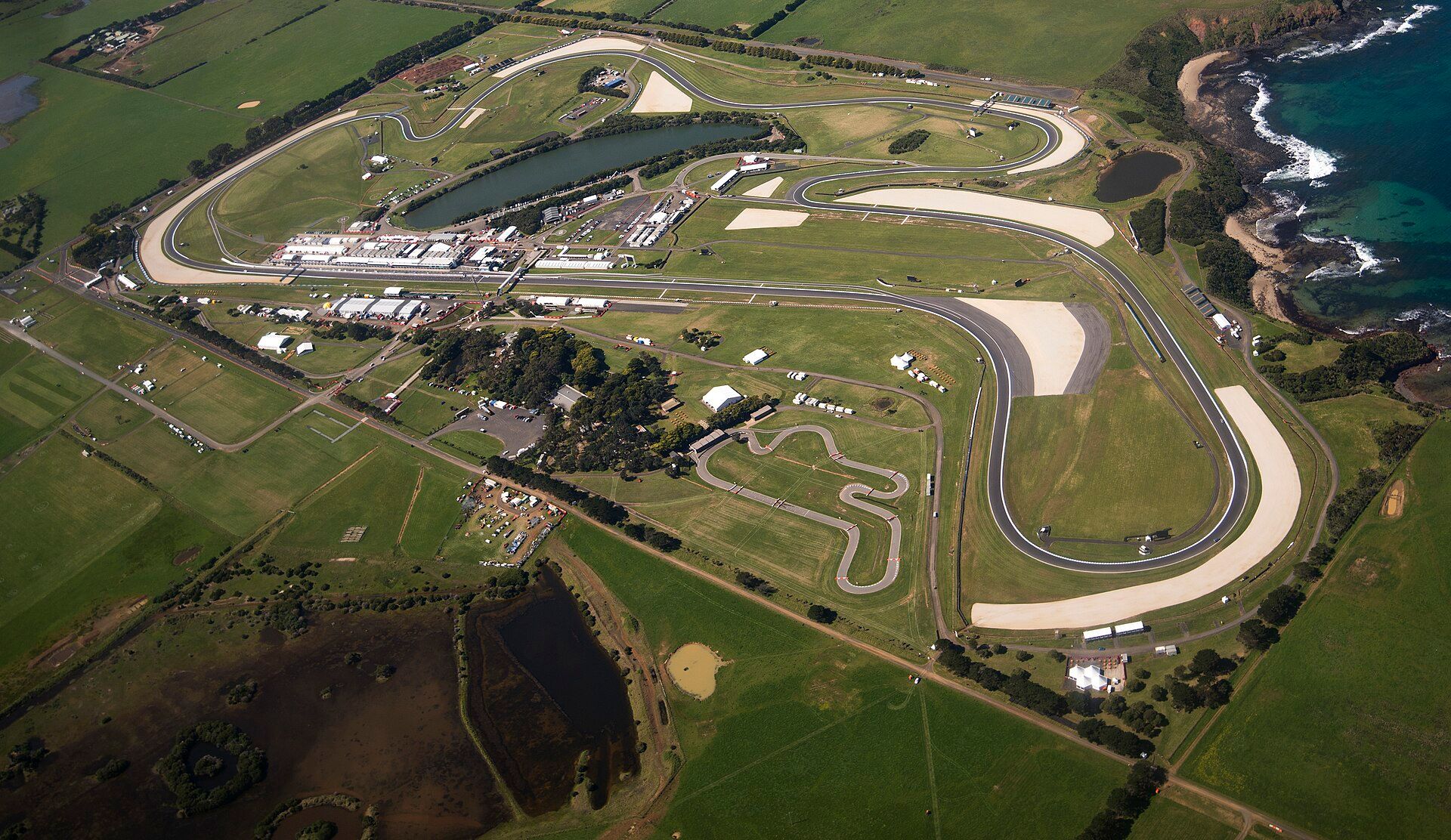
The main straight bears Gardner's name, and since 1999 the first corner has been called Doohan Corner. In October 2012, on the eve of the island round in the season at the end of which Casey Stoner was retiring, turn three was named Stoner Corner. Stoner, who until then had won the MotoGP race here five times in a row, since 2007, chose it himself: a fast downhill left-hander that MotoGP bikes enter at more than 250 km/h. He said of it: “I am almost flat out in fifth gear through there and that is pretty damn fast”. The circuit map shows twelve corners, with names including Southern Loop, Siberia, Miller Corner and Lukey Heights. Bass Strait is visible from the circuit. It is driven anticlockwise, the opposite of the old 1928 loop.
Fergus Cameron, talking about the circuit, quoted Valentino Rossi's description of Lukey Heights:
That turn is on a stretch of asphalt spread like butter over a shallow green hill. It clings to the hill tightly, following every contour. It’s like a long S, first left then right, and the apex is the top of the hill.
In the new era the surface was laid three times: in 1988, 1998 and 2012. The last one cost 3 million dollars and used 5,000 tonnes of asphalt, laid on site in two days after a year and a half of preparation and three-dimensional modelling to a tolerance of 3 millimetres. The new asphalt came as a surprise: tyre wear in practice was so high that, for safety reasons, the MotoGP race was shortened from 27 to 19 laps.
For more than 20 years, at least until 2020, the outright circuit record belonged to Simon Wills, who set it on 13 February 2000 in a Formula Holden Reynard 94D. In 2020 The Race Torque called Phillip Island the fastest circuit in Australia: the average speed on Wills's record lap exceeded 195 km/h. Today the record belongs to Tim Slade, who on 15 May 2022 lapped in 1:24.0607 in a Brabham BT62 sports car.
Linfox and the contracts
In 2004 Placetac sold the circuit to Linfox Property Group, the Melbourne transport and property group founded and run by Lindsay Fox. Cameron, who had run the circuit since 1984, explained years later that in 2004 the circuit had no long-term contracts for either MotoGP or Superbike and they were hard to renew, because Losail and Sepang were just opening, and next to them the island venue looked second-rate. Within five years Linfox spent almost 10 million dollars: on an exhibition hall, corporate facilities, surveillance, garages, a skid pan for training and a kart track that reproduces the shape of the big circuit on a small scale. In 2009 the circuit was in use about 280 days a year. The kart track is 750 metres long and operates next to a visitor centre with a display on motorsport history.
The circuit signed ten-year deals for MotoGP and WorldSBK, running to 2026 and 2027, in 2016. The Grand Prix contract, however, was concluded by the holder of the MotoGP rights with the Australian Grand Prix Corporation, which leases the circuit from Linfox; that is how Dorna's sporting director Carlos Ezpeleta explained it in 2023 to the local newspaper “South Gippsland Sentinel-Times”.
The year of two farewells
In February 2026 the Victorian government rejected Dorna's request to move the Grand Prix to the Albert Park circuit in Melbourne and offered extra money on condition that the race stayed on the island. A day later the sports minister Steve Dimopoulos confirmed that the thirtieth MotoGP at Phillip Island, in October 2026, would be the last. He said: “We could have kept it in Victoria, if we sold out Phillip Island”. He added that a year earlier 91,000 spectators had attended, the most in 13 years. From 2027 the Australian Grand Prix will run through the streets of Adelaide, for six seasons, until 2032. The last MotoGP on the island is scheduled for 23–25 October 2026.
Four months later WorldSBK announced that from 2028 the Australian round would move to The Bend circuit in South Australia. The farewell round on the island, on 19–21 February 2027, will be the thirty-sixth here; no other circuit has hosted the series so many times, with 76 races in total. Then Bob Barnard, the circuit's designer, warned that the venue could be closed and sold for a golf course. In early July 2026 Andrew Fox, managing director of Linfox Property Group, denied it: the circuit is not for sale, and when a golf course was last proposed on the neighbouring site, the council voted against it.
To the island in your own car
The circuit has no car practice days of its own in its calendar; such days run under a Motorsport Australia permit, and the operator refers drivers to partner organisers. The list includes Drive Events, Evolve Driving, On Track Events and Audi Driving Experience, and for motorcyclists Phillip Island Ride Days and California Superbike School.
Drive Events does not require a competition licence: a registered car and a driving licence valid in Victoria, including a foreign one, are enough. A day consists of six fifteen-minute sessions in groups matched by pace; the Performance Drive School option has five longer sessions with an instructor in the car and classroom sessions. In October 2026 a ticket for the Drive Day on 9 December 2026 cost 375 Australian dollars plus a 13-dollar booking fee. Evolve Driving runs performance driving courses at the circuit, which participants attend in their own cars. Timed club sprints are run by, among others, the Marque Sports Car Association: at least four timed sessions, each of at most 12–15 minutes, at most 26 cars on track at once and a noise limit of 95 dB.
A few miles to the north the roads of the old loop still lie almost untouched, only under asphalt. Jim Scaysbrook, who drove them in a 1928 Lombard for a 2008 article in “Motor Sport”, described a wooden sign with the corner's name at Young and Jackson's, although the corner itself had turned into a roundabout, and Hell Corner had recently disappeared under another one.
Timeline
- 1928: first 100-mile race on the island's roads, 31 March; won by Arthur Waite in an Austin 7.
- 1935: last Australian Grand Prix on the road loop.
- 1952: founding meeting of PIARC, 26 March.
- 1956: opening of the permanent circuit, 15 December.
- 1960: first Armstrong 500; won by Frank Coad and John Roxburgh.
- 1962: third and last Armstrong 500 on the island; circuit closed.
- 1963: the Armstrong 500 starts at Bathurst.
- 1978: death of Len Lukey, decline of the circuit.
- 1988: Bob Barnard's Barfield is awarded a round of the world motorcycle championship; redevelopment.
- 1989: first Australian motorcycle Grand Prix, won by Wayne Gardner.
- 1990: first WorldSBK round on the island.
- 1997: return of the motorcycle Grand Prix after six years at Eastern Creek.
- 2004: Linfox Property Group buys the circuit.
- 2012: turn three is named Stoner Corner; new surface.
- 2022: Tim Slade breaks the outright circuit record.
- 2026: MotoGP's move to Adelaide and WorldSBK's move to The Bend announced; last MotoGP on the island in October.
Sources (41)
- Jim Scaysbrook, No left turn, Motor Sport [en]
- Phillip Island and District Historical Society, The First Australian G.P. 31 March 1928 [en]
- Motor Sport Magazine, Phillip Island Road Course [en]
- Peter McLaren, Phillip Island owner denies ‘golf course’ claims after MotoGP loss, Crash.net, 2026-07-03 [en]
- Phillip Island Circuit, Circuit Map [en]
- phillipislandcircuit.com.au [en]
- Ventnor, Victoria, 3922, Australia [en]
- Motor Sport Magazine, Phillip Island [en]
- FIA, List of FIA licensed circuits updated on: 2025-12-01, 2025-12-01 [en]
- Marque Sports Car Association of Victoria, Circuits & Facilities [en]
- Phillip Island Circuit, Celebrating 60 Years Of Racing At The Phillip Island Grand Prix Circuit, 2016-11-22 [en]
- Phillip Island Auto Racing Club [en]
- Phillip Island Auto Racing Club, Lap Records [en]
- Phillip Island Circuit, About [en]
- Fergus Cameron, Oral histories 2015: Motor racing on Phillip Island, Phillip Island & District Historical Society (audycja radia 3MFM z lat 2014–2015) [en]
- Opening round and finale: Date set for the 2027 SBK World Championship at Phillip Island, SPEEDWEEK.com, 2026-07-02 [en]
- Crash.net, WorldSBK joins MotoGP in abandoning Phillip Island, 2026-06-19 [en]
- Supercars, 60 years on: The bridge that led to Bathurst, 2023-09-25 [en]
- Mark Bisset, 1928 100 Miles Road Race, Phillip Island, primotipo.com, 2020-05-28 [en]
- Tony Caldersmith, Austin's grand prix win, Motor Sport [en]
- Phillip Island Circuit, History [en]
- Phillip Island Auto Racing Club, A brief history of the Phillip Island Auto Racing Club and the Phillip Island Grand Prix Circuit, Shannons Club [en]
- Marcus Pye, Phillip Island Classic, Motor Sport [en]
- Supercars, First Great Race winner Coad remembered, 2021-11-23 [en]
- RacingCircuits.info, Phillip Island [en]
- WorldSBK, 2026 AUS [en]
- Ultimate Motorcycling, Phillip Island: MotoGP Racing History, 2010-10-13 [en]
- MotoGP.com, Wayne Gardner [en]
- Crash.net, Turn three presented to Casey Stoner, 2012-10-25 [en]
- Phillip Island Circuit, Get On Track [en]
- The Race Torque, The (Lap) Record Breakers: Phillip Island, 2020-11-13 [en]
- BikePoint, Phillip Island capital works hit $10m, bikesales.com.au, 2009-02-10 [en]
- Rumours aside, MotoGP seeks to extend at Phillip Island, South Gippsland Sentinel-Times, 2023-11-10 [en]
- Premier of Victoria, Labor backs Phillip Island for MotoGP, 2026-02-17 [en]
- Phillip Island loses the MotoGP race, Cycle News, 2026-02-18 [en]
- MotoGP.com, MotoGP to roar into the city streets of Adelaide from 2027, 2026-02-19 [en]
- Farewell, Phillip Island: The Bend starting in 2028, but Superbike needs more non-European rounds, Corsedimoto, 2026-06-19 [en]
- Phillip Island Circuit, Car Practice Days [en]
- Drive Events Pty Ltd, Phillip Island Grand Prix Circuit, Wed 9 Dec 2026 [en]
- Drive Events, FAQ [en]
- Evolve Driving, FAQ Performance Driving [en]
