
Balocco, Italy
Balocco: Alfa Romeo's secret track where Formula 1 tested quietly
Balocco Proving Ground: Alfa Romeo's test track since 1962, the death of Leo Cella, Brabham's secret fan-car tests, Fiat-era growth and amateur trackdays.
- Type
- test track
- Length
- 5.6 km
- Opened
- 1962
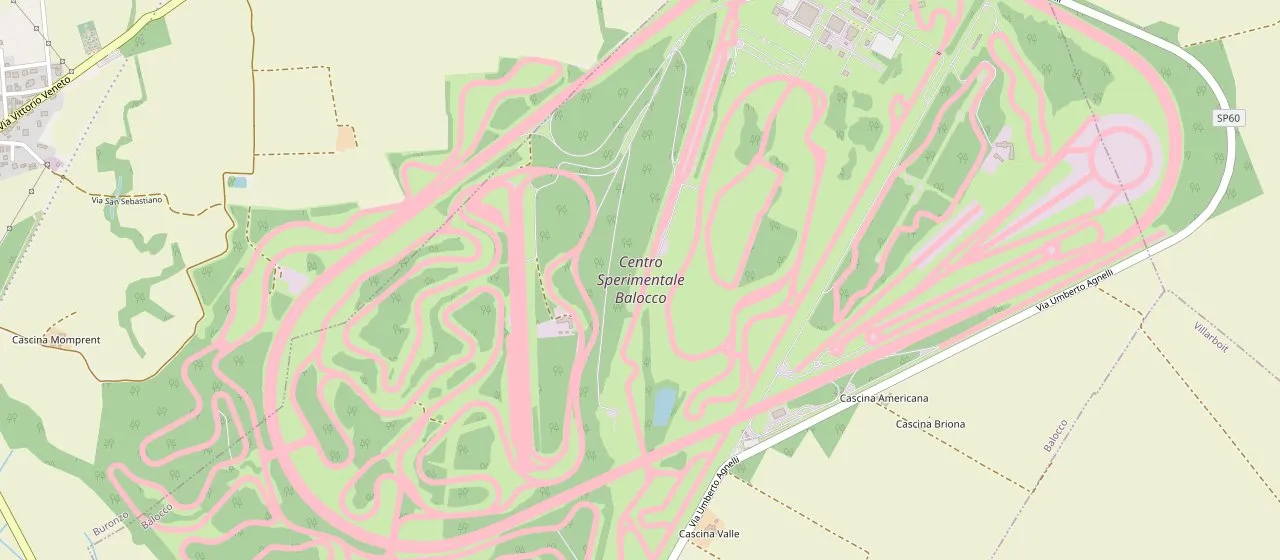
Before the Brabham team took its cars with a fan in the rear of the bodywork to Anderstorp for the 1978 Swedish Grand Prix, the first tests of the BT46B took place behind closed doors at Balocco, on Alfa Romeo's private test track. The project was so secret that parts ordered from suppliers were given misleading names on the drawings. The facility in the Piedmontese municipality of Balocco, halfway between Milan and Turin, has served for more than sixty years to test cars away from prying lenses. Its calendar for 2026, however, also includes four Sundays for amateurs with their own cars.
| Location | Balocco, province of Vercelli, Piedmont; Balocco exit of the A4 motorway from Milan to Turin |
| Type | closed research centre of a car manufacturer (test track) |
| Area and routes | about 5.5 km² and about 80 km of tracks and special surfaces |
| Alfa Romeo Track | 5.6 km |
| High-speed ring | nearly 8 km, bends banked at 30 per cent, speeds above 300 km/h; since 1992 |
| Langhe route | more than 20 km; since 1993; trackdays use its inner loop, 4.7 km long |
| Origins | construction from 1961, Alfa Romeo test track from 1962 |
| Owner | Stellantis group; access to the tracks is managed by Stellantis Europe S.p.A. |
| For amateurs | trackdays run by the organiser Track4fun; four Sundays in 2026 |
| Status | active |
A field by the motorway
Alfa Romeo began building the track at Balocco in 1961, almost at the same time as its new factory at Arese. The brand's historical archive wrote that the routes here were used to test the durability, speed and safety of every production model, and that on bends modelled on other famous circuits the racing cars of Autodelta, for more than twenty years Alfa's advanced research department across every form of motorsport, covered their first metres. According to Fiat, the later owner, Balocco began operating as Alfa Romeo's test track in 1962. The original site covered about 2 km² and held the Misto Alfa route, special surfaces and unpaved sections. Motorsport Memorial, a database of motorsport fatalities, attributes the design to engineer Giancarlo Grandi and describes the Misto Alfa bends as copies of the Curva Grande and the first Lesmo bend at Monza and of the Hugenholtz hairpin at Zandvoort.
The facility lies beside one of Italy's oldest motorways, linking Milan with Turin. Denis Jenkinson of the British "Motor Sport" remarked in 1971 that the road between Alfa's Milan and the Turin of Fiat and Lancia must be an interesting one, because it runs past Alfa's private track at Balocco. On the Monday after the race at Monza, a small orange four-seater drew level with him on the motorway; it looked like a Citroën GS and had a BMW-like grille at the front. When Jenkinson let it go past, he saw Consalvo Sanesi at the wheel, Alfa Romeo's test driver and a former driver for its Grand Prix team, on his way to Balocco; the car resembled no known Alfa. In its May issue of the same year the magazine described the presentation of the Alfa Montreal at the facility which Alfa Romeo had built, as it put it, a few years earlier west of Milan. The demonstration drive, with Sanesi at the wheel, took in the track, country roads and the motorway to Turin.
The track was also used to pick people. In autumn 1964, before the Jolly Hotels Rally, Alfa's competition department offered the crews entered by the Jolly Club a trial at Balocco. On the wet surface the benchmark time was set by racing driver Teodoro Zeccoli; rally driver Arnaldo Cavallari went next, and last came his co-driver and karting friend Sandro Munari, wearing a karting helmet. After five laps he was called back to the pits. Jolly Club head Mario Angiolini later explained to him that he had been only a second slower than Zeccoli, and that the run had been stopped for fear that he would go faster; the crew got the car.
Saturday, 17 February 1968
Leo Cella, a rally driver from the Sanremo area who won the local rally twice in a row, in 1965 and 1966, became a driver for the works Autodelta-Alfa Romeo team in the World Sportscar Championship in 1968. In February the team called him to Balocco to test the two-litre Alfa Romeo 33/2 together with Teodoro Zeccoli and Roberto Bussinello ahead of the 12 Hours of Sebring. During a run on the Misto Alfa route, begun on Saturday 17 February at 17:30, Cella's car went out of control on the entry to the main straight at about 240 km/h, rolled several times and came to rest upside down by the pillar of a bridge over the track. The driver was taken to hospital in Vercelli, where he died at around 20:30.
In its April rally column "Motor Sport" noted that the works Lancia team had lost its two best men at the start of the year: Luciano Lombardini on the Monte Carlo Rally and Leo Cella during Alfa Romeo testing at Balocco. According to Motorsport Memorial it was the first death at the track, and the public prosecutor's office in Vercelli closed it for a time after the accident.
A Formula 1 laboratory
In the 1970s Balocco became the base for Alfa Romeo's return to Formula 1. In 1975, just after Ferrari's new twelve-cylinder engine had fallen silent at Fiorano, another twelve-cylinder boxer unit was fired up at Balocco: Alfa's engine in Brabham's new car for the 1976 season, with the team's drivers, Carlos Reutemann and Carlos Pace, standing by the track. Three years later it was the BT46B's turn. Jenkinson wrote in August 1978 that all the testing and the experiments with skirt sealing, fan efficiency and radiators had taken place at Alfa's private track. Years later, designer Gordon Murray remembered one moment best:
“The thing I remember most is standing behind the car at Balocco. Niki dropped the clutch at 12,000rpm, and the rear wheels didn’t chirp. The car seemed to do 0-30mph in nothing… it just leapt from where it was.”
By then Alfa already had its own Formula 1 car, independent of Brabham. According to Jenkinson, the brand began to talk about it openly only after someone spying from the inside photographed the car during tests at Balocco; Alfa then sent out its own photographs with Vittorio Brambilla at the wheel. Bruno Giacomelli, who joined the team in 1979, recalled his first visit to the track: the car stood in the garage, and on the wall hung a huge black-and-white poster of Farina in an Alfetta from the 1950s. “It was a very emotional moment for me, as an Italian,” he said. In the winter before the 1979 season he developed the 177, with its twelve-cylinder boxer engine, at Balocco and at the Paul Ricard circuit, and at the end of 1980, within five laps, he broke the lap record here in a new ground-effect car with sliding skirts designed by Luigi Marmiroli. A change in the regulations meant that the car never raced in that form. In 1982 Alfa's turbocharged eight proved slower than the three-litre twelve in testing at Monza, but on the twisty track at Balocco the turbo car was more agile.
At that time the track's name also ended up on a car for customers. In 1982 Alfa sold the GTV6 Balocco in the United States in a series of 350 units, in red only, with a plaque bearing the car's number on the glovebox lid. The owner of one of them admitted in 2014 that buyers were not told at the time exactly what linked the name to the track.
Under the Fiat banner
Fiat took over Alfa Romeo in November 1986 and controlled it from 1 January 1987. Before the 164 made its debut at the Frankfurt motor show, "Motor Sport" was among the few European publications invited to drive four laps of a twelve-mile, or roughly 19 km, route around the track at Balocco; the presence of Fiat group chairman Vittorio Ghidella lent the presentation weight. In summer 1988 the Brabham crew came here with the Alfa 164 Procar, a racing car with a silhouette almost identical to that of the road-going Alfa. Giorgio Pianta drove two short tests, and because of a small leak from the water radiator found at Balocco, Riccardo Patrese was told before a demonstration at Monza to take care and drive only two laps. In March 1989 the car with which Alfa Romeo entered the American Indycar series turned a wheel for the first time at Balocco.
The expansion also took in the facility itself. In 1992 a high-speed ring nearly 8 km long was built, with bends banked at 30 per cent, on which more than 300 km/h is possible, and in 1993 the twisty Langhe route, more than 20 km long. According to a 2012 Fiat presentation, later additions were a comfort track (1999), an off-road route (2005), a low-grip track (2006) and, in 2008–2010, further special surfaces and a dynamic platform 1.3 km long; separate Iveco truck tracks measured 7.9 km. The whole facility then covered 5.5 km², and its routes added up to about 80 km. Balocco did not serve engineers alone: in May 2002 it hosted the annual meeting of the Fiat group's management with financial analysts and institutional investors.
A hall above the track
Over time, the track that had once been hidden from photographers became a stage. For Alfa Romeo's centenary in 2010 the brand lined up a row of its racing cars there for "Motor Sport" journalists, from the Tipo B to the Disco Volante and the TZ2; Andrew Frankel wrote of “Fiat’s old and once secret Balocco test track”. In September 2013 Alfa presented the 4C at Balocco in a conference hall built over the track, with the circuit running through the middle of it. After dark, journalists took the passenger seats across the whole 4C fleet and set off at calculated intervals into the darkness, onto the unlit track. Frankel described how a driver named Emanuele raced at 150 mph along a stretch the journalist took to be a straight, then, unable to see, threw the car into a left-hand bend at 100 mph. On 31 October 2013, in the former Autodelta workshops, Alfa handed over 4C Launch Edition cars to its first five customers, from Switzerland, France, Germany, the Netherlands and Italy, and Nicola Larini, the 1993 DTM champion, drove them round the track.
In 2016 Balocco hosted the international presentation of the new Giulia. Brand chief Harald Wester said there: “With more than €1 billion invested in this architecture and billions to be spent developing other cars from it, our credibility hangs on this car.” At the start of 2019 the Alfa Romeo Racing drivers, Kimi Räikkönen and Antonio Giovinazzi, drove production Alfas on the 5.6 km Alfa Romeo Track. On 12 June 2019 the Gumball 3000 rally caravan, travelling from Venice to Monte Carlo with more than a hundred supercars, stopped here, and Giovinazzi drove demonstration laps of the Alfa Romeo Track in a Giulia Quadrifoglio.
The track nonetheless remained a workplace, at times a dangerous one. On 20 December 2017 a 31-year-old test driver was killed during a test of a prototype that left the track. Representatives of the Fiom trade union pointed out that this was the second fatal accident on the Balocco track in two years. They called on FCA to apply safety standards that would protect workers' lives, and on the relevant authorities to establish responsibility swiftly.
Sunday at Balocco
Today the facility belongs to the Stellantis group and still serves as a test track. Lancia Corse director Eugenio Franzetti said in 2026 that the new Ypsilon Rally2 rally car was designed by Stellantis Motorsport, built at Satory and tested “on our circuit at Balocco in Italy, as well as on real mountain roads”. Access to the tracks, which documents call the “Comprensorio di Balocco”, is managed by the company Stellantis Europe. Trackday participants print and sign its declaration that they are familiar with the Balocco Proving Ground regulations and the safety manual.
In 2026 the Italian organiser Track4fun scheduled four Sunday trackdays here: 22 March, 7 June, 13 September and 8 November. Participants can drive on the 5.6 km Alfa Romeo Track and on the twistier inner Langhe loop, 4.7 km long. Road and competition cars are admitted, slick tyres are allowed, and the organiser states that there is no noise limit. For the November date it quoted prices from 200 euros for a one-hour session to 500 euros for a full day, VAT included. A road-car driver needs an open-face or full-face helmet; in competition cars a race suit, gloves and boots are also mandatory, and with four- or six-point harnesses the organiser recommends a HANS device. There are no garages or power points on site, minors are not let in through the gate, passengers must be 18 or older, and drones are banned.
The programme for 8 November has the gates opening to drivers at 08:30, a compulsory briefing at 09:15, and driving with the pit lane open from 10:15 to 13:00 and from 14:30 to 17:00. The organiser states that the trackday will go ahead in the rain too and that no refunds or vouchers are provided.
Timeline
- 1961: Alfa Romeo begins building the track at Balocco.
- 1962: Balocco starts operating as Alfa Romeo's test track.
- 1964: a trial on the wet track before the Jolly Hotels Rally; Sandro Munari takes part.
- 1968: on 17 February Leo Cella is killed during a test of the Alfa Romeo 33/2.
- 1975: Alfa's engine in Brabham's new car for the 1976 season runs at Balocco.
- 1978: secret tests of the Brabham BT46B fan car.
- 1980: Bruno Giacomelli breaks the lap record.
- 1987: Fiat controls Alfa Romeo from 1 January.
- 1989: in March, the first run of Alfa's car for the Indycar series.
- 1992: the high-speed ring is opened.
- 1993: the Langhe route is opened.
- 2013: the first 4C Launch Edition cars are handed over to customers.
- 2017: on 20 December a test driver is killed.
- 2019: the Gumball 3000 rally stops here.
- 2026: four Track4fun trackdays for owners of their own cars.
Sources (35)
- Adam Cooper, Vacuum clean-up, „Motor Sport” [en]
- Denis Jenkinson, The Brabham-Alfa Romeo fan, „Motor Sport” [en]
- Denis Jenkinson, New Formula One cars, „Motor Sport” [en]
- Fiat Group Automobiles, Balocco Proving Ground [en]
- Jay Ramey, The Alfa Romeo GTV6 Balocco stays sharp, Autoweek, 2014-08-05 [en]
- Track4fun.com, Calendario Track4fun 2026, 2026-07-22 [it]
- Track4fun.com, Balocco [it]
- Denis Jenkinson, Letter from Europe, „Motor Sport” [en]
- Stellantis Europe S.p.A., Dichiarazione di presa visione e accettazione delle regole comportamentali sulle piste del Comprensorio Balocco [it]
- Track4fun.com, Trackday Balocco – Domenica 08.11.2026, 2026-11-08 [it]
- Alfa Romeo, Immersione nel mondo Alfa Romeo per Kimi Räikkönen e Antonio Giovinazzi, alfaromeo.it, 2019-02-13 [it]
- Nanni Dietrich, Leo Cella [en]
- Archivio Storico Alfa Romeo, Balocco, 2007-02-13 [it]
- Museo Storico Alfa Romeo, Balocco [it]
- Alfa Romeo, The first European Alfa Romeo 4C 'Launch Edition' units are delivered at Balocco, Fiat Chrysler Automobiles EMEA Press, 2013-10-31 [en]
- Anthony Peacock, Lancia returns to rallying with Ypsilon Rally2 and eyes future WRC ambitions, „Motor Sport” [en]
- Alfa Romeo, Consegna a Balocco, alfaromeo.it [it]
- Rumblings, May 1971, „Motor Sport” [en]
- John Davenport, Years of the Dragon, „Motor Sport” [en]
- Gerry Phillips, Rally Review, April 1968, „Motor Sport” [en]
- Stage presence, „Motor Sport” [en]
- Denis Jenkinson, The Formula One Scene, „Motor Sport” [en]
- Bruno Giacomelli, „Motor Sport” [en]
- Paul Fearnley, Bruno Giacomelli: Besotted by his craft, „Motor Sport” [en]
- 1982 Italian Grand Prix race report, „Motor Sport” [en]
- Gary Watkins, Alfa Romeo’s forgotten 164 Procar: the 200mph monster saloon, „Motor Sport” [en]
- Mike Cotton, New cars: Alfa Romeo 164, „Motor Sport” [en]
- Alfa Romeo's 1990 World motorsport plans, „Motor Sport” [en]
- Fiat Group, Balocco - Incontro vertici Gruppo Fiat con analisti finanziari e investitori istituzionali, 2002-05-16 [it]
- Andrew Frankel, Five-Corse feast, „Motor Sport” [en]
- Andrew Frankel, Alfa Romeo’s 4C launch at Balocco, motorsportmagazine.com, 2013-09-25 [en]
- Andrew Frankel, Alfa’s moment of truth, „Motor Sport” [en]
- Fiat Chrysler Automobiles EMEA Press, Alfa Romeo accoglie a Balocco la Gumball 3000, 2019-06-13 [it]
- Incidente mortale in pista: vittima un 31enne, Notizia Oggi, 2017-12-20 [it]
- Muore nella pista di Balocco. «Accertiamo subito le responsabilità», Notizia Oggi, 2017-12-21 [it]