
Monza, Italy
Autodromo Nazionale Monza: 110 days, two ovals and chicanes
History of the Monza circuit: built in the royal park in 1922, banked curves of 1955, the 1933 and 1961 tragedies, 1970s chicanes and track days today.
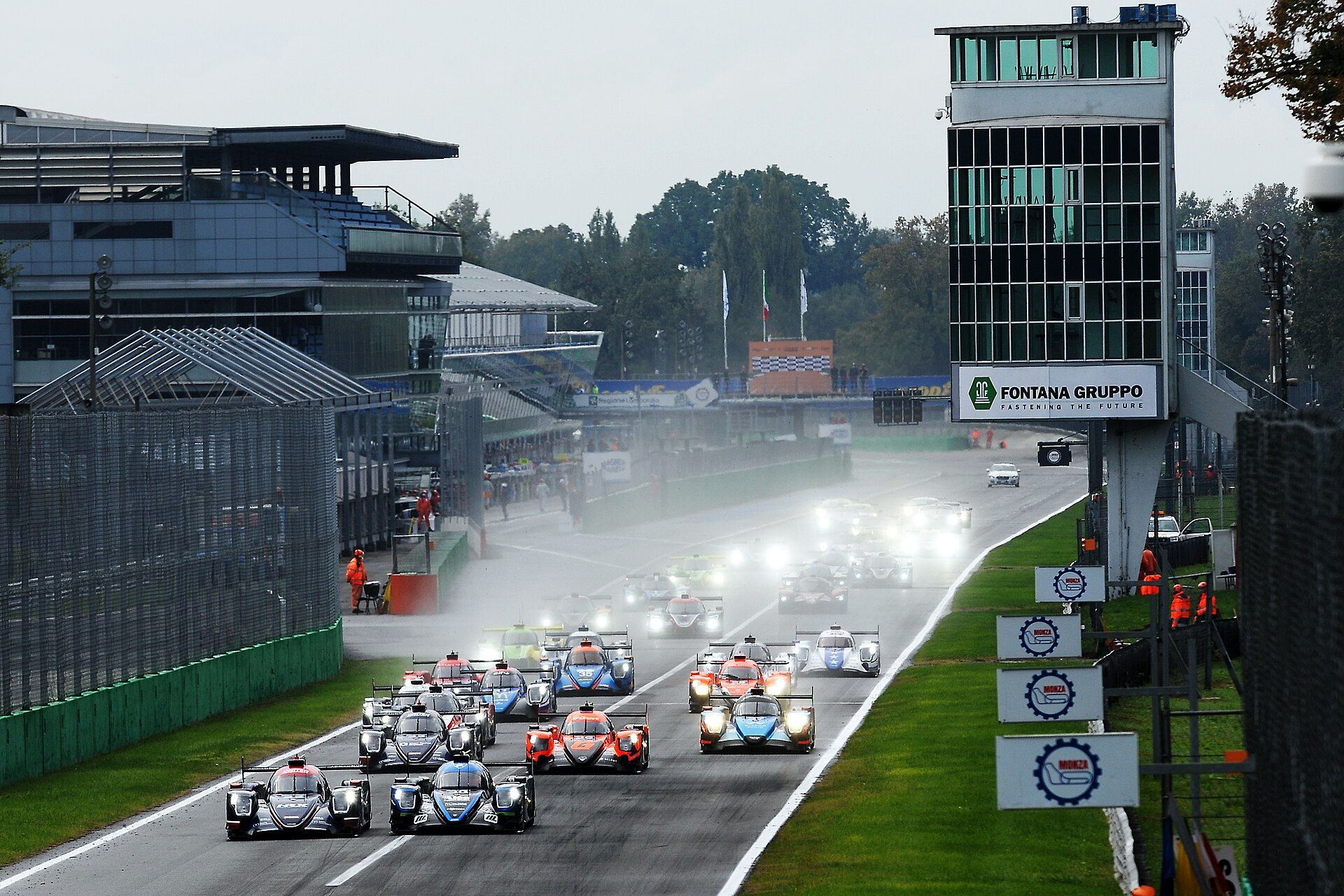
- Type
- race circuit
- Length
- 5.793 km
- Opened
- 1922
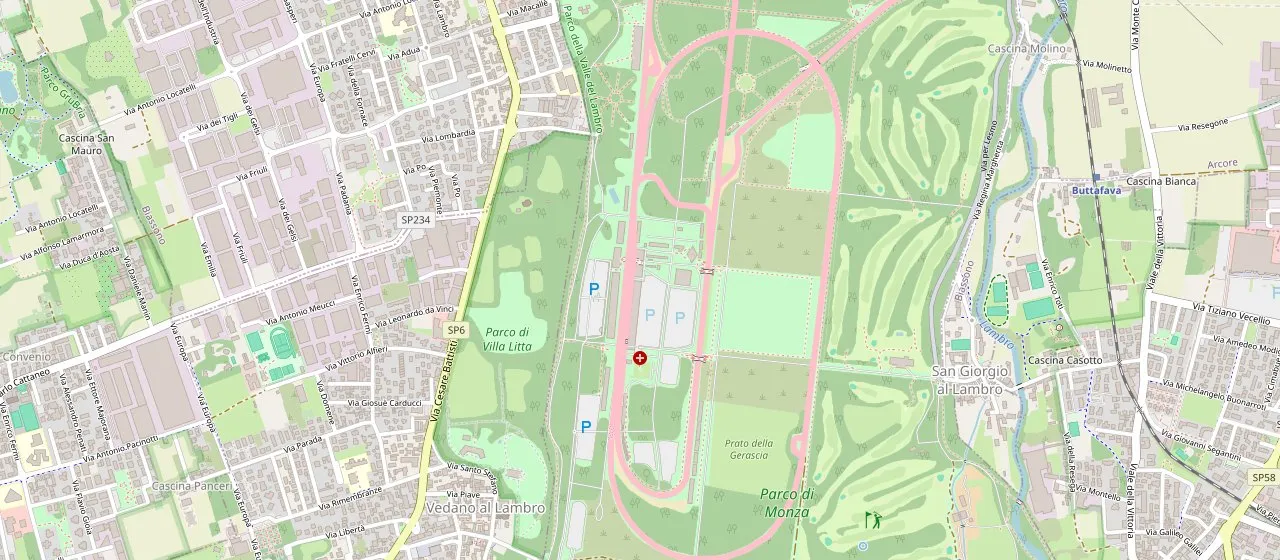
On 15 May 1922, in the northern part of the royal park in Monza, at a place called Bosco Bello, 3,500 workers set to work with 200 carts, 30 trucks and a five kilometre narrow gauge railway with two locomotives and 80 wagons. The Milan automobile club gave them a deadline of 15 August, because it had already announced the Italian Grand Prix for September. The circuit was built in one hundred and ten days and has been rebuilt several times since, twice gaining the banked curves of an oval and twice losing them, and each of those changes was preceded by something that had happened on the asphalt or in the crowd behind the fence.
| Location | Parco di Monza, Monza (Lombardy), Italy; entrance at Viale di Vedano 5 |
| Type | permanent road circuit in a park, FIA grade 1 licence |
| Length and configuration | 5,793 m, Grand Prix configuration since 2000; 11 corners (7 right, 4 left); width 10–12 m |
| Opening | 3 September 1922 |
| Direction of travel | clockwise |
| Lap record (race) | Lando Norris, McLaren MCL39-Mercedes, 1:20.901, Formula 1, 2025 |
| Operator | Autodromo Nazionale Monza SIAS S.p.A.; shareholders: Automobile Club d'Italia (90 percent) and Automobile Club Milano (10 percent) |
| Main events | Italian Grand Prix (since 1922; in 1980 held at Imola), formerly the 1000 km of Monza and the 500 Miles of Monza |
| Status | active |
One hundred and ten days in Bosco Bello
The decision was taken in January 1922. The Automobile Club di Milano wanted to mark 25 years of its existence, and Italian car manufacturers, already geared towards export, needed a permanent facility for races and testing. The first Italian Grand Prix had been held a year earlier on a semi permanent circuit at Montichiari, fast but poorly equipped; the new event was meant to match the Grand Prix of the Automobile Club of France. To build and manage the circuit, the company Società Incremento Automobilismo e Sport (SIAS) was set up, with entirely private capital, chaired by Senator Silvio Crespi. The design was entrusted to the architect Alfredo Rosselli, supported by the engineer Piero Puricelli, later the builder of Italy's motorways. The preliminary version assumed 14 km of track in two loops and a cost estimate of 6 million lire.
The foundation stone was laid at the end of February by Vincenzo Lancia and Felice Nazzaro, but the works were halted almost immediately for reasons, as the justification put it, of "artistic and historic value and the protection of the landscape". The first design took up almost the whole park and required hundreds of old oaks in Bosco Bello to be felled, so the ministry blocked it. After months of disputes and negotiations with Rome, the argument about the "absolute necessity" of the autodrome prevailed, except in a version shortened to 10 km and routed, wherever possible, along the existing avenues of the park. A local periodical, quoted today by MonzaToday, greeted the works with words about "the new Monza" which "is taking shape on the horizon" in corners of the park that until then had been "a refuge for deer".
The final shape was two loops sharing a common start straight: five and a half kilometres of road loop with seven corners and a 4.5 km oval with two banked curves, joined by straights of 1,070 m each and calculated for 180–190 km/h. The two loops crossed without conflict, thanks to an underpass beneath the embankment in the Serraglio area. The straights were laid in tarred macadam, the corners in concrete, tarred as well. For the public, a main grandstand for 3,000 and six side stands of 1,000 seats each were built. The first full lap was driven on 28 July by Pietro Bordino and Felice Nazzaro in a Fiat 570. The official opening took place in the rain on 3 September 1922, in the presence of Prime Minister Luigi Facta; that day the voiturette class race was won by Bordino in a Fiat 501. A week later, on 10 September, the same Bordino won the second Italian Grand Prix in a six cylinder Fiat 804. Monza was the third circuit in the world built specifically for racing, after Brooklands and Indianapolis.
Black Sunday and the end of the first oval
The happy years ended in 1928. During the Grand Prix, Emilio Materassi's Talbot, while overtaking a Bugatti on the start straight, suddenly turned left, broke through the barrier and drove into the crowd. The driver died on the spot and with him more than twenty spectators. A change of route followed from that accident: in 1929 the cars raced only on the oval, in the Monza Grand Prix, in which Achille Varzi in an Alfa Romeo and Alfieri Maserati exceeded 200 km/h on the fastest lap for the first time. Vincenzo Florio, chairman of the sporting commission, meanwhile laid out the so called Florio circuit of about 6,680 m, joining the middle straight of the road loop with the eastern straight of the oval and bypassing the northern curve. On that layout, in 1931, Philippe Étancelin went off the track at the Lesmo corners and drove into another group of spectators: three people died, 14 were injured.
The full, ten kilometre circuit returned to use in 1932–1933 and it was there, in 1933, that "Black Sunday" came. On the southern banked curve, Giuseppe Campari's Alfa Romeo P3 and Baconin Borzacchini's Maserati 8CM went into a slide on a patch of oil left a lap earlier; both died on the spot. The same day, in the same curve, the Bugatti of Count Stanisław Czaykowski rolled over and caught fire; the Polish driver died in the blaze. The answer was the insertion of two artificial chicanes, after which the winners Luigi Fagioli and Rudolf Caracciola in Mercedes cars achieved an average of barely 105 km/h. The oval was practically abandoned; in 1938, after the last Grand Prix on the Florio circuit, won by Tazio Nuvolari in an Auto Union ahead of a strong Mercedes team, the banked curves were demolished, and a new road loop 6,300 m long was designed with the Vialone corner and a lengthened back straight.
The war did not allow it to be tried out. The halls and buildings of the circuit were taken over by the archives of the Public Vehicle Register, the offices of the Milan automobile club, and even animals evacuated from the Milan zoo. In April 1945 a parade of Allied armoured vehicles marched along the straight in front of the grandstands and crumbled the surface; afterwards the site became a dump for military equipment. At the beginning of 1948 the Automobile Club Milano decided on a full reconstruction and in two months brought the facility into usable condition, introducing along the way the changes planned back in 1938. On 17 October 1948 the reborn Monza hosted a Formula 1 Grand Prix, won by the Frenchman Jean-Pierre Wimille in an Alfa Romeo 158.
Concrete banked at eighty percent
In 1955 SIAS returned to the idea from 1922, but in reinforced concrete instead of earth embankments. The new oval measured 4,250 m: two semicircular curves of 320 m radius joined by straights of 875 m each, with banking rising to 80 percent in the upper band, calculated for about 285 km/h; the designers, the engineers Antonio Beri and Aldo Di Renzo, wanted to make it possible to drive without changing gear and without braking. The road loop was shortened to 5,750 m, and its two porphyry "curvette" were replaced by a single curve of increasing radius, named Parabolica for that reason. The two loops again joined into a ten kilometre whole with a common straight, divided by a row of cones: cars on the pit side turned off the Parabolica onto the northern curve, and those on the grandstand side headed for the Curva Grande. That is how the Italian Grand Prix was raced in 1955, 1956, 1960 and 1961.
The oval itself served in 1957 and 1958 for the 500 Miles of Monza, a race for the Two Worlds Trophy funded by the city, open to cars from Indianapolis, which in the American tradition ran to the left, anticlockwise. The idea came from the circuit's director, the engineer Bacciagaluppi; the first edition took place almost without Europeans, while the second was taken seriously by Ferrari and Maserati, which built special cars for Luigi Musso, Harry Schell and Stirling Moss. Americans won both: Jimmy Bryan in a Dean Van Lines Special at an average of 257.594 km/h and with a fastest lap of 282.809 km/h, and a year later Jim Rathmann.
For Formula 1 the banked curves turned out to be a problem. In 1956 several drivers had tyre treads peel off on the oval; Eugenio Castellotti lost the tread of his left rear tyre on the southern curve and hit the barrier on the inside, without injury. For three seasons the Grand Prix went back to the road loop alone, and in 1960 the return to the 10 km circuit provoked a boycott by the British teams, including Cooper, Lotus and BRM, whose bosses considered the concrete too fast and too bumpy for light rear engined constructions; Ferrari took the whole podium. A year later the British came, although, as Denis Jenkinson reported in "Motor Sport", they protested "this time in more polite terms" and before practice had to go through a separate session to get used to the banking.
On 10 September 1961, on the second lap, just before the braking point for the Parabolica, the Ferrari of Wolfgang von Trips and the Lotus of Jim Clark collided. The Ferrari spun, ran up the grass embankment, bounced off the fence behind which spectators were standing, and after several rolls came to rest on the track; von Trips was thrown out of the car and died before he could be helped in hospital. The race was not stopped, and Phil Hill won it and became world champion, learning of the tragedy only after coming into the pits. More than ten spectators were killed. Although the accident happened on the road loop and not on the concrete, Formula 1 never ran on the banked curves again. The oval still served the 1000 km of Monza in 1965–1969, from 1966 with permanent chicanes at the entry to the curves, after which it fell silent.
Chicanes instead of speed
Without the oval, Monza remained a circuit of straights. The Grand Prix races of 1969 and 1971 ended in elbow to elbow finishes after whole distances driven in the slipstream of rivals; on 5 September 1971 Peter Gethin in a BRM won the fastest and closest race in the history of the championship so far, with five cars within one second. Averages were approaching 250 km/h, and the cars were getting lighter and more fragile. In 1972, in agreement with the GPDA drivers' association, two chicanes were inserted: on the straight before the Curva Grande and before the Vialone, which since 1955 has borne the name of Alberto Ascari, killed there on 26 May 1955 in a private test in Castellotti's Ferrari. Motorcycles still ran without chicanes and in 1973, during the Nations Grand Prix, a seized piston in Renzo Pasolini's machine caused a mass fall at the start of the 250 class, in which Pasolini and the Finn Jarno Saarinen died; forty days later three amateur riders died in the same place in a junior race. The motorcycle Grand Prix did not return to Monza until 1981.
The chicanes of 1972 turned out to be a stopgap and in 1976 they were replaced by variants: on the start straight a left, right, left, right sequence, which lowered the entry speed into the Curva Grande from over 300 to about 180 km/h, and a second one before the first Lesmo, at the site of the former della Roggia corner. The circuit grew to 5,800 m and in that shape, with minor changes, it survived into the 1990s. It was precisely in the throat before the first variant that on 10 September 1978 there was a pile up after which Ronnie Peterson died in hospital. After the death of Ayrton Senna in 1994 the second Lesmo was tightened to a radius of 36 m, and a year later the Curva Grande and both Lesmos were moved inwards to enlarge the run off areas; this cost SIAS about 5.5 billion lire, and for every tree cut down three new ones were planted, 555 in total. In the summer of 2000 the first variant was rebuilt from an S bend into a tight right, left combination and the circuit reached its present 5,793 m. Today, from the start straight of 1,194.40 m, cars enter that corner at over 370 km/h and brake down to 70–80 km/h.
Park, company and track day
Since the day it was built the circuit has been managed by the same company, today under the name Autodromo Nazionale Monza SIAS S.p.A., federated with the Automobile Club d'Italia; the shares are held by ACI (90 percent) and Automobile Club Milano (10 percent). The park remains open to residents, and next to the main straight there is a municipal swimming pool. The concrete from 1955 still stands: at the end of the 1990s it was threatened with demolition, in 2002 Luciano Dal Ben set up a committee for the defence of the banked curves and collected thousands of signatures under a petition to the authorities of Milan and Monza, and parts of the surface were later renovated. In 2015 Lewis Hamilton and Stirling Moss drove on them in two Mercedes W196 cars; Hamilton said afterwards that "we should have a banked corner again".
An amateur can drive here in their own car. The operator organises track days in an open pit lane format: a car session lasts 225 minutes and costs 390 euros, two sessions 690 euros, and ACI members get a 10 euro discount. A racing licence is not required, a safety briefing and a helmet are compulsory, also for a passenger; only private, registered and insured cars are let onto the track, without underage passengers. Up to 85 entries are accepted for one session, with at most 50 cars on the track at the same time, and booking and payment are made on site on the day of the event. Anyone who prefers to watch can choose the grandstand at the first variant, where braking from the start straight begins at close to 350 km/h. On track days the café opposite the Fangio monument is open, and behind the trees of the park, as RacingCircuits.info writes, the slowly crumbling concrete of the 1955 curves can still be seen.
Timeline
- 1922: decision of the Automobile Club di Milano in January; construction from 15 May in one hundred and ten days; opening on 3 September; Italian Grand Prix on 10 September won by Pietro Bordino.
- 1928: the accident of Emilio Materassi on the start straight, death of the driver and of more than twenty spectators.
- 1933: "Black Sunday", deaths of Campari, Borzacchini and Czaykowski on the southern curve.
- 1938: demolition of the first oval, new road loop of 6,300 m.
- 1948: rebuilding after the war, Grand Prix on 17 October won by Jean-Pierre Wimille.
- 1955: new oval of 4,250 m on a reinforced concrete structure, Parabolica, road loop of 5,750 m; death of Alberto Ascari on 26 May.
- 1957–1958: the 500 Miles of Monza for cars from Indianapolis.
- 1961: the accident of Wolfgang von Trips on 10 September, last Grand Prix on the full circuit.
- 1972: two chicanes agreed with the GPDA.
- 1973: deaths of Renzo Pasolini and Jarno Saarinen in the Nations Grand Prix.
- 1976: variants instead of chicanes, circuit of 5,800 m.
- 1994–1995: tightening of Lesmo, moving of the Curva Grande, circuit of 5,770 m.
- 2000: rebuilding of the first variant, circuit of 5,793 m.
- 2002: committee for the defence of the banked curves.
- 2025: race record of Lando Norris, 1:20.901.
Sources (11)
- Autodromo Nazionale Monza SIAS S.p.A., La storia dell'Autodromo di Monza, il tempio della velocità, monzanet.it [it]
- monzanet.it [it]
- Monza, RacingCircuits.info [en]
- Autodromo Nazionale Monza SIAS S.p.A., The layout of the Monza track, monzanet.it [en]
- Monza map, history and latest races, Motorsport Database [en]
- Autodromo Nazionale Monza SIAS S.p.A., Chi siamo, monzanet.it [it]
- Andrea Loddo, La storia del circuito monzese (più antico al mondo) nato nel bosco dove c'erano i cervi, MonzaToday, 2024-07-30 [it]
- Autodromo Nazionale Monza SIAS S.p.A., La sopraelevata di Monza, monzanet.it [it]
- High risk, high interest - a brief history of Italian banking, Formula1.com, 2015-09-05 [en]
- Denis Jenkinson, 1961 Italian Grand Prix race report: von Trips suffers fatal accident whilst Hill wins title, Motor Sport Magazine, 2014-07-07 [en]
- Autodromo Nazionale Monza SIAS S.p.A., Track Days, monzanet.it [en]