
Salinas, United States
Laguna Seca: a track drawn in the dirt and Zanardi's Corkscrew
History of WeatherTech Raceway Laguna Seca: from the Pebble Beach forest and a 60-day build to the Zanardi Corkscrew, the noise dispute and amateur track days.
- Type
- race circuit
- Length
- 3.602 km
- Opened
- 1957
In the autumn of 1957, bulldozers were at work on the eastern edge of the Fort Ord military training ground near Monterey, although nobody had yet drawn a plan of the track. A young architect from Salinas, Wallace Holm, laid out the course with a sketch in the dirt and stakes, and the machines followed him. Sixty days later, on 9 November, the ribbon was cut, and 35,000 spectators stood on the slopes of the natural bowl. So began the history of the Laguna Seca track, today WeatherTech Raceway Laguna Seca, whose most famous corner has borne the name of Alex Zanardi since September 2026.
| Location | Laguna Seca Recreation Area on State Route 68, approx. 10 miles from the Pacific and Monterey; address: 1021 Monterey Salinas Highway, Salinas, California, USA |
| Type | permanent road course for cars and motorcycles |
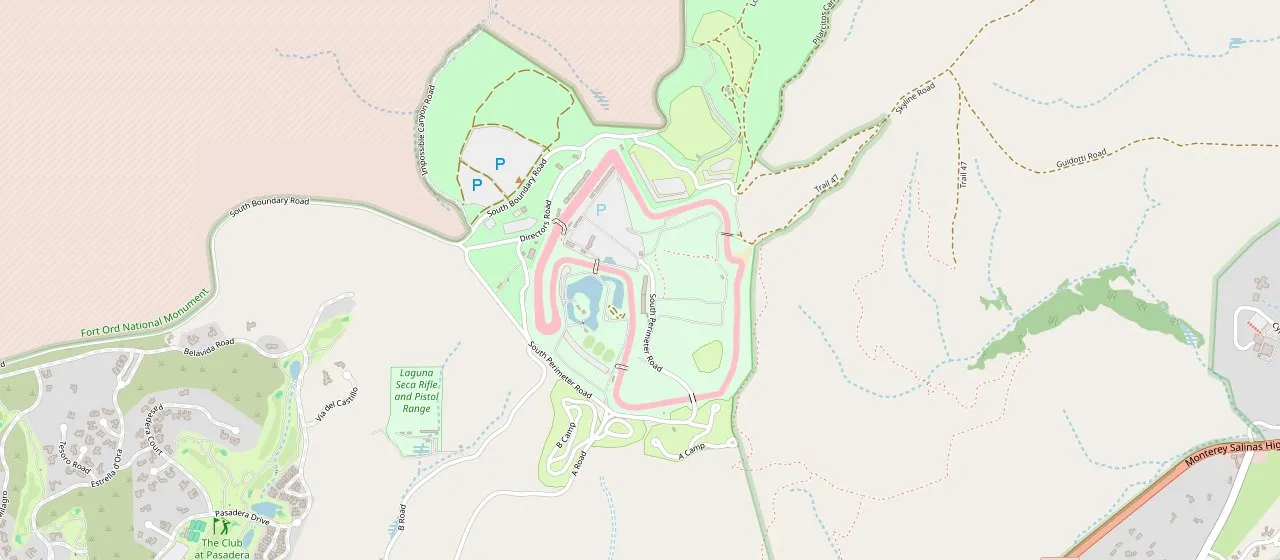
| Length | 3.602 km (2.238 miles), 11 turns |
| Original layout | 1.9 miles (approx. 3.06 km), 9 turns, until 1988 |
| Opened | 9 November 1957 |
| Elevation change | approx. 180 feet (approx. 55 m) over a lap; the Corkscrew drops 59 feet (18 m) over 450 feet (137 m) of track |
| Race lap record | 1:08.4168, Álex Palou, Dallara DW12-Honda, IndyCar, 2023 |
| License | FIA grade 2 (list dated 31 March 2026) |
| Owner | Monterey County |
| Operator | Friends of Laguna Seca, a non-profit organization |
| Main events | IndyCar, IMSA, MotoAmerica, Rolex Monterey Motorsports Reunion |
| Status | active |
The tree at turn six
Before the track existed, sports car races were run on public roads through the Del Monte pine forest in Pebble Beach. The first edition took place in 1950, and crowds reached 50,000 people standing along the road. Speeds rose faster than safety. In 1956 Ernie McAfee got turn six wrong, his Ferrari left the road and hit a tree side-on; the driver was killed on the spot. The organizers concluded that the forest course was “not enough track” for ever more powerful cars.
The races brought money to the region, so local businessmen decided to keep them. The idea of a permanent organization came up in August 1956 at a meeting of the Monterey special events committee, and by mid-1957 it had produced the Sports Car Racing Association of the Monterey Peninsula, SCRAMP for short. The land came from the Army: on the eastern part of Fort Ord, an area used for maneuvers and as an artillery range, a site was set aside for the track, and on 7 August 1957 a five-year lease was signed for $3,000. The party to the agreement was the chamber of commerce, because the Army did not yet recognize the newly founded SCRAMP.
Construction was taken on by Granite Construction, a California road-building firm that agreed to work at cost and to wait for part of its payment. Holm recalled years later that the track had been built “by committee”, and that the design had to be revised because drivers visiting the construction site warned that some corners were too dangerous.
“The plans that I drew of the track weren’t drawn until after the track was completed. We literally drew a rough diagram in the dirt, staked it out, and the bulldozers moved in and went to work.”
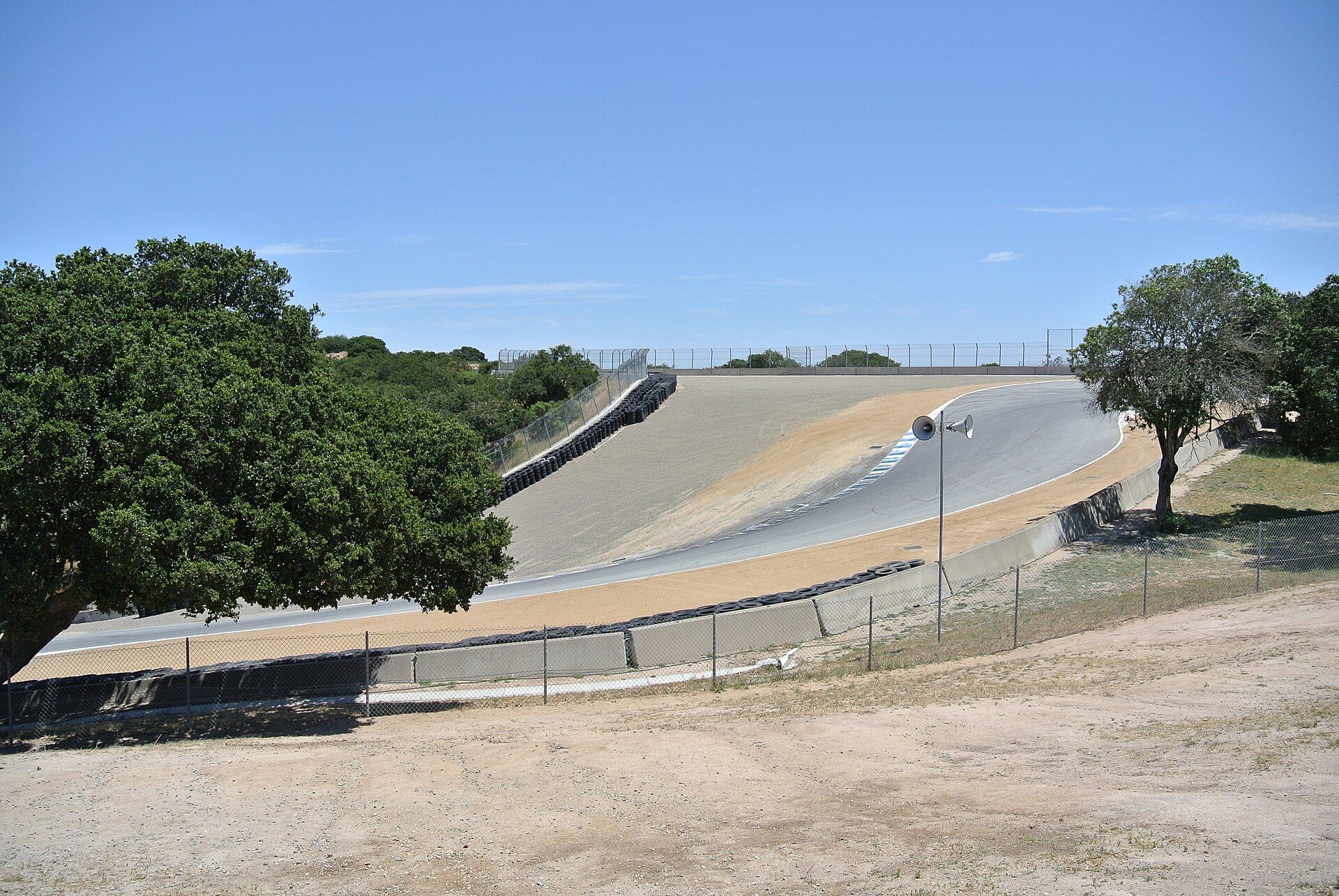
Holm also appreciated the site itself: the bowl around the dry lake meant that at least 90 percent of the race could be seen from the spectator areas. Hence the name: laguna seca is Spanish for “dry lake”. The most famous section of the track acquired a legend of its own. According to a story repeated by the track itself, a foreman, leaving for lunch, told the bulldozer operator to get down the hill “any way he could”, and that is how the left-right descent called the Corkscrew is supposed to have come about.
Pete Lovely's Ferrari at eighty miles an hour
The opening was also the eighth edition of the Pebble Beach Road Races, now held on the new 1.9-mile track with nine turns. The ribbon was cut by Major General William M. Breckenridge of Fort Ord and SCRAMP president Lou Gold. The main race was won by Pete Lovely in a Ferrari 500 TR, at an average speed of 80.19 miles per hour (approx. 129 km/h). According to Lovely's own account, his two-liter car was clearly weaker than its rivals; the favorites, among them Carroll Shelby and Jack McAfee, retired with failures, and Lovely dealt with Johnny von Neumann in a more powerful Ferrari by a ruse: he stayed far enough behind for his rival to lose sight of him, and on the last lap he set off in pursuit and overtook him at turn nine.
The early years added more anecdotes with place names to the track. In 1959 Ed Leslie was leading in an Austin-Healey 100 when a wire wheel collapsed at turn four and the car flew off the track among the oaks; the driver came out of it unhurt, and the corner has been called “Leslie's Leap” ever since. The Grand Prix of Monterey began in 1960 in the USAC championship, and from 1966 it hosted Can-Am cars, roaring McLarens, Chaparrals and Porsches. In 1974 the Army handed the land over to Monterey County, which owns it to this day.
That same year saw the birth of an event that “Motor Sport” counts among the most eagerly awaited fixtures of the August Monterey Car Week. Steve Earle, an enthusiast who, as he himself recalled, used to sneak onto the Willow Springs track with friends just to get some driving in old race cars, organized the first Monterey Historic Automobile Races on 10 August 1974. He gathered 66 cars, and advance tickets cost $7 at Sears and Macy's department stores. He established a rule that still applies today: anyone who causes avoidable contact between two cars will not race the following year. Earle ran the event for 36 years before SCRAMP took it over; since 2010 Rolex has been the title sponsor, and the number of entries exceeds 500.
A loop across the lakebed
Motorcycles changed the shape of the track more than cars did. AMA superbike races were held here from 1976, and in 1988 Laguna Seca was to bring back the US Grand Prix of the motorcycle world championship after a 23-year break. FIM rules, however, required a longer lap. So a loop was added across the former lakebed: the old turn two became a tight hairpin, followed by new corners that replaced the straight running from the present turn two to the present turn five. The track no longer fit within 1.9 miles. The finishing touches came from the rebuild of turns nine to eleven before the 1996 season, which also lengthened the start-finish straight slightly.
Riders from Europe were not enthusiastic. According to RacingCircuits.info they complained about the bumps before the Corkscrew and the proximity of the barriers, and in 1989 Wayne Gardner broke his leg in a crash at turn five. After 1994 the Grand Prix disappeared from the calendar; it returned only in 2005, after a rebuild of the runoff areas financed by Yamaha. Marco Melandri, then second in the championship, said according to “Cycle World”: “The walls are too close, and the surface is bumpy”, and he summed up Laguna as a whole by saying that if European regulations applied here, they could not race here. The 2005 race was won by Nicky Hayden, leading from start to finish; it was his first MotoGP win, taken from the first pole position of his career, earned at the 38th attempt. A year later the track spent another $7 million, among other things on runoff areas from turn six to the Corkscrew and on demolishing the old media center above turn one.
The loudest moment of the motorcycle era came in July 2008. Casey Stoner was half a second quicker in practice, but Valentino Rossi would not let him get away. On one of the first laps the Italian dived up the inside at the Corkscrew, ran over the curbs and the gravel and kept the lead down the slope.
Rossi explained afterwards: “We went a bit wide but that’s a peculiar corner so it can happen. When I realised I was going on the gravel I worried a bit, but the gravel here has good grip!” Stoner felt that on that day it had been “a little bit too much”. Later he himself ran into the sand, fell, got back on the bike and finished second.
The last lap of 1996
Indy cars came to the track in 1983 and raced here until 2004, usually in the CART season finale. The first race was won by the Italian Teo Fabi. The most famous one came on 8 September 1996. Bryan Herta of the Rahal team, who had never yet won in CART, was leading going into the last lap. Rookie Alex Zanardi, in Chip Ganassi's Reynard-Honda, threw himself at him on the entry to the Corkscrew, put his wheels onto the dirt off the track, came back onto the asphalt ahead of Herta and won. The fans on the slopes did not immediately understand what they had seen: the descent blocked the view, so they watched the replays on the big screen. On the same day Zanardi's teammate Jimmy Vasser became CART champion, which gave the Ganassi team its first title.
The move went down in history as “The Pass”, but its legality is still disputed. Years later Matt Beer of The Race called it outright “flagrant corner-cutting”. Colton Herta, son of the beaten driver, said in 2019 that his father believes a penalty was due, and that he himself is of the same opinion. The same Colton Herta described how one drives into this corner today:
“It's all aim. When you turn in, you can't see anything. You can't even see the tires against the wall on the other end of it. You're kind of blind. (...) There's a little tree; if you point [the car] directly at it, it's pretty much maybe a third of the car over the rumble strips going down the right.”
A year later Herta started from pole position, but Vasser won, and Zanardi sealed the championship title here. In 1998 Herta finally took his first CART win at this track, 0.343 s ahead of Zanardi. After 2004 Indy cars disappeared from Laguna Seca and only returned in 2019, by then as a round of IndyCar.
September 1999
On the morning of 11 September 1999, during practice before the CART race, the Penske team's Lola driven by 27-year-old Uruguayan Gonzalo Rodríguez left the track, crossed the gravel trap, broke through the tire barrier and hit a concrete wall. The car was launched into the air, flew over the fence and landed upside down on a grassy slope. The impact was estimated at more than 140 miles per hour (approx. 225 km/h); the driver was taken to hospital, where he was pronounced dead. The crash happened at the Corkscrew. A stuck throttle was initially suspected, but according to a Mercedes spokesman the telemetry did not confirm this.
The drivers asked for the afternoon qualifying to be canceled. According to the Associated Press account, starter Jim Swintell then stood above the empty start-finish straight and held the green flag over the track until the session time had run out. The Penske team withdrew both cars from the race. The AP noted that Rodríguez was the first driver killed here during a race weekend since the track opened in 1957; two sports car drivers had previously died in crashes during testing. That same day a second tire barrier and additional energy-absorbing material were added at the crash site.
Who runs the track
For more than sixty years the track was managed by the same SCRAMP, on county land. For 17 years, until 31 March 2018, Mazda held the naming rights and the venue was called Mazda Raceway Laguna Seca. Since 1 April 2018 the name has been carried by WeatherTech, an automotive accessories maker from Illinois.
In the 2010s the county's relations with SCRAMP broke down. According to RacingCircuits.info there were allegations of mismanagement, confirmed by independent audits, and the county began looking for another operator. In November 2019 it chose A&D Narigi Consulting, a firm with no motorsport experience whose founder John Narigi had worked in hospitality for 40 years. The new manager took over the track on 1 January 2020.
In 2022 the county board of supervisors approved almost $14.9 million to replace the wooden footbridge over the start-finish straight and for the first complete resurfacing since 2007. The contract went to Granite Construction, the same firm that had built the track at cost in 1957. In 2023 the track received new asphalt and the steel Mission Foods Bridge.
The next step was bigger. On 18 July 2023 the board of supervisors unanimously approved a concession agreement with the non-profit Friends of Laguna Seca. The first stage lasts five years; if the organization invests at least $10 million in the track, the agreement is extended by 25 years, and after a further $40 million by another 25. From 2028 the county is to receive 10 percent of net revenue.
Before the agreement took effect, in December 2023 a group of local residents called the Highway 68 Coalition sued the county and Friends of Laguna Seca, accusing the track of an ever greater number of event days, higher permitted noise levels and rentals of the track with noise exceeding 100 dB. The lawsuit even sought an end to racing altogether. The dispute was ended on 20 March 2024 by a settlement: the county reimbursed the coalition $75,000 in legal costs, and Friends of Laguna Seca undertook to commission an acoustician to assess the noise impact and to introduce the recommended measures if they were feasible and cost less than $2 million. The organization took over management on 1 August 2024; the county remained the owner, and the costs of maintenance and investment passed to the operator.
From an amateur driver's perspective
The track does not sell drives to private individuals. It is rented out only for whole days, and anyone who wants to drive their own car or ride their own motorcycle signs up for so-called Open Raceway Days with organizers who have rented the venue. The registration platform MotorsportReg lists days at the track from several such organizers, including Hooked On Driving, Speed SF, LightSpeed Track Events, DriveTrackTime and Golden Gate Lotus Club.
Two examples from autumn 2026 show what this looks like. Hooked On Driving advertised 10 and 11 October as “perfect for your special road car”, with prices starting at $574 per day, a 92 dB noise limit, a mandatory helmet with SA2020 or SA2025 certification and a one-on-one instructor for beginners. Speed SF, for the weekend of 28 and 29 November, gave a regular price of $500 per day and required an M2020 or SA2020 helmet and a roll bar in convertibles, and in Mazda MX-5 Miatas an approved roll bar. The prices come from the registration pages and change quickly.
The noise limit is a serious matter here. In 2024 “Motor Sport” wrote that the track is subject to limits of 90 or 105 dB and at most 35 event days a year, 24 of them for no more than 5,000 spectators. Friends of Laguna Seca stresses that the concession agreement binds it to the existing rules limiting attendance and noise. In practice, whether a louder exhaust will pass is decided by the rules of the particular day: the autumn 2026 calendar includes days with limits of 90, 92 and 105 dB, and one organizer also announces a day with no limit.
The people who say the most about the driving itself are those who squeeze the last tenths of a second out of the track. When in 2019 Randy Pobst drove a lap in a McLaren Senna in 1:27.62 for MotorTrend magazine, the magazine declared the time a production car record at this track and noted that everything is decided at turn eleven, “super slow and super tight”, which always “makes or breaks” the lap time. Pobst explained that the secret was settling the car in the middle of the corner, a good exit and driving straight on “like shooting a bullet” all the way to the braking zone.
Zanardi's corner
Alex Zanardi died on 1 May 2026 at the age of 59. In May, during the IMSA weekend, the track placed a “Grazie Alex” sign by the Corkscrew. Thirty years after “The Pass”, on Friday 4 September 2026, during the IndyCar season finale, the Corkscrew officially became the Zanardi Corkscrew. Chip Ganassi and Mike Hull came, Max Papis spoke on behalf of Zanardi's wife and son, and Bruce Canepa of Friends of Laguna Seca read a letter from Jimmy Vasser. Track president Mel Harder unveiled the design of a future monument.
Displayed alongside were Zanardi's number 4 car from that race and a plaque that will stand at the corner, bearing one of Zanardi's favorite sayings: “Courage Changes Everything”. Vasser recalled in his letter that the story of that overtake grew with every retelling: first Zanardi had planned the attack on the last lap, then over five laps, then over ten, and in the end he claimed to have seen Herta's eyes, although Herta wore a tinted visor. Two days later the race was won by Scott McLaughlin, who led 87 of the 95 laps.
Timeline
- 1950: first sports car races on the roads of the Del Monte forest in Pebble Beach.
- 1956: death of Ernie McAfee at Pebble Beach; organizers look for a permanent track.
- 1957: SCRAMP is founded; 7 August, lease of the Fort Ord land; 9 November, the track opens, Pete Lovely wins.
- 1966: first Can-Am race.
- 1974: the land passes to Monterey County; 10 August, first Monterey Historic Automobile Races.
- 1983: first CART race, won by Teo Fabi.
- 1988: a loop across the lakebed lengthens the track beyond the original 1.9 miles; the US motorcycle Grand Prix returns.
- 1996: 8 September, Zanardi's “The Pass” on Herta.
- 1999: 11 September, Gonzalo Rodríguez is killed.
- 2005: MotoGP returns to the USA, Nicky Hayden wins.
- 2008: Rossi's duel with Stoner at the Corkscrew.
- 2018: 1 April, the track is renamed WeatherTech Raceway Laguna Seca.
- 2019: IndyCar returns to the track; the county chooses a new manager to replace SCRAMP.
- 2023: new surface and Mission Foods Bridge; 18 July, concession agreement with Friends of Laguna Seca.
- 2024: 20 March, settlement with the Highway 68 Coalition; 1 August, Friends of Laguna Seca takes over management.
- 2026: 4 September, the Corkscrew is named after Zanardi.
Sources (38)
- Mazda Raceway Laguna Seca: How The Track Came To Be, Roadracing World, 2017-02-25 [en]
- Laguna Seca, RacingCircuits.info [en]
- WeatherTech Raceway Laguna Seca, The Zanardi Corkscrew Officially Dedicated at WeatherTech Raceway Laguna Seca, 2026-09-04 [en]
- WeatherTech Raceway Laguna Seca, Contacts [en]
- WeatherTech Raceway Laguna Seca, Track Information [en]
- FIA, List of FIA Licensed Circuits, 2026-03-31 [en]
- Laguna Seca map, history and latest races [en]
- IndyCar 2023 Laguna Seca Results [en]
- Dave Faries, Friends of Laguna Seca take over long-term management of the park and its iconic track, Monterey County Weekly (Monterey County Now), 2024-08-01 [en]
- Scott McLaughlin Ends Drought With Dominant Laguna Seca Win, IndyCar.com, 2026-09-06 [en]
- Monterey Motorsports Reunion tells the history of track racing in on wild week, Motor Sport, 2024-06-04 [en]
- SPEED SPORT Staff, 65th Anniversary Laguna Legends: 1950s, Speed Sport, 2022-02-22 [en]
- Larry Edsall, Old race cars were worthless, until Steve Earle changed things, ClassicCars.com Journal, 2021-04-10 [en]
- Back in the USA, Cycle World [en]
- Faultless Hayden wins first GP, home GP!, Crash.net, 2005-07-10 [en]
- Matt Beer, MotoGP Revisited: Rossi and Stoner’s US Grand Prix flashpoint, The Race, 2020-04-05 [en]
- Clash of Wills, Cycle World [en]
- Il «cavatappi» di Laguna Seca non è per tutti, Il Post, 2026-09-03 [it]
- Matt Beer, Why I love: An era-defining Laguna Seca trilogy, The Race, 2021-09-18 [en]
- Laguna Seca to Rename Corkscrew After Zanardi, Sportscar365, 2026-09-01 [en]
- David Malsher-Lopez, Herta on dad’s defeat by Zanardi: «I thought it was a cool pass!», Motorsport.com, 2019-09-20 [en]
- Chip Ganassi Racing, «Courage changes everything.» Ganassi team, racing community join to dedicate the Zanardi Corkscrew at Laguna Seca, 2026-09-04 [en]
- Associated Press, Qualifying canceled after Rodriguez tragedy, ESPN.com, 1999-09-11 [en]
- Stef Schrader, Laguna Seca’s $14.9M Glow-Up Includes Fresh Track Surface, New Bridge, The Drive, 2022-08-01 [en]
- Jerry Perez, Laguna Seca Will Soon Be Called WeatherTech Raceway at Laguna Seca, The Drive, 2018-03-12 [en]
- Laguna Seca Makes It Official With WeatherTech, Performance Racing Industry, 2018-03-21 [en]
- Sara Rubin, County votes unanimously in favor of long-term agreement for Laguna Seca, Monterey County Weekly (Monterey County Now), 2023-07-18 [en]
- Experienced Firm Selected For Laguna Seca Repaving Project, Roadracing World, 2022-08-11 [en]
- Charles Bradley, Laguna Seca responds to lawsuit over noise complaints, track usage, Motorsport.com, 2024-01-23 [en]
- Bay City News, Monterey County weighs partnership deal for management of Laguna Seca park, racetrack, Local News Matters, 2023-07-08 [en]
- Neighbours launch legal case to ban racing at Laguna Seca over noise, Motor Sport, 2024-01-29 [en]
- Dave Faries, Coalition of residents settles with county over Laguna Seca contract, agrees to drop lawsuit, Monterey County Weekly (Monterey County Now), 2024-03-22 [en]
- WeatherTech Raceway Laguna Seca, Friends of Laguna Seca [en]
- WeatherTech Raceway Laguna Seca, Raceway Rental [en]
- MotorsportReg.com, WeatherTech Raceway Laguna Seca [en]
- Hooked On Driving, Laguna Seca OctoberFast (92db), MotorsportReg.com [en]
- Speed SF, Speed SF - 92dB Laguna Seca 11/28 - 11/29, MotorsportReg.com [en]
- Scott Evans, Lap Record! McLaren Senna Is the Fastest Production Car on Laguna Seca, MotorTrend, 2019-10-23 [en]