
Bowmanville (Clarington), Canada
Canadian Tire Motorsport Park: Moss Corner and the Canadian Grand Prix
The history of Mosport near Bowmanville, Ontario: a corner reworked on Moss's advice, eight Formula 1 Grands Prix, the first safety car and track days.
- Type
- race circuit
- Length
- 3.957 km
- Opened
- 1961
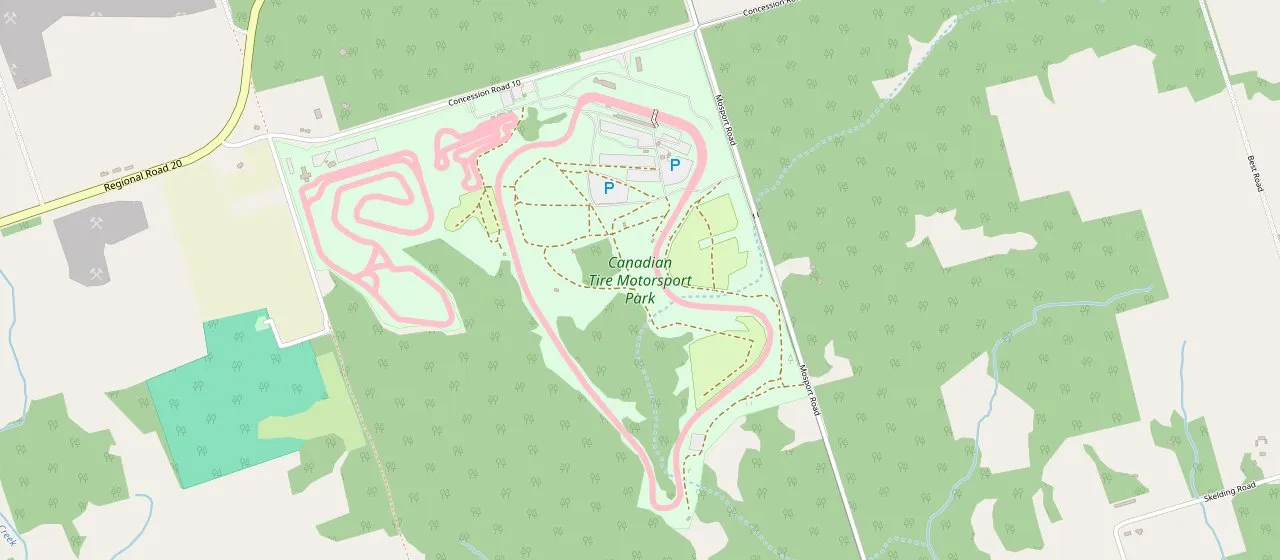
On Saturday 24 June 1961, in the hills north of Bowmanville in Ontario, around 40,000 spectators watched the Player's 200 sports car race, run in two heats of 100 miles each. Stirling Moss won in a Lotus 19 with a Coventry Climax engine, followed by Jo Bonnier and Olivier Gendebien. The Briton was racing on a track he had himself helped shape: a year earlier he had looked at its plans and recommended turning the hairpin at the southern end into two right-hand corners, today called Moss Corner. That was the start of the history of Mosport, known since 2012 as Canadian Tire Motorsport Park: the track where the Formula 1 Canadian Grand Prix was born, where for the first time in the history of that series a safety car came out, and which to this day has almost the same layout as on opening day.
| Location | 3233 Concession Road #10, Bowmanville, Durham Region, Ontario, Canada |
| Type | road course, asphalt |
| Length | 3.957 km (2.459 miles), 10 turns |
| Other layouts | Driver Development Track, 2.88 km, opened in 2014; kart track |
| Opening | track ready at the end of May 1961, first major race on 24 June 1961 |
| Designer | Alan Bunting |
| FIA licence | grade 2 |
| Fastest lap | 1:04.094, Rinaldo "Dindo" Capello, Audi R10 TDI, American Le Mans Series qualifying, August 2008; in that weekend's race Marco Werner, Audi R10 TDI, 1:05.823 |
| Owner | group of Peter Thomson with Chris Pfaff and Alek Krstajic (since December 2025) |
| Main events | Formula 1 Canadian Grand Prix (1967–1977, with gaps), Can-Am, Trans-Am, IndyCar, World Sportscar Championship, IMSA |
| Status | active |
The motorcycle club's gamble
The track was conceived by a club with a long tradition. The British Empire Motor Club (BEMC) was founded in 1928 as a motorcycle club and began organising car races only in 1950, at the former Edenvale airfield near Stayner; it then moved to Harewood Acres near Port Dover. In 1958 the club's members, as BEMC itself puts it, took an option "in a huge gamble" on land north of Bowmanville. It was a piece of farmland of about 450 acres, and a separate company, Mosport Limited, whose name abbreviated the words "motor sport", was set up for the construction. The first event there was held on 24 May 1959: a motorcycle scramble.
The design was prepared by Alan Bunting, who had come from England in 1956 and earlier had been to Donington Park and raced at Snetterton. The Canadian Motorsport Hall of Fame writes that he not only drew the course but also devoted time to local organisations and helped raise money for it. In 1960 the layout was taking shape: fast curves rose and fell with the hills. That summer Moss looked at the plans. According to the operator he was generally pleased, but recommended replacing the single-radius hairpin at the southern end of the track with a 90-degree right followed by another right leading onto the back straight, because such a combination would better test the drivers' skills and give more of a spectacle. The name Mosport was meant to be pronounced "mo-sport", but because of the link with Moss many people still say "Moss-port" today.
According to Clarington Museum staff the track was ready in May 1961 and cost $500,000, twice what the estimate had assumed; it was 28 feet wide (about 8.5 m). A club race, organised by a local club from Oakville, came first, followed by the Player's 200. The first season also had a darker side. The Motorsport Memorial database, which documents racing fatalities, records the first driver death at Mosport as early as 9 August 1961: Nick Sperazze was killed.
Crowds, debts and the Canadian Grand Prix
In 1964 the Player's 200, in which Bruce McLaren won by more than a lap, was watched by more than 52,000 spectators; the operator calls this an attendance record for a sports event in Canada. The money, however, did not add up. The high construction costs caught up with Mosport Limited, and in 1966 the company went into receivership, with the receiver selling the track to new owners. BEMC ran the facility with partners up to that very year. For the next thirty years the heart of the track was the new company's accountant, Harvey M. Hudes. The Canadian Motorsport Hall of Fame writes that he guided Mosport through its best years, the era of the Canadian Grand Prix and Can-Am racing.
The year 1967, Canada's centennial, was exceptional for the track. It hosted five international events: besides Formula 1, a Can-Am race won by Denny Hulme, two 100-mile IndyCar races, both won by Bobby Unser, a USAC stock car race and Canada's first motorcycle World Championship Grand Prix, in the 500 cc class, won by Mike Hailwood. The most important date was 27 August. On that day Mosport hosted the first Canadian Grand Prix in history to count towards the Formula 1 World Championship. Despite rain, 58,000 people came, according to the operator. Jack Brabham won in a Brabham BT24 with a Repco engine after 90 laps, ahead of his teammate Denny Hulme and Dan Gurney in an Eagle.
The Grand Prix did not stay in Ontario for good. In 1968 and 1970 it was moved to Mont-Tremblant in Quebec, and in 1975 there was no race in Canada. Mosport organised the Formula 1 Grand Prix eight times: in 1967, 1969, 1971–1974, 1976 and 1977.
The yellow Porsche and the pencil
One of those eight Grands Prix, called by many the "Confusion Grand Prix", took place on 23 September 1973. The race began on a wet track. Around lap thirty Jody Scheckter and François Cevert collided, and the officials sent a safety car onto the track for the first time in Formula 1 history: a yellow Porsche 914 driven by the Canadian Eppie Wietzes. Wietzes, however, pulled out in front of the wrong car, Howden Ganley's Iso-Marlboro, rather than the leader. On top of that, many cars pitted for tyres for a dry track, which, with pit stops rare at the time, completely scrambled the order. Years later Emerson Fittipaldi told Ron Fellows about it:
"At that time there was no electronics, it was all done with a pencil and a little square. And you checked the box every time you went by to make sure you went by".
Lotus chief Colin Chapman threw his cap in the air at the finish, convinced that Fittipaldi had won. The Brazilian recalled that when he went up on the podium to receive the trophy, one of the officials began shouting that he had not won and should come down. After the lap charts were checked, Peter Revson of McLaren was declared the winner; Fittipaldi and Ganley both believed they had won. According to Sky Sport the safety car was officially written into the FIA regulations only in 1993.
An anecdote that the journalist Norris McDonald told Brian Makse of Hagerty speaks to how the track was kept at the time. In 1976 James Hunt was showing journalists around the track by bus and, not knowing that Hudes's partner Bernie Kamin was sitting in the front row, called the hosts "the cheapest guys to ever have a grand prix in the history of grand prix promoters" who "won't even buy a gallon of paint". A year later, on 9 October 1977, Formula 1 came here for the last time. Jody Scheckter won in a Wolf, while Gilles Villeneuve in a Ferrari dropped out after 76 laps with a gearbox failure. Clarington Museum staff write that the many accidents in that race raised concerns about the safety of the bumpy track. The Canadian Encyclopedia says that Europeans called the narrow and dangerous Mosport an "old-fashioned circuit" and that talks about a Grand Prix in Montreal began as early as December 1977. The race has been held in that city since 1978.
Turn 2
Motorsport Memorial describes turn 2 as a difficult downhill corner with adverse camber, which the fastest cars took flat out, in fourth gear, at around 140 miles per hour (about 225 km/h).
On the approach to it, on 11 August 1985, in the Budweiser GT 1000 km race counting towards the World Sportscar Championship, Manfred Winkelhock crashed. The German, who in that same season also raced in Formula 1 for the RAM team, was driving the Kremer brothers' Porsche 962C from Cologne, shared with Marc Surer. The car went straight on and hit a concrete wall; according to Motorsport Memorial, rescuers needed more than forty minutes to extract the unconscious driver from the wreckage. A helicopter took him to Sunnybrook Hospital in Toronto, where he died the next day, 12 August. Surer told "Auto Bild" years later that when it suddenly went quiet on the track, which meant the safety car had come out, he somehow sensed that it was about Manfred.
Winkelhock was not the only one. In its database of car accidents Motorsport Memorial lists sixteen fatalities at Mosport from 1961–2018: fifteen drivers and one track marshal, Gordon Harrison, who died in 1966. The last was Jeff Green, who in June 2018 was leading a race of historic Formula 5000 cars and crashed at turn 8; the organisers stopped the race and awarded him the win posthumously.
Festivals, the oval and an American
Mosport lived on more than racing. In 1970 it hosted the Strawberry Fields music festival, at which, according to Clarington Museum, Sly & the Family Stone, Ten Years After, Mountain, Jethro Tull and Alice Cooper, among others, performed. The thirteen-year-old Myles Brandt began cleaning up after it; over the following decades he worked at the track in the snack bar, sweeping the surface and mowing the grass, until he became its president and general manager. In 1974 the Mosport Park company was listed on the Vancouver stock exchange.
Hudes also left behind an oval. According to the Canadian Motorsport Hall of Fame he built it to make stock car racing a regular part of the programme. The half-mile oval was opened in 1989; it had an 800-foot straight, corners banked at 6 degrees and grandstands for 8,500 people. Hudes died in 1996, and his partner Bernard J. Kamin became president. A year later International Motorsports Group (IMSG) took over the lease and renamed the facility Mosport International Raceway. According to Hagerty, IMSG belonged to Andy Evans, a banker to Bill Gates.
In 1998 Don Panoz, with his company Panoz Motorsports, took over first the lease and, in the same year, the whole facility. In 1999 the pit lane was extended for $2.5 million, a new pit exit was built and the run-off areas behind turns 2, 4 and 5 were enlarged, and in 2000 the whole loop was resurfaced and widened to 12 metres. The layout was left unchanged. From 1999 the track hosted the American Le Mans Series, a sports car series owned by Panoz, every year; in 2008 the operator stated that only Mosport and Road Atlanta had been on its calendar since the first season. The track record cited by the operator was also set in that series. In August 2008 Rinaldo "Dindo" Capello recorded 1:04.094 in qualifying in an Audi R10 TDI, and in the race Marco Werner lapped in 1:05.823 in the same model and won with Luhr as his co-driver.
Back in Canadian hands
The idea of buying the track back came, as Ron Fellows recalled, from Carl Fidani. In 2010 the two were at Fellows's driving school in Nevada and Fidani said: "We should buy a track. Do you think Mosport would be for sale?". Fellows called Panoz, who, as he put it, thought it would be good if the track returned to Canadian hands. The company Canadian Motorsport Ventures Ltd. took over the facility on 1 June 2011. Fellows, who earned the nickname "the Mayor of Mosport", agreed that he and his partners are custodians of the place.
In 2012, after a long-term agreement with the Canadian Tire store chain was signed, the track received its present name. In 2013 the Event Centre opened, a building with offices, a media centre, race control and timing, and the half-mile oval, as the track announced in a statement of 12 June, was to be closed from 27 July to make room for expanding the training centre. Brandt bid it farewell as the fastest half-mile paved oval in Canada, in operation for 24 years. In 2014 the Driver Development Track opened, a 2.88 km loop with a skid pad measuring 1000 by 150 feet. The operator now states that the facility covers more than 900 acres, and that Lake Ontario can be seen from the Event Centre.
The track hosts, among other events, the Victoria Day SpeedFest weekend, which opened the NASCAR Pinty's Series season in 2015, 2018 and 2019, the VARAC Vintage Grand Prix historic races and a round of the IMSA WeatherTech SportsCar Championship. In July 2026 that round was won by Dillmann and Clarke of Inter Europol Competition in an ORECA LMP2 07. In 2020, because of the pandemic, all major events were cancelled, and only track days and smaller events without spectators were held.
On 11 December 2025 the track changed hands. It was bought by a group led by the rally driver and investor Peter Thomson, whose partners are Chris Pfaff, head of the Pfaff Automotive Partners dealership group and owner of the IMSA-competing team Pfaff Motorsports, and Alek Krstajic, former president of the mobile operators Freedom Mobile and Public Mobile. The management with Brandt remained, and Canadian Tire stays on as title sponsor. In February 2026, on the stage of the Canadian International AutoShow in Toronto, the new owners spoke of year-round use of the site and winter driving training; the trade magazine "Canadian Auto Dealer" noted that the winter plans had not been announced as firm commitments. Pfaff also mentioned a possible car museum and confirmed talks with NASCAR about bringing in higher series.
On the Grand Prix circuit in your own car
The operator does not sell track days itself: on its page for drivers with their own cars it lists the companies that organise driving on its loops, including 6th Gear, DriveTeq, Infinite Motorsports, Track Matrix, Engineered Automotive and the HANSON International school. Infinite Motorsports explains that a track day is an event at which non-professional drivers drive their own cars on the Mosport track, after safety briefings and with an instructor in the car. DriveTeq divides its day into three groups, from novices with classroom sessions to advanced drivers; overtaking is allowed only in designated zones, after a signal from the driver being passed. For the 2026 season that company planned ten days on the Grand Prix loop, from 30 April to 9 October, at a price of 775 Canadian dollars plus HST, and for driving without an instructor required a helmet with Snell 2020 or later homologation. The organiser points out that six of the track's ten corners are blind.
Another route is the HANSON school: one-day courses at the Driver Development Centre, from 8:00 to 17:00, for anyone with a valid driving licence. The school does not supply cars and requires that the brake fluid in the student's car has been changed no more than a month before the course. Fellows told Hagerty that he learned driving over crests, drops and fast curves mainly here, adding that "if you could do that at CTMP, you could go fast and win anywhere". He heard the same from Fittipaldi, who came back to Mosport for the first time since 1977 when his son raced on the track's kart circuit. Together they drove round the Grand Prix loop in a Camaro ZL1, and the Brazilian kept repeating that despite all the safety changes the track had kept its character and that it was, in his words, "a fantastic circuit".
Timeline
- 1958: the British Empire Motor Club takes an option on land north of Bowmanville, and the company Mosport Limited is set up.
- 1959: on 24 May the first event on the site of the future track, a motorcycle scramble.
- 1960: Stirling Moss looks at Alan Bunting's plans and proposes the combination of corners later named after him.
- 1961: a club race by a local Oakville club; on 24 June the Player's 200, won by Moss.
- 1966: the company Mosport Limited goes into receivership, a new company buys the track, and its accountant is Harvey M. Hudes.
- 1967: on 27 August the first Formula 1 Canadian Grand Prix, won by Jack Brabham.
- 1970: the Strawberry Fields music festival.
- 1973: on 23 September the first safety car in Formula 1 history.
- 1977: on 9 October the last Formula 1 Grand Prix at Mosport.
- 1985: on 11 August Manfred Winkelhock's crash in a World Sportscar Championship race.
- 1989: the half-mile oval opens.
- 1996: death of Harvey M. Hudes.
- 1997: lease to IMSG, the name Mosport International Raceway.
- 1998: Panoz Motorsports buys the facility.
- 1999: first American Le Mans Series race.
- 2000: new surface, track widened to 12 m.
- 2011: on 1 June Canadian Motorsport Ventures Ltd. buys the track
- 2012: new name, Canadian Tire Motorsport Park.
- 2013: the Event Centre opens, closure of the oval from 27 July is announced.
- 2014: the Driver Development Track opens.
- 2025: on 11 December a new ownership group of Thomson, Pfaff and Krstajic.
Sources (32)
- Canadian Tire Motorsport Park, History [en]
- Racing Sports Cars, Player's 200 Mosport 1961, 1961-06-24 [en]
- Brian Makse, Tracing the colorful, surprising history of Canadian Tire Motorsport Park, Hagerty Media, 2020-11-13 [en]
- The History of Canadian Tire Motorsport Park, „Clarington Promoter” [en]
- Canadian Tire Motorsport Park, With Your Own Vehicle [en]
- Canadian Tire Motorsport Park, About us [en]
- Canadian Tire Motorsport Park, Grand Prix Circuit [en]
- Fédération Internationale de l'Automobile, List of FIA Licensed Circuits, 2026-03-31 [en]
- Canadian Tire Motorsport Park, Driver Development Track [en]
- Canadian Motorsport Hall of Fame, C. Alan Bunting [en]
- Racing Sports Cars, American Le Mans Series Mosport 2008, 2008-08-24 [en]
- Canadian Tire Motorsport Park, Canadian Tire Motorsport Park announces new ownership group, 2025-12-11 [en]
- John Dagys, CTMP Announces New Ownership Group, Sportscar365, 2025-12-11 [en]
- IMSA (Al Kamel Systems), Race Official Results (2 Hours 40 Minutes), IMSA WeatherTech SportsCar Championship, 2026-07-12 [en]
- British Empire Motor Club, History of the British Empire Motor Club [en]
- Motorsport Memorial, Car and truck fatalities by circuit: Mosport Park (offically called Canadian Tire Motorsport Park since 2012) [en]
- Canadian Motorsport Hall of Fame, Harvey Hudes [en]
- OldRacingCars.com, Canadian Grand Prix 1967 [en]
- Yvon Doré, Grand Prix du Canada, L'Encyclopédie Canadienne, 2007-06-20 [fr]
- thecanadianencyclopedia.ca [fr]
- Canadian Tire Motorsport Park, 50 years of the safety car in F1, a Mosport first, 2023-09-25 [en]
- Redazione Sky Sport, Safety Car in Formula 1: la storia dal GP del Canada 1973 a oggi, Sky Sport, 2019-06-08 [it]
- OldRacingCars.com, Canadian Grand Prix 1977 [en]
- Motorsport Memorial, Manfred Winkelhock [en]
- Motor Sport, Manfred Winkelhock [en]
- Ralf Bach, Bianca Garloff, Schwarzer Sommer 1985, Auto Bild, 2020-08-16 [de]
- Inside Track Motorsport News, Canadian Tire Motorsport Park closing Speedway July 27, 2013, 2013-06-12 [en]
- Perry Lefko, New owners of Canadian Tire Motorsport Park discuss plans for facility, Canadian Auto Dealer, 2025-12-19 [en]
- Todd Phillips, Pfaff and partners outline four-season vision for Canadian Tire Motorsport Park, Canadian Auto Dealer, 2026-02-25 [en]
- Infinite Motorsports, FAQs [en]
- DriveTeq.ca, DriveTeq Track Day – Still Feel My Toes 2026 [en]
- HANSON International Advanced Driving School, Our Services [en]