
Braskereidfoss (gmina Våler), Norway
Vålerbanen: from a truck skid pad to the home of STCC and Gatebil
Vålerbanen in Solør: a truck driver training centre from 1993, the circuit lengthened in 1997, STCC rounds, the Gatebil festival and own-car track days.
- Type
- race circuit
- Opened
- 1993
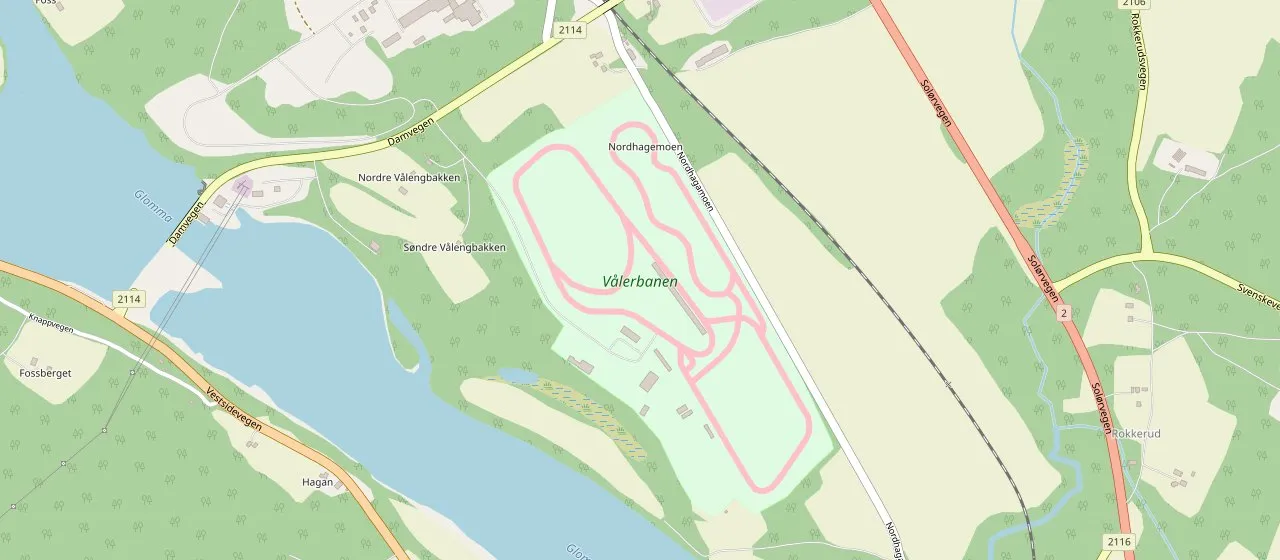
On 1 June 1993 it was pouring in Våler when Minister of Transport Kjell Opseth cut the ribbon on Norsk Trafikksenter A/S. The guests toured the tracks, a full bus tried its hand on the skid pad, and in the parade of the facility's users, among buses, lorries, bicycles and roller skis, Roger Sandberg also drove past in his new Ford Escort Cosworth. The centre was built so that lorry and bus drivers could practise driving on slippery surfaces. From the same asphalt grew Vålerbanen, the circuit where the Swedish touring car series STCC raced and to which the Gatebil festival returns.
| Location | Braskereidfoss, Våler municipality, Solør region, Innlandet county, Norway; Damvegen 90 |
| Type | permanent road circuit within a driver training centre; the site also has an off-road track (2 km), a kart track (800 m) and three skid pads |
| Layout | 10 corners, driven clockwise (according to Trackday.no) |
| Opening | 1 June 1993 (the centre); circuit lengthened in 1997 |
| Operator | NAF Trafikksenter AS; the majority owner is Norges Automobil-Forbund (NAF) |
| Key events | an STCC round (2005–2009), the Gatebil festival, Norwegian car and motorcycle racing championships |
| Status | active |
A skid pad for 24 million kroner
The decision was taken in Oslo. In 1992 the Storting, the Norwegian parliament, introduced a compulsory slippery-road driving course for candidates for heavy-vehicle licences, and that required skid pads large enough to hold lorries, buses and articulated combinations. The first such pad was operating in Våler already in June 1993. The daily “Glåmdalen” reported that the centre between Braskereidfoss and the centre of Våler cost just over 24 million kroner: 12 million came from the state, 5 million each from Våler municipality and the county. NAF Trafikksenter AS, the company that runs the facility today, is listed in the business register with a founding date of 21 November 1989.
At the opening there were three tracks with a combined length of 2500 m. The main one was 1500 m long and 10 to 30 m wide, with a 200 m skid section with computer-controlled obstacles, speed measurement and traffic lights. In addition there was a skid pad on a curve and a slippery hill with an 8 per cent gradient. The centre covered about 260 decares (26 ha), and about 5000 m² of asphalt was coated with white epoxy resin that can be sprayed with water. In his speech Opseth said that the opening of the centre was “the first step towards better training of drivers of heavier vehicles”. The centre's manager was Erik Dobloug. Kjell Magne Fredheim, chairman of the board, said that lorry courses had priority, but that the company needed additional activities to sustain itself: “We want to use this facility, and we must, for as many hours of the day as possible, for different activities”.
The course did not convince everyone. In February 2001 four members of parliament, Kenneth Svendsen, Øyvind Korsberg, Christopher Stensaker and Per Sandberg, submitted a proposal to the Storting to replace compulsory driving on skid pads with training on snow-covered roads. They cited TØI report 334/1996, according to which the course did not reduce the risk of an accident on a slippery road, and the trend of the results pointed rather to an adverse effect.
The loop that grew
“Glåmdalen” wrote on the day of the opening that a race meeting led by Sandberg would probably be held here on 18 September. According to RacingCircuits.info, the first racing loop from 1993 only occasionally hosted races. By the mid-1990s motorcyclists were already racing here. In June 1995 almost 140 riders entered the Classic Roadracing, only the second event of its kind in Norway, thirty more than at a national championship round a week earlier. The event was organised by Solør MC klubb and Norsk Classic Racing Club, and the sidecar class featured a 1972 BMW that had previously competed in World Championship rounds.
The breakthrough was the 1997 season. Before the June round of the Norwegian motorcycle championship, “Østlendingen” wrote that the track had been lengthened and was therefore “new this year”, and that riders would also be fighting for lap records. RacingCircuits.info states that after the 1997 rebuild this longer loop is still used for racing today. Already at the end of May the first round of the season of the Norwegian Cup in car racing had taken place here. More than 2000 spectators came for the Sunday finals, and “Hamar Dagblad” singled out 18-year-old Christer Halvorsen, who finished eighth in his first race ever, and Christina Dobloug, called by the paper “Vålerbanen's daughter”. “Drammens Tidende” wrote on the occasion about the Super Touring class, the youngest and hottest in Norwegian racing, whose factory cars cost close to a million kroner. The encyclopedia Store norske leksikon today lists Vålerbanen as one of three Norwegian circuits where both motorcycles and cars race.
In the second heat of the Norwegian championship final in September 2015, the fastest lap, 52.952 s, was set by Joakim Ottersen in an Opel Vectra DTM.
Swedes in Solør
From 2005 to 2009 Vålerbanen hosted a round of STCC, the Swedish Touring Car Championship, every year. In July 2006 the race was won by Richard Göransson, for whom it was his fourth start in Norway and his fourth win. 4800 people came to the stands. “That is fewer than we expected,” said Erik Dobloug, described in the Swedish report as the owner of the track. He named three reasons: a date in the middle of the holidays, no motorcycle class, and no star after Tommy Rustad had moved to rallycross.
A year later rain decided the result, starting to fall as the cars drove out to the grid. Göransson was a second late to line up before the start and had to start from the pit lane, so he had time to change to rain tyres. He fought his way through the field and won, for the fifth time in a row in Norway. “This was one of my most enjoyable wins in STCC because I started last,” he said after the finish.
In September 2008 the Volvo Polestar team came to Våler with one aim: the first win for the new Volvo C30. Two weeks earlier it had tested at this track for a whole week. Robert Dahlgren took the lead on the first lap and held it to the finish, and after a collision between Fredrik Ekblom and Tommy Rustad, Göransson secured the championship title a round before the end of the season. In August 2009 the hosts had their weekend. Rain fell from Thursday until Saturday late morning and kept spectators away from the stands, and when the track dried, the Norwegian Rustad won both races in a Volvo C30, the first from seventh on the grid. “You get a race weekend like this at best once in a career,” he said. A month later at Mantorp Park Rustad became STCC champion. The series never returned to Våler.
The centre, the hotel and the festival
The facility is run by NAF Trafikksenter AS, whose majority shareholder is Norges Automobil-Forbund, the Norwegian automobile club. The company employs 42 people. The centre has 3.5 km of asphalt tracks, three skid pads (a hill, a curve and a straight) sized for heavy vehicles, a manoeuvring area with a roundabout and traffic lights, an off-road track and a kart track. In 2016 a hotel was built on the site, operating since 2017, with 26 rooms and 42 beds.
The operator's 2026 calendar shows what the track lives on today: two rounds of the Norwegian car championship (Racing NM) in May and September, the national motorcycle road racing championship in August, make-specific club meetings, motorcycle courses and the Gatebil festival at the end of May. From 30 June to 31 July it has not a single event. At Vålerbanen, Gatebil means a campsite right next to the track, drifting and open driving on the loop, and its owner Hans Jørgen Andersson estimated in 2025 that between 10 and 15 thousand people would come over the weekend. Fredric Aasbø, three-time Formula Drift champion, told “Dagbladet” at the time:
“This is my favourite track in Norway, maybe in the world, and I have been lucky enough to drive in the USA, Europe and Asia”.
In your own car on the loop
The most days for private cars here are organised by Trackday.no: six in 2026, from 26 April to 27 September. A day of driving cost 2495 kroner per car with driver. A category B driving licence and an age of 18 are enough; a helmet and clothing covering the whole body are mandatory, and there is a briefing before going out on track. Driving takes place in sessions divided by type of car and experience, with separate groups for beginners, on summer tyres from April to October. The organiser announces registration for 2027 for January. Trackday.no points out that it drives on the main racing loop and advises checking which part of the facility other offers advertised as driving at Vålerbanen refer to.
A track day is also organised by the club KNA Hedmark: after the event on 27 April 2026 it wrote that participants drove a lot, in private cars or licensed cars. At Gatebil the track groups are divided into driving without sliding (Straight Line) and several drifting groups. A driving licence, a suit (not necessarily FIA-homologated), a helmet, a technical inspection of the car, a noise limit of 100 dB and a briefing are required, and the permitted blood alcohol level is zero. The operator itself takes orders all year round for own-car courses for private groups and companies; free driving on the loop is also in the programme.
The skid pads, where it all began, operate in summer and winter. The centre still runs on-track safety courses for drivers of heavy vehicles.
Timeline
- 1989: on 21 November the company is founded that today bears the name NAF Trafikksenter AS.
- 1992: the Storting introduces a compulsory slippery-road driving course for candidate heavy-vehicle drivers.
- 1993: on 1 June Minister Kjell Opseth opens Norsk Trafikksenter in Våler.
- 1995: in June almost 140 motorcyclists enter the Classic Roadracing.
- 1997: the circuit is lengthened.
- 2005–2009: an annual STCC round.
- 2008: Robert Dahlgren scores the first Volvo C30 win in STCC.
- 2009: Tommy Rustad wins both STCC races in Våler and a month later takes the title.
- 2016: a hotel is built on the site, operating since 2017.
- 2026: Trackday.no runs six own-car driving days at Vålerbanen.