
Karlskoga, Sweden
Gelleråsen Arena: the gravel loop that gave Sweden its first Formula 1 race
The history of Gelleråsen near Karlskoga: built without a permit in 1949, Moss and Clark in Formula 1, the velodrome, the 1970 disaster and track days in your own car.
- Type
- race circuit
- Opened
- 1950
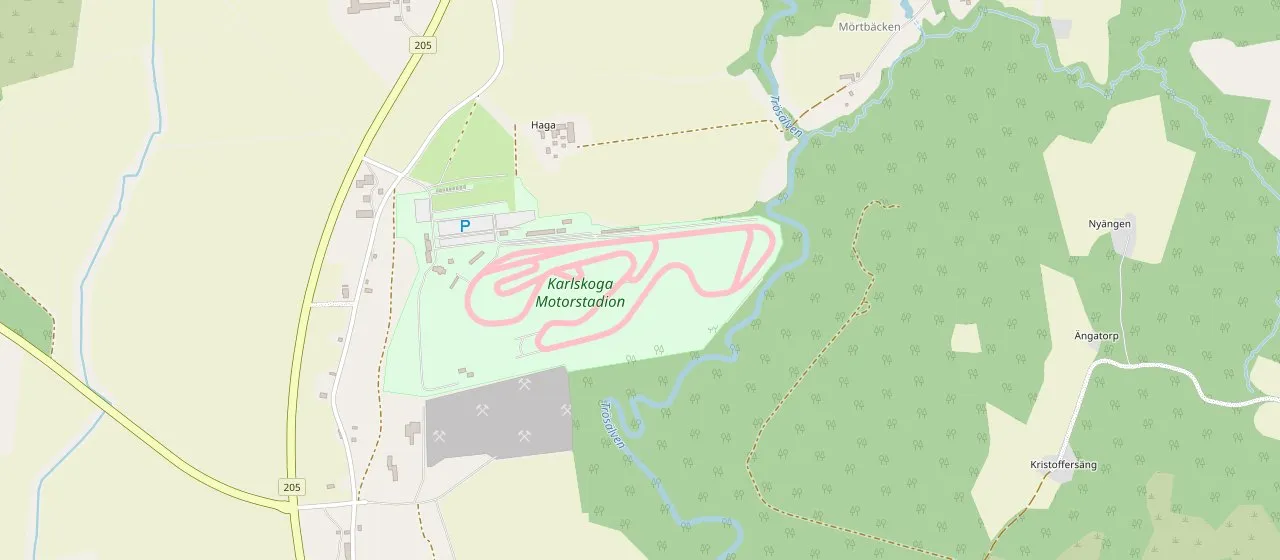
Stirling Moss flew into Karlskoga on the day of the race. He missed practice and qualifying, so on 20 August 1961 he started his UDT team Lotus from the back of the grid, then carved through the whole field and won. It was the first Formula 1 race held in Sweden, although it did not count towards the world championship. The track on which it took place had been a field by a gravel pit twelve years earlier, and the local club had heaped up a loop on it without a building permit. Today Gelleråsen Arena near Karlskoga in Örebro County welcomes drivers in their own cars on track days.
| Location | Gelleråsen, about 6 km north of Karlskoga, on road no. 205; Karlskoga municipality, Örebro County, Sweden |
| Type | permanent road circuit, a loop and a shorter Shorttrack variant; beside it a kart track and a practice area |
| Length | shorter Shorttrack variant: 1.16 km according to the licence of the Swedish Motorsport Association (SBF) for 2026; the length of the full loop differs between the sources, see the footnote |
| Direction | clockwise |
| Width | 10 m |
| Corners | ten marked on the track plan (T1–T10), including Tröskurvan, Hårnålen and Depåkurvan |
| First race | 4 June 1950, the first Kanonloppet on a gravel loop 1,550 m long |
| Fastest lap on the operator's list | 1:03.470, Lukas Sundahl, Porsche Carrera Cup, 17 August 2024 |
| Owner and operator | Karlskoga Motorstadion AB; chairman and owner Richard Göransson |
| Main events | Kanonloppet, Gelleråsloppet, Velodromloppet (historic cars), Swedish motorcycle road racing championships |
| Spectator facilities | three grandstands: the main one with 720 seats, a wooden one by the track for over 1,000 people and one at Depåkurvan for nearly 600 |
| Status | active, season usually from 1 April to 31 October |
Gravel from Elias Frisk's field
Karlskoga Motorklubb (KMK) had been thinking about a track of its own since 1948. First it considered racing on public roads from Gelleråsen through Lonnhyttan to Källmo, but the plan never got beyond paper. The club's chairman Gunnar Olsson already had an arrangement with Elias Frisk, the owner of the land and the gravel pit, who was interested in motor sport. The club was to lease the ground and pay only out of event income, and the surface was heaped up from gravel that Frisk had to haul away anyway when he exposed the deposit. On 21 June 1949 KMK decided to build, and according to the chronicle written by Ingvar Kanvik the gravel was carried day and night and the work was finished in a week.
The first Kanonloppet took place on 4 June 1950 on a loop 1,550 m long and drew 15,000 spectators; engines overheated on the loose surface. The name of the race refers to the cannons for which Karlskoga, an industrial armaments town, was famous. The authorities treated the track as unauthorised building work and the club had to answer for it before the district court; RacingCircuits.info writes that Olsson deliberately did not apply for a permit, hoping it would be harder to refuse a track that already existed, and that the dispute ended with a symbolic fine. For the second race in 1952 the loop was paved and lengthened to 1,600 m, and in 1953, when no events were held, a corner then called Björkdungskurvan, today Tröskurvan, was added and the track grew to 2,000 m. The construction left debts: according to Kanvik the club owed Frisk 180,000 kronor for work, material and rent.
The enlarged track was opened in 1954 by Prince Bertil in front of 14,000 paying spectators, and among the starters was the Italian film director Roberto Rossellini. A year later Denis Jenkinson came from the British “Motor Sport”. He described the event as a friendly meeting with a club atmosphere on a flat two-kilometre track that doubled back in the middle of the arena, so that the public could see the cars almost without a break; he compared it to “our own Brands Hatch circuit, though this one was completely flat”. In the main race Gunnar Carlsson, known as “Persbergarn”, led in a Ferrari for all 30 laps, while the Swiss Benoit Musy in a Maserati hit him in the rear three times; on the penultimate lap he tried to pass on the outside, spun and finished second. Kanvik for his part noted that in 1956 the Marquis Alfonso de Portago threatened to leave because the organisers had hoisted the wrong Spanish flag, and the correct one had to be hurriedly brought from Stockholm.
The velodrome and Formula 1
In 1958 the track was lengthened by roughly a kilometre: a banked turnaround named Velodromkurvan joined the two straights. RacingCircuits.info compares it to a fairground “wall of death”. The 1958 Kanonloppet drew 25,000 spectators, and Moss, who came here for the first time, won the sports car race in a Maserati ahead of Carlsson. He came back in 1959 and 1960 and won every time.
In 1961 the Kanonloppet moved to Formula 1 rules. Lotus sent the only full works team; Jim Clark took pole position easily but retired with an oil tank problem. Second was Jo Bonnier in a Porsche 718/2, and the fastest lap, 1:30.5, was set by John Surtees. For Moss it was his fourth win at this track. At the end of the year Gunnar Olsson, the club's chairman and race director, to whom according to RacingCircuits.info the track owed its existence, died suddenly.
Formula 1 came back twice more. In 1962 only ten cars started; the winner was the American Masten Gregory in a UDT-Laystall Lotus with a BRM V8 engine, while Graham Hill, driving Rob Walker's Lotus, retired after leaving the track. In 1963, 35,000 spectators watched Jim Clark win. After that the Kanonloppet moved to Formula 2 and Jack Brabham won the next three editions, 1964–1966. In 1965 the Kanonloppet drew 44,000 people, which the operator gives as the track's attendance record. In 1967 the event was titled Sveriges Grand Prix and was run to Formula 2 rules; the starters included Jackie Stewart, Jochen Rindt, Jim Clark and Graham Hill.
“Motor Sport” and the operator's old chronicle call Gelleråsen the home track of Ronnie Peterson. In 1969 he won a Formula 3 race here ahead of Tim Schenken. The club also wanted to organise a Swedish Grand Prix, but according to the operator's old chronicle, referring to the Formula 1 years of the early 1960s, the track was too short for it, and a plan to lengthen it with a so-called forest loop never came to fruition; Nordisk Bilsport writes of plans to extend it to 4 km that the year 1970 put an end to.
August 1970
In August 1970, during the Kanonloppet weekend, the worst accident in the track's history took place. According to RacingCircuits.info, in a touring car race a Ford Escort and a BMW 2002 touched on the entry to the straight leading to Velodromkurvan, left the track, jumped a grass bank and ran into the crowd; many spectators were looking at another incident at the previous corner. Spectators were killed and about 30 people were injured. The meeting was stopped for several hours and then finished; the main sports car race was won by Chris Craft in a McLaren, whose time of 1:16.4 set the lap record for the long version of the track.
Gelleråsen was closed for two years. RacingCircuits.info states that after the disaster the Swedish authorities introduced new requirements for barriers and spectator safety, and after the reopening the public was admitted only on the north and west side of the track. Kanvik called 1970 the blackest year in the history of the club and of Swedish motor sport.
Jarier, Peterson and Sheene
The track returned in 1973, partly rebuilt, with a round of the European Formula 2 Championship held on 12 August. Jean-Pierre Jarier won in a March with a BMW engine ahead of Peter Gethin and Torsten Palm, and Peterson was fifth. A year later Peterson won in front of his home crowd: on 11 August 1974 he covered 68 laps in 1 hour 23 minutes 0.4 s and beat Patrick Depailler by three tenths of a second. Depailler then set a lap of 1:12.1, and “Motor Sport” gives that time as the track record.
In 1978 and 1979 Karlskoga hosted the motorcycle Swedish Grand Prix, a round of the world championship. Barry Sheene won both 500 cc races on a Suzuki: on 23 July 1978 ahead of Wil Hartog, on 22 July 1979 ahead of Jack Middelburg. Sponsors and investors had already withdrawn after the 1974 edition, however, and in 1984 Karlskoga Motorklubb went bankrupt. According to Nordisk Bilsport the club was then planning a refurbishment of the track and the building of a hotel; the municipality verbally promised a guarantee, but the proposal was rejected in a vote.
The track without a velodrome
The bankruptcy estate was bought by the Norwegian businessman and racing enthusiast Bård Bergsjö. From 1992 the track was leased by Mike Luff, who founded the company Karlskoga Motorstadion AB, and later Lennart Bohlin became a partner. The operator's old chronicle describes the state in which they took it over: the asphalt was so bad that even endurance races were run under a special dispensation. In the 1990s Velodromkurvan was removed for safety reasons; RacingCircuits.info writes that the banking was dismantled and part of the original loop was converted into a kart track.
In 2000 the paddock was moved to the outer side of the track, behind the grandstand and the commentary tower. Before the 2006 season Tröskurvan, the first corner, was rebuilt: it was moved by about 30 m, which gave room for a run-off area, and the track became shorter, at 2,400 m. The SBF licence gives 22 August 2006 as the date of the last international inspection, carried out by Marcel Martin of the FIA. In the following years new pits (2008) and a race control tower with timing (2010) were built, and in 2016 the whole track received new asphalt. In the same year the exit from Depåkurvan was changed: the new section joins the start straight at the finish line, and the old route was left for lining up the starting grid.
At the beginning of March 2018 it was announced that after 25 years Luff and Bohlin were handing the track over to Richard Göransson, five-time champion of the STCC touring car series. “This is where I saw my first races as a child, and this is where the wish to start racing took root in me,” Göransson said then; the Karlskoga municipality and Bård Bergsjö joined him in the venture. The venue was given the name Gelleråsen Arena. The new owner's first Kanonloppet, in August 2018, brought a tragedy: in qualifying for one of the support series a member of the event staff was killed. In 2023 a kart track 1,257 m long was opened next to the loop, which the operator presents as the longest in Sweden; the ribbon was cut by Prince Carl Philip and the chairman of the municipal board Tony Ring, sitting in electric karts, and the seventh corner was named “the Prince's Corner”.
A track day at Gelleråsen
The loop has ten corners; the operator's plan names, among others, Tröskurvan (T1), the esses, the Ejes corner, the Hårnålen hairpin and Depåkurvan (T10). The SBF licence permits up to 33 touring cars and GT cars in a race on it. On the operator's record list the fastest lap belongs to Lukas Sundahl in a Porsche Carrera Cup car, 1:03.470 in August 2024, just ahead of Philip Victorsson in a Radical SR3 (1:03.514). For comparison, the operator says that the 160 hp Volvo C30 rented out for track days laps here in about 1:21 and the Porsche Cayman GTS 4.0 in about 1:11.
In the 2026 season the operator planned twelve track days of its own, from 18 April to 18 September. The Sport format cost 2,495 kronor including VAT per day and divided drivers into four groups that alternated in 15-minute sessions: three by lap time (the slowest for new drivers and cars lapping slower than 1:19) and a separate one for Legends and Aquila cars. Open Pit cost 2,695 kronor and allowed drivers to go out on track at any time, with a limit of 15–17 cars at once. You can come in a registered road car; everyone in the car must have a helmet and cotton clothing covering the body, a noise limit of 95 dB measured at drive-by applies, and every driver and passenger signs a waiver of claims. Formula cars are excluded, and lunch and collective accident insurance are included in the price.
Other organisers also run at Gelleråsen. Tracklife Sweden had two dates here in 2026, 12 August and 3 October, and requires neither membership nor a licence. Scandinavian Time Attack announces a test day and two rounds of its series for 27–29 August 2027, with a day licence or insurance for 250 kronor and the same 95 dB limit. Avancerad Förarkurs, a school run since 2001, teaches driving in your own registered and insured car and after the course issues a Swedish racing licence; for 2027 it announces two courses at Gelleråsen, including one on 16 September. Prices and dates come from the organisers' websites as of October 2026.
The name of the former turnaround has survived in the calendar. A race called Velodromloppet drew 14,000 spectators in 1965. Under the same name the operator today organises an event that it presents as the largest in Sweden for historic cars and motorcycles: cars from the 1930s to the 2000s take part, and the public is encouraged to wear period dress. The corner from which the name came has not been on the track since the 1990s.
Timeline
- 1949: on 21 June Karlskoga Motorklubb decides to build a track on Elias Frisk's land.
- 1950: on 4 June the first Kanonloppet on a gravel loop 1,550 m long.
- 1952: the loop is paved, 1,600 m.
- 1953: the Björkdungskurvan corner (today Tröskurvan), the track is 2,000 m long.
- 1958: Velodromkurvan, the track is about a kilometre longer.
- 1961: the first Formula 1 race in Sweden (non-championship), won by Stirling Moss.
- 1962–1963: Formula 1 wins by Masten Gregory and Jim Clark.
- 1965: attendance record, 44,000 spectators.
- 1970: disaster during the Kanonloppet weekend, track closed for two years.
- 1973–1974: rounds of the European Formula 2 Championship; Ronnie Peterson wins in 1974.
- 1978–1979: motorcycle Swedish Grand Prix, two wins by Barry Sheene in the 500 cc class.
- 1984: bankruptcy of Karlskoga Motorklubb.
- 1992: Mike Luff takes over the track, Karlskoga Motorstadion AB is founded.
- 2006: first corner rebuilt, the track is 2,400 m; FIA inspection.
- 2016: new surface on the whole track.
- 2018: Richard Göransson takes over the track, new name Gelleråsen Arena.
- 2023: opening of a kart track 1,257 m long.
Bibliography
- Bengt-Åce Gustavsson, a book on the history of the Gelleråsen track (633 pages, over 1,500 photographs, covering 1950–2018), written on commission; the title has not been established, description according to Nordisk Bilsport.