
Vila Verde de Ficalho (gmina Serpa), Portugal
Circuito do Sol: from a Serpa kart track to an Alentejo track club
The history of Circuito do Sol near Serpa: a closed kart track, a plan for an electric-car circuit, an environmental assessment, a members' club and track days.
- Type
- race circuit
- Length
- 3.5 km
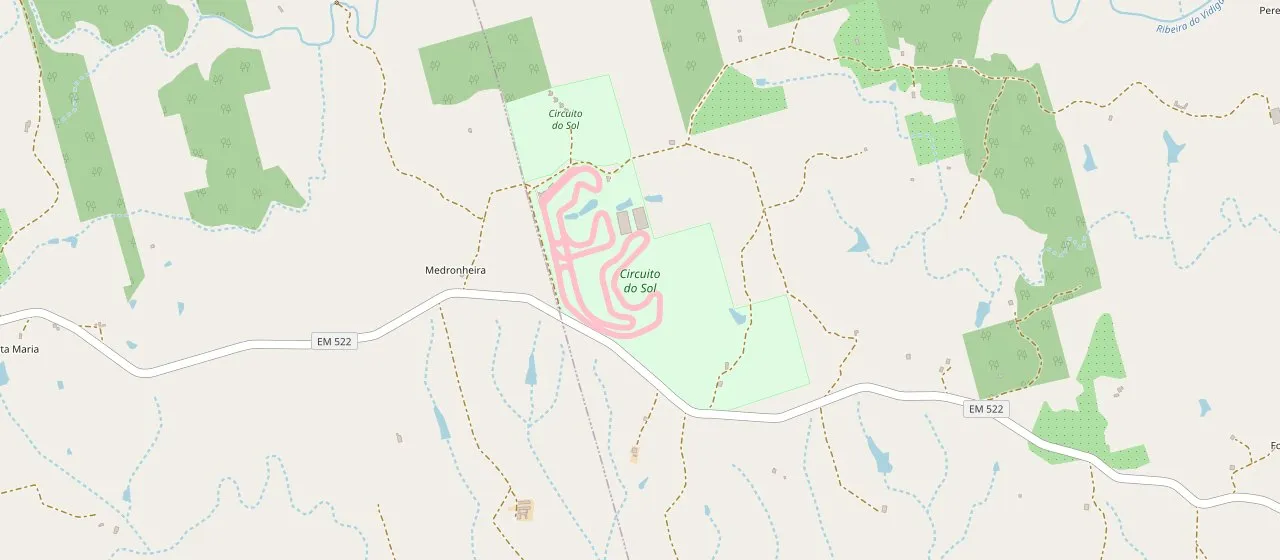
In the autumn of 2023 the committee assessing the Circuito do Sol project near Vila Verde de Ficalho was supposed to be giving an opinion on documents, and learned that construction was already under way. The developer had levelled 41,070 m² of land and moved 36,270 m³ of earth for the extension of the loop, although it did not yet have a decision on the project's conformity with the environmental conditions, nor an archaeologist supervising the works. The track was to be built on the site of a disused kart track in the municipality of Serpa and, according to its creators, to become the first track in the world conceived from the start for electric cars. Today the operator sells it as a club for drivers with their own track cars, with an annual fee counted in tens of thousands of euros.
| Location | Vale de Milhano, parish of Vila Verde de Ficalho, municipality of Serpa, Beja District; about 25 km from Serpa and about 13 km from Rosal de la Frontera in Spain |
| Type | multi-configuration road circuit, built by extending a former karting loop |
| Configurations according to the operator | full loop 3.5 km and 23 corners; GT Track 3.0 km and 18 corners; Club Semi-Circuit 1.4 km and 11 corners (lit); South Semi-Circuit 2.0 km and 11 corners; karting track 700 m and 7 corners (lit) |
| Length in the approved execution project | 2992 m |
| Investors | Raul Garcia Isern and Lars Lindberg, partners in the SPV Racing team from Malaga; the company Circuito do Sol, Unipessoal, Lda. |
| Announced investment | about €16 million |
| First drives after the extension | a Motor Sponsor track day before the last layer of asphalt was laid, summer 2024 |
| Operating model | members' club Club Circuito do Sol, hire to organisers, testing |
| Status | active; no confirmation of FIA or FIM homologation found |
The kart track in Vale de Milhano
The site lies in the parish of Vila Verde de Ficalho, by the access roads EN392 and CM1071, 9 km from Vila Nova de São Bento and 13 km from the Spanish border. On the plots "Vale Milhano" and "Vale Milhanito" there had previously been the Kartódromo de Serpa: a loop about 1400 m long and 8.5 m wide, with an administration building, on an area of about 10 ha. In 2020 the facility was disused and, according to the environmental impact study prepared for the investors, also insolvent; the investors decided to buy it and then to buy the neighbouring land. The same document, in which its authors counted 40 kart tracks and a few permanent circuits in Portugal, also shows that Alentejo had no race track at that time.
The buyers came from a different world than local karting. Raul Garcia Isern and Lars Lindberg were partners in SPV Racing, a company connected with motorsport in Malaga; according to the study they had experience in managing and servicing racing cars and represented, among others, the Radical and Ligier brands on the Iberian Peninsula. In February 2016 the team, with Raul Garcia as chief executive and Lindberg as team manager, announced an entry in the European Le Mans Series with a Ligier JS P3 and Borja Garcia, a former Toyota Formula 1 test driver. Two years later the organiser of the Michelin Le Mans Cup presented it as a Spanish-Swedish team based in Malaga, testing before the season at the track in Portimão.
SPV Racing's clients were, according to the study, mainly Germans and Scandinavians, who for half the year have nowhere to drive at home and look for a track in the south of Europe. The idea of a track of their own was born in 2014. The company Circuito do Sol, Unipessoal, Lda. was founded in February 2018, and in August of that year the investors asked the municipality of Serpa whether the former kart track could be extended into a track for racing cars. The reply of 31 August 2018 was: yes, provided that the institutions responsible for the ecological reserve, agriculture and the environment agree. Lindberg later explained to journalists of "Razão Automóvel" his choice of place by its location, cuisine, climate and the fact that an existing facility of a similar purpose made the permits easier.
"I come from northern Europe, where for many months of the year it is impossible to drive a car on a track, or even, in the case of racing brands and teams, to test their cars, and here we are creating all the conditions for that to happen."
The first track for electric cars, on paper
The environmental impact study was submitted in July 2020. It described a complex on a property of 62.7 ha, with a works area of about 26 ha: a loop exactly 2978 m long and 12 m wide (9 m of asphalt and 3 m of run-off zone), charging bays for 30 cars, energy from photovoltaic panels stored in batteries, a clubhouse, workshops, pits, a rural hotel with 14 units and the DEAL laboratory (Development Electric Auto Lab) for building and developing electric cars. According to the study the loop was designed by the architects of Formula E circuits, and in the first years it was to be used mainly by drivers of combustion-engine cars.
The Lusa agency, which read the study in January 2022, reported that the investment was to cost €16 million and create about 40 jobs, and that later phases would add an oval for wet-surface testing, a 4x4 track, a track for electric motocross, a driving school and a five-star tourist development. Public consultation on the study ran from August to September 2021. The regional coordination and development commission of Alentejo (CCDR Alentejo) issued a favourable but conditional environmental decision on 22 November 2021. The DEAL laboratory, as a facility of an industrial nature, was to be moved to the industrial zone. Every earthwork was to proceed under the eye of an archaeologist. Two wells and a house from the Monte de Baixo farmstead, rural buildings whose loss would be irreversible, had to be described, measured and photographed before work began. According to the study, one of those wells stood three metres from the planned loop. If the track were to operate in the evening and at night, the investor had to present a separate noise study.
A Tesla, a Radical and ground without an archaeologist
In April 2022 journalists of "Razão Automóvel" went to see the first phase: 1.6 km and 11 corners partly along the line of the old kart track; the photographs in their article show a Tesla Model S and a Radical as the first racing cars on the new asphalt. Lindberg, presented as chairman of the board, announced a second phase with a loop of 3.8 km and 26 corners by the end of 2022 and a third with 5.9 km and 32 corners for 2024. The new part was to be laid by the company that had recently replaced the surface at the Jerez circuit, and the sequence of corners drew inspiration from the Corkscrew at Laguna Seca, Eau Rouge at Spa and the Porsche Curves at Le Mans. In autumn 2022 Circuito do Sol and SPV Racing announced a winter LPC series for light prototypes with races in, among others, Portimão, Estoril and Jerez, and a Nevada LPC cup for beginners with an inaugural race "on our track in Portugal". Whether those races took place in Vale de Milhano could not be established.
The execution project went to CCDR Alentejo in October 2023, together with a report on conformity with the environmental decision (RECAPE). It was more modest than the 2020 plan: without workshops, a pit building, a rural hotel and the DEAL laboratory, with an aparthotel of 18 units, a clubhouse with a built-up area of 1225 m², converted from former kart track buildings, and a garage with eleven entrances. The loop was to be 2992 m long. Its route was changed after consultations with the Portuguese federation FPAK and with the FIA and the FIM, in order to dig less, build run-off zones and improve the corners.
It was then that it came to light that the works had begun in October 2023, before the decision. The committee noted the removal of vegetation, levelling and the making of a platform for the new section of the loop and part of the aparthotel, without the required archaeological supervision. The permit for supervision was issued only between 28 and 30 November; the archaeologist walked all the work sites and found a schist substrate with no traces of settlement, so she proposed no additional work. It also noted that the area around the track has a noise level typical of sensitive zones, and that the impact of driving on the nearest buildings had not been calculated, and it set limits for them: Lden up to 55 dB(A) and Ln up to 45 dB(A). During the public consultation on the report, from 13 November to 4 December 2023, not a single comment was received. In its final opinion of January 2024 the committee concluded that the trimmed-down project affects the environment less than the 2020 version.
Asphalt in two layers
In April 2024 Lindberg, presented as president of SPV Racing, described the surface to the SportMotores website: the first layer, 6 cm thick, was ready, and a 3 cm wearing course with a texture chosen for grip was to go on top of it. Before laying it the team wanted to drive the track in a racing car on slicks, because the loop is "quite undulating" and once the last layer is laid nothing can be changed. The kerbs were to be of the new type from Misano, like those installed in Portimão, Jerez, Valencia and Barcelona, and FIM homologation was expected in the third quarter of 2024, FIA homologation in the fourth. A few months earlier the environmental committee, describing the earthworks, had written about the "flat relief" of the site, where there was no need to move large masses of earth.
In May 2024 "Razão Automóvel", citing the track's announcement, gave the length of the full loop as 3.5 km with 23 corners, opening for club members in July and a calendar for organisers from September. In July the same title described the first cars on the intermediate layers of asphalt: the organiser Motor Sponsor organised a track day at the circuit for professionals and amateurs, so as to check the banking of the corners and the visibility at several points before the last layer. "Pre-inaugurating a circuit is a great responsibility, but in the end it was worth it. We loved the layout. It is challenging and extremely beautiful," said the company's founder André Marques. The German organiser Gedlich Racing entered Circuito do Sol in the calendar of its Endless Summer series for 7 and 8 December 2024 and describes the track as new, from summer 2024, with climbs and descents of up to 12 per cent and banking of up to 10 per cent.
A club with a €15,000 entry fee
The operator calls Circuito do Sol the first community of drivers around a track in Europe, modelled on the track clubs of North America. The offer includes car storage, mechanics, a simulator, a coach, 25 villas planned for purchase on the grounds and the company CDS Engineering for vehicle testing and development. The track is to be open 360 days a year, up to 24 hours a day. The board, according to the track's website, comprises Raul Garcia, Lars Lindberg, Mark Ryhorski and Andreas Zielke, and operations are run by João Charraz, who grew up ten minutes' drive from the track.
The members' brochure of November 2025 gives the prices: a one-off entry fee of €15,000 and an annual fee of €12,500, €18,500 or €100,000 including VAT. The cheapest package gives 30 members-only track days a year, the more expensive ones add 20 test or race days and car storage. A member may bring a guest driver, who pays €500 a day for driving their own car. Circuito do Sol also belongs to a network of private club circuits run by the Tilke office, which announces future changes to the layout here under its direction.
From the perspective of a driver with their own car
Outside the club the track opened on days rented by organisers. According to the news site Notícias ao Minuto, the company Motor Sponsor entered the "new Sol track" in Serpa in its 2025 calendar: 8 March, four hours of driving in the open pit lane format, that is, with free exit from the pit lane, for €350 per car, with a limit of 30 cars on track. Gedlich Racing invited drivers on 4 and 5 February 2026 to two open pit lane days at €3490 per car, with catering; an additional driver cost €590, and transport of the car both ways from €3750. The organiser advertised the track as the "brand new, 3 kilometres long and billed as the 'Ascari of Portugal'" and wrote that FIA homologation was close. Confirmation that the FIA or FIM homologated the track was not found in the sources available in October 2026; the operator does not publish public driving regulations, a noise limit for cars or a lap record.
Of the kart track from which it all began, what remains is a building, converted into the club, and the route of the old loop on which the extension was based. The shortest of the road configurations on the operator's list, the Club Semi-Circuit, has eleven corners, lighting and a length of 1.4 km, the same as the old loop for go-karts measured in 2020.
Timeline
- 2014: the idea of a track of their own for SPV Racing's clients is born
- 2018: the company Circuito do Sol, Unipessoal, Lda. is founded (February) and the municipality of Serpa gives its opinion that extending the former kart track is feasible (31 August)
- 2020: the environmental impact study is submitted (July)
- 2021: public consultation on the study (August and September), conditionally favourable environmental decision (22 November)
- 2022: first phase with a 1.6 km loop (April), announcement of the LPC series and the Nevada LPC cup (autumn)
- 2023: works begin before the decision (October), consultation on the RECAPE report with no comments (November and December)
- 2024: the committee's final opinion (January), asphalt laying (April), first Motor Sponsor track day (summer)
- 2025: Motor Sponsor open pit lane day (8 March), club brochure with membership prices (November)
- 2026: two-day Gedlich Racing track days (4 and 5 February)