
La Palma del Condado, Spain
Circuito Monteblanco: secret tests, bankruptcy, track days by Seville
History of Circuito Monteblanco in La Palma del Condado: Mercedes launches, F1, DTM and Formula E tests, bankruptcy with €30m debt and amateur track days.
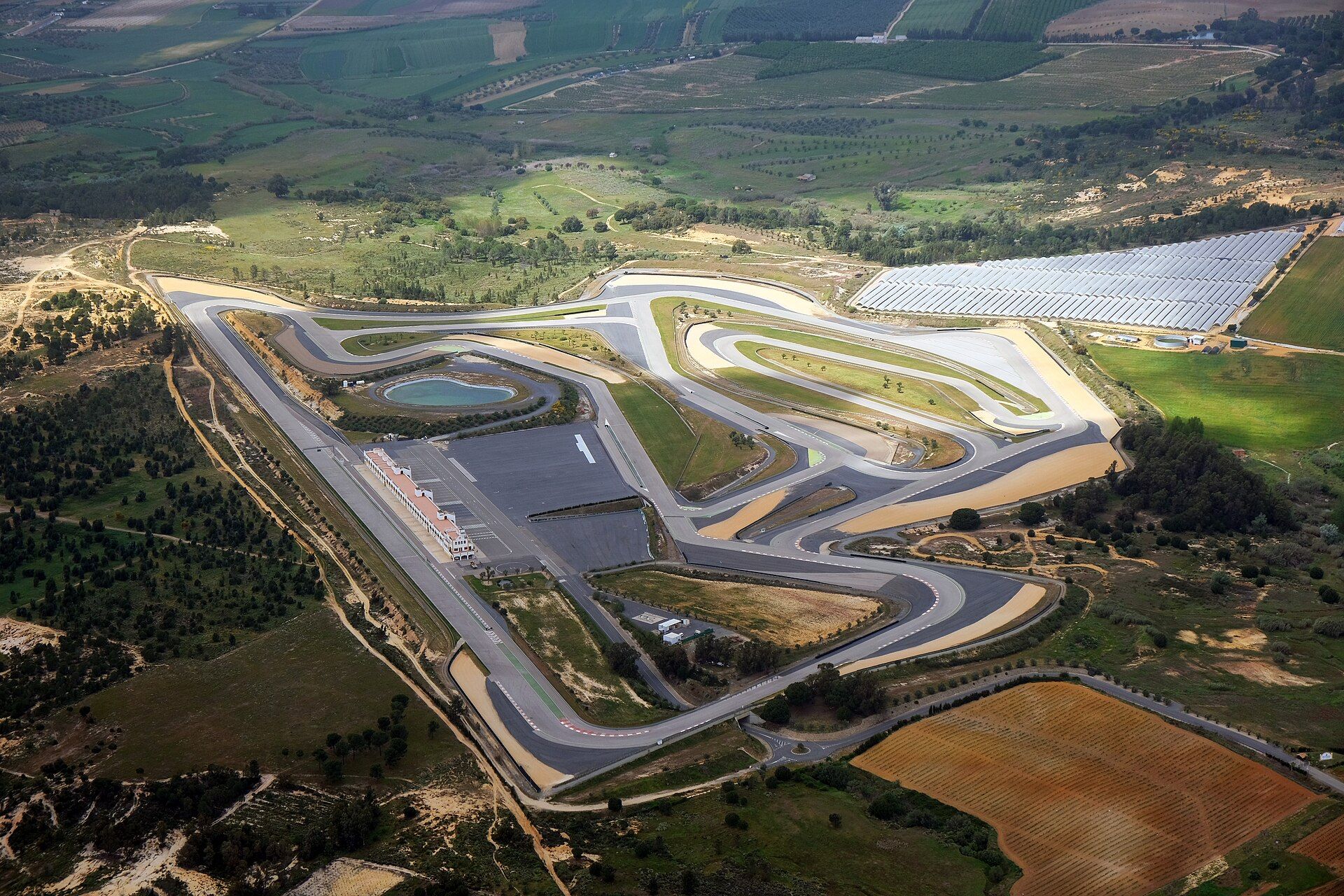
- Type
- race circuit
- Length
- 4.458 km
- Opened
- 2007
In mid-January 2007, guests of the DaimlerChrysler group began arriving at a new circuit near La Palma del Condado. Mercedes was presenting the new C-Class to the world here; the launch was to last until April, and according to the daily “Cinco Días” 300 people a day were to come to Seville for it. Circuito Monteblanco thus began with rental to industry, not with a race, and that order has lasted two decades: secret Formula 1 tests, test running by DTM and Formula E, a bankruptcy with debt of close to 30 million euros, and finally track days to which amateurs come in their own cars.
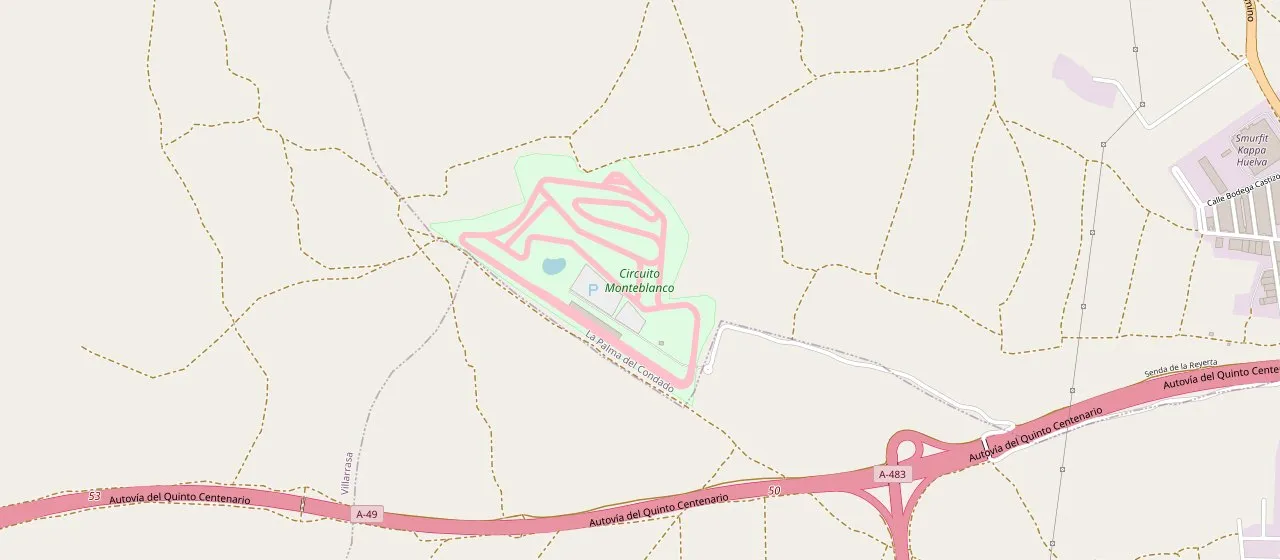
| Location | La Palma del Condado (province of Huelva, Andalusia), on the A-49 motorway, exit 48; between Huelva and Seville |
| Type | permanent test and racing circuit: 26 track variants and 12 combinations allowing two loops to be used at the same time |
| Length | main layout 4458 m, 18 corners (11 right, 7 left); variants include variant 6 (4738 m), variant 1 (4432 m) and variant 2 (3926 m, 15 corners), used by the Andalusian championship and track days; around 5600 m of asphalt in total |
| Straight | 960 m long and 15 m wide; the rest of the track 13 m |
| Design | the office of engineer Jaime Nogué; engineering study by TNGPO |
| Originator | Thierry Reynaud, French former racing driver and entrepreneur |
| Opening | commercial activity from January 2007; sporting inauguration on 25 May 2008 |
| Homologation | FIA T1, i.e. a licence for Formula 1 testing, since 2009 |
| Operator | Sport Carbon Fiver, S.L. |
| Main events | tests by Formula 1, DTM and Formula E teams; Masters Historic Racing (2010), Mini Challenge final (2011), Roborace (2019), Andalusian championship (CAVA), Porsche Sprint Challenge Ibérica (since 2025), 11H de Monteblanco of the Lamera Cup series (2025) |
| Status | active |
A town around the straight
The originator and promoter of the circuit was the French former racing driver Thierry Reynaud. In 2005 he chose La Palma del Condado in the province of Huelva as the site. The location decided it: a direct exit from the A-49 motorway and the proximity of the airports in Seville, Faro and Jerez. The track was designed by the office of engineer Jaime Nogué, author of the circuits at Montmeló and Cheste. The engineering study was prepared by the Barcelona firm TNGPO, and Monteblanco's technicians made changes dictated by commercial goals.
The plan was much bigger than the track itself. When the construction site was shown to journalists in August 2006, more than 55 per cent of the facility was finished. “Motociclismo” described 5600 metres of asphalt, of which 4430 m was to form the Grand Prix loop and 1100 m a Monte Carlo-style street circuit. Hotels and restaurants were to be built around it, and the facility was to host international races up to GP2 level. According to “Cinco Días”, the project also included a hotel in the shape of a village with Provençal-style houses, in which the town hall would serve as the reception, and next to it a motoring museum, a driving school and workshops.
Racing was not the main goal. The company Reynaud España assumed that national competitions and one-make series, such as the BMW cup, would take up at most 30 per cent of the calendar, and that the rest would be filled with launches of new models, training for the brands' staff and press campaigns for new cars and motorcycles; until June 2007 the track was 97 per cent booked. The C-Class was followed by launches of the Mercedes S-Class, the Renault Mégane and the Lamborghini Gallardo Superleggera, as well as events by Jaguar, Porsche and Ferrari. The facility's manager Francisco Vázquez explained in 2010 that some of these events deliberately stay out of the media, because “privacy is one of our assets”, and discretion is something “companies demand of us”. More than 90 per cent of clients, he said, came from Europe, most often by plane.
Hamilton behind a closed gate
The sporting opening came more than a year after the first launch. On Sunday 25 May 2008 it was presided over by the mayor of La Palma del Condado, Juan Carlos Lagares, by Reynaud and by the president of the Andalusian Automobile Federation, Vidal Castro. Around 3000 spectators watched races of the Andalusian championship, an exhibition of cars from the Andalusian Ferrari club and aerobatics by a light aircraft. Monteblanco was the fifth racing circuit in Andalusia, and “Huelva Información” called its 15-metre straight the widest in Spain; the rest of the track was 13 metres wide, 80 centimetres more than the FIA minimum to which the other national circuits kept.
On that occasion the local press described what had been happening behind the gate earlier. According to “Huelva Información” and “20minutos”, the Formula 1 teams Williams and McLaren had trained at the circuit, the latter with Lewis Hamilton and Heikki Kovalainen, which until then had been kept secret. “Huelva Información” wrote two years later that Hamilton had come to test his car “in absolute secrecy”. Around 40 people worked at the circuit at the time, joined at some events by temporary staff, including marshals and security.
In February 2009, after a visit by FIA inspector Charlie Whiting, Monteblanco received T1 homologation, which allows it to host Formula 1 tests before and after the season. It was the fourth such circuit in Spain, after Jerez, Cheste and Montmeló. The Motorpasión website listed at the time the brands that came here for tests and launches (Mercedes-Benz, BMW, Porsche, Seat, Lexus and Toyota), as well as tests by teams from the Superleague Formula, FIA GT and WTCC series.
Lotus 72 and drives from 49 euros
In autumn 2010 the management announced that the circuit would gradually focus on large sporting events for the public. In October the Masters Historic Racing series of the company run by Ron Maydon arrived; according to “Huelva Información”, it was the first time it came to a Spanish circuit. Around a hundred drivers competed in five classes, and the greatest expectations surrounded the race for Formula 1 cars from the 1970s, among them a Lotus 72 in JPS colours and the Matra MS80 that Jackie Stewart drove. A week earlier the series had raced at Portimão. At that time commercial director Gonzalo Gobert announced a karting academy for children aged 6 to 12, a motorcycle school, road safety classes and GT car driving courses. Gobert had worked at Monteblanco since the beginning of 2010; in 2012 the Valencian authorities brought him back as general director of the Ricardo Tormo circuit.
In November 2011 Monteblanco hosted the Mini Challenge final, the last three races of the season after rounds in the Algarve, Montmeló, Navarra, Valencia and Jarama. Luis Miguel Reyes and Marta Suria led with 230 points, eight ahead of the pairing of Bruno Méndez and Alex Royo, and the organiser prepared free driving courses and passenger rides for spectators. In spring 2012 the GT Academia of French driver Xavier Anthony operated here; together with his wife Maite Moreno he had founded a company based on its own fleet: Lotus Elise, Porsche Boxster Spyder, GT3 RS and Cup, Audi R8, Ferrari F430 Scuderia and BMW M5. Vázquez argued that from as little as 49 euros one could come to a circuit homologated for Formula 1 testing and drive down a straight almost a kilometre long.
Thirty million in debt
Economically, the circuit was driving into a headwind from the start. “Huelva Información” recalled in 2010 that it had opened practically on the threshold of the crisis, but still wrote that the management had managed to keep it profitable, and that since opening the facility had brought hotels in the provinces of Huelva and Seville 75,000 overnight stays. In March 2013 the same newspaper, citing the daily “Expansión”, reported that the commercial court in Huelva had opened insolvency proceedings (concurso de acreedores) against Reynaud España, the company that had run the circuit from the start. The petition was filed by Servicios y Obras Isetán, which had carried out part of the construction work. The debt came close to 30 million euros, and KPMG was appointed administrator in the proceedings.
According to the newspaper, the circuit generated enough money for its day-to-day operations, but not for repaying the mortgage loans taken out to build it. It was also only the centrepiece of a much larger venture, whose plans included a four-star hotel, an 18-hole golf course and 400 residential plots. On top of that, Monteblanco had to share a shrinking market with new circuits in Aragon and Navarra. The proceedings dragged on for years: in January 2021 the Palco23 website wrote that the circuit had been in insolvency for several years with a debt of 30 million euros owed by its owner, Reynaud España.
The legal notice on the circuit's website today names Sport Carbon Fiver, S.L. as the website's owner. In November 2024 this company moved its registered office to the circuit grounds, at exit 48 of the A-49 motorway. How and when it took over the running of the facility could not be established.
Winter laboratory
Racing teams kept coming here to test during the insolvency years as well. In February 2016 BMW Motorsport spent three days here with two M4 DTM cars driven by Marco Wittmann, Bruno Spengler, Timo Glock and Augusto Farfus. The fastest lap of the 3.357 km variant was set by Glock in 1:21.311, and all three DTM manufacturers tested new safety systems here together with the German federation DMSB. For Wittmann it was his first outing in a car in the new Red Bull colours.
In March 2018 the Motorpasión website reported that seven Formula E teams (Mahindra, Jaguar, Audi, DS, Venturi, Nissan and Dragon) went out here for the first time in second-generation cars, which were to cover a whole race without a car change. The series' official website named Monteblanco and Calafat as the venues of the first group tests of this car. At the end of April 2019 Monteblanco hosted a race that the Roborace series presented as the first successful duel of fully autonomous cars. Two electric DevBot 2.0 cars built on a Ginetta chassis raced at dusk, and the series' boss Lucas di Grassi called the event a success.
The circuit hosted the first group tests of the fourth-generation Formula E car in November 2025. Jaguar, Porsche, Nissan, Stellantis and Lola ran behind closed doors, on a special track variant with a temporary chicane, and lap times were not disclosed. According to Vincent Gaillardot of the FIA, the cars ran here only in the low-downforce configuration. Porsche later reported that by mid-January its Gen4 car had covered 1,472 test kilometres at the Monteblanco and Almería circuits. Almost two decades after McLaren's secret running, the circuit is still selling the same thing: kilometres away from the cameras.
A September Sunday
Racing returned to Monteblanco on a regional scale. Every year the Andalusian federation holds rounds of the regional circuit racing championship (CAVA) here, organised together with the 103 Octanos club, with free admission for spectators. In September 2024 “Diario de Huelva” wrote about the “renovated” circuit and about the refreshed asphalt, which the drivers praised highly; Dallara GP2 cars raced in the Fórmula Mix class at the time. Eighteen years earlier the circuit had been announced as capable of hosting races up to GP2 level. At the end of May 2025 the Porsche Sprint Challenge Ibérica made its debut here; the organiser described a 50-minute endurance race on “abrasive asphalt” at 30 degrees. In November of the same year the French Lamera Cup ended its season with the 11H de Monteblanco race, split into a four-hour part and a seven-hour part.
For the weekend of 5 and 6 September 2026 the federation announced 64 entered teams: a CAVA round within the RACE championship programme plus the Saxo Trophy and GTI Trophy cups, on the 3926 m variant with fifteen corners. On the Sunday, in the fourth round of the GTI Trophy, a series for race-prepared fourth-generation Volkswagen Golf GTIs, Pablo Amorós Leblic died after an accident. The Royal Spanish Automobile Federation (RFEDA) expressed its “deep sadness”; the circumstances of the accident were not officially disclosed. Amorós was a lawyer by profession; in 2022 he won the Spanish cross-country rally championship in the Open category, and he had already raced at Monteblanco in 2011 in the Mini Challenge. The circuit said it was the first fatal tragedy of this kind in its history so far.
Your own car at Monteblanco
For an amateur driver, Monteblanco is a circuit opened up by organisers. The operator writes that motoring enthusiasts can rent it for their own “track days”, and its sports club, C.D. Monteblanco, with free registration, announced its own track day on 1 February 2025. The 103 Octanos club from Málaga organised track sessions on 5 September 2026 on variant 2, 3926 m long: up to 30 cars at once on an open track, a mandatory briefing at 08:35, four hours of driving for 299 euros or two for 180 euros. TrackTool Planet sold out all places for its full-day track day on 10 October 2026. For the evening of the same day it scheduled two-hour HotLaps, a timed session for 8–12 cars with prizes for the three fastest, priced from 350 to 540 euros; a helmet is mandatory, and bringing your own food is not allowed.
The circuit also works for brands. In November 2022 Ferrari held the Passione Ferrari Club Challenge here, with six hours of driving for club members, and since 2025 BMW Ibérica has run the Spanish base of BMW M Driving Experience at Monteblanco, with the “BMW M Race Track Training” course for owners of M cars with the M Driver's package. The operator advertises the facility as the circuit with the most hours of daylight in Europe. In winter, organisers from Germany come here too: GEDLICH Racing from Eschborn has scheduled a two-day track day with an open pit lane for 28 and 29 January 2027, priced at 3490 euros for taking part with one car, with the option of adding a course for a national racing licence. It called it “Endless Summer”.
Timeline
- 2005: Thierry Reynaud chooses La Palma del Condado as the site of the circuit.
- 2006: in August the construction is more than 55 per cent complete and is shown to the press.
- 2007: in January commercial activity begins, with the world launch of the Mercedes C-Class.
- 2008: on 25 May, sporting inauguration with races of the Andalusian championship.
- 2009: in February, FIA T1 homologation for Formula 1 testing.
- 2010: in October, the Masters Historic Racing meeting.
- 2011: in November, the Mini Challenge final.
- 2013: in March, insolvency proceedings against Reynaud España, with debt close to 30 million euros.
- 2016: in February, three days of DTM testing.
- 2018: in March, the first tests of the second-generation Formula E car.
- 2019: at the end of April, the Roborace autonomous car race.
- 2024: in November, Sport Carbon Fiver, S.L. moves its registered office to the circuit grounds.
- 2025: BMW Ibérica opens its Spanish BMW M Driving Experience base here; in November, the first group tests of fourth-generation Formula E and the 11H de Monteblanco race of the Lamera Cup series.
- 2026: on 6 September Pablo Amorós Leblic dies after an accident in a GTI Trophy race.
Sources (40)
- Pilar Manzanedo, Huelva estrena el cuarto circuito español homologado para F-1, „Cinco Días”, 2007-01-27 [es]
- J. Álvarez de Miranda, El circuito palmerino de Monteblanco ya «echa humo», „Huelva Información”, 2008-05-26 [es]
- Carlos López, Monteblanco genera al año diez millones ajenos a su explotación, „Huelva Información”, 2010-10-11 [es]
- BMW Group PressClub, BMW Motorsport continues its pre-season preparations with the BMW M4 DTM at a three-day test in Monteblanco., 2016-02-25 [en]
- Everything we've discovered about Formula E's covert new car test, The Race, 2025-11-14 [en]
- Carlos López, El Circuito Monteblanco, a concurso de acreedores por 30 millones de deuda, „Huelva Información”, 2013-03-19 [es]
- 103 Octanos, Trackday Circuito Monteblanco – 5 de septiembre 2026 [es]
- Circuito Monteblanco, Aviso Legal [es]
- Circuito Monteblanco, Sobre nosotros [es]
- Mario Asensio, Bautismo deportivo para el Circuito Monteblanco de La Palma del Condado, „20minutos”, 2008-05-26 [es]
- Circuito Monteblanco [es]
- Federación Andaluza de Automovilismo, El CAVA acelera en el Circuito de Monteblanco con una parrilla de lujo y más de 60 equipos en pista, 2026-09-03 [es]
- Jorge Torrecillas, El Circuito Monteblanco abre sus puertas a la prensa, „Motociclismo”, 2006-08-17 [es]
- Alexuny, El Circuito de Monteblanco podrá acoger tests de F1, Motorpasión, 2009-02-26 [es]
- Boletín Oficial del Registro Mercantil, 2024-11-13 [es]
- S. D., Monteblanco, con los clásicos, „Huelva Información”, 2010-10-23 [es]
- Carlos López, Fiesta de la velocidad en el circuito de Monteblanco, „Huelva Información”, 2011-11-11 [es]
- First Roborace driverless car race held in Spain, Motor Sport Magazine, 2019-05-03 [en]
- Federación Andaluza de Automovilismo, La velocidad regresa al Circuito de Monteblanco con la tercera prueba del CAVA 2025, 2025-06-12 [es]
- Porsche Sprint Challenge Ibérica, Manuel Alves, Dylan Pereira and AS&V Motorsport triumph in Monteblanco [en]
- Lamera Cup, 11H de Monteblanco [fr]
- Palco23, Gonzalo Gobert. Director general del Circuito de la Comunidad Valenciana-Ricardo Tormo [es]
- Carlos López, Conducir modelos GT es posible en Monteblanco, „Huelva Información”, 2012-05-15 [es]
- Albert Ferrer, De Montmeló a Fuente Álamo, quién es quién en los circuitos españoles, Palco23, 2021-01-22 [es]
- BMW Group PressClub, Debut in Monteblanco: Wittmann at the wheel of the Red Bull BMW M4 DTM with immediate effect., 2016-02-23 [en]
- María Vidal, La nueva generación de coches de Fórmula E se estrena en Monteblanco, Motorpasión, 2018-03-31 [es]
- ABB FIA Formula E, Driving Formula E's Gen2 car - in the champion's words, 2018-05-14 [en]
- What we learned from private Formula E Gen4 test, The Race, 2026-01-18 [en]
- Porsche Newsroom, Revolution in testing as new Porsche Formula E car pushes boundaries, 2026-02-05 [en]
- Redakcja, El circuito de Monteblanco acoge el Campeonato Andalucía de Velocidad, „Diario de Huelva”, 2024-09-17 [es]
- Paul Holroyd, Disqualification crowns unforeseen winner in Monteblanco, PorscheSport, 2025-05-31 [en]
- RTVE.es / Agencias, Muere el piloto Pablo Amorós tras sufrir un accidente durante el GTI Trophy de Monteblanco, RTVE, 2026-09-07 [es]
- José Juan Ramos, El piloto Pablo Amorós muere en el Circuito de Monteblanco durante una prueba del GTI Trophy, Andalucía Información (Viva El Condado), 2026-09-08 [es]
- Pipo López, Fallece Pablo Amorós en una competición en Monteblanco, AS, 2026-09-06 [es]
- Circuito Monteblanco, C.D. Monteblanco [es]
- TrackTool Planet, Tanda Monteblanco | 10 de Octubre [2026] [es]
- TrackTool Planet, HotLaps Monteblanco | 10 de Octubre [2026] [es]
- Ferrari, Passione Ferrari Club Challenge: Monteblanco 2022 [es]
- BMW Group PressClub España, BMW Ibérica lanza BMW M Driving Experience en España., 2025-02-11 [es]
- GEDLICH Racing, 28/29 Jan 2027 Endless Summer Trackday Monteblanco-Sevilla [en]