
Ryga, Latvia
Biķernieku trase: sixty years of a circuit in a Riga forest
History of Biķernieku trase in Riga: a circuit built by volunteers in 1966, Seiler's Bend, a land dispute, Loeb's rallycross win and own-car laps among pines.
- Type
- race circuit
- Length
- 3.662 km
- Opened
- 1966
Kārlis Ošiņš rode every bend of the circuit under construction several times over, and when a curve did not suit him, he demanded that it be reworked. The Soviet Union champion in motorcycle racing put 288 hours of voluntary work into the construction, and when the first races began on 30 July 1966 in the Biķernieki forest on the eastern edge of Riga, he won the 125 and 350 cc classes on the new loop. Sixty years later Biķernieku trase remains the only permanent racing circuit in Latvia. Drivers from the socialist countries raced here, Sébastien Loeb took his first rallycross win here, and amateurs drive out onto the same loop in their own cars.
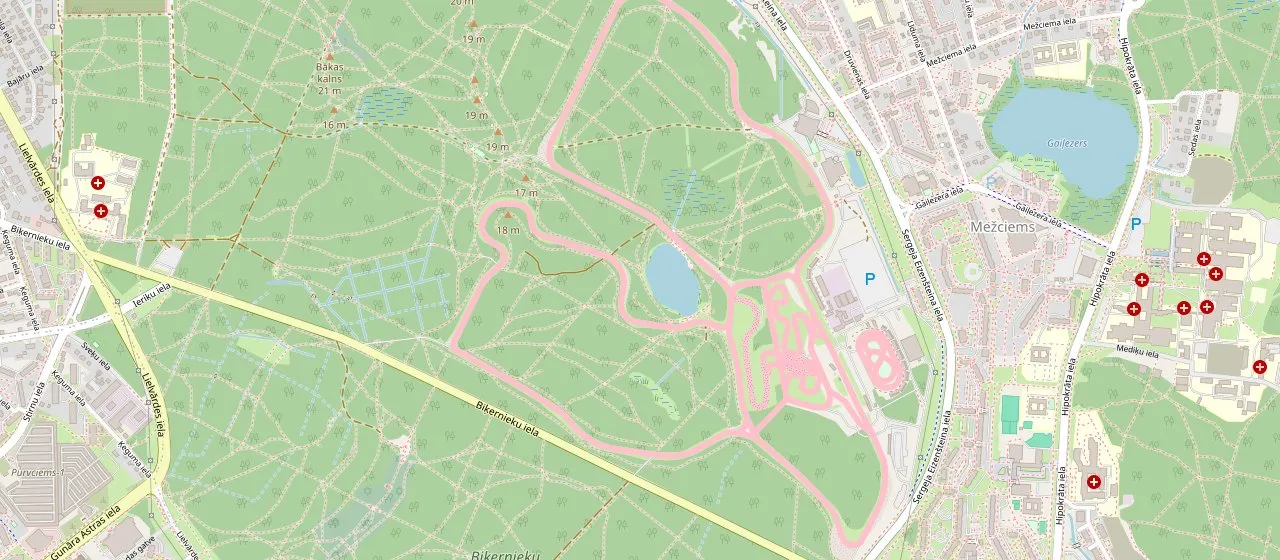
| Location | Biķernieki forest in the eastern part of Riga, next to the Mežciems housing estate; the facility's grounds at Sergeja Eizenšteina iela 18 |
| Type | a complex of circuits: asphalt car and motorcycle loops, an oval, a karting track, a rallycross track, a drift track, a speedway stadium |
| Speed loop (lielā auto trase) | 3662 m, width 10–16 m, asphalt, up to 38 cars at once |
| Mastery loop (moto aplis) | 3570 m according to the operator's current description; 3580 m at the opening in 1966 |
| Grand combined loop | about 5.5 km |
| Rallycross track | 1295 m, 60 per cent asphalt, 40 per cent gravel, run anticlockwise |
| Direction on the road loops | clockwise |
| Terrain | elevation difference up to 10 m, gradients up to 16 per cent |
| Opened | 30 July 1966 (mastery loop); first race on the speed loop 2 June 1968 |
| Speed loop lap record | 1:12.725, Tõnis Vanaselja, Oldbac Kalana prototype, 15 June 2024, demonstration session during a round of the Baltic Touring Car Championship |
| Operator | the state company VAS “Ceļu satiksmes drošības direkcija” (CSDD), since 2011 |
| Main events | rounds of the USSR championships (1966–1991), the Friendship Cup of the socialist countries (1968, 1984–1986, 1988–1990), the World Rallycross Championship (2016–2022), a special stage of Rally Latvia in the WRC (2024), the Latvian speedway Grand Prix (2024), the European Rallycross Championship (2026) |
| Status | active |
A forest instead of a park
Before the circuit at Biķernieki was built, Riga's motorcyclists and drivers raced on a road loop in Mežaparks, which A. A. Rogachev, a researcher of Soviet motorsport, considers to have been of little use for racing. According to the history of the facility published by its operator, the motorcycling community was already looking for a site for a sports base in the 1950s, with the support of the republic's ministry of motor transport and roads. A commission whose members included Pauls Grauze, chairman of the automobile and motorcycle sports federation, Eduards Kiope, head of the sports department, and Ošiņš inspected three sites: the area of Senču sils by Lake Baltezers, the forest around Babīte across the Daugava, and the farthest corner of the Biķernieki forest by old Mežciems. It unanimously chose the last, because there, alongside a road circuit, motocross courses of international standing could also be laid out.
Riga's architects were against it: motor sport meant noise, exhaust fumes and crowds, so the dispute dragged on for a long time. In 1960, after a review of possible sites in the city, a 15-hectare plot in Biķernieki was deemed the most suitable. Edvīns Liepiņš, the author of the longer version of this history, adds that consent was given by E. Slēde, chairman of the Riga executive committee, and V. Apsītis, the city's chief architect, and that the plot lay near the former Burhard estate, on Biķernieku Street. The forest sheltered competitors and spectators from wind and rain off the sea; Rogachev writes of side gusts that were dangerous for motorcyclists. The short distance from housing estates and main streets was meant to draw spectators, and with them ticket revenue, on which the assessment of the facility's work depended. According to Rogachev, the forest then lay three kilometres east of Riga, and today it is within the city limits; the complex was initially called “Druzhba” (Russian for “Friendship”), a name that soon fell out of use.
The same forest also has another history. According to the Jewish Community of Latvia, it is the country's largest site of mass murder and burial of victims of Nazi terror: in 1941–1944 about 35,000 people were killed here, Jews from Latvia and Western Europe, Soviet prisoners of war and opponents of the regime. Since 2001 a memorial complex has commemorated them.
A circuit that was not meant to be fast
In 1962 design work began, and Kiope became director of the complex then taking shape. The commission went to the Latvian road and bridge design bureau; project manager Gunārs Binde found the task unusual but interesting and proposed that it be done on a voluntary basis. Working on it were Pēteris Dzenis, later an associate professor at the Riga Polytechnic Institute, Jānis Roops, Kārlis Rība and Vilnis Vasulis. The first stage covered a loop for motorcyclists, named the mastery loop (meistarības aplis), and a karting track; the second, the speed loop (ātruma aplis) for cars. The designers were to spare the forest as much as possible, and the calling of Dzenis, the chief engineer, was, according to the operator, landscape design, “building a beautiful road in a natural setting”.
Roops and Kiope had first toured circuits in the Soviet Union, including the loop by the Neva in Leningrad and the circuit in Pirita park in Tallinn. Their conclusion was that the circuit in Biķernieki would not be fast. Instead of long straights it was to have several left and right bends of small radius, as well as climbs and descents, demanding good dynamics and reliable brakes from the machine and virtuosity from the competitor. Accelerations and braking distances in the bends were calculated by filming runs by model competitors: Ošiņš on a motorcycle, Arnolds Dambis in a car. The result was that the speed loop could be lapped in 1 min 35 s, at an average of 138 km/h. Liepiņš states that this loop was designed by the engineer A. Muižniece-Maltiniece.
Sources give different dates for the start of construction. On site it turned out that there was a bog where the karting track and the start were planned, and underground springs in many other places. In places the bog had to be dug out to a depth of seven metres and filled with tens of thousands of cubic metres of sand. On the hills above Lake Linezers the rollers were pulled by tractors; Liepiņš describes a team in which the front tractor pulled the roller uphill and the rear one held it back on the descent so that it would not ripple the fresh surface. The equipment of the time could not mill turf, shape verges or clear forest, so this work was done by hand by sportspeople with their families, officials and staff of the Central Automobile and Motorcycle Club, more than 10,000 hours in total without pay. Rogachev also lists students of the Riga Polytechnic Institute among the volunteers.
The opening on 30 July 1966 comprised races on the 3580 m mastery loop. In the 350 cc class Ošiņš beat, among others, a three-time USSR champion from Estonia, and the winners also included Ērika Kiope in the women's 125 cc class. On the first day car drivers, karters, moped riders and cyclists raced too; the car races were won by Yakov Zisman in the Volga class and Bruno Erdmanis in the Moskvich class. As early as 13–14 August the new circuit hosted a round of the USSR championship, which Ošiņš won again, and the first circuit record, 95 km/h, was also his. Still in 1966, all car and motorcycle races were moved from Mežaparks to Biķernieki, including the races for the “Amber Volga” prize (Dzintara Volga), which according to Rogachev became the circuit's calling card; the LETA agency dates this series to 1964–1991.
Seiler's Bend
The first race on the speed loop, the first round of the Baltic republics championship, was held on 2 June 1968. It claimed the life of Ants Seiler, born in Tartu in 1930, the 1961 USSR champion and one of the founders of the Tallinn works TARK, which built the Estonia racing cars. In the last, left-hand bend of the loop his Wartburg-engined Estonia 9M touched wheels with the Melkus of the Georgian Shota Mamrikashvili, who was right behind him. Both cars went off among the trees. Mamrikashvili suffered minor injuries, and Seiler was killed on the spot after hitting a tree. The last bend of the speed loop was later named after him.
In the same season the speed loop hosted a round of the USSR championship and the third round of the Friendship Cup of the socialist countries. It was won by the East German driver and constructor Heinz Melkus, who lapped in 1 min 33 s, at an average of 141 km/h, in the Formula 3 Melkus-Wartburg he had built himself. Rogachev notes that in 1968 all the most important circuit races of the season were held at Biķernieki. On 11 August 1968 the grand loop, made up of parts of both circuits, was opened.
According to Rogachev the speed loop had 10 m of asphalt, eight right-hand and four left-hand bends, and the mastery loop 8 m of asphalt, twelve right-hand and nine left-hand bends; the start zone was 20 m wide over a 250 m stretch. The elevation difference across the whole circuit did not exceed 10 m, but gradients reached 16 per cent. The bends were given names: Pie ozola (“By the oak”), Elkonis, Slimnīca (“Hospital”), Smilšu kalns (“Sandy hill”) and Seilera. At the first three, grandstands shielded by concrete walls or earth banks were built in 1976. The complex also grew beyond the asphalt: in 1974 a motoball pitch, that is, a pitch for football on motorcycles, opened by the start straight, according to Liepiņš the first in the USSR with a rubberised asphalt surface, and in 1976 a speedway track was built around it.
The estate behind the trees
In 1976–1977 construction of the large Mežciems housing estate was completed on the eastern edge of the forest. Many blocks stood right next to the circuit, residents began to complain about noise on race days and, as Rogachev writes, the circuit's existence was called into question. After agreement with the USSR federations, exhaust noise was limited to 90 dB. Cars had to have silencers, noise was measured in practice and in races, exceeding the limit meant disqualification, and on days without competition no practice or testing was allowed. According to Liepiņš, in 1981 a 180-metre sound-absorbing wall on the estate side was designed on the basis of research by Alberts Vecsīlis, associate professor of acoustics at the Riga Polytechnic Institute; Rogachev states that in the same year it was built by the Pie ozola and Elkonis bends. Demands to close the circuit did not stop and, according to Rogachev, the matter was settled only by the intervention of the leadership of the Voluntary Society for Cooperation with the Army, Aviation and Navy (DOSAAF) and the republic's ministry of transport.
A strong impetus came with the return of Friendship Cup rounds in 1984. In line with the recommendations of the International Automobile Federation (FIA), concrete barriers with fencing were installed along the circuit, around the whole lap by 1987, run-off areas were widened, and an electronic scoreboard and top-speed measurement appeared by the start straight. Rogachev writes that the complex was then widely regarded as the best in the USSR, both for its circuit and infrastructure and for the organisation of competitions. In 1987 the karting track was rebuilt and work began on new grandstands by the Pie ozola and Elkonis bends, which were also meant to dampen noise more effectively than the wall; the first of them were completed at the end of the 1980s. Of similar grandstands by the Smilšu kalns and Seilera bends only part was finished, by the Seilera bend, and the planned officials' building with a press centre was never built.
In 1983, during the 8th Spartakiad of the Peoples of the USSR, R. Aizstrauts won his first gold here on a 125 cc Rīga-23S motorcycle from the Riga factory Sarkanā zvaigzne, designed by V. Kleinbergs, G. Glūdiņš and I. Kārkliņš. Rogachev counted that in 1966–1991 the circuit hosted 29 rounds of the USSR championship for racing cars and 13 for production cars, seven rounds of the Friendship Cup (1968, 1984–1986, 1988–1990) and five other international competitions in 1988–1991. As the Soviet motorsport system was falling apart, the federations of the Baltic republics organised their own competitions here, with mainly Finns and Swedes taking part; in 1990 one of the guests set the speed loop record of those years in a Reynard 873 of Scandinavian Formula 4: 1 min 20.5 s, at an average of 163.77 km/h.
Land under the asphalt
After independence was regained in 1991, the racing structure integrated with the USSR fell apart, and new international regulations required larger run-off areas and a surface two metres wider, for which large sums had to be found. In the same year the “Amber Volga” races were held for the last time. The current affairs programme “Nekā personīga”, whose findings were summarised by the Skaties.lv portal in a text reprinted by LA.LV, describes the 1990s as a time of decline: there were no international competitions and no money for investment, and the company “Biķernieku kompleksā sporta bāze”, owned by the ministry of transport, became insolvent.
According to the same programme, control of the insolvent company was taken over, in circumvention of the rules, by a firm belonging to one of the businessmen, and he and two other businessmen bought 18 ha of the land under the facility from its former owners. Sportspeople warned that the new owners wanted to close the base and go into property; the prosecutor's office investigated and ordered the firm to be removed from among the company's owners. The government gave Biķernieki the status of a national sports base and handed management of the site to CSDD, the state Road Traffic Safety Directorate. This happened in the summer of 2011, the year of the circuit's 45th anniversary.
The land under part of the facility, however, remained in private hands. According to a ministry of transport report summarised by LETA, the base occupied 128.15 ha in five plots: one belonged to the ministry, two to CSDD, and two to three businessmen whom the agency described as appearing on Latvian rich lists. On the private land stood 52 structures belonging to CSDD, including part of the road circuit and the historic karting track, the speedway stadium and the grandstands. In 2018 the owners asked the ministry of education and science to remove the national sports base status from part of their land. They argued that the land did not serve the base's purposes, that part of the grandstands was in a dangerous state, and that CSDD let the site to car repair shops, although because of that status no property tax was paid. The ministry refused, regarding the base as an indivisible whole.
In December 2019 the government backed the idea of buying back the plots for 3.55 million euros, based on a valuation by Interbaltija; the owners wanted to sell them based on a valuation by Vestabalt, for a total of 10.7 million euros. On 31 August 2022 the government agreed that the ministry of transport would buy two plots of 3.2253 ha and 14.5012 ha, and allocated 8,192,004 euros from the contingency reserve for the purpose; the compensation was set at 8,141,004 euros after a valuation by Grant Thornton Baltic. The Union of Greens and Farmers (ZZS) pointed out that the cadastral value of this land was 800,000 euros and asked the Prosecutor General's Office to examine the decision, and the Fiscal Discipline Council judged the expenditure inconsistent with fiscal policy priorities. The prosecutor's office opened a review. How it ended, and whether the purchase went through, could not be established.
Pines for rallycross
CSDD put the circuit in order step by step. In 2012 it renovated the start and finish building, which had not been refurbished since 1966 and looked like a ruin. In the summer of 2015 the circuit underwent its biggest renovation since the opening; circuit director Aivars Aksenoks listed concrete barriers meeting FIA requirements, new kerbs and 750 m of new asphalt. In July of that year it was announced that the organiser RA Events and the promoter of the World Rallycross Championship, IMG, had signed an agreement for rounds in Riga in 2016–2018. Rallycross consists of short heats on a mixed surface, asphalt and gravel. The track at Biķernieki was prepared with the involvement of Apex Circuit Design, which had worked among others on the rallycross tracks at Hockenheim and Franciacorta and on the Formula 1 circuit at Sepang: 1295 m and twelve bends, eight of them to the left. On 2 December 2015 the FIA World Motor Sport Council approved a calendar with a round in Riga on 1–2 October 2016.
Construction took less than a year and was finished in the summer of 2016. For the gravel section, as the Russian magazine “Autoreview” wrote, several dozen pines had to be sacrificed. Jumps were built: a large one on the so-called forest section and two parallel ones, one on the main line and the other on the joker lap, the longer variant of the lap, measuring 1355 m. The first round, run in the rain in front of full grandstands, was watched by the President of Latvia, Raimonds Vējonis. On Sunday 2 October 2016 the final was won by nine-time World Rally Champion Sébastien Loeb, ahead of Mattias Ekström and Timmy Hansen; it was his first win in rallycross. According to the operator, 15,000 people watched the event over the two days. Loeb said after the race:
It's great to come to a place where people are happy to see you. The atmosphere was pleasant, the prime minister and the president came. It seems this event was important here, and the track was of good quality.
According to the operator, the 2016 and 2017 rounds were judged the best of the season, and the Latvian Annual Sports Award twice named them event of the year. In 2018 the round was watched by about 29,000 spectators, 72 drivers from 13 countries took part, 77 television channels broadcast it, and the circuit recorded a record 73 competitions in the season. It was visited by FIA President Jean Todt. Ekström told the magazine “Klubs”: “You go to Silverstone, one of the most famous circuits in the world, and you expect an excellent rallycross track to have been built there. But if you compare Silverstone and Biķernieki, in my opinion Riga wins on every count”.
In December 2020, when it was unclear who would replace the championship's previous promoter, IMG, Riga was missing from the first version of the 2021 calendar; by then the circuit had hosted the world championship five years in a row. It returned as early as 2021 with a double-header on 18–19 September, and the championship's website wrote that the long gravel section through the wooded infield and no fewer than three jumps had immediately won over drivers and fans alike. In 2022, the first season of electric cars, a double-header was held here on 3–4 September, for which the city council granted 118,000 euros. Riga was no longer on the 2023 calendar. In May 2026 the circuit opened the European Rallycross Championship season, and the final of the top class was won by the Swede Johan Kristoffersson.
Other international series came to the circuit too. On 18 July 2024 the first special stage of Rally Latvia, a round of the WRC world championship, was run over two laps with a total length of 11.13 km; the route combined sections of the road loop, the motorcycle loop, the rallycross and karting tracks, and a twisty section inside the speedway stadium. In September 2024 the speedway stadium hosted the Latvian Grand Prix, a round of the individual world championship, which was won by Bartosz Zmarzlik. For the FIA Intercontinental Drifting Cup, scheduled for 3–4 October 2025, the operator announced 45 competitors from 33 countries.
Decibels under the apartment blocks
The dispute with the neighbours did not disappear along with the USSR. Since 2015 the circuit has run public noise monitoring. In May 2018, during the opening of the Baltic drift season, the average level was 55 dB during the day and 53 dB in the evening, against permitted levels of 60 and 55 dB. Facility manager Normunds Lagzdiņš told LETA that control measurements had already led to competitors being disqualified. CSDD cited a survey by Latvijas fakti according to which 65 per cent of local residents viewed the circuit's presence positively and 8 per cent negatively.
In August 2026 the Jauns.lv portal described a recent ruling by the Senate, Latvia's supreme court. Residents had challenged a permit issued by the Riga authorities for championship car races at the circuit; the court of first instance refused to accept the complaint, finding that they were defending other people's interests. The Senate ruled that noise is an environmental matter and that citizens may act in the public interest, but it did not uphold the complaint: according to the circuit's public measurements, noise on the disputed days slightly exceeded 58 dB(A) and was within the standards.
In your own car between the trees
On 15 June 2024 the Estonian driver Tõnis Vanaselja broke the circuit's outright record in a demonstration session during a round of the Baltic Touring Car Championship. In the Judd V8-engined Oldbac Kalana prototype he lapped the speed loop in 1:12.725; the previous record, 1:14.093, belonged to Haralds Šlēgelmilhs. Vanaselja explained that he drove with a margin in hand, because “the Biķernieki circuit is narrow and runs between trees, and several bends have to be driven from memory”.
The same lap is open to amateurs. Practice sessions and track days at Biķernieki are organised by, among others, the association MANO Motorsport events. The organiser requires a driving licence, a roadworthy car, a helmet and clothing that covers the body, tyres with at least 3 mm of tread, and personal accident insurance of at least 1500 euros covering motorsport. Cars without a roll cage usually run two 15-minute sessions in groups and without passengers; instructors are available for a small surcharge. The regulations require club membership and a passed test on the meaning of flags, registration no later than the day before, a helmet with E homologation and a fire extinguisher of at least 1 kg. For the season closer on 10 October 2026, three 15-minute sessions cost 70 euros and six cost 140 euros.
Anyone who wants to be timed can enter MANO Superlaps, where most participants drive road cars, nobody fights for position, and the result is decided by the sum of the two fastest laps. In winter the circuit hosts the Rīgas ziemas kauss autosprint, open, according to the operator, to anyone regardless of car and experience, on non-studded tyres only; 188 drivers came to the season opener on 7 December 2024. The part of the facility called Raganas katls (“Witch's cauldron”) has large elevation differences, blind bends and small run-off areas; the organisers and the drift commission of the Latvian Automobile Federation deemed it too dangerous for Street class cars. According to the CSDD price list in force from 2026, hiring the whole speed loop costs 191 euros gross per hour on working days between 7:00 and 15:00, and 2049 euros per day. The site is open daily from 6:00 to 23:00, with restrictions during events, and outside events the asphalt belongs to runners, rollerbladers and cyclists, and in winter to cross-country skiers.
Sixteen cylinders for the sixtieth birthday
On 18 April 2026 an exhibition for the circuit's sixtieth anniversary opened at Rīgas Motormuzejs, the Riga Motor Museum, with more than twenty historic motorcycles, karts, single-seaters and racing cars. On 15 August, for the facility's anniversary, the Auto Union Type C, a pre-war racing car with a six-litre V16 engine, was presented and driven on a parade lap of the circuit. Then Audi works driver Dindo Capello, a three-time winner of the Le Mans 24 Hours, drove the car through the streets of Riga to the Freedom Monument, and Prime Minister Andris Kulbergs, who was at the circuit, filmed it, like many other guests. Museum director Agris Šmits recalled: “The sound of the Auto Union V16 engine was last heard in Riga in 1997, so its return to the city's streets after almost thirty years is a historic moment”.
Timeline
- 1960: a 15-hectare plot in the Biķernieki forest is judged the best site for a circuit.
- 1962: design work begins, Eduards Kiope becomes director of the future complex.
- 30 July 1966: opening of the mastery loop (3580 m), a double win for Kārlis Ošiņš.
- 2 June 1968: first race on the speed loop, death of Ants Seiler.
- 11 August 1968: opening of the grand loop.
- 1974 and 1976: the motoball pitch and the speedway track.
- 1984: return of the Friendship Cup, concrete barriers following FIA recommendations.
- 1991: the last “Amber Volga” races.
- 2011: CSDD takes over management of the facility.
- 2015: biggest renovation since the opening, agreement on the World Rallycross Championship.
- 2 October 2016: first World Rallycross Championship round in Riga, won by Sébastien Loeb.
- 2022: World Rallycross double-header, the last before Riga disappeared from the calendar; the government allocates 8.19 million euros to buy back the private land under the facility.
- 2024: circuit record by Tõnis Vanaselja (1:12.725), Rally Latvia WRC special stage, Latvian speedway Grand Prix.
- 2026: European Rallycross Championship, Senate ruling on noise, the circuit's sixtieth anniversary.
Sources (52)
- Biķernieku kompleksā sporta bāze (VAS „Ceļu satiksmes drošības direkcija”), Trases vēsture, bksb.lv [lv]
- Edvīns Liepiņš, BKSB celtniecība: problēmas un risinājumi, BKSB [lv]
- A. A. Rogaczow (А. А. Рогачев), Бикерниеки [ru]
- Biķernieki, RacingCircuits.info [en]
- Biķernieku kompleksā sporta bāze, FIA Starpkontinentālais Pasaules drifts Rīgā: rekords ar 33 valstīm Biķernieku trasē, bksb.lv, 2025-09-30 [lv]
- LETA, Slavenais Lēbs pēc uzvaras Biķerniekos priecājas par komandu un savu mehāniķi latvieti, LA.LV, 2016-10-02 [lv]
- MANO Motorsport events, Informācija interesentiem, manoevents.lv [lv]
- LETA, Trokšņi Biķernieku trasē nepārsniedzot atļauto līmeni, LA.LV, 2018-05-08 [lv]
- Biķernieku kompleksā sporta bāze, Biķernieku kompleksās sporta bāzes iekšējās kārtības noteikumi, bksb.lv [lv]
- Biķernieku kompleksā sporta bāze, Izpēti trasi, bksb.lv [lv]
- Biķernieku kompleksā sporta bāze, Septembra nogalē Biķernieku apvienotajā aplī norisināsies 100 minūšu izturības brauciens, bksb.lv, 2026-09-14 [lv]
- Biķernieku kompleksā sporta bāze, Rallijkross, bksb.lv [lv]
- Guntars Pulss, Pasaules rallijkrosa čempionāts nākamgad notiks Rīgā, LA.LV, 2015-07-21 [lv]
- Ants Seiler, Motorsport Memorial [en]
- Biķernieku kompleksā sporta bāze, Autosporta svētki un rekorda mēģinājums Biķerniekos jau 15. jūnijā, bksb.lv, 2024-06-11 [lv]
- Biķernieku kompleksā sporta bāze, Biķerniekos jauns trases rekords, uzvaras Batrakam un Šubeckim, bksb.lv, 2024-06-17 [lv]
- Eesti Autospordi Liit, red. Gunnar Leheste, VIDEO | Eesti inseneride loodud superauto püstitas Bikernieki ringraja rekordi, Delfi Sport (sport.delfi.ee), 2024-06-18 [et]
- VAS, Ceļu satiksmes drošības direkcija, „Vispārīga informācija un vēsture” [lv]
- Guntars Pulss, Atjaunota Biķernieku trases starta–finiša māja, LA.LV, 2012-07-10 [lv]
- Rallycross Promoter GmbH, Updated calendar issued for 2022 World RX campaign, fiaworldrallycross.com, 2022-03-21 [en]
- World RX unveils global calendar for 2023, fiaworldrallycross.com, 2022-12-07 [en]
- The big 3-0: Kristoffersson doubles up in Latvia, fiaworldrallycross.com, 2022-09-04 [en]
- Biķernieku kompleksā sporta bāze, Biķernieku trasē vēsturiski pirmais Tet Rally Latvia ātrumposms un skatītāju aktivitātes vēl pirms starta, bksb.lv, 2024-07-16 [lv]
- Biķernieku kompleksā sporta bāze, Ļebedevam satriecošs sniegums Biķernieku trasē, OlyBet FIM Speedway Grand Prix of Latvia – Riga triumfē Žmaržļiks, bksb.lv, 2024-09-09 [lv]
- Glābēji, evakuatori un neatliekamā palīdzība - Biķerniekos aizvadīts spriedzes un pārdzīvojumu pilns Eiropas rallijkrosa čempionāta pirmais posms. FOTO, VIDEO, Jauns.lv, 2026-05-10 [lv]
- Memoriāls Biķerniekos, jews.lv [lv]
- LETA, Atjaunoto Biķernieku trasi atklās vēsturisko automašīnu sacensības «Dzintara aplis», LA.LV, 2015-08-06 [lv]
- Skaties.lv, VIDEO. Miljonāri par Biķernieku trases zemi no valsts prasa trīsreiz vairāk nekā tā gatava maksāt, LA.LV, 2020-01-12 [lv]
- LETA, Valdība atbalsta Biķernieku sporta kompleksa zemes atpirkšanu no miljonāriem, LA.LV, 2019-12-10 [lv]
- LETA, IZM atsaka miljonāriem Biķernieku trases lietā, LA.LV, 2018-11-13 [lv]
- «Skultes terminālis, Biķernieku trases zeme – valstiska mēroga zādzības šodien pat vairs netiek slēptas», uzskata Lapsa, LA.LV, 2022-09-14 [lv]
- ZZS mudina Ģenerālprokuratūru izvērtēt valdības dāsnumu, atpērkot zemi Biķernieku trasē 10x dārgāk par kadastrālo vērtību, LA.LV, 2022-09-04 [lv]
- FIA, FIA announces World Motor Sport Council decisions, fia.com, 2015-12-02 [en]
- World RX reveals its 2016 calendar, fiaworldrallycross.com [en]
- Witalij Blinuszow (Виталий Блинушов), Рига — город контрастов, или как в Бикерниеки мировой ралли-кросс давали, „Авторевю”, 2016-10-07 [ru]
- Latvija palikusi bez rallijkrosa pasaules čempionāta posma, Jauns.lv, 2020-12-17 [lv]
- Biķernieku trase uzstāda rekordu, ko novērtē arī FIA prezidents Tods, LA.LV, 2018-11-02 [lv]
- 2021 World RX of Riga-Latvia becomes double-header event, fiaworldrallycross.com, 2021-07-19 [en]
- Rīgas dome piešķir 118 000 eiro Pasaules rallijkrosa čempionāta posma norisei galvaspilsētā, Jauns.lv, 2022-06-29 [lv]
- Izsludināts iepirkums Biķernieku rallijkrosa trases seguma atjaunošanai pirms gaidāmajiem FIA Eiropas čempionāta posmiem, Jauns.lv, 2026-01-17 [lv]
- Timetable Tet Rally Latvia 2024, eWRC-results.com [en]
- Michelsen season over after Riga crash, FIM Speedway Grand Prix (fimspeedway.com), 2024-09-10 [en]
- Samanta Kārkliņa, Par skaļu! Biķernieku trases troksnis nonāk līdz Senātam - lūk, ko drīkst darīt ikviens iedzīvotājs, Jauns.lv, 2026-08-08 [lv]
- MANO Motorsport events, Treniņu un trases dienas nolikums, 2025-04-16 [lv]
- MANO Motorsport events, Sponsoru vizināšana – 10. oktobris, manoevents.lv [lv]
- Biķernieku kompleksā sporta bāze, Izbaudi Biķernieku trasi ar savu ielas auto un startē Superlaps posmā jau šo ceturtdien, bksb.lv, 2025-07-16 [lv]
- Biķernieku kompleksā sporta bāze, Piedalies Rīgas ziemas kausā un izbaudi leģendāro Biķernieku trasi ziemas apstākļos, bksb.lv, 2024-11-26 [lv]
- Biķernieku kompleksā sporta bāze, Rīgas ziemas kauss Biķerniekos startē ar 188 dalībniekiem, starp tiem arī DTM zvaigzne Pauls, bksb.lv, 2024-12-09 [lv]
- Biķernieku kompleksā sporta bāze, Raganas katla driftam Biķerniekos šogad 10 gadu jubilejas sacensības, kas noticis un mainījies pa gadiem?, bksb.lv, 2024-09-02 [lv]
- VAS, Ceļu satiksmes drošības direkcija, 2026-01-01 [lv]
- FOTO: apmeklētāji 60 gadu jubilejas izstādē iepazīst Biķernieku trases bagāto vēsturi un izbauda sacensību atmosfēru, Jauns.lv, 2026-04-18 [lv]
- VIDEO: Rīgas ielās dodas leģendārais sacīkšu auto «Auto Union», ko filmē pat premjers, Jauns.lv, 2026-08-15 [lv]