
Ridaküla, Estonia
Rapla kardirada: the 1988 karting loop that lets cars on
History of the karting track near Rapla: a long build, the 1988 opening, a USSR championship, drift, amateur Best Lap and driving your own car for 50 euros.
- Type
- kart track
- Length
- 1.035 km
- Opened
- 1988
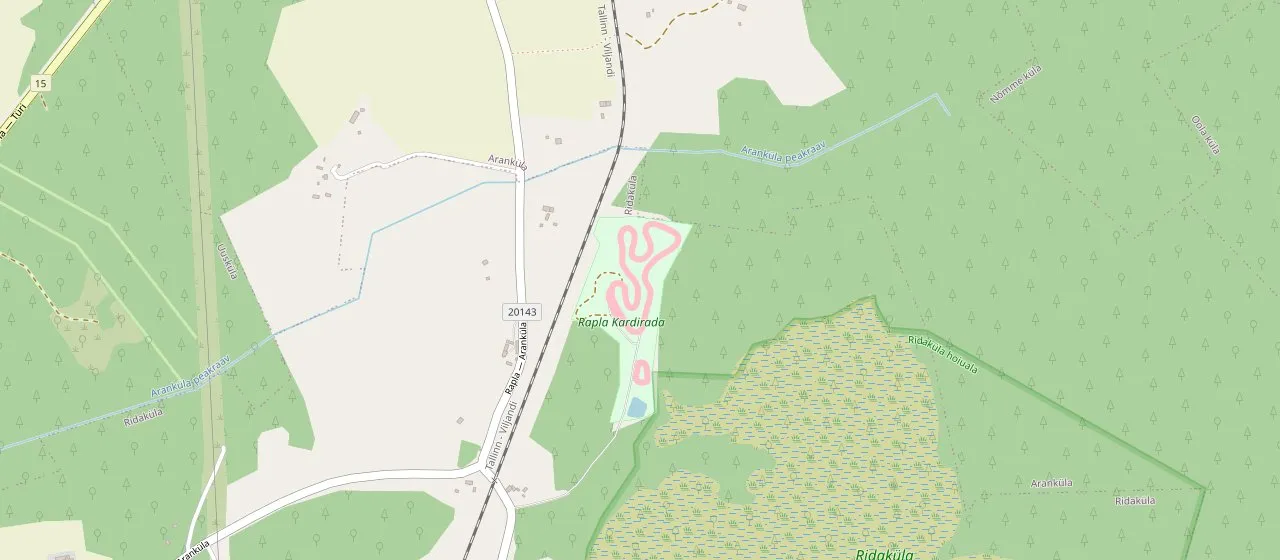
On Sunday 24 July 1988 about ten colourful parachutes opened above the new karting track near Rapla. The skydivers jumped from 1200 m and landed exactly on the marked target; before that, rally drivers had shown themselves to the public, and when a hundred karts had driven a lap of honour and lined up for the opening race, Ülo Peets, deputy chairman of the district executive committee, said: “This area has never seen such a mighty parade.” The last metres of asphalt had been laid eleven days earlier, and construction had begun at the turn of the 1970s and 1980s. Rapla kardirada, a 1035 m loop in the village of Ridaküla, went on to host the final round of the Soviet Union championship as well as rounds of the Estonian championships in karting, supermoto and drift, and today the operator also lets cars onto it for a daily fee.
| Location | Ridaküla village, Rapla rural municipality, Rapla County, Estonia; about 3 km north-east of central Rapla as the crow flies, 50 km from Tallinn according to the operator |
| Type | asphalt karting track also used by motorcycles and cars; next to it, a 400 m gravel section with corners, climbs and a jump for supermoto |
| Length | 1035 m |
| Width | 9–11 m |
| Corners | 9, of which six left and three right |
| Direction | anticlockwise |
| First race | 24 July 1988 |
| New surface | May 2003 |
| Lap record | according to the operator's list: in a race 40.765 s (average 91.402 km/h), Markus Kajak, OK class kart, 20 June 2020; fastest lap overall 40.597 s in KZ2 class qualifying, Mark Villem Moor, 27 May 2017 |
| Owner | Rapla rural municipality |
| Operator | Kardikeskus OÜ, since April 2019; since 2024 the track has been called Est1 Karting-Rapla |
| Spectators | three-storey grandstand, with 100 seats according to the sports register |
| Key events | final round of the USSR karting championship (1989); karting match between Latvia, Estonia, Canada and Lithuania (1990); Estonian karting championship; Estonian, Latvian and Finnish supermoto championships; Estonian drift championship; amateur Best Lap cup for road cars |
| Status | active |
The track that was supposed to empty the shops
Karts were nothing new in this area. According to the district newspaper “Ühistöö”, Avo Kadarik, a teacher at the secondary school in Juuru, built a 600 m dirt loop on the school stadium, which the newspaper called the first dedicated karting track in Estonia. It was opened on 23 September 1963, and in 1966–1967 it was rebuilt as an asphalt track 1000 m long. From 1972 to 1980 the school karting club in Juuru was run on a voluntary basis by another teacher at that school, Arge Peever, who himself raced karts until 1984. In 1978 he was first secretary of the district Komsomol committee. According to the operator, the track near Rapla was built on his initiative.
Construction went slowly. In May 1985, when Rapla hosted the fifth republican final of the youth competition “Hõbekart”, Peeter Böckler, deputy chairman of the karting committee of the automobile federation, complained that there was no dedicated track; the report says that in Rapla, as in several other places, its construction had stalled. In 1990 Peever recalled that the construction years had periods of work at full steam and years of “deathly silence”. He blamed the latter on one of the district's highest officials of the time, who believed the track was not needed because kart drivers would come for races and eat the district's shops and canteens bare. According to Peever, the authorities spent about 300,000 roubles on the track over ten years.
The breakthrough came in 1988. In February the district authorities announced that the track would be asphalted that same year, with the timing depending on what the TREV enterprise could manage. On 5 July “Ühistöö” reported the founding of the “Rapla” service cooperative, whose first task was to be finishing the construction, which had dragged on for years, and taking over the care of the track. Completion of the section at the corner known as Riia kurv, the Riga corner, was held up by a lack of materials, but on 13 July TREV laid the last metres of asphalt on a strip 9 m wide. Most of the work, Peever wrote in the race announcement, was done by the people from TREV and Rapla EPT, and the construction was financed by the district executive committee.
A thousand sunburnt noses
For the opening, a bus ran several times from Mahlamäe in Rapla to Riia kurv, and about fifty people walked to the track from the fire station in a march whose main prize was a bicycle. In his speech Peets listed the facts: the track lies on land of the Purila collective farm, is on the books of the district House of Pioneers, was built by TREV and Rapla EPT, will be managed by the “Rapla” cooperative, and is 1006 m long. Diplomas went to the TREV asphalt crew, the Rapla EPT lorry column that hauled the gravel, and the designer Priit Pallo, with separate thanks to Arge Peever, who over the years had kept the very idea of the track alive.
“Ühistöö” reporter Tiiu Luht noted that by the evening of that sunny Sunday the area had gained “about a thousand sunburnt noses (and backs too)”. The state mobile shop was cleaned out of lemonade within a couple of hours; the cooperative's shashlik lasted longer. Class C was won by Aadu Kroon from Keila, who also drove the fastest lap of the day, 50.6 s, recorded as the absolute track record. Peever drove in the veterans' classification and finished third.
The Soviet Union championship near Rapla
A little over a year later, on 9 and 10 September 1989, Rapla hosted the 27th USSR karting championship. The organisers expected 17 teams and up to 180 guests, and the local newspaper announced the arrival of a hundred and fifty drivers. It was the final round of the championship, and the 4th All-Union Youth Games were held alongside it. According to “Ühistöö”, no All-Union karting competition had previously been held either in Rapla or anywhere in Estonia; Peever later wrote the same. Before the event, seating planks were set up in the stands, but the judges' house, which was meant to be ready precisely for the championship, was not finished: the delays had begun as early as the pouring of the foundations. Peever did, however, praise the asphalt, because in his view there was no surface as smooth anywhere else in the district.
On Saturday, on a wet and slippery track, the team competition was held. Latvia won ahead of Estonia and the Russian SFSR, although the Estonians Margus Kukk and Raimo Luht won classes A and B. On Sunday the track dried. In the national class A, in which the karts were powered by the engine of the Minsk road motorcycle, to which nothing could be added, the USSR champion was 17-year-old Margus Kukk from the club in Nui: he won two races and no longer needed to drive the third. Bronze went to Urmas Uusneem of the Harju KEK club. Chief judge Mikhail Koganov from Moscow praised the organisers and the track: “The track is good and comfortable, the competitors quickly took to it. Besides, it is in a beautiful place.”
In summer 1990, on Sunday 15 July, Rapla hosted the second part of a karting match between Latvia, Estonia, Canada and Lithuania; the day before, the same teams had raced in Kandava in Latvia. The Canadians, used to karts without gearboxes, were given six-speed machines with CZ engines by the Latvian team. Their best driver, Walter John Koller, a professional racing driver, two-time Canadian and three-time US karting champion, won in Kandava. In Rapla it rained, and over the four races the best was the Latvian Arnis Jurševskis, ahead of Andres Laur from Tallinn; in the team classification the order was Latvia, Estonia, Canada, Lithuania. Peever wrote that kart drivers from the American continent had raced in Estonia for the first time, and the track's operator considers the match the largest international karting event in the venue's history.
The same text by Peever was an appeal to the authorities. The judges' house was still unfinished, and there were no garages, washrooms or overnight accommodation; finishing the judges' house would take about 20,000 roubles, and a garage and accommodation complex over the next few years about another 100,000. Before the banquet at Pirgu manor, the participants in the international event washed their faces and hands in the small sauna of the Mägismaa family.
A closed gate and iron barrels
In the 1990s Rapla was a fixture in the Estonian championship calendar. In spring 1996 the season was due to start here on 21 April, but the track was still under a thick layer of snow, and the round was held on 1 May. In 2002 Heikki Hõbemägi, executive director of the Estonian karting federation, announced in “Maaleht” a thorough renovation of the Rapla track. The new asphalt, one of Rapla rural municipality's investments, was due to be ready on 15 May 2003. The work was delayed and the first round of the Estonian championship could not be held here; the next one was scheduled for July.
Together with the new surface, in May 2003 the care of the track passed to the association MTÜ Rapla Kardirada, run by Tiit Soa and Helmet Palm, a Rapla businessman and founder of the Hepa filling station chain. Before that, Soa recalled, it was a facility with an open gate that anyone could drive onto. The new custodians closed the gate and introduced a fee for using the track, although locals kept driving for free. Because drivers ran off the edges and carried dirt onto the asphalt, Soa set up iron barrels along the track; for kart and motorcycle races they had to be rolled away to a safe place. In winter, if the frost allowed, he turned the track into an ice course. He did not let studded tyres on, except in the few winters with a thick layer of snow, when tonnes of water from the pond next door were poured onto the prepared snow course; according to the newspaper, that is why the 2003 asphalt held up so well. Palm, Estonian rallycross champion in the Super Car class in 2012, died in 2015, and Soa looked after the track as a hobby, alongside his job, for fifteen and a half years.
The track did not serve karts alone. In 2017 the student team FS Team Tallinn had been testing its Formula Student cars here for about ten years, that is, ever since such cars began to be built in Estonia at all. Its supervisor Indrek Petjärv explained that he chose Rapla for its proximity to Tallinn, the good cooperation with Soa and the fact that the track suits the car: “We also tried the Tabasalu track, but for now we prefer Rapla.” In karting, the track went on hosting national championships. The Estonian karting federation's jubilee, fiftieth season was opened in May 2012 by a round in Rapla with nearly a hundred competitors from seven countries. In August 2013, in the Rotax Junior final, 13-year-old Jüri Vips lost here to Ralf Aron after a close fight. In May 2017 Mark Villem Moor drove the fastest lap in the track's history in qualifying and set a new record in the pre-final race. Over time the events dwindled: according to “Raplamaa Sõnumid”, after the Lange track opened in Tartu County, Rapla had only one championship round in 2018 instead of two or three.
Cars on a loop built for karts
Cars have driven here since the first day: at the 1988 opening the fastest in the rally demonstration were Rainer Parik, Janno Kokk and Marko Kasepõld. The Estonian sports register states today that in motorsport, competitors here start in sprint format, one at a time. On 5 January 2014 the AG winter cup in passenger car sprint was held here: 43 drivers in three drivetrain classes drove on clean asphalt, mostly on slicks, three rounds of five laps each. The fastest was Mait Pikkof, second was Helmet Palm, and in the front-wheel-drive class second place went to 73-year-old Taivo Kuusing, by his own account the oldest competitor in the discipline in the country. In May 2015, 81 drivers came for a round of the amateur sprint, rahvasprint.
Drift drew the biggest crowds. In 2016 the ERR sports service, announcing the season finals held here, with the first ever Rapla round of the Latvian Street class, called the track the birthplace of Estonian drift. The Estonian Drift Association held a round here in almost every season, and on 7–8 September 2018 it ended its tenth season in Rapla with the national championship finals and a legends' race; about fifty competitors drove on the track. Organiser Marko Opmann praised the track: “Rapla is in itself a very comfortable track. The only problem is parking spaces.” According to the newspaper, the line of cars parked along the access roads at the time was about a kilometre long. The current operator does not allow drift cars on the track.
Amateur car events do not always go ahead. The KR Racing Rapla sprint set for 1 June 2025 was cancelled because, instead of the expected minimum of 50 drivers, fewer than half signed up; in the two previous years, as organiser Valmar Gilden said, about 90 competitors had started here, with a similar number of spectators. In August 2025 and 2026, on the other hand, the track hosted rounds of the amateur Best Lap cup for road cars.
The municipality looks for a tenant
The track belongs to Rapla rural municipality. In summer 2018 the municipality announced a competition to lease the track property for car and motorcycle sport, for five years with an option to extend by another five. Five applications came in, four of which met the conditions. New was the requirement of a rent of at least 500 euros a month; Soa, who until then had paid the municipality nothing, applied but did not win. “As if it were my own child,” he told the newspaper about the track. In January 2019 the municipality decided on a five-year contract with Kardikeskus OÜ, which since April of that year has managed the track under Margus Leesmaa and also runs the track in Aravete.
On 7 August 2020 the new operator opened a rental service: fifteen leisure karts from the French Sodikart factory. The opening had been planned for May, but the factory shut down during the pandemic. The investment cost 88,950 euros excluding VAT, of which 53,370 euros was covered by the LEADER programme. That same summer Hõbemägi, by then a board member of the karting federation, said the track needed renovation because the asphalt had last been replaced in 2003. The operator states that 143 competitors came to the season opener on 6–7 June 2020, which it calls the attendance record for Estonian karting events since the restoration of independence. In 2024 the track took the name Est1 Karting-Rapla, after the Est1 Racing team, the track's sponsor, as Leesmaa explained.
Taking your own car to Rapla
The operator writes that the track is used by racing and cross karts, motorcycles and cars, and that you can drive your own machine every day from 11:00 to 19:00. According to the operator's price list (as of 4 October 2026), a day of driving with a car or cross kart costs 50 euros per vehicle, and with a racing kart or motorcycle 40 euros per person, regardless of how long you drive. The date has to be arranged by phone or email, and drift cars are banned. The operator advertises Rapla as one of the fastest tracks in Estonia, because the loop is long and has few corners. In a leisure kart a lap takes about a minute, 57 s for the fastest drivers, and on the fast straights such a kart can reach 100 km/h.
A more structured format is Best Lap, an amateur time-attack series run by the association Hobby Racing MTÜ. In 2026 it had four rounds, and the third was held in Rapla on 8 August. Classes Street A, B, C and D are defined by engine capacity and power as stated in the registration certificate. A car in these classes must meet roadworthiness inspection requirements and run on road tyres marked E; the driver needs a valid driving licence, a helmet marked E, a fire extinguisher of at least 1 kg and at least one tow hook. Overtaking is prohibited as a rule, everyone drives three rounds, the best lap in each counts, and the result is decided by the sum of the two best rounds. The organiser publishes entry forms at least 30 days before a round. In 2026 the fastest in Rapla was Rain Tedre, in the Unlim 2000+ class, in a car described in the results as E46 S55, with a time of 48.69 s; Street A winner Marek Kaljend drove an MX-5 at around 54 s.
The track today lacks the facilities Peever asked for in 1990. The operator notes that no buildings belong to the track, the sports register lists portable toilets and no changing rooms or showers, and in the Kart Cup regulations of May 2026 the race office and notice board are housed in a site trailer at the start. Whether the 1989 judges' house was ever completed could not be established.
Timeline
- 1985: at the “Hõbekart” event in Rapla, officials complain that construction of the track has stalled.
- 1988, 13 July: TREV finishes laying the asphalt.
- 1988, 24 July: first race on the track.
- 1989, 9–10 September: final round of the 27th USSR championship; Margus Kukk champion in class A.
- 1990, 15 July: karting match between Latvia, Estonia, Canada and Lithuania.
- 2003, May: new surface; the track is managed by MTÜ Rapla Kardirada.
- 2012: the Estonian karting federation's jubilee, fiftieth season starts in Rapla.
- 2018, 7–8 September: Estonian drift championship finals; that year the municipality launches a competition for a tenant.
- 2019, April: Kardikeskus OÜ takes over management of the track.
- 2020, 7 August: kart rental opens.
- 2024: the name Est1 Karting-Rapla.
- 2025, 16 August, and 2026, 8 August: rounds of the Best Lap cup for road cars.
Sources (54)
- Tiiu Luht, Riia kurvis alustati, „Ühistöö”, 1988-07-28 [et]
- Tiiu Luht, Tõnis Tõnisson, Ülo Allvee (podpisani pod rubryką), Rajoonis, „Ühistöö”, 1988-07-19 [et]
- Arge Peever, Rapla kardiraja avavõistlused, „Ühistöö”, 1988-07-23 [et]
- Arge Peever, Mõelgem ka tulevikule, „Ühistöö”, 1990-07-26 [et]
- Kardikeskus OÜ, Rapla, Karting.ee [et]
- Kardikeskus OÜ, Rapla vaba aeg, Karting.ee [et]
- Henn Saarmann, Kardisõitjad sõitsid kodurajal hästi, „Spordileht”, 1989-09-11 [et]
- Siim Jõgis, Rapla kardirajal peeti driftihooaja viimane etapp, „Raplamaa Sõnumid”, 2018-09-12 [et]
- Siim Jõgis, Tudengivormelid ja muud põnevat Rapla kardirajal, „Raplamaa Sõnumid”, 2017-12-06 [et]
- MTÜ Viljandi Kardiklubi, Kart Cup 2026. Võistlusjuhend. 1. etapp – Rapla kardirada, 30. mai 2026, autosport.ee [et]
- Eesti Spordiregister (Spordikoolituse ja -Teabe SA), Rapla kardirada, 2026-02-16 [et]
- Triin Sao, Kardipidu Raplas, „Ühistöö”, 1989-09-16 [et]
- Avavõistlus Rapla kardirajal, „Ühistöö”, 1988-07-21 [et]
- Tiiu Luht, Nädalavahetus kardirajal, „Ühistöö”, 1989-09-07 [et]
- Kardikeskus OÜ, Rapla ajalugu, Karting.ee [et]
- Siim Jõgis, Kardirajal saab üks ajastu ümber, tuleb uus haldaja, „Raplamaa Sõnumid”, 2018-12-21 [et]
- Mati Kähär, Kokkuvõtted möödunud töökast aastast, „Rapla Teataja”, 2004-01-01 [et]
- Kardikeskus OÜ, Rapla rajarekordid, Karting.ee [et]
- Siim Semiskar (red.), Mark Villem Moor võitis kardispordi Eesti meistrivõistluste etapi, ERR Sport, 2017-05-29 [et]
- Kardiraja rendikonkurss, „Rapla Teataja”, 2018-09-14 [et]
- Kardikeskus OÜ, Kontakt, Karting.ee [et]
- Siim Jõgis, Rapla kardirada ärkab uuele elule, „Raplamaa Sõnumid”, 2020-08-19 [et]
- Marleen Murumets, Rapla kardirada sai endale uue nime, „Raplamaa Sõnumid”, 2024-06-26 [et]
- Ivo Pilve, Läti, Eesti, Kanada, Leedu, „Päevaleht”, 1990-07-17 [et]
- Hobby Racing MTÜ, Tulemused 2026 [et]
- Traditsioonid püsivad, „Ühistöö”, 1985-02-07 [et]
- T. Raid, Paar küsimust komsomoli rajoonikomitee esimesele sekretärile Arge Peeverile, „Ühistöö”, 1978-10-28 [et]
- Tiiu Luht, «Hõbekart» Raplas, „Ühistöö”, 1985-05-25 [et]
- Jaan Nikker, Infotund, „Ühistöö”, 1988-02-18 [et]
- Ester Šank, Rajooninõukogu täitevkomitees, „Ühistöö”, 1988-07-05 [et]
- NSV Liidu meistrivõistlused Raplas, „Ühistöö”, 1989-08-29 [et]
- 1. Läti, 2. Eesti, „Noorte Hääl”, 1989-09-10 [et]
- Kodurajalt kuld ja pronks, „Noorte Hääl”, 1989-09-12 [et]
- Olid poolakad, tulevad kanadalased, „Päevaleht”, 1990-07-11 [et]
- Pille Russi (ETA), Kardivõistlus ei ole «siseringi» üritus, „Spordileht”, 1996-05-14 [et]
- Heikki Hõbemägi, Atraktiivne kardisport, „Maaleht”, 2002-06-06 [et]
- Iiris Saluri, Rapla ehitab ja areneb, „Rapla Teataja”, 2003-06-01 [et]
- Mälestuspink Helmet Palmile, „Rapla Teataja”, 2024-01-12 [et]
- In memoriam Helmet Palm 3. VII 1955 – 3. XI 2015, „Raplamaa Sõnumid”, 2015-11-11 [et]
- Ivo Dobkevitsch (red.), Kardispordi hooaja avaetapil oli rekordarv osavõtjaid, ERR Sport, 2012-05-06 [et]
- Siim Boikov (red.), Raplas võtsid mõõtu kuue riigi sportlased, ERR Sport, 2013-08-24 [et]
- Taivo Kuusing, AG talvekarikavõistlused Rapla kardirajal, „Raplamaa Sõnumid”, 2014-01-08 [et]
- Kalle Kruusma, Läänlased kihutasid laupäeval Rapla kardirajal, „Lääne Elu”, 2015-05-12 [et]
- Siim Semiskar (red.), Driftihooaja suur lõpuüritus toimub Raplas, ERR Sport, 2016-09-05 [et]
- Siim Solman, Kärssav kumm ja rajud hobujõud, „Raplamaa Sõnumid”, 2016-09-14 [et]
- Marleen Murumets, Kas Rapla Sprindi huvilised on kadunud?, „Raplamaa Sõnumid”, 2025-05-28 [et]
- Hobby Racing MTÜ, Tulemused 2025 [et]
- Kardikeskus OÜ, Bestlap autovõistlus 8.08.26 Rapla kardirajal, Karting.ee, 2026-07-07 [et]
- Vallavalitsus jaanuaris, „Rapla Teataja”, 2019-02-08 [et]
- Kardikeskus OÜ, Projektid, Karting.ee [et]
- Siim Jõgis, Eesti kardispordi meistrivõistlused avati Rapla rajal, „Raplamaa Sõnumid”, 2020-06-26 [et]
- Hobby Racing MTÜ, Võistluste reglement - Best Lap 2026, Best Lap [et]
- Hobby Racing MTÜ, Tehniline Reglement – Best Lap 2026, Best Lap [et]
- Hobby Racing MTÜ, Ohutusnõuded - Best Lap 2026, Best Lap [et]