
Čavle, Croatia
Automotodrom Grobnik: a circuit built to save the Grand Prix
The circuit near Rijeka: the Preluk street course and the FIM ban, a gravel pit built over in 1978, 13 Yugoslav Grands Prix, crashes, new asphalt.
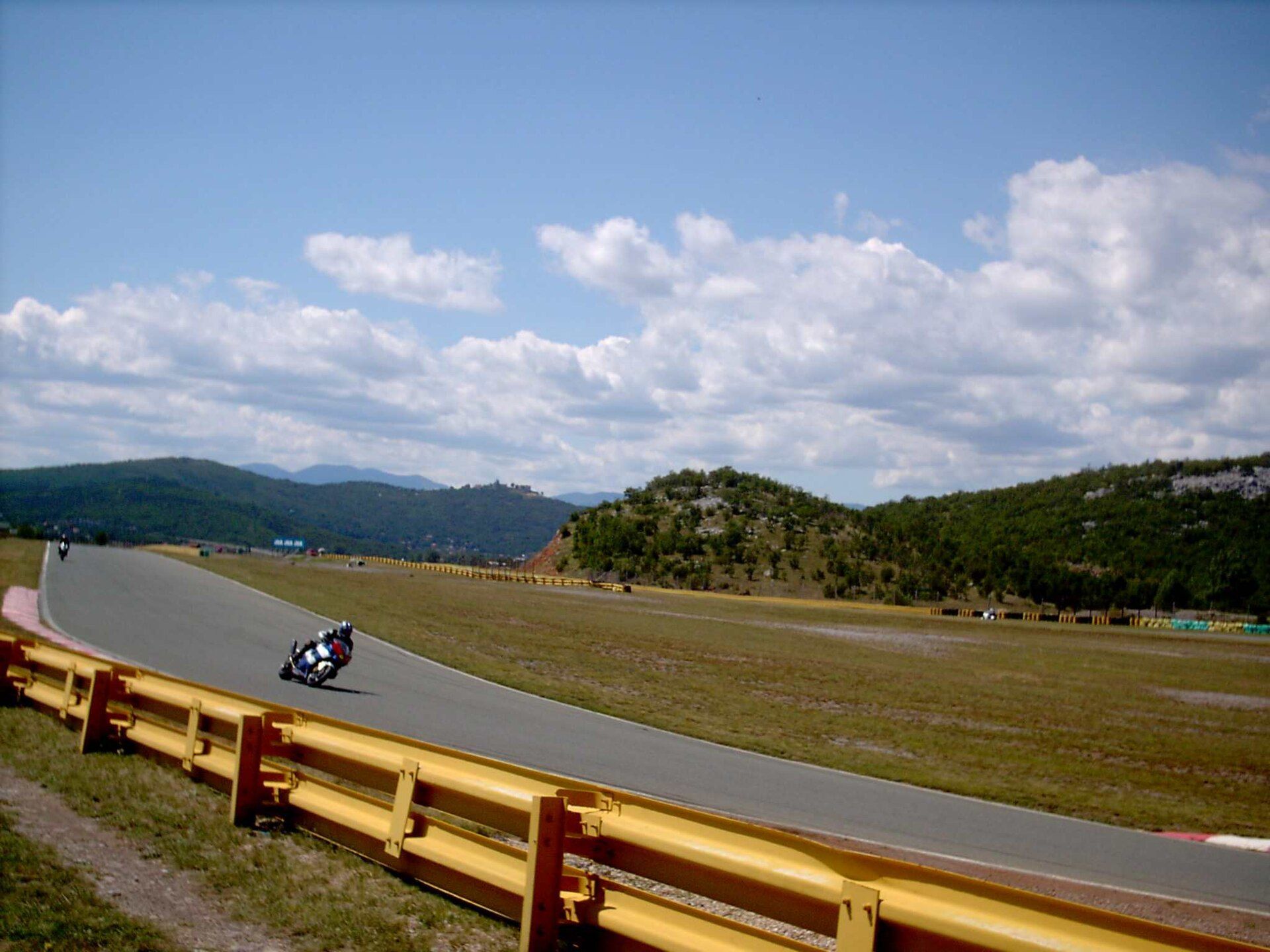
- Type
- race circuit
- Length
- 4.169 km
- Opened
- 1978
On Sunday 17 September 1978 Branko Bevanda, a motorcyclist from Opatija, rode a lap of honour on the fresh asphalt at Grobničko polje, on a Yamaha borrowed from Marijan Kosić of Rijeka, his greatest rival. On the surrounding hills, according to estimates cited by the circuit's chronicler, stood between 80,000 and 100,000 people. The track he was riding had still been a gravel pit in the winter. It came about because after the tragic 1977 season the International Motorcycling Federation (FIM) banned Grand Prix racing on the street loop at Preluk and gave the organisers a condition: a new circuit or the end of the Yugoslav Grand Prix.
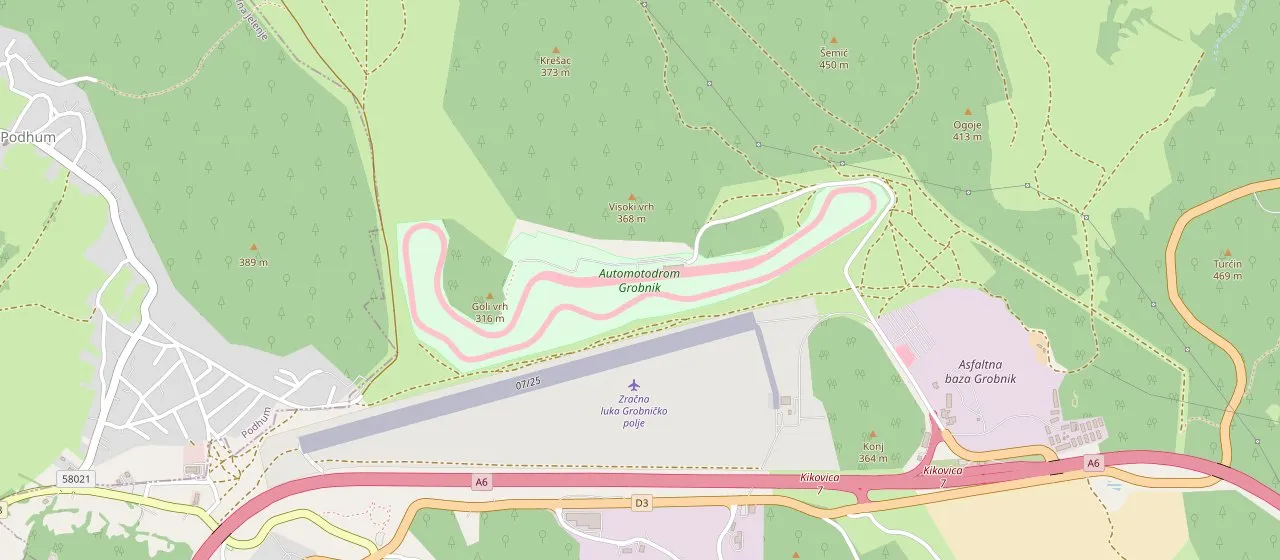
| Location | Grobničko polje, Čavle municipality, about 10 km north of Rijeka, Croatia |
| Type | permanent race circuit, FIA grade 4 licence |
| Length | 4,168.75 m (racing line) |
| Number of corners | 18 (8 right, 10 left) |
| Direction of travel | anti-clockwise |
| Width | 10.6 m, start straight 15 m |
| Elevation | about 320 m above sea level |
| Opening | 17 September 1978, Yugoslav Grand Prix |
| Lap record (motorcycles, GP era) | 1:29.220, Wayne Rainey, Yamaha, 500 cc class, 17 June 1990 |
| Fastest lap by a car | 1:16.388, Josef Neuhauser, Minardi M190 Ford, Interserie, 3 September 2000 |
| Owner and operator | Automotodrom Grobnik d.o.o., a company of the Motociklistički klub Kvarner from Rijeka |
| Most important events | Yugoslav Grand Prix (1978–1990), sidecar world championship, Alpe Adria championship, Nagrada Hrvatske in the FIA CEZ zone |
| Status | active; open days for amateurs |
The ultimatum from Preluk
Before Grobnik came into being, motorsport on the Kvarner had its own address: a six kilometre loop of public roads between Rijeka and Opatija, called Preluk. The course ran along a coastal road squeezed between the rocks and the water, in the "Opatija corner" it climbed towards the junction for Matulji and Trieste, and then came back along a flat section to the "Rijeka corner". The first post-war motorcycle race was held here on 1 September 1946; in 1947 the loop hosted the first Yugoslav road racing championship, and in 1950 the first international event, under the name Nagrada Jadrana. Even earlier, on 9 July 1939, when Opatija belonged to Italy, the same road hosted the I Circuito del Carnaro, a race for single-seater cars up to 1500 cc counting towards the Italian championship, watched according to the estimates of the time by around 30,000 spectators.
In 1969 Preluk entered the calendar of the motorcycle world championship. With the status came speed and risk. Miroslav Krpan, a Rijeka journalist who himself served as deputy director and secretary of races at Grobnik, wrote in "Novi list" that the winding course "squeezed between the rocks and the sea, without run-off zones" was already then reckoned, alongside the Isle of Man, to be the most dangerous in the world. For the last Grand Prix, on 18 and 19 June 1977, 421 entries arrived, of which the organiser accepted 126, because that was all the road could hold. On race day the 31-year-old Swiss rider Ulrich Graf, the winner of the year before, was killed; ten days after a crash in practice the 23-year-old Italian Giovanni Ziggiotto died in the hospital in Rijeka. Soon afterwards the FIM announced what had long been signalled: the end of Grand Prix racing on street circuits. From the following season, permanent venues only.
A circuit in a gravel pit
The people of the Centar auto moto sporta, which brought together four clubs of the region (Matulji, Opatija, Rijeka and Ina), led by Stjepan Lakić, had no intention of giving up the Grand Prix. The autumn of 1977 went on choosing a location. The engineer Andrija Prager, later the chief designer, toured the well known European circuits with one task: to design the best venue in this part of Europe. A site near Rupa was considered, but the choice fell on Grobničko polje to the north east of Rijeka, on a wide gravel pit under a rock face.
The deadlines were merciless. As the daily "Novi list" wrote in 2017, one year remained to build and homologate the new circuit, and other candidates for the championship round, Greece among them, were waiting for it to fail. According to the same account the Yugoslav People's Army took part in the construction, and some of the work was even done by a "brigade of prisoners"; the ownership disputes over the land were "swept under the carpet". The French site Racing Memory writes that the circuit was built "at little cost, by the army and prisoners". From the FIM ultimatum to the first race, as Krpan counts, barely 15 months passed. On 13 September the first world championship teams drove into the paddock, entered from the Podhum side.
The design called for 18 corners, 15 straights and asphalt 10 cm thick. The loop measures 4,168.75 m, is 10 m wide at its narrowest point and lies at an altitude of about 320 m above sea level, as Krpan put it, "one third of the vertical way up to Platak". Against the treeless plain the black ribbon looked, according to the same author, like insulating tape stuck onto a little heap of sugar. Today the official data sheet of the venue gives 18 corners, of which 8 are right handers and 10 left handers, anti-clockwise running, a maximum climb of 5.276 per cent and a descent of 2.198 per cent. In its first years the venue was called Automotodrom Rijeka; it took the name Grobnik later.
Sunday, 17 September 1978
The FIM scheduled the last Grand Prix of the 1978 season precisely at Grobnik. "Many doubted, but it was held! What is more, everyone came, including those who had already secured the title", says the history on the circuit's former website. Bevanda, after his lap of honour with a raised hand, said goodbye to active racing that day. Then four classes went out: 50, 125, 250 and 350 cc; the 500 cc class did not appear in the programme.
The first winner was the Spaniard Ricardo Tormo on a Bultaco in the 50 cc class (average 130.783 km/h), followed by his compatriot Ángel Nieto on a Minarelli in 125 cc. The Australian Gregg Hansford won on a Kawasaki in both 250 and 350 cc and set the first outright track record: 153.110 km/h. He rode in someone else's leathers. According to Krpan's account, on the night before the race someone stole his suit, so he started in one borrowed from the Austrian Harald Bartol; the "night birds" let the stars understand that they were in the Balkans after all. The winners doused each other with "Bakarska vodica".
Thirteen years of Grand Prix
From 1978 to 1990 Grobnik hosted 13 Yugoslav Grands Prix. The 500 cc class arrived in 1979, and from 1981 it raced here every year. The list of winners, which Krpan recites in one breath, opens with Roberts, Mamola, Uncini, Spencer, Lawson, Gardner, Schwantz and Rainey. According to RacingCircuits.info, Freddie Spencer, Wayne Gardner and Eddie Lawson each won here twice in the premier class, and Franco Uncini was the only winner from outside the English speaking circle, in 1981, on his way to the title on a Suzuki. In 1979, barely a year after the opening, the machines of the Formula 750 world championship also raced at Grobnik; the two races were won by Johnny Cecotto and Michel Frutschi.
The circuit also drew celebrities from outside the paddock. In 1988, during a break in the Grand Prix, the 1982 Formula 1 world champion Keke Rosberg in a McLaren Honda took on Giacomo Agostini on a Yamaha in a demonstration run; Rosberg was faster. Krpan also recalls how Bernie Ecclestone, the husband of Slavica Radić from Rijeka, strolled around the circuit, and "only strolled". There were mundane troubles too: groundwater flooded the site, until, as the tale of the old inhabitants cited by Krpan has it, "the water will come out one day"; a protective channel had to be built, and it works to this day.
The last Grand Prix took place on 17 June 1990. The 125 cc class was won by Stefan Prein, the 250 cc by Carlos Cardús, the 500 cc by Wayne Rainey, and the sidecars by the crew of Alain Michel and Simon Birchall. Rainey on a Yamaha covered the 4,168.75 m in 1:29.220, at an average of 168.178 km/h, and for many years remained the outright record holder of the circuit.
"The asphalt was rough, and the corners had considerably more banking than other circuits of that time. That is why it was special to ride, so many riders very much liked coming to Grobnik".
That is how Dražen Srdoč, one of the most decorated Croatian motorcyclists and for a time a member of the works Honda team, remembers that Grobnik.
Straw bales and hospital minutes
A modern venue did not remove the dangers. The Motorsport Memorial database lists nine people from motorcycle racing, including a sidecar passenger, who lost their lives at this circuit, as well as one marshal. The first world championship victim was the Frenchman Michel Rougerie. On 31 May 1981, on the second lap of the 350 cc race, he fell, got up and was trying to leave the track when his Pernod-Yamaha team mate Roger Sibille hit him at full speed. Rougerie died on the spot; he was 31 years old. Two years later, on 12 June 1983, the 26-year-old Swiss rider Rolf Rüttimann lost control of his MBA in the left hand curve before the pits, on lap 23 of the 27 of the 125 cc race, at about 160 km/h, and struck his head on the lower element of the barrier. According to Motorsport Memorial, before the start the riders of the lower classes had asked for more straw bales in the pit area, and the bales in front of that very barrier had been moved a few metres further on. Rüttimann died the same day in the hospital in Rijeka.
The year 1990 was the blackest. On 27 May, during a round of the 250 cc European championship, there was a pile-up at the first corner: the machine of Nigel Bosworth and the straw bales bounced back towards the oncoming riders, the 28-year-old Italian Eros Manferdini fell and was run over, and six other riders suffered serious injuries. Three weeks later, on the day of the Grand Prix, the straw wall at the first corner took a further toll: 19 riders collided in the 125 cc race, although, as the German Speedweek writes, the FIM ignored warnings on this matter. Then, despite the rain that was starting, the 250 cc race was not stopped. Three laps from the finish Reinhold Roth, a two-time world championship runner-up who was fighting for the win, ran at about 180 km/h into the back of the Yamaha of the Australian Darren Milner, who was riding slowly along the racing line towards the pits; according to Motorsport Memorial he believed the race would be stopped. There was no oxygen apparatus in the ambulance; Roth was left without oxygen for about eight minutes, spent more than six weeks in a coma and suffered permanent brain damage, with paralysis of the left side of his body. The race was halted and the classification was settled according to the previous lap. Speedweek calls that day "the scandal race of Rijeka", and Motorsport Memorial judges that the series of accidents of 1990 closed Grobnik's way to further international rounds; it was regarded as a dangerous circuit.
There were victims later as well. The Motorsport Memorial database records the death of a sidecar passenger in 1997 and of motorcyclists in 1987, 1998, 2002, 2007 and 2009. On 23 July 2022, during a one hour Endurance race within the Nagrada Hrvatske, a round of the FIA Central European Zone, a car went off the track at the so-called Zagreb corner, jumped the barrier and hit two marshals at their post. The man, a licensed marshal of the Autoklub Rijeka, died in the hospital at Sušak; his female colleague suffered lighter injuries. The second day of racing was cancelled, and the Croatian federation HAKS appointed an investigating commission. HRT described the event as the first accident in car racing at Grobnik in which a licensed marshal was killed.
War, silence and sidecars
For the 1991 season the circuit already held an FIM licence, but the Yugoslav Grand Prix did not take place: in its slot the European Grand Prix was run in Spain. The last big international race before the war was the Nagrada Opatije on 12 May 1991. Afterwards, as "Novi list" puts it, in terms of the most important competitions the venue fell into "a kind of hibernation"; national car and motorcycle races up to the level of the European championship carried on.
The new beginning started with the "Race of friendship" in October 1992. Out of it grew the Alpe Adria Cup, later the Alpe Adria championship, the oldest and most widely attended motorcycle series of the region; by December 2017 72 of its races had been run here. The sidecar people came back to Grobnik as well: according to RacingCircuits.info the sidecar world championship arrived here in 2005 and stayed for good. In 2017 Krpan wrote that this was the highest ranked competition at the circuit, organised by the Moto klub Kvarner. In the calendar for 2026 the FIM placed Grobnik as the second round, and the circuit scheduled it for 8–10 May, together with the Alpe Adria championship. The four wheel world came back too: in 2020 the NASCAR Whelen Euro Series moved a round cancelled at Most here at the last moment and, as RacingCircuits.info writes, stayed in the calendar for the following years.
The fastest car lap recorded in the RacingSportsCars database comes from 3 September 2000, when Josef Neuhauser in a former Formula 1 car, a Minardi M190 Ford, won both races of the Interserie round and covered a lap in 1:16.388, at an average of 196.429 km/h.
Who actually owns it
The army took part in building the circuit, the land under the loop belonged to the state, and for decades the ownership relations were not settled. Only in September 2010 did the State Property Management Office sign an agreement with the municipality of Čavle on the right to build on about 18 ha, covering the loop and its protective belt at the Zagreb corner; the municipality pays the state 2,000 kuna a year per hectare, that is about 36,000 kuna. In February 2011 the municipality announced a tender for the transfer of that right. Only one entity came forward: the Motociklistički klub Kvarner, which had already held the right to build on the neighbouring plots with the pits and the administrative building since 2002, and which offered 37,013 kuna a year. Opposition councillors asked what it meant to hand over such valuable land for 30 years without an investment plan, and the lawyer Zdravko Vodopija, the author of the agreement, admitted that for years the circuit had in fact been an illegal structure, because the ownership of the land beneath it had not been put in order; the agreement was meant to be a step towards its legalisation.
The operator is the company Automotodrom Grobnik d.o.o., registered in 2004 with its seat at Automotodrom 1 in Čavle. Its director Zdenko Šantić said in 2014 that the company belonged 100 per cent to the Kvarner club, employed 13 permanent staff, and that the main income came from renting out the circuit from the middle of March to the middle of October; the average daily revenue from rental in 2012 was 19,700 kuna. According to Fininfo data, the company's operating revenue grew from 2.53 million euro in 2021 to 3.61 million euro in 2025. Already in 2004 the circuit was in use for more than 290 days a year, and the local tourist organisation estimates that 80,000 people visit it annually, counting drivers, competitors and spectators.
New asphalt after forty years
The first surface, from 1978, lasted 39 seasons. The aggregate of 16 mm diameter lost its bituminous binder over time, and the exposed stones sharpened; "the circuit is covered with countless stone spikes", Šantić described in February 2017. At the same time the old asphalt had a reputation for exceptional grip; according to RacingCircuits.info it was possible to ride on slick tyres in the rain. Without a new surface the circuit obtained licences for major competitions mainly thanks to the reputation built within the FIM by its former director Igor Eškinja, for three decades a member of the federation's bodies.
The Kvarner club had to secure a loan of 10 million kuna itself; HBOR and Privredna banka Zagreb helped, and a long term concession to manage the venue became the security. The works began on 4 December 2017, a day after the Rijeka Rally Ronde, in which 57 crews, as a gesture of farewell to the old surface, drove the loop in the opposite direction. The last metre of asphalt was laid on 9 April 2018 at 12:48: 5,200 t of mix over 55,000 m² of track, 180 lorries in 66 hours of almost uninterrupted work by around 50 people. The design and execution were entrusted to the Italian group Dromo and the firm Adige Bitumi, the mix was prepared by the GP Krk plant, and Rijekaprojekt supervised. Jarno Zaffelli of Dromo told "Novi list" that the circuit "has exceptional potential, the track has a true soul of its own, attractiveness, banking, elevation difference, linked corners", and that the new mix would wear tyres less. The kerbs were replaced, the run-off zones were widened and straightened, and barriers were added, especially at the lowest point of the circuit and beyond the Zagreb corner. The first runs on the new asphalt produced a time of 1:28.618.
Grobnik for the amateur
The circuit lies by the A6 motorway from Zagreb to Rijeka, just past the toll gates. The operator runs open days, for which registration goes through the online shop; a ticket for the Moto Open Day for motorcycles on 9 July 2026 (9:00–18:00) cost 150 euro and included a place in a pit garage. The rules of the venue are prosaic: an identity document at the entrance, the gate open from 8:00 to 22:00, a limit of 20 km/h in the paddock, rubbish in bags, dogs on a lead. Up to 48 road motorcycles or 29 sidecars may practise on the track at the same time; there are 10 large and 12 small pit garages and a paddock with an area of 35,000 m².
Most of the days in the calendar are filled by outside organisers. In September 2026, after the Porsche Sprint Challenge Central Europe, events such as the Grab the Flag Classic Bike Event, Rehm Race Days, King of Grobnik, the Schräglage week and Dreier-Racing follow one another. The Slovenian FLUXX Racing sells evening car sessions at Grobnik: two hours on the track for 250 euro for the driver and 50 euro for a passenger, with a requirement of a driving licence, a helmet with Snell or ECE homologation and insurance. The organiser of the Grand Prix of Croatia describes in its track guide the "Riječki" hairpin at the top of the loop as the slowest point of the lap, the chicane and "Lijevi u Rupu" (left into the hole) in the lowest part, the "Lakat" (elbow) corner and the fast right hand "Zagrebački" complex at the eastern end, the exit from which decides the speed on the start straight.
In 2018, the jubilee year, the celebrations were closed with a ceremonial session of the Moto klub Kvarner, an open day and the first exhibition of historic cars and motorcycles at the circuit; the honorary patronage was taken by President Kolinda Grabar-Kitarović, who comes from Grobnik. Krpan, who has kept the chronicle of the circuit from the first day, wrote in 2017 a sentence about Preluk that describes the whole region just as well: on the former start and finish line "there is not a trace of a memory of the legend". Grobnik needs no such plaque. The municipal tourist organisation advises drivers coming off the motorway: follow the signposts, and "the sound of powerful engines and tyres" will lead you straight in front of "the Grobnik beauty".
Timeline
- 1939: 9 July, I Circuito del Carnaro on the roads of Preluk, a race of the Italian championship.
- 1946: 1 September, the first post-war motorcycle race at Preluk.
- 1969: the Grand Prix at Preluk counts towards the world championship for the first time.
- 1977: 19 June, the last Grand Prix at Preluk; the deaths of Ulrich Graf and Giovanni Ziggiotto; the FIM bans GP racing on street circuits.
- 1978: construction of the circuit in a gravel pit at Grobničko polje; on 17 September the first Yugoslav Grand Prix at the new circuit.
- 1979: a round of the Formula 750 world championship; the 500 cc class enters the GP programme.
- 1981: 31 May, the death of Michel Rougerie.
- 1983: 12 June, the death of Rolf Rüttimann.
- 1990: 27 May, the death of Eros Manferdini; 17 June, the last Yugoslav Grand Prix, the accident of Reinhold Roth, Wayne Rainey's record of 1:29.220.
- 1991: 12 May, Nagrada Opatije, the last big race before the war.
- 1992: October, the "Race of friendship", the beginning of the Alpe Adria series.
- 2000: 3 September, Josef Neuhauser (Minardi M190) covers a lap in 1:16.388.
- 2002: the agreement of the municipality of Čavle with the Kvarner club on the right to build on the area of the pits and buildings.
- 2004: registration of the company Automotodrom Grobnik d.o.o.
- 2005: the return of the sidecar world championship.
- 2010: September, the state grants the municipality of Čavle the right to build on 18 ha of the circuit for 30 years.
- 2011: the municipality transfers the right to build to the Motociklistički klub Kvarner for 37,013 kuna a year.
- 2017: 4 December, the beginning of the surface rebuild.
- 2018: 9 April, the end of laying the new asphalt.
- 2020: the first round of the NASCAR Whelen Euro Series.
- 2022: 23 July, the death of a marshal during the Nagrada Hrvatske.
- 2026: 8–10 May, a round of the sidecar world championship and Alpe Adria; FIA grade 4 licence.
Sources (38)
- AUTOMOTODROM GROBNIK Sunčane nedjelje, 17. rujna 1978. godine, počela povijest koja traje, SportCom.hr, 2018-09-16 [hr]
- Miroslav Krpan, 30 godina ponosa, 2008-09-17 [hr]
- Rijeka - Grobnik, RacingCircuits.info [en]
- Vincent Glon, 1978, Racing Memory [fr]
- Automotodrom Grobnik d.o.o., General Information, grobnik.hr [en]
- FIA, List of FIA licensed circuits, updated on: 2026-03-31, 2026-03-31 [en]
- Edi Prodan, Zdenko Šantić: Zlonamjernima nudimo menadžersku priliku, Novi list, 2014-02-09 [hr]
- Automotodrom Grobnik d.o.o., Grobnik circuit, grobnik.hr [en]
- Vincent Glon, 1990, Racing Memory [fr]
- Interserie Grobnik 2000, RacingSportsCars.com, 2000-09-03 [en]
- AUTOMOTODROM GROBNIK d. o. o. Čavle – prihod, dobit, blokada, bonitet i vlasnici te uprava, Fininfo [hr]
- Miroslav Krpan, Povijesni dan na Automotodromu Grobnik, počeli radovi na rekonstrukciji staze, Sportnet, 2017-12-04 [hr]
- Miroslav Krpan, Tragedija na Automotodromu Grobnik: Poginuo sudac, otkazan nastavak Nagrade Hrvatske 2022., Novi list, 2022-07-23 [hr]
- Automotodrom Grobnik d.o.o., Events for September 2026, grobnik.hr [en]
- Miroslav Krpan, Preluk četiri desetljeća poslije: Prisjećanje na jednu od najznačajnijih epizoda u povijesti hrvatskog motociklizma, Novi list, 2017-06-27 [hr]
- Aleksandra Kućel Ilić, Jedna cesta, miris oktana i legendarne utrke: Preluk je pisao povijest svjetskog automobilizma, Novi list, 2018-05-27 [hr]
- Preluk - Opatija, RacingCircuits.info [en]
- Automotodrom Grobnik, Povijest, grobnik.hr [hr]
- Edi Prodan, Novi život automotodroma: U srpnju kreće deset milijuna kuna »teška« obnova piste na Grobniku, Novi list, 2017-02-13 [hr]
- Nakon 40 godina, novi afsalt na grobničkoj pisti!, Rijeka Danas [hr]
- Motorcycle, sidecar and ATV fatalities by circuit: Rijeka (Automotodrom Grobnik), Motorsport Memorial [en]
- Car and truck fatalities by circuit: Rijeka (Automotodrom Grobnik), Motorsport Memorial [en]
- Michel Rougerie, Motorsport Memorial [en]
- Vincent Glon, 1981, Racing Memory [fr]
- Rolf Rüttimann, Motorsport Memorial [en]
- Vincent Glon, 1983, Racing Memory [fr]
- Eros Manferdini, Motorsport Memorial [en]
- Reinhold Roth: Verhängnisvoller Unfall vor 30 Jahren, Speedweek.com, 2020-06-17 [de]
- Tragedija na automotodromu Grobnik, poginuo sudac, HRT, 2022-07-24 [hr]
- FIM, The FIM is proud to announce the 2026 FIM Sidecar World Championship provisional calendar, fim-moto.com, 2025-12-15 [en]
- Automotodrom Grobnik d.o.o., FIM World Sidecar Championship 08.-10.05.2026., grobnik.hr, 2026-05-10 [en]
- Općina Čavle, Općina dobila pravo građenja, „Gmajna” [hr]
- Jelena Androić, PGS ne prepušta prava gradnje za Automotodrom a nemaju namjeru investirati, Novi list, 2011-05-25 [hr]
- Turistička zajednica Čavle, Automotodrom Grobnik [hr]
- Miroslav Krpan, Novi asfalt na Automotodromu Grobnik: Ovo je povijesni dan za našu stazu. Zahvalni smo svima, Novi list, 2018-04-10 [hr]
- Grobnik Shop, MOTO OPEN DAY 09.07.2026. 09,00-18,00h, 2026-07-09 [en]
- FLUXX Racing, Grobnik Track Day — 9 September 2026 [en]
- Automotodrom Grobnik Track Guide, Grand Prix of Croatia 2026 [en]