
Linthe, Germany
ADAC Fahrsicherheitszentrum Linthe: a skid in a former gravel pit
The ADAC centre in Linthe near Berlin: 13.5 million euro in a former gravel pit, skid plates, guests from Struck to Matt Damon and a 1.6 km loop for amateurs.
- Type
- motorsport venue
- Length
- 1.6 km
- Opened
- 2002
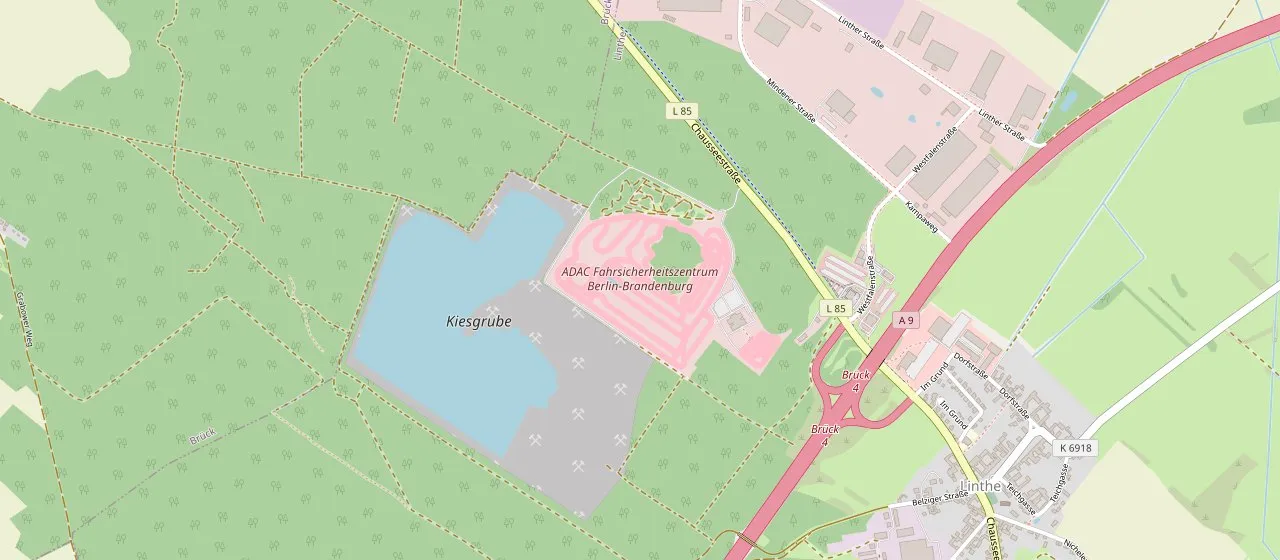
“Take your foot off the gas, tap the brake, steer carefully against the skid, keep your nerve!” That was how an instructor talked a driver through a car sliding down a steep, mirror-slick surface straight into a sharp right-hand bend; “Tagesspiegel” reporter Claus-Dieter Steyer noted that the car spun anyway, slid and came to rest across the road. The piece appeared on 5 November 2002, six days after the opening of the ADAC Fahrsicherheitszentrum Berlin-Brandenburg, a driver training centre built in a former gravel pit in Linthe, by the motorway from Berlin to Leipzig. There is no race track here. There are, however, three loops, the longest of which, at 1.6 km, runs around the whole site, and training in the participant’s own car that ends with a guided run around the loop.
| Location | Am Kalkberg 6, Linthe, Brandenburg; by the A9 motorway, exit 4 Brück/Linthe |
| Type | driver training centre (Fahrsicherheitszentrum) operating under the ADAC brand |
| Opening | 30 October 2002 |
| Construction cost | 13.5 million euro |
| Area | 25 ha, including 3.5 ha of off-road terrain |
| Modules | 15: ten road modules, three handling routes, a karting track and an off-road area |
| Longest route | the “große Rundstrecke” (module 11), approx. 1.6 km around the whole centre; alongside it loops of approx. 700 m and approx. 900 m |
| Operator | ADAC Fahrsicherheitszentrum Berlin-Brandenburg GmbH, a subsidiary of the regional club ADAC Berlin-Brandenburg e.V.; managing director Andreas Sägner |
| For amateurs | Pkw-Top-Training in your own car with a run around the loop, 289 euro; Drift-Training Level 1, 259 euro (prices as of 4.10.2026) |
| Status | active, the main one of the company’s three centres (alongside Oberkrämer and Berlin-Tegel) |
A gravel pit by the road to Leipzig
Linthe is a village in the Fläming tourist region, built around a shared square. It is first mentioned in 1342, and above the buildings a church stands on a hill which, according to the regional tourism organisation, is more than 800 years old. The ADAC centre was built by the A9 motorway, on ground that “Tagesspiegel” the day after the opening called a former gravel pit.
The investment cost ADAC 13.5 million euro. On its website in 2002 the operator wrote that the centre was being built by the company ADAC Fahrsicherheit GmbH together with the Max Bögl group of companies and the regional club ADAC Berlin-Brandenburg. “Berliner Zeitung” compared the site to almost fifty football pitches and recalled that when construction began in March, Manfred Stolpe, then still the Minister-President of Brandenburg, came to Linthe. Stolpe welcomed the investment not only for the roughly thirty new jobs; he said that the number of accidents urgently had to be reduced. The paper reported that Brandenburg had for years been among the federal states with the most road accidents: in the previous year 375 people had died on its roads, and 274 in the first nine months of 2002.
The operator documented the construction on its website. The photographic diary begins with a view of the site from the west dated 13 December 2001; photos from February 2002 are already captioned with the numbers of modules 6 and 7, the main building appears in them from April, and it closes with aerial photos of 12 September 2002. The same “Berliner Zeitung” noted that the ground was also called the “Fläming-Ring”, that next to the practice routes a traffic town for children was being built, and that ADAC was counting on car manufacturers who would test and present new models here. A similar clientele was then being courted by Dekra, which was building a technology centre at the Lausitzring track in Klettwitz for almost 25 million euro, including 8 million euro in subsidies.
The president on the breakdown-service image
The centre opened on 30 October 2002. The next day “Tagesspiegel” described how cars slide in zigzags down a slippery slope and how tankers in tight bends tip onto additionally fitted support wheels. At the opening ADAC president Peter Meyer said: “ADAC has so far had above all the image of a breakdown helper. But we want to present ourselves ever more clearly as a service provider, and all questions of road safety necessarily belong to that.” The paper added that five more such centres were to be built in Germany by 2004.
The press reported prices from the first weeks. The centre was open daily from 9 to 18, and training was mainly in participants’ own cars; cars could be hired on request. A full-day car or motorcycle course cost 130 euro on weekdays (ADAC members paid 100), 160 euro at weekends (members 130), and a half-day course 79 euro, 95 euro at weekends. Before the opening ADAC announced in “Berliner Zeitung” “the most modern and largest driving safety centre in Europe”, and on its 2004 website the operator wrote simply of the largest; today it puts it more cautiously, as one of the largest and most modern in Europe.
Plates, fountains and a waterfall
In 2002 the operator listed eleven modules on more than 20 ha, more than 6,000 m of carriageway, more than 60 water obstacles and more than 350 sprinklers. There were four hydraulic plates: two for passenger cars, one for lorries and one for motorcycles, which the operator on its 2004 site called a world first. According to the same page, more than 130 km of cables were laid, including more than 16 km of fibre optic, and about 20 km of pipes carrying water.
Today the operator counts fifteen modules. The dynamic plate, a hydraulic section of road, gives the rear axle of the passing car an impulse and throws it into a skid in a controlled way. On module 1 it measures 2.9 by 2.7 m and is driven over at a speed of 25 to 55 km/h, while eight fountains leap out of the road like sudden obstacles. Module 2, intended for lorries and buses, is 250 m long and has a 115 m skid surface. The braking section has four surfaces of differing grip: concrete with a friction coefficient of 0.9, asphalt 0.8, cobblestones about 0.5 and a slippery coating 0.2. There are two circles for driving in an endless bend, with diameters of 80 and 50 m, and two descents: the winding module 6, 410 m long with a 10 per cent gradient, and module 7, with a 7 per cent gradient and a slippery surface in the curve.
The longest is the “big loop”, module 11, which runs around the whole centre over about 1.6 km; among the possible exercises the operator lists anticipatory driving and learning the ideal line. The medium loop is about 900 m, and the small one, about 700 m, is for driving in the wet: its sprinkling is set by computer, and one bend can be flooded to provoke lateral aquaplaning. A winding module about 650 m long was described by the operator as early as 2003 as a traffic town that is also suitable as a karting track; today it also serves motorcycle training, and local primary schools learn the rules of the road on it. For 17 June 2004 the centre announced the opening of a children’s traffic school prepared with Michelin; on that occasion 36 pupils from Brandenburg were to compete in the district cycling championship on a skill course. The off-road area covers 3.5 ha, has about 20 m of height difference, a waterfall and climbs with gradients of up to 60 per cent; in 2003 a wading pool of 150 m² was finished there.
A minister on a motorcycle, Bourne on the plate
After the first year the operator counted about 15,000 individual customers and more than 350 companies that had organised their events here. It employed 13 people permanently and about 50 trainers. The same summary listed guests: the ministers Peter Struck and Manfred Stolpe, former Formula 1 drivers Christian Danner and Jochen Mass, the president of the German automotive industry association VDA, Bernd Gottschalk, and the actor Daniel Brühl. In April 2004 Defence Minister Struck came with the vice-president of the Bundestag Hermann Otto Solms and Ute Vogt, parliamentary state secretary at the federal interior ministry, for motorcycle training, with an enduro excursion off-road; the motorsport group of the Bundestag sports club thereby launched its “Sicher fahren” campaign.
In autumn 2004 the dpa agency reported that about 30,000 people had been trained here over two years, and another 20,000 guests had come for company presentations and other events. Struck had been to Linthe three times, and the American actor Matt Damon had practised stunt scenes here for the film Die Bourne-Verschwörung. The centre mentions Damon and Brühl among its guests also in its present company profile. Women were only 20 per cent of customers, so the centre prepared a separate offer for them, with an additional course on dealing with a breakdown run by the “Yellow Angels”, the ADAC roadside assistance patrols.
Show business came too. On 3 June 2004 a music video for the rapper Kool Savas’s single “Da bin, da bleib” was shot here on commission from the label BMG; according to the centre’s announcement it was the first clip recorded on the site. Marco Kessler, who was responsible for the centre’s marketing, told dpa that the rapper’s crew included a driver with a Ferrari worth about 600,000 euro: “The most expensive car that ever drove here. Not even the driving instructor dared to steer it.”
A Lupo from the cup and the speed at which driving feels good
In 2004 the centre sold a “Sportfahrer-Training” for 395 euro, with food for the whole day. First came safety training in your own car, with a run over the dynamic plate and a slalom as preparation for the ideal line, and then, as the main point of the day, driving at racing pace on a sprinkled handling route. For this part the centre provided original race cars from the 2003 VW Lupo Cup, and the ideal line was explained by an experienced competitor. According to a dpa report from the same year the centre wanted in this way to reach young drivers too, who, as Kessler said, prefer to spend money on tuning; sessions under an experienced racing driver were meant to let them test themselves and get to know their own limits.
Three years later, in February 2007, training manager Cornelius Jahn told “Potsdamer Neueste Nachrichten” that the centre had already received more than 65,000 participants, and that in the previous year more than 2,000 young drivers had completed a full-day course here. Asked about speed on wet and slippery roads, he gave no figure: “we advise the participants of our training to choose the speed at which they feel comfortable, without becoming an obstacle to traffic”. Besides speed, he named as the most common mistakes overestimating oneself, poor awareness of risk, too small following distances and technical faults; in his view most participants simply lack practice, for example genuine emergency braking in the shortest possible distance. Today Jahn appears on the centre’s website as operations manager and the company’s authorised signatory.
Two rungs before the loop
A run around the loop today closes the Pkw-Top-Training, a roughly nine-hour course in your own car for at most ten people, held only in Linthe. You can enrol after documenting two earlier rungs, Intensiv-Training and Perfektions-Training, the latter of which must have taken place within the last three years. The programme includes a slalom with axle load change, sudden lane changes, braking with obstacle avoidance, aquaplaning in a bend, the dynamic plate at high speed and U-turns, and on the small loop determining braking and turn-in points. At the end, as the main attraction of the day, the operator lists a guided run around the loop, where those points have to be applied. The course costs 289 euro, the nearest date was set for 25 October 2026, and the participant can buy insurance for the car for the duration of the session.
The middle rung, Perfektions-Training, lasts about 8.5 hours, costs 239 euro and includes, among other things, the “moose test”, that is a sudden lane change with and without braking. Separately the centre runs a drift course for rear-wheel-drive cars with ESP and ASR switched off; you can start with it. At most seven people practise kicking the rear out on the dynamic plate and changing the axle load, and then the first metres of controlled skid in a circle on a slippery surface. The course costs 259 euro; there is no insurance for the duration of the session here, and you must show a liability policy. Training is held in German, in English only for closed groups, and ADAC membership is not required.
Three sites around Berlin
The centre belongs to the company ADAC Fahrsicherheitszentrum Berlin-Brandenburg GmbH, which the operator describes as an economically independent subsidiary of the regional club ADAC Berlin-Brandenburg e.V.; it appears in the commercial register of the district court in Potsdam. After eight years of management by Philipp Dressel, management was taken over on 1 October 2014 by Gökhan Teke, and on 1 January 2019 by Andreas Sägner, who had worked at the company since 2005. In 2017 “Tagesspiegel” wrote that Linthe is the largest of ADAC’s eleven centres in Germany. According to the operator, up to 15,000 people a year have trained here since the opening.
In spring 2020 Linthe could resume training only on 11 May, after obtaining a permit that covered only this one of the company’s sites. In the building masks were compulsory, only one person could sit in a car, the trainer spoke to participants by radio, and off-road training and courses for seniors were suspended. On 22 August 2024 representatives of the club and the Brandenburg authorities broke ground for the second site in that state, in Bärenklau in the municipality of Oberkrämer, north of Berlin. The facility opened in November 2025 cost more than 12 million euro and covers 4.7 ha, and in Berlin-Tegel the company also has a small site for basic training. Linthe remains the main centre and most of the training takes place here.
Five months before the opening of the new site, on 21 June 2025, Linthe invited visitors to an open day. Despite the heat many guests came; motorcyclists took part in free trial sessions, car drivers in refresher courses, and in the shaded off-road area visitors were driven in off-road Lada Nivas over steep slopes, side slopes and through small waterfalls.
Chronology
- 2001: 13 December, the date of the earliest photo of the site in the operator’s construction diary.
- 2002: from February to September photos of the construction of modules and the main building; 30 October opening of the centre.
- 2003: completion of the wading pool in the off-road area; after a year of operation approx. 15,000 individual customers and more than 350 companies.
- 2004: motorcycle training of minister Peter Struck (April), Kool Savas music video (3 June), opening of the traffic school prepared with Michelin announced for 17 June, Sportfahrer-Training in VW Lupo Cup cars.
- 2007: more than 65,000 training participants since the opening.
- 2014: Gökhan Teke replaces Philipp Dressel as managing director.
- 2019: Andreas Sägner takes over management.
- 2020: 11 May, training resumes after the spring break.
- 2024: 22 August, ground broken for the site in Bärenklau (Oberkrämer).
- 2025: the centre in Oberkrämer opens in November; Linthe remains the main one of the company’s three sites.