
Madison, United States
World Wide Technology Raceway: a loop on a former swamp near St. Louis
The history of the track near St. Louis: the 1967 drag strip, the 1985 road course, Chris Pook's oval, the 2010 closure, the revival, and Tuesday SCCA track days on the roval.
- Type
- race circuit
- Length
- 2.575 km
- Opened
- 1985
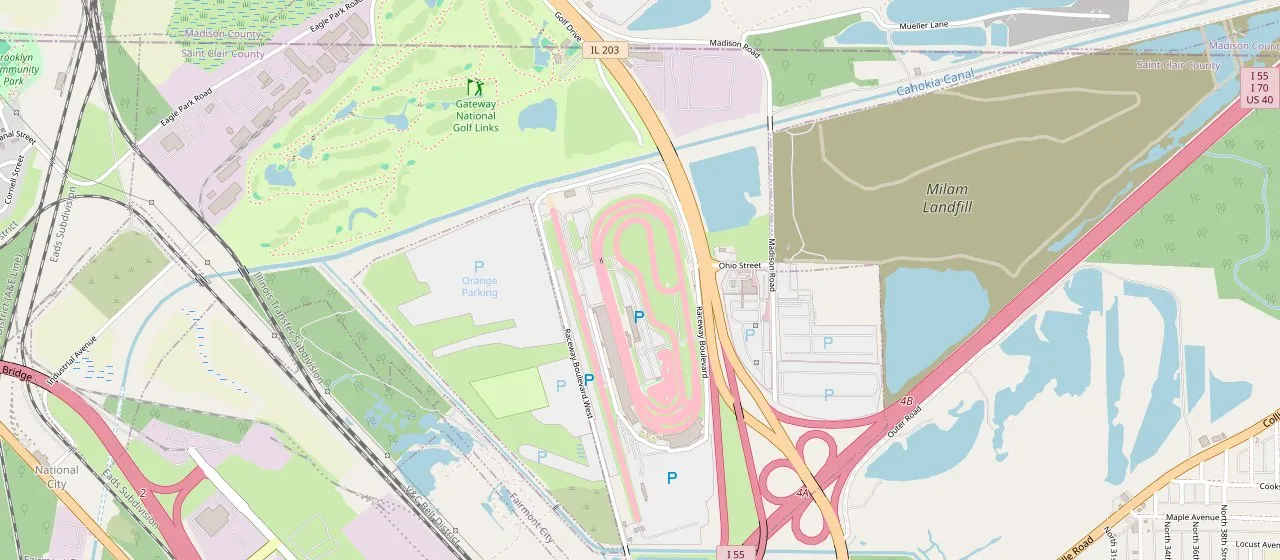
In May 1985, 34-year-old Kevin Eichner, a Harvard business school graduate, told a UPI reporter that he felt like he was behind the wheel himself. Across the Mississippi from St. Louis, five minutes from downtown, he was opening a road course built around an existing drag strip. The region had earlier been scouted by Bill France Jr. of International Speedway Corp. and Jim Trueman, the owner of Mid-Ohio, whose concept cost 70 million dollars; Eichner's group came in at 2 million. “Racing is not a game; it's a business,” he said. Today the same site, under the name World Wide Technology Raceway, hosts the NASCAR Cup Series, IndyCar and NHRA, and on selected Tuesdays amateur drivers take their own cars out on the roval, a loop drawn through the oval.
| Location | 700 Raceway Blvd., Madison, Illinois, USA; across the Mississippi from St. Louis, about five minutes from downtown St. Louis |
| Type | complex: oval, road course inside the oval, drag strip, Gateway Kartplex go-kart track |
| Road course | 1.6 miles (about 2.6 km); since 2019 also a 2-mile variant (about 3.2 km), using a section of the oval's banking |
| Oval | 1.25 miles (about 2.0 km) |
| Beginnings | 1967 drag strip, first road course in 1985, oval opened May 24, 1997 |
| Former names | St. Louis International Raceway, Gateway International Raceway, Gateway Motorsports Park |
| Fastest race lap on the oval | 24.6317 s, Josef Newgarden, Dallara DW12-Chevrolet, IndyCar, 2017 |
| Owner and operator | Gateway Acquisitions Inc.; owner and chairman Curtis Francois |
| Most important events | NASCAR Cup Series (since 2022), IndyCar (Bommarito Automotive Group 500), NHRA Midwest Nationals |
| For amateurs | Tuesday Performance Driving Experience run by the St. Louis Region of the SCCA, in your own car, with an instructor |
| Status | active |
Scrap and water by the river
The land the track stands on was a swamp. Rosemarie Brown, director of the chamber of commerce for southwestern Madison County, recalled in “The Telegraph” of Alton how David Bergfield came home and announced to his wife that he had bought the parcel. Helen Bergfield was furious with him. “It was absolutely nothing but a swamp; it was an area with nothing but junk and water,” Brown said. In 1966 Wayne Meinert leased the land from Helen Bergfield, and in 1967 he opened an eighth-mile drag strip on it. In 1971 it was extended to a quarter mile.
The strip later changed direction. According to the track, it was reversed as speeds grew and there was no longer enough room to slow down, and veterans still boast today that they raced here “when the track ran the other way”. Pat Gauen, a columnist for the “St. Louis Post-Dispatch,” described the change from the construction side: in the mid-1990s the south-facing strip was torn down and a new one, facing north, was built in its place.
Two million instead of seventy
Eichner told UPI where the money came from. Each investor put in 30,000 dollars, 300,000 in total; the rest came from a 1.3 million dollar loan from Southside National Bank of St. Louis, and because of a wet autumn another 700,000 was drawn from a bank in St. Clair County. The loop was 2.2 miles (about 3.5 km) long, the site covered 150 acres (about 60 ha), and UPI placed it in Fairmont City. 126 events were booked for the first season. “NASCAR is the only type of racing event we can't have,” Eichner said, since he had chosen the road course concept for maximum flexibility. The track's land and part of the surrounding parcels were annexed by the city of Madison in the 1980s.
The new road course swallowed the old facility. Its main straight was the drag strip, and braking into the first corner fell right on the strip's starting zone, so grip there differed from the rest of the ribbon, as “Cycle News” described it. The first year brought ARCA, the IMSA Firehawk series, and Trans-Am. The Trans-Am race was held on September 15, 1985, and was won by Wally Dallenbach Jr. in a Mercury Capri; on August 3, 1986, the track hosted Can-Am, won by Lou Sell in a March. According to SpeedCenter, interest in the track was weak and by 1988 it stood essentially idle; it survived thanks to a strong local SCCA chapter and IHRA events on the strip. In 1988 local driver Curtis Francois began racing sports cars there.
Heat in 1995
The national motorcycle championship came to the old loop only once. In 1995, Gateway was added to the AMA Superbike championship calendar as an emergency replacement, because the rival NASB series had poached some of the best tracks. The track was known to club-racing amateurs, but as “Cycle News” wrote, even by the looser standards of the mid-1990s it was dangerous: Armco barriers stood close to the track, and the biggest concern was the final, fast left-hander leading onto the drag strip. AMA Pro Racing took down and remounted 230 feet (about 70 m) of barriers.
Then came a heat wave. For three days St. Louis officially hit 98 degrees Fahrenheit (about 37°C) with humidity close to 80 percent, and team thermometers showed up to 103 degrees (about 39°C). It was estimated that perhaps only 1,500 spectators showed up. The winner was Canadian Miguel Duhamel on a factory Honda, who later said: “The heat just took everything out of you. I really had nothing left at the end.” For AMA Pro Racing it was a financial blow, and the organization no longer wanted anything to do with the track.
Chris Pook's oval
The small track had two advantages: its location next to Interstate 55-70, close to the geographic center of the St. Louis region, and a full set of planning approvals that would have been hard to secure from scratch anywhere else. That was how Gauen explained it. It attracted Chris Pook, the promoter of the Long Beach Grand Prix. “The Telegraph” wrote that Pook looked at several sites and chose this one mainly because the permits saved years of preparation; he also took over the site of the former nightclub Stages, where today's turns 3 and 4 now sit. According to SpeedCenter he secured the land for 21.5 million dollars from bonds issued by the Southwestern Illinois Development Authority. The old strip and road course disappeared, replaced by a 1.25-mile oval and a new, 25-million-dollar drag strip; the facility was named Gateway International Raceway. The new strip opened in September 1995.
The inaugural event almost didn't happen. Two days before the race, CART ruled that the pit lane's concrete wall was 100 feet (about 30 m) too short to be safe; Korte Construction managed to make the fix in time. On May 24, 1997, the day before the rival series' Indianapolis 500, the Motorola 300 was held. Paul Tracy of Penske won, passing Patrick Carpentier in the final minute; Raul Boesel started from pole position and finished five laps behind the winner. SpeedCenter noted that drivers praised the oval for its varying-radius turns. The same outlet wrote before the race that a 1.6-mile road course was under construction. Amateurs drive a loop of that same length today.
The first day also exposed the facility's weakness. Gauen, who attended as a ticket-holding spectator, remembered traffic jams and parking that resembled roadside ditches; in his view the site was too small. The track tried to expand: the Southwestern Illinois Development Authority initiated condemnation on its behalf of 148 acres (about 60 ha) belonging to a neighboring car-recycling company, which took it to court and ultimately won before the Illinois Supreme Court. By the end of the decade the track had passed from Pook into the hands of the Dover group; by 2010 it belonged to Dover Motorsports. NASCAR never gave it a top-tier series, according to Gauen simply for lack of space; “The Telegraph” pointed out that the Winston Cup races went instead to the then-still-under-construction Chicagoland Speedway and Kansas Speedway, both tied to Bill France, NASCAR's chairman at the time, and his family. Open-wheel racing disappeared after 2003.
In June 2004, 35-year-old Darrell Russell, a Top Fuel driver, meaning the nitromethane dragsters that exceed 300 miles per hour by the end of the quarter mile, died on the drag strip. He crashed in the second round of eliminations at the Sears Craftsman Nationals, in a pairing against Scott Kalitta, and died at Saint Louis University Hospital. He was the first NHRA competitor to die at a national event since 1996.
In the summer of 2010, Dover Motorsports notified NASCAR that it would not hold any race at the track in 2011. The last Nationwide Series race took place on October 23, and on November 3 the company announced the facility's closure. “Gateway is a tremendous facility in a great racing community, but we are simply unable to operate it with an acceptable return,” said chairman Denis McGlynn. Gauen closed his August column with a metaphor of flags:
I figure Gateway has been running for a long time under racing's white flag. That's the signal for one lap left, a sort of notice to drivers of their last chance to win. Now it may become the white flag of surrender.
A deal on a handshake
The facility was put up for sale and nobody wanted it. The grounds were deteriorating, and the grandstands were set to be scrapped. In March 2011, Dover handed its land and lease back to the landowners. That is when Curtis Francois stepped in, the same man who had been racing on the loop here since 1988 and whose career included IMSA, Grand-Am, and Indy Lights. Since 1998 he had been a developer in the St. Louis region. He first asked NHRA whether it would come back to St. Louis if he leased the track for a single event. “We struck a 20-year deal on a handshake. Based on that handshake, I closed the deal on the race track,” he recounted years later. On September 8, 2011, Dragzine, citing the “St. Louis Post-Dispatch,” reported that NHRA would return to the track in 2012 under a lease with Francois. “We never wanted to leave Gateway,” said NHRA president Tom Compton. The track came back as Gateway Motorsports Park.
IndyCar returned in 2017, and once again it didn't happen without surface problems. After a May test, teams complained about the asphalt, so the track replaced the entire oval surface; work began on June 19 and finished before the August test. “It's smooth like a baby's bottom,” Hélio Castroneves, who had won the last Indy car race here in 2003, said in August. The race was won by Josef Newgarden after a move on lap 218 of 284, when he squeezed into the first corner alongside teammate Simon Pagenaud and the cars touched. “I think on a road course, that was a beautiful pass. But we're not on a road course,” Pagenaud said after the race.
A loop through the oval's banking
On April 17, 2019, the track sold its naming rights to World Wide Technology of St. Louis, a technology solutions provider founded in 1990 by David Steward; the facility became World Wide Technology Raceway. Two months later, an extension of the road course from 1.6 to 2 miles opened, designed by Tony Cotman of NZR Consulting. The reason was Formula Drift, whose 2018 debut had filled the paddock in the middle of the oval; the new loop runs onto the banked section of the oval, something series president Jim Liaw boasted about. The track announced that the shorter 1.6-mile variant would stay in use alongside the new one. In early 2020, the trade publication “Club + Resort Business” reported that the raceway had bought the neighboring Gateway National Golf Links golf course; the same item described the 1.6-mile loop as a track for the SCCA, the Porsche Club of America, and car clubs.
Trans-Am returned on September 23, 2023, for the first time in 38 years in the St. Louis area. Chris Dyson of Poughkeepsie started from pole position and led all 63 laps, though, as he said, the clean air out front lasted “for about 30 seconds around here”. A year earlier, a plan that neither Pook nor Dover had managed to pull off finally came true: on June 5, 2022, the oval hosted the first NASCAR Cup Series race, the Enjoy Illinois 300. The track sold out 57,000 grandstand seats and more than 1,200 camping spots that time; it was the first sold-out event in the facility's history. On September 13, 2026, the Cup race was won by Kyle Larson after two overtimes, with a fifth straight sold-out crowd and a record 17 caution periods. In 2022 the track emphasized that it was the only one in the world to host NHRA, the NASCAR Cup Series, and IndyCar all at once.
Tuesday with an instructor
The St. Louis Region of the SCCA calls this facility its home track and describes what you drive on: “we use the roval, which is the infield road course as well as part of the oval to make a complete circuit”. The loop hosts the Performance Driving Experience (PDE), a non-competitive drive without timing, where an instructor teaches a participant one-on-one in the participant's own car: the racing line, passing zones, the point-by signal that authorizes a pass, the meaning of the flags, and the rules of conduct on track. It usually runs in the afternoon on the second Tuesday of the month, and a participant gets four 20-minute sessions. A newcomer has an instructor for all four. Seven such Tuesdays were scheduled for 2026, from April to October; the last, seventh date fell on October 13.
The formalities are simple. Before the event, the driver either fills out the car's self-inspection card themselves or asks someone experienced to do it; on track a helmet, long pants, and closed shoes are required. Sign-up goes through MotorsportReg; insurance requires membership, so someone outside the club buys a weekend membership for 15 dollars, and the club has a few helmets to lend out. The program also runs in the rain, pausing only for a lightning storm, and as the organizers put it, cars show up “from a Toyota Prius to a Ferrari 430 and everything in between”. Anyone who just wants to try it first can ride along with an instructor as a passenger for 25 dollars. On the schedule for the last date, the day began at 12.30 with an optional walking tour of the track, at 13.00 came mandatory registration and the car's technical inspection, at 14.00 a mandatory drivers' briefing, and the first group was set to go out at 14.30. There is no gas station on the track; drivers fuel up across the road, at a truck stop.
Others use the same ribbon too. In 2025, a spring SCCA weekend was scheduled here with Race Experience sprint races, which don't require an SCCA license, as well as the Cycle the Raceway cycling event and Formula SAE car testing by local universities on the 1.6-mile loop. For 2026, a three-day SCCA weekend was scheduled for April 10–12, three three-day weekends of the St. Louis chapter of the Porsche Club of America, and, in July, Xtreme Xperience with its fleet of supercars, offering both ride-alongs and driving behind the wheel. The 2026 oval and road course calendar still has Drift STL, scheduled for November 1.
Timeline
- 1967: opening of an eighth-mile drag strip on leased land.
- 1971: the strip extended to a quarter mile.
- 1985: opening of the St. Louis International Raceway road course; ARCA, IMSA and Trans-Am races.
- 1995: the only AMA Superbike race on the old loop.
- May 24, 1997: first race on the Gateway International Raceway oval, the CART Motorola 300.
- 2004: death of Darrell Russell during the Sears Craftsman Nationals.
- November 3, 2010: Dover Motorsports closes the facility.
- 2011: Curtis Francois leases the track and announces NHRA's return.
- 2012: the track reopens as Gateway Motorsports Park.
- 2017: IndyCar's return after the oval's surface is replaced.
- April 17, 2019: new name, World Wide Technology Raceway.
- June 26, 2019: opening of the 2-mile road course variant.
- June 5, 2022: first NASCAR Cup Series race.
- September 23, 2023: Trans-Am's return after 38 years.