
Snetterton, United Kingdom
Snetterton: a bomber airfield, the Russell school and Palmer's 300 lap
The history of Snetterton in Norfolk: from the runways of a B-17 airfield and the 1951 sprint through the Jim Russell school and the Willhire 24 Hour to the 300 lap and track days.
- Type
- race circuit
- Length
- 4.778 km
- Opened
- 1951
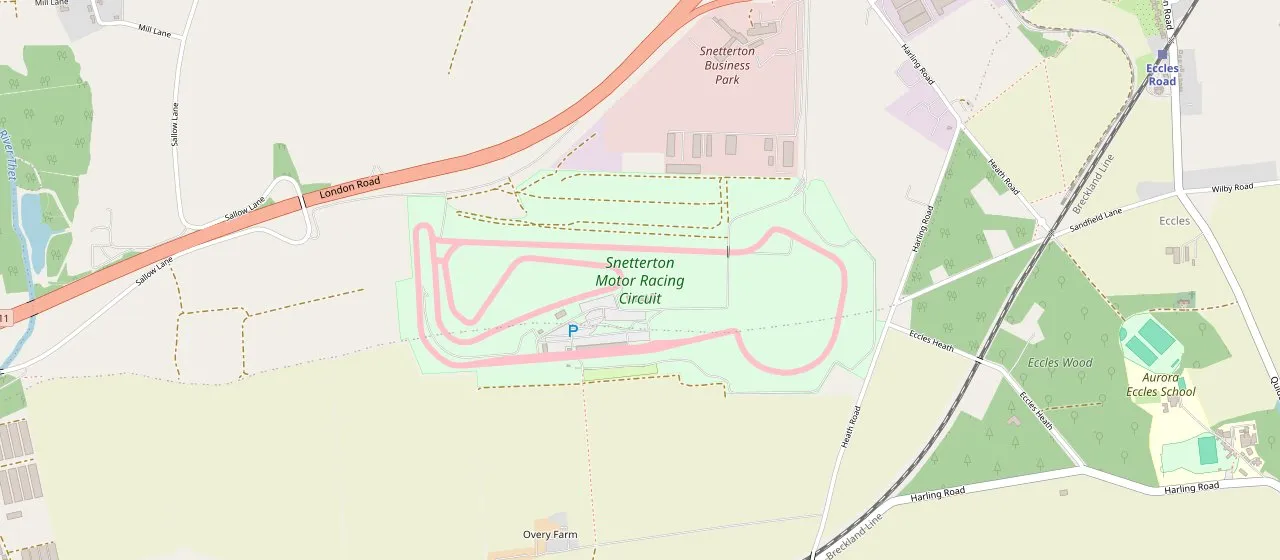
In autumn 1951, on the runways of a disused airfield in Norfolk, Ken Wharton, driving the ERA known as “Humphrey”, set the best time of the first event held there. Most of the land belonged to Fred Riches, who according to RacingCircuits.info was a churchwarden and agreed to racing on condition that on Sundays nobody would run between 10:45 and noon and everything would fall quiet before evensong. That was how the history of Snetterton began, a circuit beside the A11 road that hosted non-championship Formula 1 races and Britain's first 24-hour race, and in 2011 received a new lap nearly five kilometres long.
| Location | Snetterton, Norfolk, on the A11 from London to Norwich, about 10 miles (16 km) north-east of Thetford and about 20 miles south-west of Norwich |
| Type | permanent road circuit on a former military airfield |
| Length and configurations | 300 lap: 2.969 miles (4.78 km), 12 corners (5 left, 7 right); 200 lap: about 2 miles, 8 corners; 100 lap: about 1 mile, 5 corners; the 200 and 100 variants can run at the same time |
| First event | October 1951, a sprint of the Aston Martin Owners Club |
| 300 lap record | Felipe Nasr, Dallara F308 (Formula 3), 1:39.933, 2011 |
| Owner and operator | MotorSport Vision (MSV), since January 2004 |
| Main events | BTCC, British Superbike and British GT rounds; the 2CV 24 Hours race |
| Status | active |
Bombers, Barrels and Christmas Trees
Before the cars came, there was an airfield. The Norfolk monument register states that it was built in 1942–1943 for the 96th Bombardment Group of the United States Army Air Forces (USAAF), and that after the Americans left the site served the Royal Air Force (RAF) as a storage depot until 1948. The circuit's operator and RacingCircuits.info give the same year as the end of the site's military history. According to RacingCircuits.info, B-17 Flying Fortress bombers flew from Snetterton Heath, and the base lost more than 900 aircrew and 250 aircraft during the war. On the other side of the A11 lay the satellite airfield of Eccles Road, where Flying Fortresses were to be repaired, but there were not enough aircraft to repair.
The idea of racing on the runways is credited to two enthusiasts. RacingCircuits.info names Oliver Sear and Dudley Coram, who in 1951 persuaded Riches, the owner of most of the former airfield's land. “Motor Sport” called Coram, one of the men who reformed the club after the war, in his obituary a co-creator of the circuit; his name is now borne by the Coram corner. The first event, in October 1951, was organised by the Aston Martin Owners Club (AMOC). The operator's statement for the 60th anniversary gives the exact day, 27 October, and credits Sear with inviting the club. It was a sprint in which the best time of the day was set by Wharton in the ERA belonging to Peter Bell.
The first route used the perimeter roads and one of the runways. It measured 2.71 miles (4.36 km), and its hallmark was the almost mile-long Norwich Straight, running parallel to the A11 and ending in a tight hairpin. The outline of the track was marked by sand-filled oil barrels, on which, as RacingCircuits.info recorded, Christmas trees were placed. There were no bridges or tunnels, so the infield could be reached only in the gaps between runs. A “Motor Sport” reporter in 1954 placed this 2.71-mile circuit “out in the wilds of Norfolk”, not far from the one-time home of Burrell road locomotives.
The Russell School and Formula 1 in the Rain
In 1952 the Snetterton circuit was visited by 32-year-old Jim Russell, a car dealer from Downham Market in Norfolk. After that visit he bought a Cooper for Formula 3, and in 1955–1957 he won the BRSCC national Formula 3 title three years in a row. In 1957 he opened a racing driving school at Snetterton. The British Racing Drivers' Club (BRDC) wrote in his obituary that it set the template on which most later schools of this kind were based. Motorsport.com writes that the school played a part in the early careers of drivers including Emerson Fittipaldi, Derek Bell and Tiff Needell. Russell's brother-in-law, Ralph Firman, started at the school as a mechanic, and his company Van Diemen later built racing cars in a factory right at the circuit's gates.
Russell also left a mark on the track itself. In the mid-1960s the speeds on the exit of the last corner before the pits began to worry the organisers, and a chicane named after him was added there. RacingCircuits.info describes how the first version of 1965 turned out so tight that motorcyclists in particular could barely get through it, so in 1967 it was softened. The result was a corner taken flat out by the brave, where a mistake ended at the wall of the pit lane.
Formula 1 came here for non-championship races. One of them was the Lombank Trophy; in 1962 it was won by Jim Clark. The fourth edition, on 30 March 1963, was the first Formula 1 race of that season, and the works teams of BRM, Lotus and Cooper came to it. It rained during practice and on race day. Denis Jenkinson reported in “Motor Sport” that Graham Hill started his BRM from the back of the grid because he had missed practice, and then methodically caught the leader Clark in his Lotus and pulled away from him; Innes Ireland was third. Peter Windsor wrote half a century later that Snetterton had turned into a quagmire of mud, rain, wind and spinning wheels. Hill also won that day's sports car race in a Jaguar E-type.
According to Windsor it was only the second event organised by the circuit's new owners, the company Motor Circuit Developments, that is, by the promoter John Webb. In the 1960s Snetterton found itself in one group with Brands Hatch, Oulton Park and Cadwell Park, owned by Grovewood Securities. The circuit also served as a proving ground. Before that weekend Clark had tested a Lotus 29 prototype prepared for Indianapolis here, and for the races at Snetterton he stayed at Jack Sears's farm, not far from the circuit. Sears, the first British Touring Car champion, lived in the Thetford area. Among the cars developed at this circuit the operator lists the Lotus 49 with the DFV engine and the Lotus 38, the Indianapolis 500 winner, and, from more recent times, the Bentley EXP Speed Eight, the marque's first car at Le Mans for 70 years.
Summer 1974 at the Esses
In the mid-1970s the circuit was shortened. RacingCircuits.info admits that the exact reasons have become blurred, and supposes that it was about the cost of maintaining the long lap. The new route of 1974 turned off before the former Sear corner onto a runway running from west to east and returned to the old track through the left-right Esses. Drivers entered them fast, and beyond the edge of the track stood the abutment of a bridge spanning the track.
On 14 July 1974, in a Formula Ford and Monoposto race, 26-year-old Jon Thorne from Wayland in Norfolk hit the bank at the Esses sideways in his Merlyn-Ford and was killed on the spot. Marshals said that they had heard him searching for a gear and then braking later than usual. According to RacingCircuits.info, after his death and several serious accidents later in the same season a tighter passage was laid out, designed by the driver Peter Wardle.
The short lap measured just under two miles, about 3.1 km. The long route with the Norwich straight was used for a few more years for testing and motorcycle races, and from 1980 it was no longer used. On the old straight a Sunday market ran for years, and a McDonald's restaurant now stands roughly where the Norwich hairpin was.
Round the Clock in Norfolk
In 1980 Snetterton held Britain's first 24-hour race. It was sponsored by the vehicle rental company Willhire, and the event took its name from it. Jeremy Walton wrote in “Motor Sport” that the idea was born at a meeting of the firm's owner Roger Williams and the then BRSCC director Peter Browning. In 1980 it was a mixed race of sports cars and saloons; from 1985 it was contested by cars from the saloon car championships, which according to Walton drew more spectators and competitors to the circuit. In 1983 it was won by Tony Dron, a BTCC runner-up.
Walton did not watch the 1988 edition from the stands but drove in it, in a Ford Sierra RS Cosworth. There were 37 cars on the grid, and the Sierras were the favourites. He called the Revett straight Snetterton's answer to Mulsanne, and wrote of the circuit itself that many remember it only for its windy isolation. This is how he described the entry into Coram:
“Fourth is required to dive into the aptly named Bomb Hole dip that introduces you to the delights of Coram. All through this eternal right you listen to the tortured near-side front tyre wailing”.
The Willhire race was held until 1994. Round-the-clock driving at Snetterton is now kept up by the 2CV 24 Hours race, scheduled for 22 and 23 August in 2026.
The Lap Drawn by Palmer
In May 1986 all four of the group's circuits, Snetterton among them, were bought by the computer entrepreneur John Foulston. After his death in 1987 the company was run by his daughter Nicola, and her company Brands Hatch Leisure sold the circuits in 1999 to the Interpublic group. In January 2004 Interpublic, which was from then on to concentrate on Silverstone and the British Grand Prix, sold Brands Hatch, Oulton Park, Cadwell Park and Snetterton to MotorSport Vision. It was founded by the former Formula 1 driver Jonathan Palmer and the businessmen Peter Ogden and John Britten, and the value of the deal was estimated at about £30 million.
Palmer spoke openly about the circuit's weaknesses. “Snetterton has its own character and great features of long straights and superb high speed corners but overall has lagged behind the other MSV circuits in terms of driver/rider appeal and spectator entertainment”, he said in 2010, as quoted by “Autosport”. He designed the new lap personally. MSV stated that he drew on sections of Monza (Parabolica), Montreal (the hairpin before the casino) and Imola (Rivazza). Construction began in November 2010, and the contractor, Buckingham Construction Group, finished it in ten weeks despite a snowy winter. On 17 February 2011 the first to lap the new track was the Formula 2 car JPH1B, designed by Williams.
The new section inside the circuit, a mile long, extended the lap to 2.969 miles, that is 4.78 km. Three configurations emerged: the full 300 lap, the 200 variant, closest to the old circuit, and the short 100, laid out on the new section. The Russell chicane was replaced by the Murrays corner, and the Sear corner by a hairpin modelled on Montreal. The design assumed an FIA Grade 2 licence, allowing it to host every series except Formula 1, and Palmer told “Autosport” that he would like to see DTM here. According to RacingCircuits.info, the international series nevertheless did not come to Snetterton. The 300 lap record has belonged since 2011 to Felipe Nasr, who in a Formula 3 Dallara F308 covered it in 1:39.933.
The corner names, as the operator states, refer to great figures of the sport, from Giacomo Agostini to Lewis Hamilton. From the BTCC round of 30–31 July 2016 the Montreal hairpin has borne the name Wilson, in honour of Justin Wilson, the first champion of the Formula Palmer Audi series, who was killed in an IndyCar race in 2015. The hairpin leads straight into the Palmer corner. Justin's brother Stefan recalled then that their father had raced here in the 1960s and told his sons about driving down the old Norwich straight.
Through Bombhole in Your Own Car
The main events at Snetterton today are rounds of the British touring car championship (BTCC), the superbike championship (BSB) and GT cars. The 2026 calendar, announced as the circuit's 75th anniversary, provided for the BTCC on 23 and 24 May, British Superbike on 3–5 July and British GT on 15 and 16 August. Before the season 400 metres of new tyre walls were laid at Coram, and 250 sheets of Armco barrier were replaced around the circuit. Paul Lawrence wrote in “Motor Sport” in 2001 that it is one of the busiest circuits in the country and, thanks to its remote location, has few limits on its use.
Amateur drivers come here in their own cars with, among others, MSV Trackdays, the owner's track day division, which by default makes the full 300 lap available. The organiser advertises Snetterton with speed and the half-mile Bentley Straight, one of the longest on British circuits, and also with the “exhilarating” Bombhole and the “never-ending” Coram. It requires a full driving licence (a racing licence alone is no longer enough), a helmet for the driver and passenger, and, for a road car, a condition at least at the level of an MOT test and a fitted towing eye; insurance is not compulsory. From April to October camping at the circuit is free. Track days at Snetterton are also run by Javelin Trackdays, which for the end of 2026 listed three dates on the 300 lap, 27 October, 22 November and 7 December, at prices from 99 to 159 pounds including VAT. The noise limit there is usually 105 dB(A) static and 92 dB(A) drive-by.
The anniversary calendar reached back to the roots. It included an April meeting of the HSCC club for the Jim Russell Trophy and a July show of American cars, USA Snetterton 300, announced as a tribute to the time when the circuit was a base of the American air force. The Norfolk monument register notes that in 2003 a hangar still stood on the former Eccles Road airfield, across the A11, surrounded by new buildings.
Timeline
- 1942–1943: construction of Snetterton Heath airfield for the 96th Bombardment Group of the USAAF.
- 1948: end of the airfield's military use.
- 1951: first event, the October sprint of the AMOC club.
- 1957: Jim Russell opens a racing driving school at the circuit.
- 1963: the Lombank Trophy opens the Formula 1 season, won by Graham Hill.
- 1965: the Russell chicane before the pits, softened in 1967.
- 1974: the short lap; the death of Jon Thorne at the Esses.
- 1980: Britain's first 24-hour race (Willhire); end of the long lap.
- 1986: John Foulston buys the group's circuits.
- 1994: the last Willhire race.
- 1999: the circuits pass to Interpublic.
- 2004: MotorSport Vision becomes the owner.
- 2011: opening of the 300 lap designed by Jonathan Palmer.
- 2016: from the BTCC round of 30–31 July the Montreal hairpin bears the name Wilson.
- 2026: the circuit's 75th anniversary season.