
Long Pond, United States
Pocono Raceway: road courses inside a triangular oval
The history of the road courses at Pocono Raceway in Long Pond: the first IMSA race, AMA motorcycles, the Porsche 962, the 2013 rebuild and track days in your own car.
- Type
- race circuit
- Length
- 4.023 km
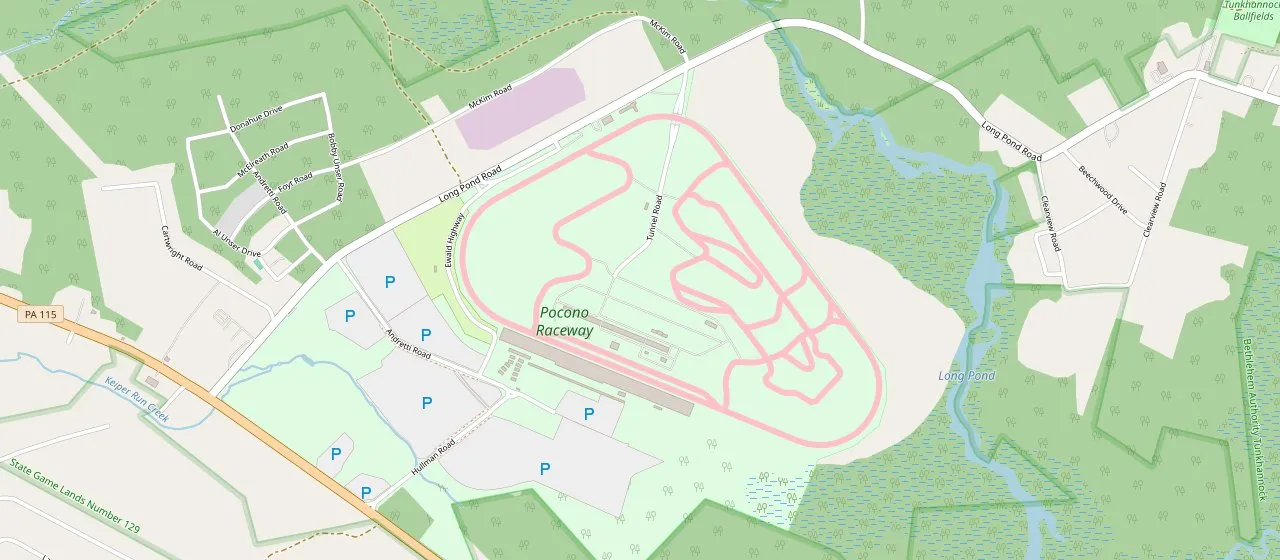
In August 1971, around 4,000 spectators in Long Pond watched the first AMA championship motorcycle race at the new Pocono track. On the last lap Dick Mann on a BSA and Kel Carruthers on a Yamaha were six metres apart; Mann entered the last corner low, forced his rival to go around the outside and won by a few centimetres. They rode on the infield loop and on parts of the big oval that the world knows as the “Tricky Triangle”. Pocono Raceway is first of all a triangular NASCAR and IndyCar oval, but since its first seasons a tangle of road courses has lain inside it, where Porsche 962s, American championship motorcycles and, today, amateurs in their own cars have raced or driven.
| Location | 1234 Long Pond Road, Long Pond, Pennsylvania, United States; the Pocono Mountains, in the north-eastern part of the state |
| Type | triangular oval with a complex of road courses in the infield |
| Length (road courses) | 2.5-mile road course 4.023 km (eight turns); North 2.414 km (nine turns); South 1.609 km (ten turns); East 2.253 km (13 turns) |
| Oval | 4.023 km; banking of 14° in the first turn, 8° in the second and 6° in the third |
| Width | road courses from 14 to 30 m (45–100 feet), oval from 18 to 30 m |
| Direction of travel | after the 2013 upgrade each configuration can be driven in both directions |
| Fastest lap (2.5-mile course, race) | 1:15.440 (191.99 km/h), Porsche 962 of Al Holbert and Derek Bell, Camel GT 500 Grand Prix at Pocono, 8 September 1985 |
| First race on the oval | 3 July 1971, Schaefer 500 (USAC), winner Mark Donohue |
| Owner and operator | the Mattioli family; Looie Mattioli (Chairman of the Board), Nick Igdalsky (Chief Executive Officer) |
| Events | NASCAR Cup Series (since 1974), formerly USAC, CART, IndyCar, IMSA, Trans-Am and AMA; track days from April to October |
| Status | active |
The dentist who bought the land
Joseph Mattioli was a dentist from Philadelphia. After the war, in which he served as a Navy corpsman in the Pacific, he finished dentistry at Temple University; there he met Rose, his future wife and a podiatrist. According to his 2001 account, quoted by RacingCircuits.info, he was drawn into racing by chance, by an elderly man he met at an airport who was looking for investors for a track project in the Pocono Mountains. Mattioli recalled: “It's been said that I got in on the ground floor but that's not true - there wasn't any ground! I had to buy it.” His partners had only an option on the land, so the dentist guaranteed a mortgage loan and later paid it off.
The track's operator writes that the site had previously been a spinach farm. RacingCircuits.info dates the breaking of ground to 8 July 1965. First came a short oval, next to it a strip for side-by-side racing that was to become the main straight of the big track. The shape of the big loop was for a long time undecided. The operator credits Roger Ward and Mario Andretti with a share in the design, and Andretti recalled: “They didn't know whether it was going to be a triangle, a rectangle”. Ward modelled the first turn on the no longer existing Trenton track, the second on Indianapolis Motor Speedway and the third on the Milwaukee Mile. That is how an oval with three different turns, three different straights and three different banking angles came about; the longest, the main straight, measures 1,140 m.
The first race on the big oval took place on 3 July 1971. The USAC Schaefer 500 was won by Mark Donohue in a McLaren of Roger Penske's team. According to RacingCircuits.info, Donohue started from pole position, and after a late caution Joe Leonard in a Colt led for three laps; the McLaren regained the lead on the main straight and won by 1.6 seconds after 500 miles.
Formula Ford on the short oval
Before the triangle existed, the short oval made its mark in the history of another organization. On 19 October 1969 the first IMSA race in history was held here, for the new federation founded by John Bishop with the support of NASCAR's creator Bill France Sr. Two weeks before the event the track's president, Dave Montgomery, phoned Bishop to say that he had to cancel it under pressure from the SCCA (Sports Car Club of America), which threatened tracks and officials with exclusion for taking part in a rival's events. Mattioli agreed to lease the facility directly to IMSA, but for nothing more, as he feared losing the SCCA's dates the following year. Bishop borrowed 10,000 dollars for the lease and the prize fund.
The Formula Ford race ran for 200 laps, and the cars covered the loop in 26 seconds. Times were taken by hand from the grandstand, uncovered, and the drivers' wives were enlisted to count laps. 350 spectators came. Jim Clarke was declared the winner, and only after the ceremony did it turn out that the real winner was Jim Jenkins, who had finished second. Bishop left the result unchanged and it was never corrected.
Motorcycles in the middle of the triangle
The first road course, 1.8 miles (2.897 km) long, linked the infield with parts of the oval. Motorcyclists came to it before the facility was ready: in August 1970, in a regional race, Gary Nixon on a three-cylinder Triumph beat Yvon DuHamel on a Kawasaki. After Mann's win in 1971 the AMA championship returned in 1973, by then on a course of 2.8 miles (4.506 km); Nixon won on a Kawasaki ahead of Kenny Roberts. Roberts won in 1977 and Mike Baldwin in 1978, on his way to the national road-racing title.
In 1979 the season finale, in which the top four riders were separated by seven points, was cancelled because of rain. According to Cycle News many thought the AMA was thus saving the organizer from a loss, because only a handful of spectators came in the downpour. Large crowds appeared in the early 1980s, when Dale Singleton, Freddie Spencer and Mike Baldwin took turns winning. Then the surface began to fall apart, and the owners could not afford new asphalt.
“The steel walls were unforgiving and scary in hindsight”.
That is how the rider Mark Coughlin remembered them. The last round of the AMA championship at Pocono was held in 1986; in the Superbike class Wayne Rainey won. The club federation WERA staged its Cycle Jam here for several more years, until it too gave up. WERA's head Evelyne Clarke explained: “The bikes got too fast to take the chances”. The last major motorcycle race, a Formula USA round, was held at Pocono in 2002.
Camel GT, Corvette and Porsche 962
Sports cars used the same courses. On 10 June 1973 IMSA returned to Pocono with a 500-mile Camel GT race: over 179 laps of the 2.8-mile course, i.e. a distance of 804.7 km, Carter and DeLorenzo won in a Chevrolet Camaro. In 1975, on the same course, John Greenwood opened the Trans-Am season with a win in a Chevrolet Corvette. In September 1981 the Kenwood Stereo 500 Grand Prix, a Camel GT round, was won by Paul Jr. and Paul in a Porsche 935, over 150 laps of a 4.506 km course. According to RacingCircuits.info most road races were run clockwise, the opposite of the oval.
In the mid-1980s a new course was opened that bypassed the old short oval: from the start-finish straight a new stretch of asphalt branched off and joined the old course at the point of the esses. At the same time the South loop was created inside the first turn of the oval. For several years the SCCA used a variant that bypassed the last turn of the oval, but out of concern for the verges it returned to the old route, with a chicane before the last banked turn. On 8 September 1985 Al Holbert and Derek Bell won the Porsche 962 Camel GT 500 Grand Prix at Pocono over 124 laps, i.e. 498.9 km. The fastest lap of their car, 1:15.440, meant an average of 191.99 km/h. To this day the operator reminds visitors that the 2.5-mile course hosted IMSA GTP prototypes.
Speedway Digest wrote in 2018 that even races on the oval alone have a lot in common with road racing. Paul Menard, a winner of NASCAR races at Indianapolis and Milwaukee, put it briefly: “You're shifting every lap”.
The business card that saved the track
The 1970s and 1980s were a struggle for survival for the owners. According to the operator the Mattiolis were close to selling the track, because of construction mistakes, the dispute between CART and USAC and, as the family itself admitted, a lack of experience. Bill France Sr. talked them out of it. On the back of a business card he wrote them a sentence: “On the plains of hesitation lie the bleached bones of millions, who when within the grasp of victory sat and waited, and waiting died.” NASCAR, which had come to Pocono in 1974, when Richard Petty won the first Cup Series race, gave the track a second date in the year in 1982.
After the 1989 season CART races disappeared from the calendar. The Mattioli family bought out the remaining shareholders and began rebuilding the facility piece by piece. In 1991 the East course, 1.4 miles long, was created, and further work removed the short oval. In 2010 a 3 MW solar farm was built next to the track: nearly 40,000 panels on 10 hectares power the whole facility, and in summer about 50 sheep trim the grass between them.
The year IndyCar left
Joseph Mattioli died in January 2012 aged 86; a few months earlier he had handed the running of the track to his grandchildren. IndyCar returned in 2013, but its second stay ended badly. On 23 August 2015 the Briton Justin Wilson was hit on the helmet by the nose cone of Sage Karam's wrecked car; he died the next day in a hospital in Allentown. In 2018 Robert Wickens hit the catch fence and was paralysed from the waist down. After another pile-up on the first lap of the 2019 race, which sent Felix Rosenqvist to hospital, Wickens wrote: “How many times do we have to go through the same situation before we can all accept that an IndyCar should not race at Pocono”. The 2020 IndyCar calendar replaced Pocono with the track at Richmond.
Rose Mattioli died in June 2020, the day after the first-ever Cup Series double-header weekend held without spectators. In the calendar for 2022 NASCAR took one of the track's two Cup Series races away, which the Mattioli and Igdalsky families received with disappointment.
Seventeen courses, thirty-four directions
In spring 2013 the track announced the end of the rebuilding of the road courses. New asphalt was laid on all the courses in the infield, bidirectional rumble strips meeting FIM (Fédération Internationale de Motocyclisme) requirements appeared on every turn, and the verges were levelled. Each of the 17 configurations can now be driven in both directions, which gives 34 variants: from a technical half-mile loop to a 2.53-mile course. Two buildings with classrooms and a bar were built, along with 100 camper sites.
The operator today describes four basic road courses. North, 1.5 miles long, runs through the northern part of the infield and the third turn of the oval; its longest straight is about 520 m. South, one mile long, has a hairpin and uses the most steeply banked, first turn of the oval. East, 1.4 miles long, runs along the Long Pond straight and has 13 turns. The longest, 2.5 miles, links the infield with oval straights of up to 931 m and has eight turns. The rental season runs from April to October, and the operator says that over 300 events take place in that time, from motorcycles to exotic sports cars.
In your own car at Long Pond
Pocono does not sell single hours on track: a rental covers the whole day, with driving from 08:00 to 18:00, and is intended for clubs and companies. A driver with their own car therefore enters through an organizer. In 2026 the track itself hosted two HPDE (High Performance Driver Education) days, on 8 July and 9 September, organized by the instructor Dennis Macchio. The basic package cost 275 dollars with lunch, and the variant with a personal instructor and a garage 350 dollars. Drivers run in three groups; the advanced, red one is entered after assessment by the track's senior instructor. A Snell SA2015 or newer helmet is required, convertibles must have a roll cage, and electric cars are not admitted. The Stock Car Racing Experience also offers a programme for your own sports cars, but on the oval alone: two sessions of 15 minutes.
The clubs' calendar is busier. MassTuning announced for 18 October 2026 a day for 249 dollars on a course it calls the “Mega Course”. According to the organizer it is 3.51 miles long and is driven counter-clockwise, with no noise limit. Two days later, on 20 October, the SCCA's evening Track Night in America will run the North/South Option 3 variant; members pay 185 dollars, others add 25 dollars for a weekend membership. The organizer warns that there will be no food service on the track and asks people to bring their own snacks.
Kalendarium
- 1965: ground broken on 8 July.
- 1969: on 19 October the first IMSA race in history, Formula Ford on the short oval.
- 1971: on 3 July the first race on the 2.5-mile oval, the Schaefer 500, won by Mark Donohue; in August the first round of the AMA championship on the 1.8-mile course.
- 1973: the 2.8-mile course; IMSA Camel GT over 500 miles and the AMA championship.
- 1974: first NASCAR Cup Series race, won by Richard Petty.
- 1975: Trans-Am on the 2.8-mile course, won by John Greenwood.
- 1982: NASCAR's second date in the year.
- 1985: new 2.5-mile course; Holbert and Bell win in the Porsche 962.
- 1986: last round of the AMA championship at Pocono.
- 1989: last CART race.
- 1991: the East course.
- 2010: 3 MW solar farm.
- 2012: Joseph Mattioli dies in January.
- 2013: new surface on the road courses, 34 route variants; IndyCar returns.
- 2015: death of Justin Wilson after a crash in an IndyCar race.
- 2020: Richmond takes Pocono's place in the IndyCar calendar.
- 2022: the NASCAR calendar provides one Cup Series race at Pocono instead of two.
Sources (30)
- Larry Lawrence, Archives: Racing in the Poconos, Cycle News, 2019-11-05 [en]
- Pocono Raceway, RacingCircuits.info [en]
- Pocono Raceway, Track Rental For Events [en]
- Pocono 500 Kilometres 1985: Race Results, RacingSportsCars, 1985-09-08 [en]
- Pocono, Motorsport Database [en]
- Pocono Completes Road Course Upgrades, Performance Racing Industry, 2013-05-03 [en]
- Pocono Completes Extensive Road Course Upgrades, Speedway Digest, 2013-05-03 [en]
- 1971 Schaefer 500, ChampCarStats.com [en]
- Pocono Raceway, 50 Years of The Tricky Triangle [en]
- Pocono Raceway, Our Staff [en]
- Jim Utter, Obituary: Pocono Raceway co-founder Dr. Rose Mattioli - 1927-2020, Autosport, 2020-06-30 [en]
- Pocono Raceway releases statement on 2022 NASCAR Cup Series schedule, FOX56 (WOLF), 2021-09-15 [en]
- SCCA Trans-American Championship Pocono 1975: Race Results, RacingSportsCars, 1975-06-01 [en]
- Pocono Raceway, HPDE Track Day [en]
- David Newton, Pocono Raceway's Joseph Mattioli dies, ESPN, 2012-01-26 [en]
- Zach Sturniolo, 50 Years of The Tricky Triangle- The 1970's, Pocono Raceway, 2021-12-27 [en]
- Menard Ready To Take On The Tricky Triangle, Speedway Digest, 2018-05-31 [en]
- IMSA 1969-1989: The first race at Pocono, RACER, 2019-01-15 [en]
- Early Days at IMSA: Formula Cars on Ovals, International Motor Racing Research Center, 2020-05-04 [en]
- Pocono 500 Miles 1973: Race Results, RacingSportsCars, 1973-06-10 [en]
- Pocono 500 Miles 1981: Race Results, RacingSportsCars, 1981-09-27 [en]
- Zach Sturniolo, 50 Years of The Tricky Triangle - The 1980's, Pocono Raceway, 2021-12-27 [en]
- Zach Sturniolo, 50 Years of The Tricky Triangle - The 1990's, Pocono Raceway, 2021-12-27 [en]
- Pocono Raceway, Our Sustainability Efforts [en]
- Justin Wilson, Motorsport Memorial [en]
- The Associated Press, Robert Wickens calls for end to racing at Pocono Raceway after another big crash, CBC Sports, 2019-08-18 [en]
- David Malsher, IndyCar 2020 calendar revealed, Richmond returns and Pocono dropped, Autosport, 2019-09-01 [en]
- Pocono Raceway, Driving Schools [en]
- MassTuning TrackFest (Oct 18, 2026), MotorsportReg.com [en]
- Track Night 2026: Pocono Raceway - October 20, Track Night in America (SCCA) [en]