
Mallala, Australia
Mallala Motorsport Park: A Grand Prix on a Former Flying School's Airfield
The history of Mallala Circuit in South Australia: an RAAF base, the 1961 Australian Grand Prix, closure by Keith Williams, Clem Smith, Brock, and today's track days.
- Type
- race circuit
- Length
- 2.61 km
- Opened
- 1961
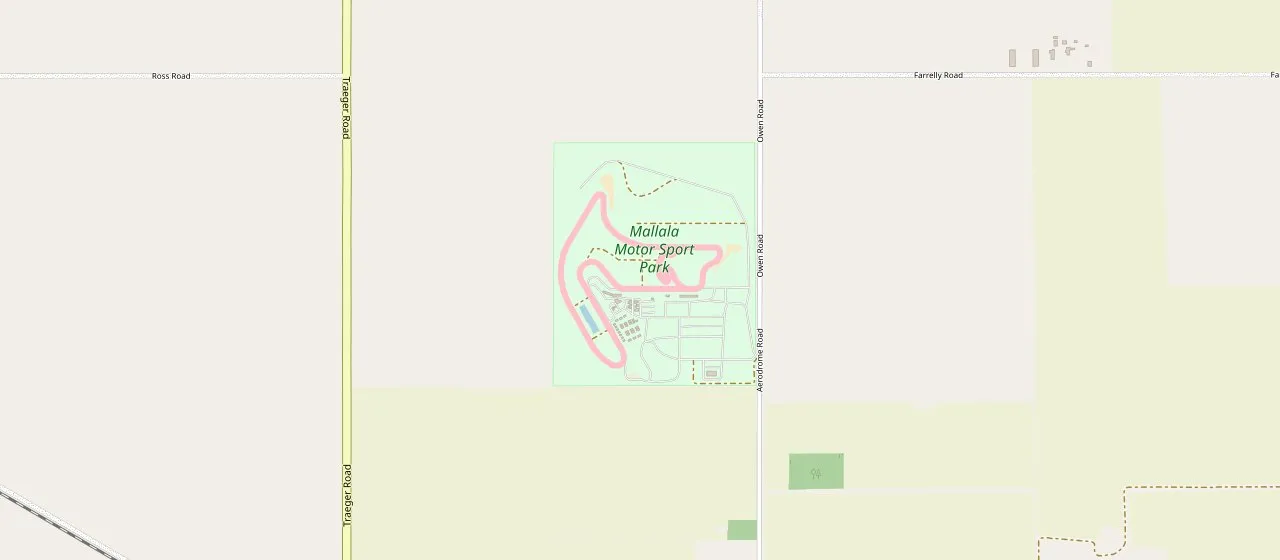
On Monday, 9 October 1961, the Australian Grand Prix started on the taxiways of a former air force base near Mallala. David McKay set off from the front row so quickly that the officials ruled it a false start and added a one-minute penalty. After 50 laps the winner was Lex Davison in a Cooper T51 from Bib Stillwell's team, second was Stillwell himself, and McKay was classified third. For Davison it was his fourth Australian Grand Prix win. The circuit, built in a few months for a single race, survived closure, a court dispute and a change of owners, and today is South Australia's oldest active racing circuit.
| Location | 225 Aerodrome Rd, Mallala (South Australia), about 55 km north of Adelaide |
| Type | permanent road circuit laid out over the taxiways and aprons of a former RAAF base |
| Length | 2.61 km (layout after the 1964 shortening); about 3.38 km in 1961–1964 |
| Opened | 19 August 1961 |
| Closure | closed for racing in 1971, car racing resumed in 1982 |
| Lap record | 1:02.570, Paul Stokell, Reynard 90D-Holden, Formula Brabham, 1994 (per the "Motor Sport" database) |
| Owner | the Shahin family's Peregrine Corporation, owner of The Bend circuit, since May 2017 |
| Major events | Australian Grand Prix (1961), Australian Touring Car Championship rounds (1963, 1969–1971, 1989–1998), Trans Am series (2025) |
| Status | active: state-level racing, drifting, track days, kart track |
A flying school on the plain
In 1939 the federal government bought a flat piece of farmland about a mile north of the township of Mallala to build an airfield for training pilots on it. On 25 August 1941, No. 6 Service Flying Training School, a flying school for pilots past the basic course, was established here, and command was taken on 1 September by Wing Commander N. Brearley. After heavy rains the airfield was unfit for flying for a long time, so the first nine Ansons did not fly in to Mallala until 19 September, and flight training began on 23 September 1941. Training here was on Ansons and Oxfords, and according to the local chronicle kept under the National Trust of South Australia banner, the base was the largest RAAF establishment in the state and at its peak had 19 Bellman-type hangars.
In September 1942 the airfield had a complement of 1,927 people, including 281 trainees and about 200 women of the WAAAF auxiliary air service. In March that year 123 people arrived from the evacuated flying school of the Dutch East Indies; they completed Course No. 22 in early April. The training cost lives: on 14 October 1941 two Ansons collided south of the base and four airmen died. By September 1945 the school had graduated 2,178 pilots. On 1 January 1946 the school ceased to exist, and its place was taken by an equipment maintenance and storage unit. The airfield continued working for the RAAF until 1960, among other things in support of the Woomera rocket range.
Grand Prix on the taxiways
South Australia was due to get the Australian Grand Prix in 1961, because the race rotated between the states in turn at the time. The state's first permanent circuit was at Port Wakefield; Jack Brabham won the Grand Prix there in 1955, but the venue was judged unsuitable for such a large event. The Race Torque explains that the regulations required a length of at least two miles, and the Port Wakefield loop was too short. The abandoned base at Mallala was bought in April 1961. According to the same outlet, the buyer was Brooklyn Speedway Co., which had previously organised races at Port Wakefield; the organisers moved the entire circuit equipment from there to Mallala. The 3.38 km loop was laid out over the existing taxiways, access roads and the concrete aprons where the hangars had stood.
The first meeting was held on 19 August 1961; the main race, for the Mallala Trophy, 20 laps, was won by Bib Stillwell in a Climax-engined Cooper. The Grand Prix was only the second event at the new circuit. The "Motor Sport" database notes that state law banned paid sporting events on Sundays at the time, and the shortfall in revenue was covered in part by a sponsor, the cigarette brand Craven A. A month after the race the CAMS federation's council abolished the rotation of the Grand Prix between states; only South Australia and Western Australia voted against. The next Australian Grand Prix in this state was not held until 1985, on the streets of Adelaide.
The circuit quickly began to crumble. According to "Motor Sport", in 1964 it was shortened, resurfaced, and the northern loop was bypassed. Richard Craill of The Race Torque found no clear explanation for the decision, and judged the most likely cause to be exactly that: damaged asphalt north of today's hairpin; the shortcut removed about 800 m. The old asphalt, cracked and overgrown, can still be seen behind the north hairpin. Before that happened, in 1963 Mallala hosted the Australian Touring Car Championship, then run as a single race: Bob Jane won in a Jaguar ahead of Ern Abbott, with Clem Smith third in a Chrysler Valiant.
The circuit where racing was banned
From 1969 the touring car championship had several rounds and Mallala got one of them. In 1971 Bob Jane won here in a Camaro, 0.3 s ahead of Ian Geoghegan; it was the last such race at this circuit for 18 years. That same year the circuit was bought by Keith Williams, owner of the Surfers Paradise circuit, who was at the time building Adelaide International Raceway (AIR), closer to Adelaide. Williams closed Mallala and placed a covenant on the land banning car racing on it. The Australian magazine "Muscle Car" writes that he subdivided the former airfield and sold it off on condition that racing would never return to it, which gave his new circuit a monopoly in the state.
For several years afterwards only Chrysler Australia and the Adelaide racing car builder Elfin tested on the asphalt at Mallala. Clem Smith, a car dealer and racing driver, said in 2014 that the land had been sold to a farmer, who put it up for sale in 1976. A friend, Reg Sparks, talked him into buying it. Smith said: "People didn't like AIR very much because it wasn't a very interesting track, they liked the sharp, hard corners of Mallala". He started negotiating in 1976 and paid for the circuit in 1977.
The dealer who won in court
Smith had raced since his youth: he started at the Rowley Park speedway, then competed in state races for several decades. He overturned Williams's ban in court. Glen Dix, who from 1991 helped him as a volunteer maintaining the circuit, told Speedcafe that the case of "Smith versus Williams" has since been cited by judges as a precedent. The rebuilding and the legal disputes took five years. Smith recalled that the CAMS federation gave him no help at all, and summed up the end of that road in one sentence: "In 1982 we got a license and started racing again".
According to "Australian Motorcycle News", Smith constantly reinvested profits into expanding the circuit and spent most of the week there, in a caravan parked on the grounds. In 2015 the area was hit by dangerous grass fires; ploughed firebreaks along the boundary of the grounds let the circuit escape them by a hair's breadth.
Godzilla, Lowndes and Brock's farewell
In 1989 the touring car championship returned to Mallala after 18 years, and the comeback round was won by Dick Johnson. A year later the Gibson team's Nissan Skyline GT-R, nicknamed Godzilla, made its championship debut here; it was driven by Mark Skaife, but the car retired with a hub failure. Skaife went on to win championship rounds at Mallala three times, more often than anyone else. In 1996 rookie Craig Lowndes secured his first Australian Touring Car Championship title here. The same round ended his run of eight consecutive race wins.
The biggest crowd came in July 1997, when Peter Brock, nine-time Bathurst winner, was touring the circuits in his farewell season. Richard Craill reports that 30,500 spectators gathered at Mallala, which remained the circuit's record, and by midday the queue to get in stretched back along Port Wakefield Road, more than 15 km from the gate. Mark Walker of the same outlet writes that there were more people wanting in than the circuit could hold. A year later the last round of the touring car championship was held here; from 1999 the state round of the series became the Adelaide 500 street race. The stars returned once more, in 2002, for pre-qualifying for the Adelaide 500: Skaife was fastest, and about 5,000 people watched on a weekday.
The former airfield had a way of literally reasserting itself. Craill described a Shannons Nationals round in the late 2000s where a car went off the track at a tight right-hand hairpin, and the ground collapsed beneath it into an underground bunker left over from the RAAF base. On 2 June 2012, during a round of the state championship, 61-year-old Mike Rooke's Honda Civic left the track and hit the barrier. The driver died at the scene, and the rest of the meeting was cancelled.
A chair behind the fast sweeper
Clem Smith died in February 2017, aged 90. The family put the circuit up for sale. In May the Shahin family's Peregrine Corporation, which was then building The Bend circuit near Tailem Bend, finalised the purchase of Mallala. The statement quotes Sam Shahin, who said that Smith's ashes rest at the circuit, and that he himself had honoured him with a minute of silence that day. Speedcafe wrote that the new owner wanted to bring national events back here. The new owners built Smith a memorial in their own way: a lone chair on a concrete pad behind the fast sweeper that cuts across the back "straight", at the spot from which he liked to watch the racing.
In 2022, as part of a one-million-Australian-dollar investment, the venue got a kart track for hire-fleet SodiKart karts, which uses sections of the main loop plus a new segment recreating its first corners in miniature.
From an amateur driver's perspective
The operator invites road-registered cars onto the circuit. The cheapest format, "Speed off the Street", costs from 120 AUD and runs for three hours, with a cap of 60 cars and about 20 on the track at once. Open Track Day is five 20-minute sessions spread across the whole day, with at most 17 cars on the track. During Open Pit Lane Track Night, driving continues without breaks for five hours under lights, with passengers; the limit is 30 cars, of which 20 are on the track at once. The operator's calendar lists the next Open Track Days for 6 November and 12 December 2026.
A step further are the Super Sprints run by the Marque Sports Car Association of South Australia: timed sessions, up to 18 cars on the track, entry fee 195 AUD for members and 220 AUD for everyone else. The club accepts anything from ordinary road cars to race cars, but requires a Motorsport Australia Speed licence; usually once a year it adds a "Come and Try" component to one of its rounds, where an introductory licence is included in the entry fee. The next Super Sprint on the circuit's calendar falls on 8 November 2026.
Homecoming
On 21 and 22 November 2025 Mallala hosted the Hi-Tec Oils Mallala Homecoming, with the second-to-last round of the Trans Am series run partly at dusk. It was the first round of a national championship at this circuit in more than a decade. Ahead of the weekend the circuit got new paint and a new starter's booth. The Bend promoted it with an open letter recalling that Adelaide International, Oran Park and Amaroo, Mallala's contemporaries, had disappeared, giving way among other things to housing estates. Nathan Herne won two races and was second once, while the longer, 38-lap final, run at dusk, was won by James Golding. The programme also announced an air display with a Wirraway, a World War II-era aircraft, over the airfield from which the school's Ansons had taken off more than eighty years earlier.
Timeline
- 1939: the federal government buys land for a training airfield north of Mallala.
- 1941: No. 6 Service Flying Training School is established; flight training begins on 23 September.
- 1960: the end of RAAF flying operations at Mallala.
- 1961: the base is bought in April, the circuit opens on 19 August, the Australian Grand Prix on 9 October.
- 1963: Australian Touring Car Championship, a single race, won by Bob Jane.
- 1964: the circuit is shortened to about 2.6 km.
- 1971: Keith Williams buys the circuit and closes it to racing.
- 1977: Clem Smith pays for the circuit.
- 1982: a licence and the return of car racing.
- 1989–1998: touring car championship rounds.
- 1997: a record 30,500 spectators at Peter Brock's farewell.
- 2017: Clem Smith's death in February, the purchase of the circuit by Peregrine Corporation in May.
- 2022: a kart track on the venue's grounds.
- 2025: Mallala Homecoming, the first national championship round in more than a decade.