
Kurwongbah, Australia
Lakeside Park: the lakeside circuit that was never meant to race again
The story of Lakeside near Brisbane: a track built with shovels by a club, two Australian Grands Prix, closure in 2001, a return in 2008 and a dispute over noise by the lake.
- Type
- race circuit
- Length
- 2.41 km
- Opened
- 1961
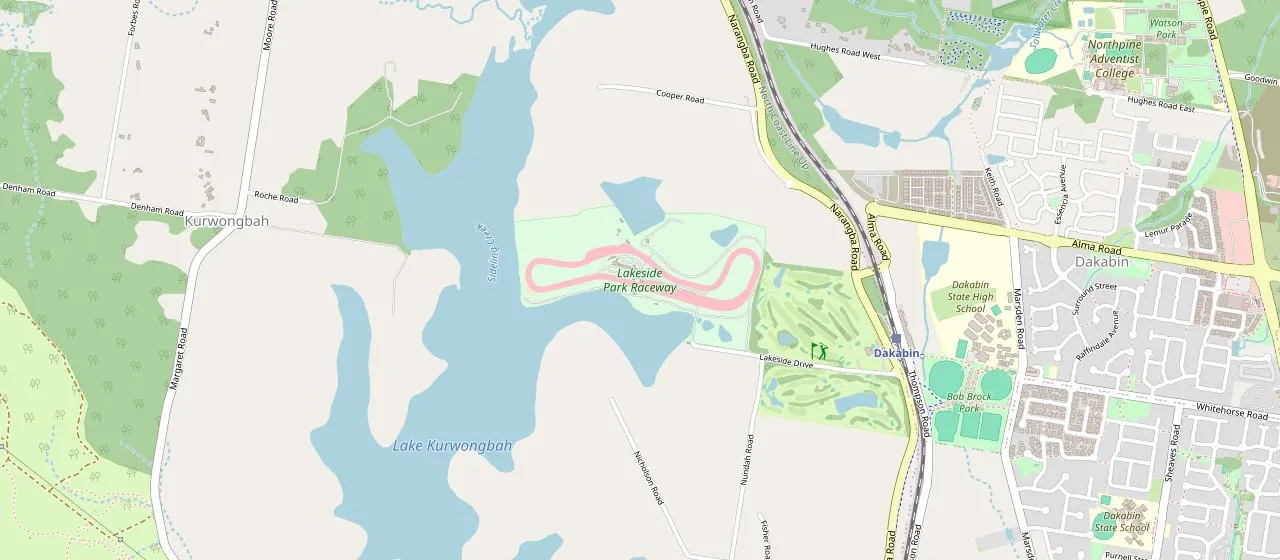
On Sunday 19 March 1961 the Governor of Queensland, Sir Henry Abel Smith, opened the state's first permanent track built specifically for racing. Fifteen cars started the main race, and the winner received 30 pounds and a Qualcast lawn mower. The track was built by volunteers from the club, sometimes with picks, shovels and even bare hands, on a former dairy farm by Lake Kurwongbah near Brisbane. Five years later Graham Hill won the Australian Grand Prix here. Forty years after the opening a new owner announced there would be no more racing at Lakeside, and was wrong.
| Location | Kurwongbah, by Lake Kurwongbah, about 30 km north of Brisbane, Queensland, Australia |
| Type | permanent road circuit; an additional Bus Stop chicane for motorcycles |
| Length | 2.410 km (1.498 miles) |
| Opened | 19 March 1961 |
| Break in operations | from July 2001 to April 2008 |
| Lap record | 0:46.66, Paul Stokell, Reynard 91D, Formula Holden, 1994 |
| Owner | Moreton Bay Regional Council |
| Operator | John Tetley, 30-year lease from the council |
| Major events | Australian Grands Prix 1966 and 1969, Tasman Series rounds, Australian Touring Car Championship (ATCC) |
| Status | active: club events, training, track days |
The Everdell Farm and the Club's Shovels
From the end of the 1940s, drivers from Brisbane travelled to events at Leyburn, Southport, Lowood or Toowoomba, all of them far from the state capital. The closest was Strathpine, a simple "there and back" run on an airstrip on private land, too small for big events. Strathpine eventually lost out to a housing estate. In September 1957 Sid Sakzewski bought the Everdells' dairy farm by Lake Kurwongbah, and the Queensland Motor Sporting Club began raising money to build a track on the hilly, densely wooded slopes.
Money was short for a long time. Barry Lake, motoring editor of Brisbane's newspaper "The Telegraph", described it in the 1964 issue of the magazine "Lakeside":
The club's limited finances could not be stretched to meet these figures and for a while it appeared that the new track would be delayed indefinitely.
In the end, businesspeople, sports organisations, the motor trade and the fans themselves helped. Volunteers worked with hired or borrowed equipment, picks and shovels, until after several months the course was ready for its first layer of asphalt. At the opening the competitors included Bill Pitt in a Jaguar 3.4, Sakzewski himself in a Plymouth Belvedere and Barry Tapsall in a Holden. About 2000 spectators came. The track was fast but narrow and bumpy, and accidents spoiled the first meetings. In 1964 the club invested in widening it and in facilities.
Over the following decades the one-and-a-half-mile loop was changed little. Its corners have their own stories: Hungry, with an exit banked the wrong way, was named so because it "devoured" the careless. The Queensland government described Lakeside as the first track in the state designed for racing and stressed that the course was laid out so that spectators could see most of its length.
Tasman, Hill and Amon
A year after the opening Jack Brabham came and won the first major international race at Lakeside in a 2.5-litre Cooper-Climax, at an average of 145 km/h. Then came the Tasman Series: in the northern-hemisphere winter, the best Formula 1 drivers raced in New Zealand and Australia in cars with engines of up to 2.5 litres. Before that, Queensland fans had seen at most one or two foreign stars. Sid Sakzewski was among the people who created the series. On 23 February 1964 the Lakeside "99" race was won by Brabham in his own design, a Brabham BT7A, ahead of John Youl and Bruce McLaren.
On 20 February 1966 Lakeside hosted the Australian Grand Prix for the first time, run to Tasman Series rules. The front row was taken by two BRM P261s with 1.9-litre V8 engines, driven by Graham Hill and Jackie Stewart. A ticket cost four dollars, and the federation CAMS, for safety reasons, cut the field from 20 to 15 cars. Stewart retired on lap 28 with a broken gearbox. Hill covered 66 laps in 62 minutes 38.4 seconds and won ahead of Frank Gardner (Brabham BT11A) and Jim Clark (Lotus 39).
A year later, on 12 February 1967, Clark won a Tasman Series round here in a Lotus 33 with a Climax V8 engine, a lap ahead of Brabham. The second Australian Grand Prix at Lakeside took place on 2 February 1969. With only a week between the round at the Teretonga circuit and the race near Brisbane, the teams, unlike in previous years, flew their cars across the Tasman Sea. Chris Amon in a Ferrari Dino 246T covered 67 laps in 60 minutes 12.8 seconds. His team-mate Derek Bell was second, Leo Geoghegan third, and the newly crowned world champion Graham Hill finished fourth in a Lotus 49.
Johnson, Brock and the Lake Water
Touring cars came to Lakeside from 1967 until the end of the 1990s. The most remembered race was the last of the 1981 season, which decided the Australian championship. Dick Johnson, who had learned to race at Lakeside in the 1960s and 1970s, won it ahead of Peter Brock and took his first national title. Johnson drove a damaged Ford Falcon XD, and Brock attacked him lap after lap without a single scrape of bodywork. Johnson said of Lakeside:
Lakeside is a real driver's circuit, one of the few left in the country outside of Bathurst.
The lake that gave the track its name intruded into its history several times. In the early 1970s the Pine Rivers Shire Council raised the water level in the reservoir that supplied the area, and a 100 m section of the straight had to be rebuilt higher up, above the flood line. In 1989 heavy rain caused the lake to flood the track, and a championship round was postponed by two weeks. When it finally took place, it was stopped with a red flag after a pile-up of several cars that ended in a fire. The race was restarted towards evening, shortened to half an hour, and Johnson won a championship round in front of his home crowd for the first time since 1981.
The track also underwent changes for safety. In 1984, after a series of accidents at the Hungry corner, the Motorcycle Sportsmen Club, with its own money and the hands of its members, built the Bus Stop chicane, used only by motorcycles. In September 1989 the Dunlop Bridge from the disused Surfers Paradise circuit was bought and joined to the existing footbridge, in order to widen the verges, especially on the left, where a bridge pillar stood dangerously close to the edge of the track. In 1991 club members moved 5000 m³ of earth from another part of the site to gain wider verges at the end of the start straight, where the slope fell towards the lake. From 1983 Lakeside also hosted the Australian Superbike Championship. Mick Doohan, later the 500 cc world champion, raced here, and he said:
If you can learn to race a motorbike at Lakeside you can compete at any track in the world.
The Year Racing Was Meant to End
In 1999 Queensland Raceway opened in Ipswich, and the V8 Supercars moved their round there. Lakeside lost its biggest event, and debts grew. The last weekend with a national series was 6–8 July 2001, with a round of the Konica V8 Supercar Series. At the end of 2001 the track's owners went into administration and the site was taken over by the Pine Rivers Shire Council, which bought the rest of the land in December. According to RacingCircuits.info it paid 600,000 Australian dollars at auction. The new owners announced: "The Council will ensure that Lakeside will never be used for racing again".
On the Queensland government's page about lost heritage, the track was placed in the category "not quite lost yet". Fans from the Friends of Lakeside group, led by Robert Hardacre and Trevor Beutel, got the track entered on the state heritage register, which made it harder for the council to develop the site for other purposes. The council later got the track removed from the register. In 2006 it announced a call for an operator and chose John Tetley, owner of Queensland Raceway. According to Tetley, a complaint by a rival bidder delayed the matter by a year. A 30-year lease, with an option to extend by 10, was signed at the end of 2007.
On 6 April 2008 racing cars returned to the track. It was a modest event for at most 50 entries, and its main purpose was to measure noise: in the pits, at various points of the track and on neighbouring properties. Tetley said in an account for "Auto Action" magazine: "If you had seen this place two months ago, the way it looked then, I just about cried". Among the starters was Tony Quinn in a Ford Sierra. In 2021 the same Quinn took over the lease of Queensland Raceway, a track run until then by Tetley.
At the turn of 2008 and 2009 the track was dug up for reconstruction, and that was exactly when the drought ended. Tetley recalled formwork worth almost 40,000 dollars washed away in a single night and an asphalt milling machine that sank into the mud. The loop was widened in places from 8 to 12 m, a tunnel under the track to a new paddock was built, and so were new pit facilities. The rebuilt track operated as Lakeside Park from 2009 at the latest; that name had already been used at the April 2008 event.
Decibels over the Water
According to "The Race Torque", in its first forty years of operation the track collected a total of six noise complaints, and after reopening two neighbours were said to have lodged more than a thousand. Every car undergoes a noise test before going out on track, and sensors stand on agreed properties in the area. According to the operator, the Moreton Bay council, which was formed by merging the Pine Rivers shire with other local governments and took over the site, has imposed penalties on it totalling 29,100 dollars since August 2018. Tetley announced a suspension of racing for 2019 and added: "Let's get one thing straight: we are not closing Lakeside down". The operator saw the heart of the dispute in the classification of the facility: as an outdoor entertainment venue, Lakeside is subject to a limit of 70 dBA between 7.00 and 22.00, whereas a sports facility would have 75 dBA.
In June 2019 the Lakeside Classic, the track's most important event, in which historic Group A and C touring cars raced, was cancelled. In January 2025 Tetley explained to fans on the track's website why the calendar is so thin. According to him, the council moved the measuring point to a house on the other side of the lake and shortened the averaging period of the measurement to 15 minutes, so the operator had to give up endurance races and split driving into 12-minute sessions. From June 2024 the council was to count exceedances by instantaneous value (LMax), and by mid-October to have counted 187 of them. According to the post, the council's chief executive agreed that scheduled events could go ahead until the matter was resolved, and the operator saw no reason to think the council would pursue these breaches. The remedy was to be an earth bund on the spectator bank, calculated to reduce noise at the house on the other side of the lake by about 3 dB. The council, as the post stated, had already issued a building permit for the bund, and the operator was waiting for its final consent to start work. This is an account from one side of the dispute.
In Your Own Car by Lake Kurwongbah
Despite these restrictions, Lakeside remained a track onto which you can drive an ordinary car. In August 2022 the member for Kurwongbah, Shane King, encouraged people in the Queensland parliament to take part in "All Aussie Day": anyone with an Australian car could, for 150 dollars, take a drive round the track with their family on Father's Day. He thanked Tetley because, thanks to him, people are "not just spectators but can enjoy it and drive it themselves".
The operator announces a Trackplay day for 7 November 2026. The Fast Laps sessions are open to registered, roadworthy road cars, with no speed limit but also no timing and no passengers. They cost 45 Australian dollars per 15 minutes. The driver needs a RACERS club licence (50 dollars for a single event or 125 for a year), a helmet meeting the AS/NZS 1698 standard, clothing covering the whole body and closed shoes. The calmer option, Family Cruise, costs 20 dollars for 20 minutes, with a limit of 110 km/h and no licence. BMW Car Club Queensland invites people to a sprint on 30 October 2026, non-members too, for 225 dollars. Beginners can drive in the Entre group, without timing and without overtaking, behind an experienced racing driver. Driving Events Australia sells half-day track days at Lakeside for 350 dollars, for any car with covered wheels, within the track's noise limits.
Plaques by the track commemorate the drivers and motorcyclists who died here. Some fans have asked for their ashes to be scattered around the course, and some couples have even exchanged wedding vows on the start-finish line.
Timeline
- 1957: Sid Sakzewski buys the dairy farm by Lake Kurwongbah.
- 1961: 19 March, Lakeside International Raceway opens.
- 1962: Jack Brabham wins the first major international race at the track.
- 1964: Brabham wins a Tasman Series round.
- 1966: Graham Hill wins the first Australian Grand Prix at Lakeside.
- 1969: Chris Amon wins the second Australian Grand Prix at Lakeside.
- 1981: Dick Johnson wins his first Australian Touring Car Championship here.
- 1984: the Bus Stop chicane for motorcycles.
- 1989: a championship round is postponed after the lake floods the track.
- 2001: the last round of the national series in July; the track passes to the Pine Rivers council.
- 2007: a 30-year lease for John Tetley.
- 2008: 6 April, the first event after a seven-year break.
- 2009: the track, rebuilt, as Lakeside Park.
- 2018: the operator announces a suspension of racing for 2019 because of noise penalties.
- 2024: according to the operator, the council changes the way noise exceedances are counted.