
Kircubbin, United Kingdom
Kirkistown: the 500 club's circuit on an airfield that was a ship
The history of Kirkistown on the Ards peninsula: the RAF airfield and HMS Corncrake II, the 500 MRCI club since 1953, Formula Ford, Hunt in 1971 and a track day.
- Type
- race circuit
- Opened
- 1953
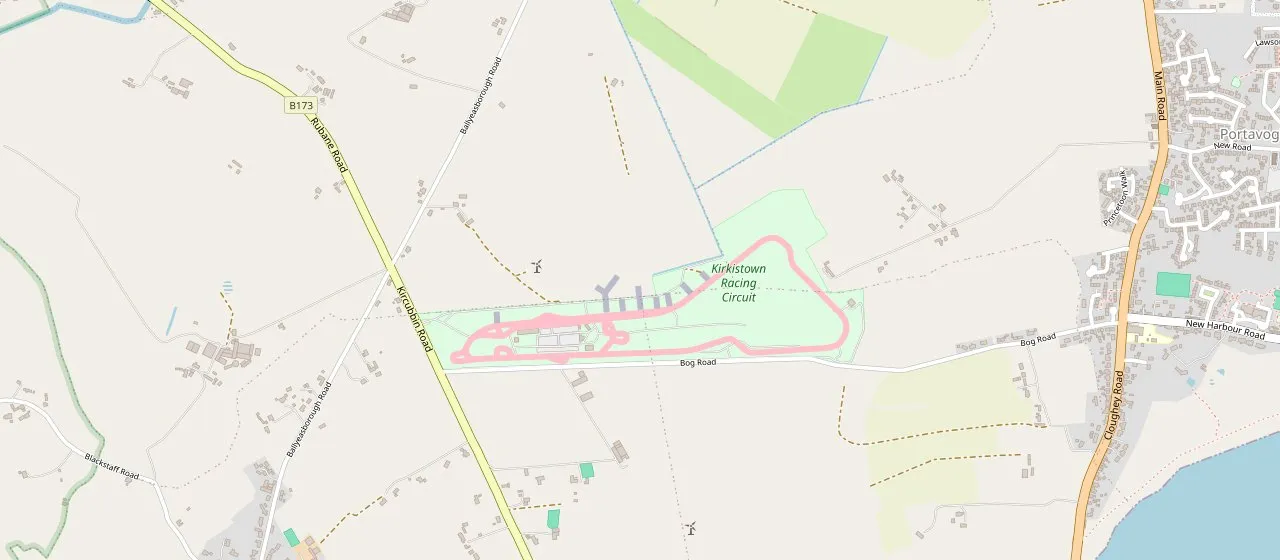
On 13 June 1953 the Five Hundred Motor Racing Club of Ireland held its first race on the abandoned wartime airfield of Kirkistown, at the foot of the Ards peninsula in County Down. The course along the runway and perimeter roads was marked out with straw bales, and race control sat in an old double-decker bus parked in the middle of the loop. The fastest lap that day was set by R.G. Lovell-Butt at an average of 71.406 mph, about 115 km/h. More than seventy years later the same club owns the circuit, and the circuit's race lap record exceeds 107 mph.
| Location | Kircubbin, Ards peninsula, County Down, Northern Ireland; near the fishing village of Portavogie |
| Type | permanent racing circuit on part of the former RAF Kirkistown military airfield |
| Length | a little over one and a half miles (approx. 2.4–2.5 km) |
| Corners | Debtor's Dip, Colonial One, Fisherman's, the Crosslé Chicane, Maguire's Hairpin |
| First race | 13 June 1953 |
| Lap record | 50.782 s (107.184 mph), Philip Shields, Dallara GP2, Formula Libre, 31 August 2013 |
| Owner and operator | Five Hundred Motor Racing Club of Ireland Ltd (a company since 8 June 1956) |
| Main events | Martin Donnelly Trophy for Formula Ford 1600, car and motorcycle race meetings, sprints, a rally |
| For amateurs | Trackskills track days in your own car, from February to November |
| Status | active |
The airfield that became a ship
Kirkistown opened in July 1941 as a satellite airfield of nearby Ballyhalbert, with three concrete runways. From January 1942 Spitfires of No 504 Squadron were stationed here, and for a shorter time also aircraft of No 485 Squadron; in August 1944 Seafire pilots practised landings here on one of the runways, painted to resemble an aircraft carrier deck. In July 1945 the airfield was taken over by the navy, which, true to its custom, declared it a ship and named it HMS Corncrake II. In January 1946 it returned to the RAF and was closed in the same year. The club's 2007 chronicle boasted that it is the only permanent circuit in the world that was once a ship.
A club was already waiting for the free land. The Five Hundred Motor Racing Club of Ireland (500 MRCI) was founded in 1948 to make racing cheaper, and it took its name from the then-new Formula 3 with its 500s, small single-seaters with 500 cc motorcycle engines. It first held races at the airfield in Newtownards, but motor sport clashed there with working air traffic, so the club began to look for a permanent circuit. In 1953 it leased the northern part of Kirkistown and laid out a loop one and a half miles long, essentially the same one that is driven today. In the 1970s it bought the circuit outright. According to the club, Kirkistown is the only circuit in the British Isles that is owned and operated by a club.
500s, specials and Formula Ford
In the beginning the club even had its own car, a Cooper, on which it taught driving and which it hired out to members, before anyone had invented racing schools. In time this proved too costly, and in the mid-1950s the club concentrated on organising races. Peter Collins, Ivor Bueb and a young Ken Tyrrell raced 500s here. Bueb won the Irish 500 cc championship at Kirkistown in 1957, two weeks after his victory at Le Mans. For a time the track record was held by the Belfast-built McCandless, the only four-wheel-drive 500; Rex McCandless used it to improve the record on 6 August 1953 to 74.301 mph. The car now stands in the Ulster Folk and Transport Museum in Cultra.
When the 500s went, their place was taken by 1172 Formula specials with a side-valve Ford engine. According to the club's chronicle, the Irish championships of this class in the late 1950s were contested by a young Eric Broadley with the first Lola and Arthur Mallock with a self-built U2, and among the locals by John Crosslé, also in a car of his own making. In 1959 John Pringle, a garage owner from Bangor, entered the Formula 1 Cooper in which Stirling Moss had won the Argentine Grand Prix a year earlier.
The most lasting mark was left by Formula Ford 1600. The first championship of this class was run at Kirkistown in 1968, and there has been one in every season since. From 1970 drivers from the area could buy a locally built Crosslé 16F, and according to the club this car became the first rung of a career for anyone who wanted to race. The club lists among its alumni later Formula 1 drivers: John Watson, Eddie Irvine, Martin Donnelly and Derek Daly, as well as Eddie Jordan. The season is closed by the Martin Donnelly Trophy, which the club ranks alongside the Formula Ford Festival at Brands Hatch and the Walter Hayes Trophy at Silverstone; in 2016 Niall Murray became the first driver to win all three in one year. In September 2026 the meeting with the Martin Donnelly Trophy drew a full grid of 26 Formula Ford 1600 cars, and Jason Smyth won the race for the trophy.
The day Hunt came
On 24 July 1971 Kirkistown hosted an international Formula 3 race, sponsored by GKN as part of the Ulster '71 celebrations. A large prize fund attracted 19 drivers to a non-championship event, run in two heats with the times added together. Before the first heat it rained so hard that nine cars spun on the warm-up lap. Colin Vandervell won both heats and the overall classification in a Brabham BT35; according to the club's chronicle the car belonged to Bernie Ecclestone. Among the starters was James Hunt in a March 713M; his race ended off the track at the Fisherman's corner. RacingCircuits.info attributes to him the opinion that the track is bumpy but enjoyable and could do with more corners.
More corners did indeed arrive, though for a different reason. In the 1970s Colonial One was moved and eased so that drivers would have more room to brake; the old tarmac remained, and “Going the long way round at Colonial” means at Kirkistown that you failed to slow down. In 1978 a permanent chicane was built on the long back straight, because at rising speeds there was not enough run-off; the lap became a little shorter and speeds dropped markedly. The chicane was rebuilt once more, and the straight after it moved half a width into the track. In 2015 the club named it after John Crosslé, a constructor and long-standing club member who died in August 2014.
Debtor's Dip and fishermen's nets
Just after the start line comes Debtor's Dip, a very fast left-hander which, according to the club, the brave and the foolish take flat out in top gear; in the Dallara of record-holder Philip Shields that means, as the club puts it, 180 mph. Even the club does not know where the name comes from. Then you have to brake to roughly 60 mph for the right-hand Colonial One. The long right-hander Fisherman's took its name from the fishermen of Portavogie, who used to dry their nets on the hedge. The lap closes with Maguire's Hairpin. For years nobody knew where the name came from, until almost seven decades after the circuit opened Johnny Maguire wrote to the club, the grandson of William Maguire of Glengormley, one of the first members. According to family lore his grandfather crashed in this hairpin in his V8-engined Mercury Special, because the car had more power than brakes, and the club named the corner after him.
The lap record measures successive eras. In 1972 John Watson raised it to 104.53 mph in a Brabham BT36; after the changes of 1978 the record fell to 97.57 mph (Gary Gibson, Chevron B42, 1979). Watson's mark was beaten only by Noel McIntyre in 2003: 105.81 mph in a Reynard. The current race record was set by Philip Shields on 31 August 2013 in a Formula Libre race: 50.782 s, or 107.184 mph, about 172.5 km/h. Superkarts with 125 and 250 cc engines run here alongside cars and, according to the club, reach up to 160 mph, lapping in under a minute.
Clubhouse, garages and a wall instead of Armco
The club's 2007 chronicle called the clubhouse, whose construction began in 2004, the biggest undertaking in the club's history: changing rooms, showers, a restaurant and a bar with a view of the whole circuit. It was first used on Boxing Day 2004, and John Watson officially opened it in 2005. According to RacingCircuits.info the circuit got a pit lane in 2000; before that cars left the track straight into the paddock. In 2011 a block of six double garages went up, with a scrutineering bay and a room for the officials, and in 2020 a concrete wall of the pit lane replaced the Armco barriers.
In 1981 a shorter, twistier track for non-gearbox karts was built at the western end of the site, and the County Down Kart Club joined the 500 MRCI as its karting section. Today the year includes seven car race meetings, four sprints, a rally run entirely within the circuit and about a dozen track days; motorcycle races are run by the Belfast & District Motor Club. After Eddie Irvine's racing school closed at the end of 2017, the Kirkistown Race School was set up; as a member of ARDS, the association of racing schools, it runs Motorsport UK race licence courses and assessments in Northern Ireland.
In 2026 the club is raising money for signal lights around the circuit. According to the club, Kirkistown is one of the few racing circuits in the country with a Motorsport UK licence that have no such lights; the governing body recommends them, and they will probably become mandatory. The project costs close to GBP 250,000, of which the club has to cover roughly half itself; chair Fay Weir set up a GoFundMe appeal, and in July work on the infrastructure was already under way. In September the club said farewell to Valerie Wright, the first woman chairperson, in the late 1980s and early 1990s.
July 2019
On Saturday 27 July 2019 Paul Conn died at the circuit, a GP from Lisburn and a member of the club since 1996. He raced in the Roadsports class in his Crosslé 47S and had already won the first race that day. In the second he was heading for another win when an accident happened on the start straight, opposite the control tower; doctors and Order of Malta personnel were with him almost immediately, but he died at the scene. Motorsport UK opened an inquiry together with the club and the Police Service of Northern Ireland (PSNI), which prepared a report for the coroner. In January 2021 the coroner Joe McCrisken appointed a retired forensic engineer, Damien Coll, to examine all aspects of the collision. The result of the investigation could not be established.
A track day at the end of the peninsula
The club itself does not sell drives to the public; car track days from February to November are run mainly by Trackskills, and single days are also held by the Lotus Club of Ireland, the Porsche Club and the Armagh Motor Association. Trackskills is run by Donal O'Neill and Keith Wray, both with a background in car and motorcycle sport. The company invites drivers, experienced and novice, in their own cars, and its instructors are ARDS registered. In 2026 the days fell on Sundays, once a month from February to November; the November one runs into darkness, so the organiser reminds you to check your lights.
The fee was GBP 170 for at least four 15-minute sessions, a passenger rode free, and an extra session with an instructor cost GBP 10. Before the first outing everyone does a familiarisation lap with an instructor, who shows the line, braking points, turn-in points and apexes. Three rules apply: no overtaking on the inside, no intimidating, no drifting. The organiser warns that in 99 cases out of 100 your normal car insurance stops working at the gate of the circuit, and in its list of tips for newcomers it says four times, in four different points, to carry a spare set of brake pads. From its observations, cars that fail to complete even four runs most often do so because of worn brake pads or discs, a scrubbed front left tyre or a clutch. The circuit lies on a narrow peninsula, it is almost always windy, and it is often dry when rain falls inland. And for the first laps Trackskills has one piece of advice:
Debtor's is NOT flat first or even second time out.
Timeline
- 1941: RAF Kirkistown airfield opens as a satellite of Ballyhalbert
- 1945: taken over by the navy as HMS Corncrake II
- 1946: returns to the RAF and the airfield closes
- 1948: Five Hundred Motor Racing Club of Ireland founded
- 1953: lease of the northern part of the airfield, first race on 13 June
- 1956: the club's company is registered (8 June)
- 1957: Ivor Bueb wins the Irish 500 cc championship
- 1968: first Formula Ford 1600 championship
- 1971: international Formula 3 race (Ulster '71), won by Colin Vandervell
- 1970s: the club buys the circuit, Colonial One rebuilt
- 1978: permanent chicane on the back straight
- 1981: karting track at the western end of the site
- 2003: the circuit's 50th anniversary celebrations, first BRDC Historic Sports Cars race
- 2004: new clubhouse
- 2011: garage block, scrutineering bay, officials' room
- 2013: Philip Shields's lap record, 50.782 s
- 2015: the chicane is named after John Crosslé; visit of Formula 3 500s
- 2017: Kirkistown Race School founded
- 2019: death of Paul Conn in a Roadsports race
- 2020: concrete pit wall replaces Armco barriers
- 2026: appeal for signal lights around the circuit