
Hidden Valley (Darwin), Australia
Hidden Valley Raceway: the Darwin circuit that borrowed a straight from the dragsters
The story of Hidden Valley Raceway near Darwin: from a 1985 drag racing strip through Supercars since 1998 and the Darwin Triple Crown to driving your own car in Lap Sprint.
- Type
- race circuit
- Length
- 2.87 km
- Opened
- 1986
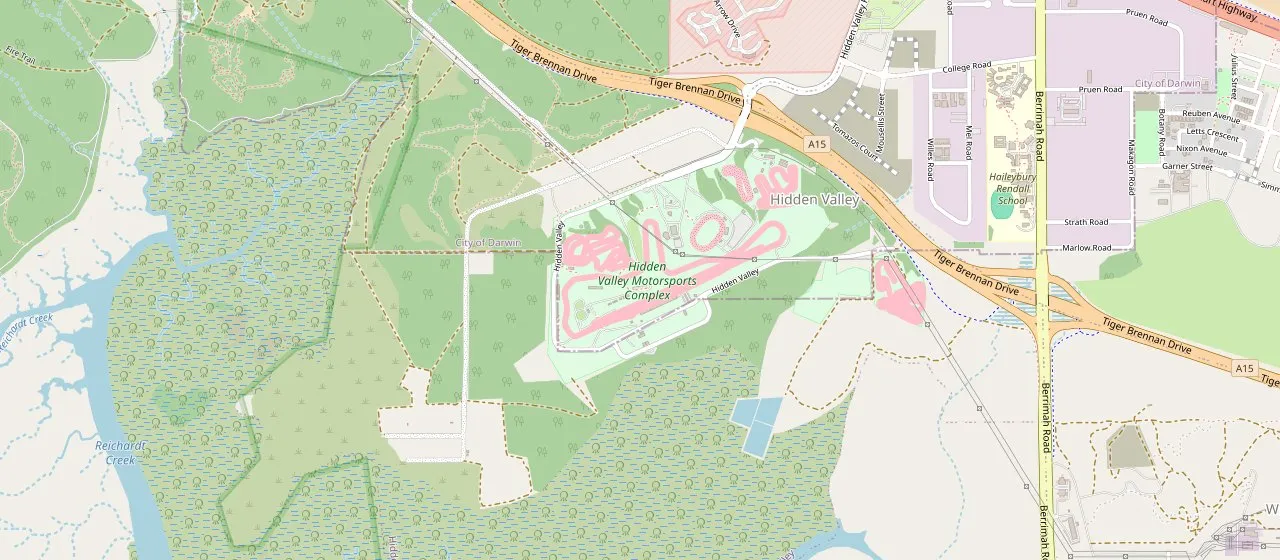
In August 1983, the last drag racing meeting was held at Livingston, a disused airfield 54 km from Darwin on the Stuart Highway. The forty-year-old strip was already too worn for the most powerful cars and motorcycles, and the planned widening of the highway settled the matter. Two years later, drivers from the Top End, as Australians call the northern edge of the Northern Territory, had a new, perfectly flat straight at Hidden Valley, a dozen or so kilometres from the city. From that straight grew a road racing circuit that has hosted the Supercars series every year since 1998 and for over ten years shared the same asphalt with the dragsters.
| Location | 171 Hidden Valley Road, Hidden Valley, Darwin, Northern Territory; about 5 km south of Darwin Airport |
| Type | permanent road circuit in a multi-discipline complex with a drag racing strip, speedway, karting track, mud racing track and quad bike track |
| Length | 2.87 km (rounded to 2.9 km in Supercars materials) |
| Direction | anticlockwise |
| Start straight | 1.1 km; top speed of Supercars 271 km/h |
| Opening | drag racing strip: 9 June 1985; road circuit: 1986 |
| GT World Challenge Australia lap record | 1:04.8293, Ferrari 296 GT3 of J. Buchan and C. Campbell (Zagame Autosport), GT World Challenge Australia, 26 July 2026 |
| Owner | Northern Territory Government |
| Main events | Supercars (since 1998, Darwin Triple Crown), MXGP on the separate motocross track at Hidden Valley (2025), GT World Challenge Australia (2026) |
| Status | active; agreement with Supercars until 2030 |
From a wartime airstrip to the edge of the city
Drag racing in the Top End began on abandoned airstrips. In 1969 the King Cobra Rod and Custom Club was formed, today operating as the Hidden Valley Drag Racing Association (HVDRA). Quarter-mile racing was held first at Hughes, an abandoned World War II bomber landing ground, and soon moved to Livingston. Despite the remote location, according to the club the meetings drew over a thousand spectators and up to sixty competitors there. A new site closer to Darwin had been sought since 1973. In 1979 came an announcement that the club attributes to Marshall Perron: a motor sports complex would be built at Hidden Valley, about 15 km south of the city.
The complex was meant to solve more than the dragsters' problem. In June 1981 the head of the Territory government, Paul Everingham, explained in the Legislative Assembly why the city council and the government were ordering the speedway to leave Bagot Park: the city was growing and there were complaints about the noise. He also recalled that about 8,000 residents apparently regularly found the Saturday night speedway meetings entertaining, and announced loans and grants for the move to Hidden Valley. In March 1983 the health minister, Dondas, said from the same rostrum that the amalgamation of motor sports in one place, achieved at “considerable expense and hard work by the organisations involved”, would be a credit “not only to the Northern Territory but to Australia”. A few months later the treasurer, Perron, in his budget speech allocated almost $3 million to sports facilities, among them the drag racing strip and the karting track at Hidden Valley.
The ambitions went further. The Northern Territory News of 27 March 1984 headed an item on page 18 “Grand prix circuit for Hidden Valley”.
The circuit that borrowed a straight
The first stage of the drag racing strip was completed in 1984. It was built to international requirements: over the whole quarter mile it is perfectly flat, has a one percent crossfall to the south, and the braking area beyond the finish line slopes down one percent. The first meeting took place on 9 June 1985. In September 1986 the club switched on lighting that it had itself designed, financed and built; according to HVDRA it met the standard for television broadcasts.
In 1986 the road circuit opened, in the simplest possible way: existing infrastructure was used, namely the drag racing strip. It was a venue on the scale of local racing. It had no buildings in the pit lane, and the risk that it would turn to dust was, according to Repco's editors, quite real. The Supercars website years later called the old Hidden Valley outright a “dust bowl”. When in 1990 the Territory government gave the club a grant for a hot-mix asphalt surface, the strip still served the road circuit at the same time. Special preparation of the surface for drag racing became possible only once the two disciplines were separated.
July 1998: marquees in the pit lane
The breakthrough came in 1997. In June it was announced that Hidden Valley would host a round of the Australian touring car championship. The upgrade of the circuit included, among other things, a new start straight parallel to the dragster strip. The strip then became, for the first time, a facility for drag racing only. The report of the government sport department for the 1997/98 financial year describes the upgrade as a commission carried out entirely, from design to construction, by a state construction agency for the NT Motor Sports Council. The department also helped set up a private company, Hidden Valley Promotions, which was to organise the round, and gave it $0.795 million; winning the event required long negotiations with several organisations, including the Confederation of Australian Motor Sport (CAMS) and the company managing the series.
Work began after February 1998, and the first weekend with the V8 Supercars series took place on 17–19 July. Not everything was ready. Craig Lowndes recalled years later: “The first time we visited there in 1998 we didn't have any garages, we were set up in marquees in pitlane.”
It was the penultimate round of the season, in which the title was being decided between Lowndes and Russell Ingall. The first race began with a pile-up at the first corner, and Lowndes won it because his teammate Mark Skaife lost his engine on the last lap. Skaife did not start the second race, his engine not having survived the first, and Lowndes's car would not fire, so the front row of the grid stayed empty. Ingall started from thirteenth and won the seventeen-lap sprint; as late as 2021 it was the furthest back on the grid from which anyone had won a Supercars race in Darwin. The third race, stopped by a red flag after a pile-up, also went to Ingall. Lowndes took the championship anyway, winning all three races at the Oran Park finale.
The Territory government was delighted. In August 1998, answering a question in the Legislative Assembly, the sport minister called the weekend “by any standards a resounding success” and announced that Darwin was assured of the event for four years. He added that the government hoped for a date earlier in the tourist season, preferably in June, so that the races would not clash with other attractions of that time of year.
A kilometre of straight and braking by feel
On the circuit plan the most important feature is the start straight: it is 1.1 km long, and the dragster strip runs parallel to it. The second part of the lap is fast, flowing curves through which the car must handle well. Lowndes said in 2015 that it is one of the longest straights on which Supercars race outside Bathurst, and that the circuit itself is very hard on tyres.
At the end of the straight, after accelerating to over 270 km/h, drivers face the long left-hand turn one, a key overtaking spot and the scene of many collisions in the circuit's history. Tony D'Alberto, Motorsport.com's expert on racing technique, explained why it is so hard to hit the braking point from pole position. With a standing start, the driver in front has no brake lights ahead to go by:
Your braking marker is on the outside of the circuit, and you're not going as fast as you would be on a flying lap, so you're basically guessing as to where to hit the pedal.
The most notorious collision in Darwin, however, happened at the end of a lap. In 2004 the championship leader Marcos Ambrose attacked the leading Skaife on the inside at the last corner of the last lap, the cars collided, and the race was won by Ambrose's teammate, Russell Ingall. Skaife summed it up briefly at the press conference: “every dog has his day”. In 2008 the Darwin round was named event of the year of the V8 Supercars series.
The trophy nobody could win
In 2006 the organisers introduced the Darwin Triple Crown prize for a driver who wins all three races of the weekend. For thirteen years nobody managed it, even when the regulations were changed to two races with the additional condition of the best time in the Top 10 Shootout session. The curse was broken in 2019 by Scott McLaughlin, who in a Ford of DJR Team Penske took pole position for both races and won both.
2020 was exceptional in Darwin: the series came there twice. The trophy was then awarded for the most points in the weekend, and Jamie Whincup and Fabian Coulthard finished the round level on points. Whincup won thanks to his victory in the final race. Since 2025 the Triple Crown has always been decided by points from three races; in the current format the winner of the Friday 100 km race gets 60 points, and the winner of each of the Saturday and Sunday races, of 200 km, gets 120. In 2025 Broc Feeney won all three races, and in 2026 Cam Waters of Tickford Racing took the trophy although he won only the Friday race; with 272 points he finished ahead of Matt Payne and Kai Allen. Since 2022 the Darwin round has been the official Indigenous Round on the Supercars calendar.
The wall after turn one
In the last race of the weekend in 2016, after exiting turn one, several cars entered the fast chicane together and a series of collisions followed. Andre Heimgartner, escaping the wrecked cars, pushed Lee Holdsworth's Holden off the track, and it hit a kink in the concrete wall side-on. Holdsworth broke his pelvis and missed the next three rounds; he returned only for the endurance races at Sandown and Bathurst.
A year later, according to Errol Edwards of the Territory's department of tourism and culture, on CAMS's recommendation a barrier of 2,500 tyres was erected along the whole wall from the exit of turn one to turn four: 115 m long, 1.2 m high, two rows joined by a conveyor belt. Edwards said that “in 20 years we've only had one accident in that location”.
The asphalt was also ageing. In 2013 the sport minister Matt Conlan announced a package of $9.42 million, including $5 million for a new surface and concrete barriers. The original asphalt from 1997 was worn by use and the extreme climate. As the minister put it: “The normal life span of a track is 10 years, so 16 years on these upgrades are long overdue.” The contract went in July 2014 to Downer, which right after the Supercars round brought a mobile asphalt plant with a capacity of 180 t an hour from New South Wales and in three days laid over 4,000 t of mix designed specially for racing conditions in the Territory. Among the works for which, according to an April 2015 announcement, funds were allocated was also a redesign of turn one to make it safer for drag racing.
Speedway, karts and mud behind one gate
Hidden Valley is today a complex: besides the road circuit and the drag racing strip it has a speedway, a karting track, a mud racing track and a quad bike track. According to the government's 2018 description of the facility, it hosted monthly club car and motorcycle events, drift events, motorkhanas (skill driving between cones in a yard), motorcycle rider training, and even weekly events of a cycling club. In 2012 the karting track, after an upgrade costing $820,000, hosted the 50th Australian championships; Chief Minister Paul Henderson claimed then that the complex attracted over 110,000 spectators a year.
In 2025 the final round of the MXGP motocross world championship was held on a purpose-built motocross track at Hidden Valley, the first in Australia in 24 years. A downpour turned the course into a bog and the second MXGP class race was cancelled. In July 2026 GT World Challenge Australia raced on the road circuit. In the Sunday race the crew of B. Feeney and B. Schumacher won in an Audi R8 LMS, and a Ferrari 296 GT3 of Zagame Autosport improved the series' race lap record, set the day before, to 1:04.8293.
The Territory government has further plans for the facility. In 2024 it allocated $3 million to the first stage of a development plan: a roof over the pit lane, a new officials' tower, a medical point and an entrance. The next stages, not yet funded, envisage lighting the track for night racing, a campground and a new covered grandstand.
In your own car down the Supercars straight
Club car racing at the circuit is run by the North Australian Motor Sports Club (NAMSC), which presents itself as one of the main users of the facility. For amateurs the club has a category called Lap Sprint, designed, as it writes, for people who want to “sample racing in their own road car”, without buying a competition car. The number of cars on track is limited, the cars run at intervals and overtaking is not allowed. Before the first start the driver goes through a briefing and at least three laps observed from the tower. A helmet to the AS/NZS 1698 standard is required, clothing made of non-synthetic materials covering from the neck to the wrists and ankles, and tow points at the front and rear. Electric cars are excluded, and the club notes that no insurance applies on the track.
Lap Sprint runs in club championship rounds. A Motorsport Australia or AASA licence and NAMSC membership are required, including a one-day one; in 2026 it cost $30, and according to the club the day comprises four sessions. Entry for the round of 6 September 2026 cost $200, and the fourth round of the season was scheduled for 18 October. On request the club also organises private practice and test days in an open pit lane format, for half a day or a full day. For drivers for whom a quarter mile is enough there is a second option alongside: since 2002 HVDRA has run Off Street Racing for road-registered cars on Friday evenings.
Timeline
- 1979: announcement of the construction of a motor sports complex at Hidden Valley
- 1981: the Territory government funds the move of the speedway from Bagot Park to Hidden Valley
- August 1983: last drag racing meeting on the Livingston strip
- 9 June 1985: first meeting on the drag racing strip at Hidden Valley
- 1986: opening of the road circuit, which uses the drag racing strip
- June 1997: announcement of a touring car championship round and of the construction of a new start straight
- 17–19 July 1998: first V8 Supercars round; Ingall wins two races
- 2006: Darwin Triple Crown trophy introduced
- 2008: Darwin round named event of the year of the V8 Supercars series
- 2014: new surface laid by Downer
- 2016: Lee Holdsworth's crash; extension of the agreement with Supercars to 2030
- 2019: Scott McLaughlin the first Triple Crown winner
- 2020: two Supercars rounds in Darwin; Triple Crown for Jamie Whincup
- 2022: Darwin the official Indigenous Round
- 2025: MXGP at Hidden Valley, the first motocross Grand Prix in Australia in 24 years; Broc Feeney wins all three Supercars races
- 2026: GT World Challenge Australia in Darwin; Cam Waters wins the Triple Crown
Sources (36)
- ANDRA (Australian National Drag Racing Association), 40+ Years of NT Drag Racing, 2020-06-16 [en]
- Repco, When Darwin joined the Supercars calendar, Repco The Garage, 2023-06-13 [en]
- James Pavey, Hidden Valley Raceway set for significant upgrades, Supercars.com, 2024-04-23 [en]
- Northern Territory Government, Hidden Valley Motor Sports Complex, NT.GOV.AU, 2018-08-09 [en]
- V8 Supercars, SKYCITY Triple Crown, Hidden Valley Raceway: Circuit, darwin.v8supercars.com.au [en]
- Mark Walker, Darwin form, facts & oddities, The Race Torque, 2020-08-13 [en]
- James Pavey, Darwin rewind: Hidden Valley's title-defining 1998 debut, Supercars.com, 2021-06-10 [en]
- Natsoft / GT World Challenge Australia, 2026 Shannons SpeedSeries, LIQUI MOLY GT Festival Darwin, Hidden Valley Raceway, 2026 GT World Challenge Australia, Race 2, Classification, Final, 2026-07-26 [en]
- James Pavey, Fast Facts: Hidden Valley, Supercars.com, 2018-06-10 [en]
- Dylan Ruddy, MXGP returns to Australia with wet and wild finale, bikesales.com.au, 2025-09-24 [en]
- Legislative Assembly of the Northern Territory, Parliamentary record: Part I debates (11 June 1981) [en]
- Legislative Assembly of the Northern Territory, Parliamentary record: Part I debates (24 March 1983) [en]
- Legislative Assembly of the Northern Territory, Parliamentary record: Part I debates (30 August 1983) [en]
- Northern Territory News, 1984-03-27 [en]
- Department of Sport and Recreation (Northern Territory), Annual Report 1997/98, 1998-10-08 [en]
- Library & Archives NT, IndexNT, rekord katalogowy, Hidden Valley Raceway Darwin 17-19 July 1998 [en]
- Andrew van Leeuwen, Lowndes hails Darwin developments, Motorsport.com, 2015-06-18 [en]
- Repco, Hidden Valley's V8 Supercars debut, Repco The Garage, 2022-06-14 [en]
- Legislative Assembly of the Northern Territory, Questions Day 1, Tuesday 11 August 1998, Parliamentary Record 8 [en]
- James Pavey, Big stop, high drama: Darwin Turn 1's notorious moments, Supercars.com, 2021-06-07 [en]
- Tony D'Alberto, Driver's Eye View: Darwin, Motorsport.com, 2015-06-22 [en]
- James Pavey, Darwin's most dramatic moment, Supercars.com, 2020-08-03 [en]
- James Pavey, How Darwin Triple Crown became so hard to win, Supercars.com, 2023-06-07 [en]
- Darwin Supercars (organizator rundy), Home of the Triple Crown, darwinsupercars.com.au [en]
- Motorsport Australia, Whincup claims Triple Crown, 2020-08-16 [en]
- Repco, Lee Holdsworth's big hit, Repco The Garage, 2026-06-16 [en]
- Andrew van Leeuwen, Holdsworth braced for Darwin return, Motorsport.com, 2017-06-15 [en]
- Toby Lynch, Track re-surface scheduled for Hidden Valley Raceway, CycleOnline.com.au, 2013-05-09 [en]
- Resurfacing of racetrack at Hidden Valley Motorsport Complex, Darwin, Roads & Infrastructure Magazine, 2015-04-10 [en]
- James Pavey, Hidden Valley infrastructure upgrades, Supercars.com, 2015-04-08 [en]
- Paul Henderson (Chief Minister), Hidden Valley becomes best motorsport track in Australia, 2012-07-05 [en]
- V8 Sleuth, Hidden Valley secures $3 million upgrade, 2024-04-23 [en]
- North Australian Motor Sports Club (NAMSC) [en]
- North Australian Motor Sports Club (NAMSC), Hidden Valley Track Hire and Private Practice [en]
- North Australian Motor Sports Club (NAMSC), Lap Sprint [en]
- North Australian Motor Sports Club (NAMSC), Dimet Tools Championship Round 3, September 6th 2026 [en]