
Saint-Pie, Canada
Circuit Sanair: Drag Strip, the Shortest CART Oval and a Dispute over a School
The history of Circuit Sanair in Saint-Pie: Jacques Guertin’s NHRA strip, Trans-Am, CART on the trioval, summer 1984, track days in your own car and a dispute over a land reserve.
- Type
- race circuit
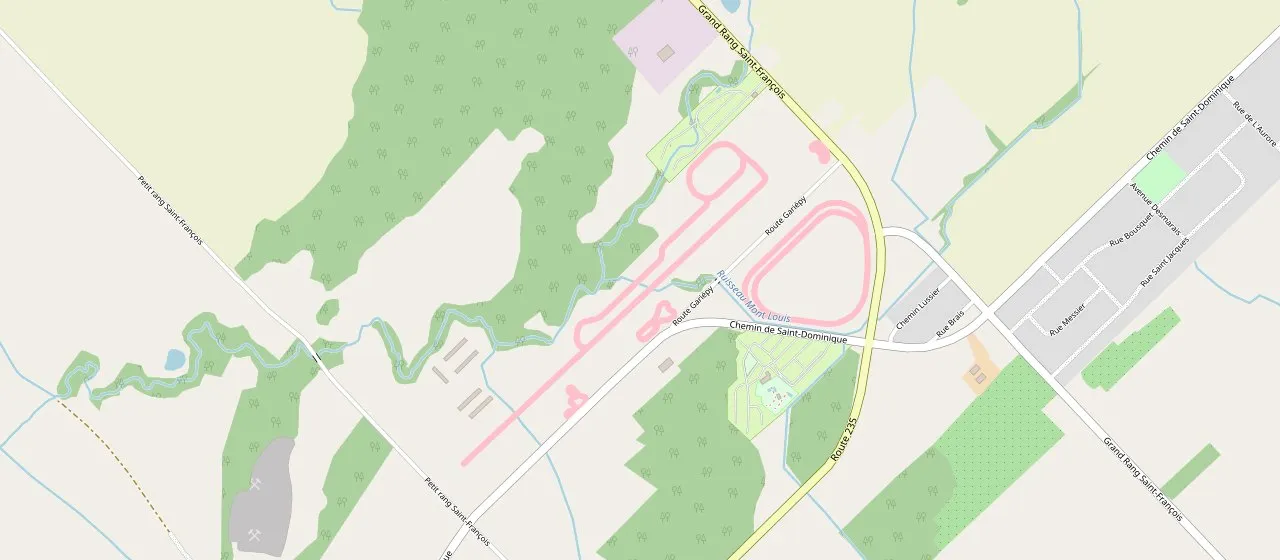
On Tuesday 4 August 2026, the agenda of the Saint-Pie town council in Quebec included an item with no company name, only the numbers of five lots. Kevin Leduc, vice-president of Fondation Sanair, said later that when they saw the notice of the meeting and checked the numbers, it turned out that “it was all of Sanair’s lots and only those”. That evening the council established a land reserve on them for a future secondary school. The site at issue is Circuit Sanair: a complex founded in 1969, where NHRA dragsters, Trans-Am cars and CART cars once raced, and where amateur drivers now come in their own cars.
| Location | 669, Le Bas du Petit Rang St-François, Saint-Pie, Montérégie, Quebec, Canada; about 40 minutes’ drive from Montreal |
| Type | motorsport complex: a road course in several configurations, the Sanair Super Speedway trioval, a drag strip for quarter-mile and half-mile racing, a kart track |
| Trioval | opened on 7 August 1983; CART races from 1984 |
| Road course | about 2 km; first loop opened in May 1972 |
| Founded | 1969, Jacques Guertin |
| Major events | NHRA Le Grandnational (from 1971), Trans-Am (1972–1973), CART (1984–1986), NASCAR North and ACT |
| Operator | Circuit Sanair; since August 2026 the site has been under a land reserve of the town of Saint-Pie |
| Status | active; track days, drag racing on Friday evenings, drifting, karting |
A racecourse, then a quarter mile
Racing in Saint-Pie is older than Sanair. On 19 July 1914, a contest for cars and motorcycles was held at the local racecourse, and a correspondent of Le Courrier de Saint-Hyacinthe reported that the best drivers in Canada had come to it. Half a century later, Jacques Guertin, a businessman and keen fan, toured several American drag strips, that is, straight strips on which cars race in pairs against the clock. On his return he decided to spend more than a million dollars on such a strip in the parish of Saint-Pie. The operator and Radio-Canada date the founding of Sanair to 1969. The operator explains the name as a combination of the Latin sane (“clean”) and the word air: Guertin produced air purifiers on site.
The quarter mile quickly drew crowds. In the early 1970s more than 14,000 people watched the first Pro Stock championship in Canada, in which more than 364 cars of all categories competed for a purse of 3,000 dollars. In 1971 the American National Hot Rod Association (NHRA) came to Saint-Pie for the first time, with the Le Grandnational Molson event. Le Courrier lists Top Fuel, Funny Car and Pro Stock among its classes. In the same year an asphalt oval of one third of a mile, used by NASCAR Late Model Sportsman stock cars, was built next to the strip.
A loop stitched from two tracks
From the start Guertin also wanted a road course. According to RacingCircuits.info, a construction workers’ strike in the summer of 1969 delayed the plans, so the loop opened only in May 1972 with a regional Formula Ford race. It was assembled from a section of the drag strip, its return road and the one-third-mile oval. The result was about two kilometres.
The same site judges that it was not a track that impressed with its shape, but it arrived at a good moment. Circuit Mont-Tremblant was then in financial and political trouble, and Sanair took over some of its events: in 1972 and 1973 it hosted the Trans-Am series, and Formula B and Formula Atlantic cars came four times. On 30 July 1972, in the over-2.5-litre class, Warren Tope won from pole position in a Ford Mustang Boss 302; the field included twenty Chevrolet Camaros. A year later, on 15 July 1973, it was overcast and humid, and 12,400 spectators watched the race. Warren Agor in a Chevrolet Camaro took pole position, the fastest lap and the win.
In 1973 Gilles Villeneuve became Quebec Formula Ford champion; he had earned the money to start in car racing by winning snowmobile races. The operator recalls that it was at Sanair that Villeneuve won his first title in that class.
A triangle south of the strip
In the early 1980s the track was mostly drawing local races. A change came with a new investment south of the strip: Sanair Super Speedway, an asphalt trioval. The first race took place on 7 August 1983 in the NASCAR North series and was won by the American Harmon “Beaver” Dragon, who in 1979 had also won the first NASCAR North race on the old oval. According to the history of the American Canadian Tour (ACT), the successor to NASCAR North, the only Quebec-born driver to win a major stock car event here was Claude Leclerc, winner of the Molson 300 on 5 August 1984.
A year after the trioval opened, the CART series arrived, the Indycar championship. The race was named the Molson Indy, after the brewery that sponsored it. Sanair became the shortest oval in CART history. On 9 September 1984, after 225 laps, Danny Sullivan won in a Lola T800 of Doug Shierson’s team, ahead of Bobby Rahal.
The summer of 1984
Before Sullivan collected his trophy, Sanair saw two serious accidents. On 29 June 1984, in the last qualifying session of the Le Grandnationals, the left front tyre of the Top Fuel dragster of Shirley Muldowney, a three-time NHRA champion, fell apart. The inner tube slid out of the tyre and wrapped around the steering arm, and the car, travelling at about 400 km/h, left the strip at a point where there was no barrier and broke apart in a ditch. Muldowney had a broken pelvis, a partly severed right thumb and shattered ankles. After six weeks in Montreal General Hospital, a private jet took her to Detroit for further treatment.
A little over two months later, on 7 September 1984, Rick Mears, winner of that year’s Indianapolis 500, crashed during practice for the Molson Indy. The front of his car went under a crushed barrier on the start straight and smashed his feet. Years later Mears told Motor Sport magazine that the Penske team had tested at Sanair earlier and wanted to keep its advantage, and that he himself had been too impatient:
Sanair’s a bullring, it’s hard to get a clear lap.
Passing Rahal, he came up on Corrado Fabi, who was warming up on the inside lane of the track and had just then accelerated; the cars touched. “It was my fault,” said Mears. According to Mears, doctors in Canada concluded that both feet would have to be amputated. Roger Penske and Steve Olvey, head of the series’ medical team, did not agree. Olvey phoned the Indianapolis orthopaedic surgeon Terry Trammell, and Mears was flown by helicopter and Penske’s private plane to Indianapolis, where Trammell spent the whole night putting his feet back together. Mears returned to racing and in 1985 won at Pocono. “I broke every bone in my right foot, half of them more than once, and half the bones in the left foot,” he summed up years later. According to RacingCircuits.info, the pit lane wall, made up at that time of metal barriers, was replaced with a concrete wall before the next race.
The green light on the last lap
The second edition, on 8 September 1985, went into the history of the series as one of its most disputed finishes. In front of 18,500 spectators, only nine of the 25 cars finished the race. On lap 209 the leader Bobby Rahal collided in the first corner with Jacques Villeneuve, a driver from Quebec who was trying to pass him. “He had the red mist in front of his eyes,” said Rahal. Villeneuve replied briefly: “It was my fault -- period.”
Johnny Rutherford took the lead, and the last lap began under a yellow flag. In its last third Pancho Carter passed Rutherford and crossed the finish line three tenths of a second ahead of him. Rutherford claimed he had seen neither the green flag nor the green light. The CART chief steward Wally Dallenbach ruled that both signals had been switched on, and the report of the UPI agency from race day named Carter as the winner. According to RacingCircuits.info the decision was later reversed in Rutherford’s favour, and ChampCarStats.com records him as the winner, with Carter second.
In 1986 Bobby Rahal won in a March of the Truesports team, ahead of Al Unser Jr. It was the last CART race in Saint-Pie. According to the ACT history, the Molson brewery moved its support for the series to the street race in Toronto. A year later another big project failed: the Molson 300, the first round of the Stock Car Connection alliance, was meant to draw more than 20,000 spectators, and fewer than 9,000 came.
The drag strip wrote one more important chapter in those years. In 1987 John Force, later the NHRA record holder for the number of wins, won his first Funny Car race at Sanair, beating Ed McCulloch in the final. The final, postponed because of rain, was run on Monday morning. NHRA vanished from Saint-Pie after the 1992 edition, when Canadian regulations limited lead in racing fuel and the cars of the top classes stopped meeting the requirements.
Fridays on the quarter mile
After the big series left, the site, as ACT puts it, gradually declined. At the end of the first decade of the 21st century an oval kart track, a motocross course, tracks for radio-controlled models and an ice road course were added. The ACT series returned to the trioval in 2012 and 2013, and then dropped off the calendar. The editorial team of the motoring magazine RPM recorded a large part of its car tests here in 2005–2009.
The core of the business became Friday evenings on the strip. In 2026 they ran from 24 April to 25 September, from 19:00 to 23:00; admission cost 10 Canadian dollars and a run cost 5 dollars per car. A helmet is mandatory only in cars that cover the quarter mile in under 10 seconds. Emergency services also use the track. According to Kevin Leduc, the Sûreté du Québec, the provincial police, has several hundred days reserved there; police officers from Lévis, Laval, Longueuil, Quebec City and Deux-Montagnes train here, and the cégep de Saint-Hyacinthe brings its ambulances.
The strip also has a dark chronicle. On 3 July 2026, during open runs, a car that was racing another for acceleration left the track; its passenger was killed and the driver was taken to hospital in critical condition. A year earlier, in August 2025, a driver was killed who was going down the strip without a rival, in his own unmodified car. The coroner Lyne Lamarre found that the death might not have happened had the end of the acceleration zone and the end of the strip been clearly marked, and recommended renewing the gravel run-off area, which had become overgrown with grass. Martin Bourassa, a columnist of Le Courrier, counted seven deaths at Sanair since 1999, noting that this was his own count. He also recalled that after the 2001 report of the coroner Andrée Kronström, on three deaths at this track, Quebec changed the rules of the public insurance scheme SAAQ: compensation for physical and psychological harm no longer covers accidents during races, competitions and open runs. The racing driver and motoring columnist Bertrand Godin, for his part, told Radio-Canada that these accidents would have had worse consequences had they happened on an open road.
Jacques Guertin died in 2025. The operator bids him farewell on its website and announces that the next generation will develop the track in the founder’s spirit.
Your own car, your own pace
Track days at Sanair are called Sanair Track Day. The operator invites people to them directly: “come lap at your own pace and with your own car,” open to everyone. For the 2026 season it planned nine dates (ten days): 2 May, 6 June, 27 June, 18 July, 1 and 2 August, 15 August, 19 September and 17 and 18 October. Three of these dates (four days) are marked by the operator with the note “Trioval”. The event page names two entrances: gate no. 1 to road course no. 3 and gate no. 4 to road course no. 5 “Trioval”. Driving runs from 7:00 to 17:00. Registration until noon on the Tuesday before the event costs 150 Canadian dollars per car, later 180 dollars; a pass for ten days costs 1,200 dollars (as of 10 October 2026).
The rules are short and concrete. A helmet with a 2015 or later approval (M2015, ECE or Snell, motorcycle helmets included) is required, along with a technical inspection before going out on track and a drivers’ briefing at 8:30. Drivers are divided into beginner, intermediate and advanced groups, and overtaking is allowed only on designated straights, after a hand signal or turn signal from the driver being passed. Anyone who does not know the track can ask for an instructor. The minimum driver age is 14, slick tyres are allowed only in the advanced group, and a car with a full roll cage must have a working fire suppression system. Beginners can start with the one-day Driving Time course on the road course: in 2026 on two dates, 20 June and 5 September, for 434.88 dollars plus taxes. There is also the Classique hivernale, that is, driving and controlled slides on an icy or snowy track, for 100 dollars per car; the operator has not yet announced its dates.
A reserve for two years
The dispute that began on 4 August 2026 is not about the track but about the land. The town of Saint-Pie explains that the Centre de services scolaire de Saint-Hyacinthe expects a shortage of places in secondary schools, and that the Sanair site “imposed itself” as the place for a new school, because a school needs a large area, it would be hard to build one within the town’s present built-up limits, and the council wants to spare farmland. Radio-Canada reported that it concerns 1,000–1,500 places, and that the assessed value of the track’s land and buildings is 1,629,000 dollars. The reserve is to last two years and freezes the subdivision of lots and construction, and expropriation could follow within two to four years. In its press release the town stresses that the final location of the school has not yet been chosen and that the reserve will be lifted if the project does not come to Saint-Pie. The owners of the track replied that the reserve is not an expropriation and that operations continue as normal.
The matter quickly spilled out of the council chamber. According to Dany “Babu” Bernier, a radio presenter and amateur driver who had called on fans to come to the meeting, 250–300 people gathered at the town hall. That evening someone splashed paint remover on the car of the mayor, Mario St-Pierre, and graffiti also appeared at his maple sugar house. The next morning one of the councillors received hateful messages on Facebook. Fondation Sanair distanced itself from these acts. Godin asked Quebec’s Minister of Culture, Mathieu Lacombe, to recognise the complex as a heritage site. On 1 September 2026, during the campaign before the provincial election, the leader of the Conservative Party of Quebec, Éric Duhaime, drove his campaign bus onto the track and spoke to several hundred protesters. The mayor told Radio-Canada that he remembers the track’s golden years, but that “Sanair is no longer the Sanair of before”.
The operator’s calendar, meanwhile, has not changed. For 18 October 2026 the last track day of the season is entered, marked “Trioval”, at the track where Rick Mears crashed in 1984 and where a year later the CART officials settled a dispute about the green light on the last lap. On the pages of several events the operator repeats the same sentence: “Thank you for using a race track and not the street.”
Timeline
- 1914: contest for cars and motorcycles at the racecourse in Saint-Pie
- 1969: Jacques Guertin founds Sanair
- early 1970s: more than 14,000 spectators at the first Pro Stock championship in Canada
- 1971: first NHRA Le Grandnational Molson event; one-third-mile oval
- 1972: road course opens (May); Trans-Am, win by Warren Tope (30 July)
- 1973: Trans-Am, win by Warren Agor (15 July); Gilles Villeneuve Quebec Formula Ford champion
- 1983: Sanair Super Speedway trioval opens (7 August)
- 1984: accidents of Shirley Muldowney (29 June) and Rick Mears (7 September); first Molson Indy, won by Danny Sullivan (9 September)
- 1985: disputed finish of the Molson Indy, Johnny Rutherford becomes the winner
- 1986: last CART race, won by Bobby Rahal
- 1987: John Force’s first Funny Car win
- 1992: last NHRA event
- 2013: last race of the ACT series
- 2025: death of Jacques Guertin
- 2026: land reserve of the town of Saint-Pie on the track site (4 August)
Sources (34)
- Jean-Luc Lorry, Le dossier Sanair dégénère à Saint-Pie-de-Bagot, La Voix de l'Est, 2026-08-07 [fr]
- Avenir incertain pour le circuit de course Sanair à Saint-Pie, Noovo Info, 2026-08-05 [fr]
- Charles Séguin, Le circuit automobile Sanair est menacé d'expropriation, Radio-Canada, 2026-08-05 [fr]
- Circuit Sanair, Accueil [fr]
- Sanair, RacingCircuits.info [en]
- Circuit Sanair, Contact [fr]
- Circuit Sanair, Drag du vendredi [fr]
- Circuit Sanair, Sanair Track Day [fr]
- Circuit Sanair, Karting Sanair [fr]
- 1984 Molson Indy, ChampCarStats.com [en]
- This Track in ACT History: Sanair Super Speedway/Sanair International Raceway, American Canadian Tour, 2019-01-14 [en]
- Trans-Am Sanair 1973, RacingSportsCars.com, 1973-07-15 [en]
- Cent ans de sports à Saint-Pie (3), Le Courrier de Saint-Hyacinthe, 2012-05-17 [fr]
- Trans-Am Sanair 1972, RacingSportsCars.com, 1972-07-30 [en]
- Gilles Villeneuve, L'Encyclopédie canadienne [fr]
- Drag racer Shirley Muldowney left Montreal Wednesday, six weeks..., UPI, 1984-08-15 [en]
- Bobby Bennett, Coming back from the big one: five stories of courage, Competition Plus, 2008-11-11 [en]
- David Tremayne, The remarkable Rick Mears: Penske's most successful IndyCar star, Motor Sport, 2014-07-07 [en]
- Bruce Martin, Pocono rates high on Indy car great Mears' list for special reason, INDYCAR, 2017-08-19 [en]
- Pancho Carter won a controversial, accident-filled Grand Prix Molson..., UPI, 1985-09-08 [en]
- 1985 Molson Indy 300, ChampCarStats.com [en]
- 1986 Molson Indy Montréal, ChampCarStats.com [en]
- John Force, Canadian Motorsport Hall of Fame, 2025-06-04 [en]
- The Top 75 Moments in NHRA history: Revealing Moments 6-15, NHRA, 2026-02-19 [en]
- Sylvain Raymond, Le célèbre circuit Sanair dans la mire de la Ville? Les amateurs se mobilisent, RPM, 2026-08-05 [fr]
- Nicolas T. Parent, Embardée mortelle sur le circuit Sanair, La Voix de l'Est, 2026-07-04 [fr]
- Martin Bourassa, Encore Sanair, Le Courrier de Saint-Hyacinthe, 2026-07-09 [fr]
- Circuit Sanair, Driving Time [fr]
- Circuit Sanair, Classique hivernale [fr]
- Mario St-Pierre, 2026-08-20 [fr]
- Ville de Saint-Pie, La Ville de Saint-Pie fait le point sur les démarches entourant une éventuelle nouvelle école secondaire, 2026-08-06 [fr]
- Le coureur automobile Bertrand Godin presse Québec de faire du circuit automobile Sanair un site patrimonial, Noovo Info, 2026-08-17 [fr]
- Charles Lecavalier, Piste de course menacée de fermeture. Duhaime s'en prend aux « donneurs de leçons », La Presse, 2026-09-01 [fr]
- «Assez, c'est assez»: Éric Duhaime se porte à la défense de la piste de course Sanair et dénonce une «guerre à l'auto», Noovo Info, 2026-09-02 [fr]