
Cheste, Spain
Circuit Ricardo Tormo: the stadium at Cheste that its namesake never saw
Cheste near Valencia: 25 years of campaigning, Ricardo Tormo's death, MotoGP finales, Formula 1 testing, a Formula E race, the 2024 flood and driving your own car.
- Type
- race circuit
- Length
- 4.005 km
- Opened
- 1999
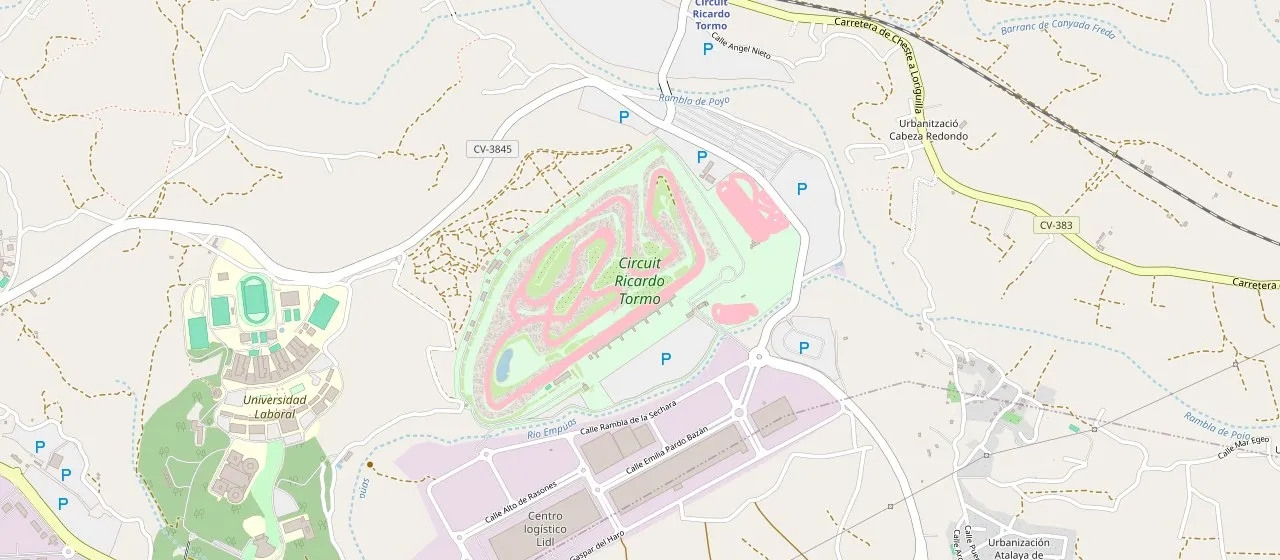
On Sunday 19 September 1999, a hundred thousand fans filled the grandstands of the new circuit at Cheste near Valencia in the rain and watched the Frenchman Régis Laconi win the 500cc race at the first Grand Prix in its history. The man whose name the circuit bears was not among them. Ricardo Tormo, the first world motorcycle racing champion from Valencia, had campaigned for years for a permanent circuit in his home region and died of leukaemia nine months before the opening. A quarter of a century later, Cheste ends the MotoGP season, racing teams test here in winter, and any adult driver with a driving licence can take their own car onto the track.
| Location | Cheste, province of Valencia, Valencian Community; about 20 km west of Valencia, exit 334 off the A-3 motorway to Madrid |
| Type | permanent racing circuit for motorcycles and cars, surrounded by grandstands like a stadium |
| Length | 4005 m in the Grand Prix configuration; 3.1 km outer variant |
| Corners and direction | 14 corners, five of them right-handers; anticlockwise |
| FIA licence | grade 2 for both variants, valid until 30 June 2027 |
| Opening | 19 September 1999, Valencian Community Grand Prix of the motorcycle world championship |
| Capacity | 65,000 seats in permanent grandstands, up to 120,000 spectators during the Grand Prix |
| Lap record | MotoGP, race record: 1:29.976, Raúl Fernández, Aprilia, 16 November 2025; MotoGP circuit record: 1:28.809, Marco Bezzecchi, Aprilia, qualifying, 15 November 2025 |
| Owner and operator | Circuito del Motor y Promoción Deportiva, SA, a public-sector company of the regional government (Generalitat Valenciana) |
| Major events | MotoGP from 1999 (except 2024), WorldSBK in 2000–2010 and planned again in 2027, a Formula E round in 2021, pre-season Formula 1 and Formula E tests |
| Status | active |
Ricardo's tears
The opening day went against the hosts from the morning. After a sunny week, Sunday arrived with rain, and by half past eight the crowd already filled the venue tightly. It was the first race weekend at the new circuit, and the riders had had only 20 minutes of practice on a wet surface. Just before the start of the 500cc class the rain stopped and the asphalt began to dry. Most of the field, including the championship leader Àlex Crivillé, chose intermediate tyres with tread. Laconi, starting from the front row, fitted slicks to his Yamaha and led from start to finish.
Crivillé, the winner of six of the eleven earlier races of the season, began cautiously and five laps from the end, chasing the riders on the podium places, he crashed. „I took a risk to catch them, and I failed”, he explained later. Laconi covered 30 laps, or 120.15 km, at an average of 135 km/h and beat Kenny Roberts by 3.5 s; it was the Frenchman's first Grand Prix win. The trophies were presented by King Juan Carlos and the head of the regional government, Eduardo Zaplana. „El País” noted that after the premier-class race „La Marseillaise” was played for the first time in 14 years. Crivillé became world champion that year anyway, the first Spaniard with a title in the top class.
The circuit operator repeats the story of people who saw Tormo race. He was brilliant in the dry and unbeatable in the wet, so they said that on that day it was not ordinary rain but „the tears of Ricardo, who could not come to the first Grand Prix at the circuit he had fought so hard for”.
Races between the houses
Before the circuit at Cheste existed, motorcyclists from the region raced on the streets of towns; the most famous course was the street circuit in Cullera. Ricardo Tormo, born in 1952 in Ayacor, a hamlet of Canals, started on such courses. He raced on the streets before he even had a licence for the motorcycles he rode, and he finished his first race, in November 1970 in Cullera, in second place. In 1974 Salvador Gascón, president of the Cullera motorcycle club and later of the Valencian motorcycle federation, floated the idea of a permanent circuit.
In autumn 1977 Tormo rode in the 250cc class on a street course near Alicante. From the account he later gave to „El Mundo Deportivo”, it appears that the front brake failed before a slow corner. The motorcycle went into spectators standing along the improvised course: a ten-year-old boy was killed, five people were seriously injured, and „El País” wrote that the accident showed the danger of such courses. Tormo, with a vertebral injury and advice to rest for two months, said then: „I will not race on street circuits any more”.
A year later he won five of the season's seven races and became the 50cc world champion. In 1981 he was champion again, winning all six races he started. His career was ended by an accident on 24 April 1984. Before the Grand Prix at the Jarama circuit he was testing modifications to his Derbi motorcycle on a road in the Martorelles industrial zone near Barcelona and collided with a car. His right leg was crushed; according to „El País” he then underwent 27 operations and never returned to the track.
A foundation stone without excavators
The political beginning of the circuit falls in the same year, 1984. According to SoyMotor.com, José Antonio Ibars, the member of the regional government responsible for sport, met Tormo and Jorge Martínez „Aspar” in Valencia, and a commitment to build came out of that meeting. The circuit had earlier been considered for Cullera, Benidorm, Gandia, Sueca and L’Alcúdia. Cheste was chosen, among other reasons because of its proximity to the airport and the A-3 motorway, and the land was expropriated.
Then came years of stagnation. Money was short, and circuits were being built in other parts of Spain, at Jerez, Albacete and Montmeló. In 1990 the head of the regional government, Joan Lerma, laid a symbolic foundation stone in an area called Cambrillas, but, as SoyMotor.com writes, not a single machine came to the building site. Throughout the 1990s motorcyclists gathered almost every Sunday in the centre of Valencia to demand that work begin. The journalist Fernando Miñana recalls posters with the slogan „Cervera, cumple”, that is „Cervera, keep your word”, aimed at José Emilio Cervera, the region's top official for sport.
The change of government in 1995 gave the project support, although money was still scarce. Construction began in 1997 and lasted two years. By notarial deed of 23 September 1998 the regional government founded a single-shareholder company, Circuito del Motor y Promoción Deportiva, SA. Its articles of association still name as its purpose the construction and running of the racing circuit of the Valencian Community and the promotion of sport; the share capital exceeds 32 million euros.
In December 1998 the circuit was presented to fans at the Luis Puig hall in Valencia, and on 27 December Ricardo Tormo died of leukaemia in Valencia. He was 46. „He won two world titles, but he could have won many more”, his friend Salvador Gascón told „El País”. The circuit was opened under the name Circuit de la Comunitat Valenciana Ricardo Tormo.
A circuit inside a stadium
Instead of stretching the loop across the countryside, the designers enclosed it in a compact site and surrounded it with grandstands. The operator calls this „a circuit inside a stadium”: from the 65,000 permanent seats the whole track can be seen. SoyMotor.com estimated that from every spectator seat 80 to 90 per cent of the lap is visible. Carmelo Ezpeleta, head of Dorna, the company that manages the MotoGP rights, said in 2025 that the circuit is „unique for the view it offers to spectators”. The whole facility covers 130 hectares, and for the Grand Prix its capacity rises to 120,000 spectators.
The Grand Prix loop measures 4005 metres and is driven anticlockwise; of its fourteen corners only five turn right. The grade 2 FIA licence also covers a shorter outer variant, 3.1 km long. Nine corners have patrons. The first is Jorge Martínez „Aspar” corner, the second Michael Doohan's, the sixth Ángel Nieto's, the seventh the fans', and the fourteenth, the last before the start straight, is Adrián Campos's, at the time it was named in 2003 the only Formula 1 driver from Valencia. The monument to Ricardo Tormo at the main entrance then received a fourth bust: Campos joined Doohan, Nieto and Aspar. According to the operator every Valencian world champion gets a corner; in 2023 the eleventh corner went to Jaume Masià, the Moto3 champion and the fifth world champion from the region.
The 1999 asphalt was replaced in full in 2012, and in 2016 a new surface was laid on the last 460 metres of the start straight, in the braking zone. In autumn 2022 the operator announced a third full resurfacing, of 58,536 square metres.
The championships end here
The Valencian Community Grand Prix stayed on the calendar and in time became the season finale. Twelve days after the attacks on the World Trade Center, on 23 September 2001, in a race in which it neither properly rained nor stopped raining, Sete Gibernau won here. It was the first win by a Spaniard in a Grand Prix at this circuit and the first of Gibernau's career; on the lap of honour he planted an American flag next to the Spanish one in front of the grandstands.
Valentino Rossi came into the finale of 29 October 2006 as championship leader. After a poor start he crashed at Doohan corner, rejoined and finished thirteenth. Nicky Hayden was third and became world champion with a margin of five points, 252 to 247. The race was won by Troy Bayliss, a Superbike world championship rider to whom Ducati gave a motorcycle for the final round. According to the circuit operator the Australian cut short his holiday for it, and the win at Cheste remained his only one in MotoGP.
At the finale on 6 November 2011, two weeks after the death of Marco Simoncelli at Sepang, the grandstands paid him tribute, and Nico Terol from Alcoy, second in the 125cc race, secured the world championship. He was the first graduate of the Cuna de Campeones school, which operates at the circuit, to win a world title, and the fourth Valencian champion after Tormo, Aspar and Manuel „Champi” Herreros.
The operator calls the finale of 8 November 2015 „the race of the century”. Rossi, the leader with a margin of seven points, started from the back of the grid, penalised because, as the AP agency wrote, in the previous race in Malaysia he had kicked Marc Márquez. Jorge Lorenzo won from pole position, Rossi fought his way up to fourth place and lost the title by five points, 325 to 330. According to the operator the authorities for the first time classed the Grand Prix as a high-risk event, and 110,571 people sat in the grandstands.
Winter laps of Formula 1
From 2000 the circuit received FIA homologation for Formula 1 testing every year and became a popular venue for winter driving before the season. It also hosted the WTCC touring car world championship and the German DTM series. According to the operator, Fernando Alonso was tied to the circuit for two years, during his learning period. In 1999 Alonso won the Nissan series in the colours of Adrián Campos's team, and according to SoyMotor.com he secured the title in November at Cheste itself.
In February 2006 the head of the regional government, Francisco Camps, spoke in London with Bernie Ecclestone about a Formula 1 Grand Prix in Valencia. The circuit then announced a rebuilding plan: widening part of the loop, lengthening it by 400 metres, to 4400 metres, and replacing the middle section, from the fourth corner to the bend before the straight, with a new straight, two very fast bends and two hairpins. „We got ahead of a possible decision to put the circuit on the Formula 1 calendar”, said the managing director Eduardo Nogués. In April that year the GP2 series, the feeder series of Formula 1, came here. The lengthened loop does not exist to this day: the 2026 FIA licence gives 4005 metres for the Grand Prix configuration. When Formula 1 came to Valencia in August 2008 for the European Grand Prix, it raced on a street circuit in the city.
The tests stayed. The 2010 winter testing season was opened by Cheste itself: on 1 February Michael Schumacher, the seven-time world champion returning to racing, drove 40 laps in the afternoon in the Mercedes W01. It was his first outing in a current Formula 1 car since April 2008. The same day Robert Kubica did 69 laps in the new Renault R30. „My first day of testing the R30 went well”, he said. Two days later thousands of spectators came to see Fernando Alonso in a Ferrari for the first time. The Spaniard drove 127 laps and had the best time of the day, 1:11.470.
The race that ran out of power
Since autumn 2017 Cheste has also hosted pre-season Formula E tests. When the pandemic broke up the calendar, the series put the circuit down for 24 April 2021. It was the first round of the Formula E world championship in Spain, held not on the full loop but on a specially prepared variant. Concrete barriers at key points and a tight chicane after the last corner were meant to give the circuit the character of a street course.
The race was interrupted by safety car neutralisations, and under the rules each of them reduced the amount of energy the drivers could use. The leader, António Félix da Costa, crossed the finish line shortly before the 45 minutes expired, and the field had to complete two more laps, not one, as many drivers had counted on. Some of them ran out of energy. Nyck de Vries of Mercedes won, and da Costa was disqualified for exceeding the limit; nine drivers remained in the final classification and five were disqualified. „I don’t think we should ever come to a circuit like this, because it is not Formula E”, said Jean-Éric Vergne, da Costa's team-mate.
Seventy euros for half an hour
Between the big events the circuit is filled with training and driving days. In 2024, according to the operator, the lights at the circuit were green on 87.4 per cent of days, not counting the forced shutdown. The operator itself organises „tandas de coches”, open driving sessions for, as it writes, anyone who wants to drive their own car, professional or amateur. The day is divided into four half-hour sessions, A to D. In advance sale a set of all four costs 250 euros and a single session 70 euros, plus compulsory insurance of 15 euros per person, payable at the race office.
The rules stress that this is „recreational driving, not a competition”. The driver must be at least 18 and hold a category B licence, and the car must be roadworthy. A helmet is required (open-face only if it is a car helmet), as are belts or harnesses, and the permitted alcohol level is zero. Single-seaters and convertibles are not accepted for general driving, and passengers may not be carried on the rear seats.
Private companies also organise driving days. The Spanish Tandas Privadas has planned a day at Cheste for Saturday 19 December 2026; seven hours with an open pit lane cost 299 euros if you sign up by 31 October, and 399 euros later. The German company GEDLICH Racing of Eschborn sells, for 8 and 9 March 2027, two-day driving in groups at 3490 euros per participant with one car, with catering included. The circuit is reached by the A-3 motorway (exit 334), and on Grand Prix weekends suburban trains from Valencia stop at a station by the circuit.
Eighteen thousand tonnes of mud
On the evening of 29 October 2024, water from a storm that in Spain is called DANA or „cold drop” (gota fría) destroyed the access roads to the circuit. The pre-season Formula E tests, a round of the FIM JuniorGP and the sold-out Grand Prix were cancelled. Circuit staff hauled out about 18,000 tonnes of mud from more than 170,000 square metres of car parks, and the circuit was closed for 37 days. The first private sessions returned on 5 December. The MotoGP finale was moved to Barcelona, where the Solidarity Grand Prix was held on 15–17 November. It raised 1.6 million euros for the victims, and according to the Cheste operator the money went to the two worst-hit municipalities next to the circuit, Cheste and Chiva.
In March 2025 the regional government extended its agreement with MotoGP to 2031: for five seasons from 2027, without rotation with other circuits. It earmarked a million euros for rebuilding the bridge and the access roads. Another return is already in the calendar: on 4 April 2027, after a 17-year break, the Superbike world championship is due to return to Cheste, having run 22 races here in 2000–2010.
MotoGP returned to Cheste in November 2025. On Saturday Marco Bezzecchi of Aprilia set a qualifying lap of 1:28.809, the fastest in the history of the circuit in this class. On Sunday, 16 November, he won the race from pole position, 0.686 s ahead of Raúl Fernández, who on the fourth lap set the race lap record, 1:29.976. The grandstands held 93,972 spectators that day and 205,319 over the whole weekend, twenty-six years after the rainy Sunday that Ricardo Tormo did not live to see.
Timeline
- 1970: Ricardo Tormo makes his debut in a street race in Cullera.
- 1974: Salvador Gascón proposes building a permanent circuit in the Valencia region.
- 1978: Tormo becomes 50cc world champion; he will win a second title in 1981.
- 1984: the regional government commits to building a circuit and chooses Cheste; on 24 April an accident ends Tormo's career.
- 1990: Joan Lerma lays a symbolic foundation stone.
- 1997: construction begins.
- 1998: on 23 September the company Circuito del Motor y Promoción Deportiva is founded; on 27 December Ricardo Tormo dies.
- 1999: on 19 September the circuit opens with the first Grand Prix, won by Régis Laconi.
- 2000: the first round of the Superbike world championship; the circuit receives homologation for Formula 1 testing.
- 2001: Sete Gibernau becomes the first Spanish winner in the premier class at this circuit.
- 2003: the last corner is named after Adrián Campos.
- 2006: plan to lengthen the circuit to 4400 m for Formula 1; a GP2 round; Nicky Hayden becomes world champion after the finale at Cheste.
- 2010: Formula 1 test with Michael Schumacher's comeback and Fernando Alonso's debut in a Ferrari; last WorldSBK round before the break.
- 2011: Nico Terol becomes 125cc world champion at his home circuit.
- 2012: first full replacement of the asphalt.
- 2015: Jorge Lorenzo becomes champion after a finale in which Valentino Rossi started from the back of the grid.
- 2021: on 24 April a Formula E world championship round on a special variant of the circuit.
- 2023: corner 11 is named after Jaume Masià.
- 2024: on 29 October a flood destroys the access roads; the MotoGP finale is moved to Barcelona.
- 2025: agreement with MotoGP extended to 2031; on 16 November the Grand Prix returns and Marco Bezzecchi wins.
- 2027: on 4 April the planned return of the Superbike world championship.
Sources (42)
- Francisco Latorre, Se aguó la fiesta, „El País”, 1999-09-20 [es]
- MotoGP (Dorna Sports), G. P. Movistar Comunitat Valenciana, 500cc, Race Classification, Cheste, 1999-09-19 [en]
- Circuit Ricardo Tormo, Ricardo Tormo [es]
- Tormo pierde la carrera contra la leucemia, „El País”, 1998-12-28 [es]
- Circuit Ricardo Tormo, Historia [es]
- Circuit Ricardo Tormo, RacingCircuits.info [en]
- Circuit Ricardo Tormo, Tandas de coches [es]
- FIA, List of FIA Licensed Circuits, 2026-03-31 [en]
- Circuit Ricardo Tormo, El Circuit Ricardo Tormo renovará su asfalto el próximo verano, 2022-11-01 [es]
- Circuit Ricardo Tormo, El Circuit concede la curva 11 del trazado al Campeón de Moto3 Jaume Masià, 2023-11-26 [es]
- Redakcja ComarcalCV, El Circuito Ricardo Tormo de Cheste cumple 25 años, ComarcalCV, 2024-09-12 [es]
- MotoGP (Dorna Sports), Motul Grand Prix of the Valencian Community, MotoGP Race Classification, Cheste, 2025-11-16 [en]
- Circuit Ricardo Tormo, 93.972 aficionados celebran el regreso de MotoGP al Circuit Ricardo Tormo, 2025-11-16 [es]
- Circuito del Motor y Promoción Deportiva, SA, Estatutos consolidados de la sociedad pública Circuito del Motor y Promoción Deportiva, SA - 2025 [es]
- Carlos Pascual de Miguel (notariusz), Constitución de la sociedad unipersonal «Circuito del Motor y Promoción Deportiva, S.A.». Otorgante: Generalitat Valenciana, 1998-09-23 [es]
- Circuit Ricardo Tormo, El Circuit cierra 2024 recibiendo el apoyo de la comunidad del mundo del motor tras la DANA, 2024-12-23 [es]
- Circuit Ricardo Tormo, ¡¡Vuelven las Superbikes!! 17 años después WorldSBK recupera Valencia para su calendario 2027, 2026-10-01 [es]
- FIA Formula E, Round 5 - Valencia e-Prix - Race (45' +1 lap), Final Classification, 2021-04-24 [en]
- Circuit Ricardo Tormo, 5 momentos inolvidables + 1 salvada histórica, 2016-05-09 [es]
- Circuit Ricardo Tormo, 25 aniversario: 1999 – 2024 la máquina del tiempo, 2024-02-04 [es]
- El circuito de Cheste cumple 18 años de emociones, SoyMotor.com, 2017-09-19 [es]
- Un niño muerto en Alicante, „El País”, 1977-10-25 [es]
- Tormo: «No correré más en circuitos urbanos», „El Mundo Deportivo”, 1977-10-26 [es]
- Fernando Miñana, Bonitos recuerdos de los 25 años del Circuito Ricardo Tormo, Plaza Deportiva (Valencia Plaza), 2024-09-12 [es]
- Circuit Ricardo Tormo, Carlos Mazón anuncia la renovación del ValenciaGP en el Circuit hasta 2031, 2025-03-25 [es]
- Una de las curvas del circuito llevará el nombre de Adrián Campos, AS, 2003-10-14 [es]
- MotoGP (Dorna Sports), GP Marlboro Comunitat Valenciana, 500cc, Race Classification, Cheste, 2001-09-23 [en]
- MotoGP (Dorna Sports), GP bwin.com de la Comunitat Valenciana, MotoGP Race Classification, Cheste, 2006-10-29 [en]
- MotoGP (Dorna Sports), GP bwin.com de la Comunitat Valenciana, MotoGP World Championship Classification, Cheste, 2006-10-29 [en]
- Associated Press, Jorge Lorenzo wins third MotoGP title with victory in Valencia finale, „The Guardian”, 2015-11-08 [en]
- MotoGP (Dorna Sports), GP Generali de la Comunitat Valenciana, 125cc World Championship Classification, Cheste, 2011-11-06 [en]
- MotoGP (Dorna Sports), GP Motul de la Comunitat Valenciana, MotoGP Race Classification, Cheste, 2015-11-08 [en]
- MotoGP (Dorna Sports), GP Motul de la Comunitat Valenciana, MotoGP World Championship Classification, Cheste, 2015-11-08 [en]
- EFE, Cheste realizará modificaciones para albergar un Gran Premio, AS, 2006-02-23 [es]
- Formula 1, 2008 Europe, Race Result [en]
- Valencia day one - Massa leads the way for Ferrari, Formula1.com, 2010-02-01 [en]
- Valencia day three - Ferrari stay top as Alonso debuts, Formula1.com, 2010-02-03 [en]
- Circuit Ricardo Tormo, La Fórmula E en el Circuit Ricardo Tormo, 2021-01-28 [es]
- Hazel Southwell, Formula E stands by energy management rules after Valencia farce, RaceFans, 2021-04-25 [en]
- Tandas Privadas, CHESTE…. Tandas Privadas 19.12.2026, 2026-12-19 [es]
- GEDLICH Racing, 8/9 Mar 2027 Endless Summer Track days Valencia [en]
- Circuit de Barcelona-Catalunya, MotoGP y Valencia premian al Circuit por el Gran Premio Solidario de 2024, 2025-11-16 [es]