
Le Mans, France
Circuit Bugatti: mocked by F1, loved by motorcycle racers
History of the Bugatti circuit at Le Mans: from Charles Deutsch's hand, through the only F1 GP of 1967, to MotoGP, 24h Motos, rebuilds, crashes and track days.
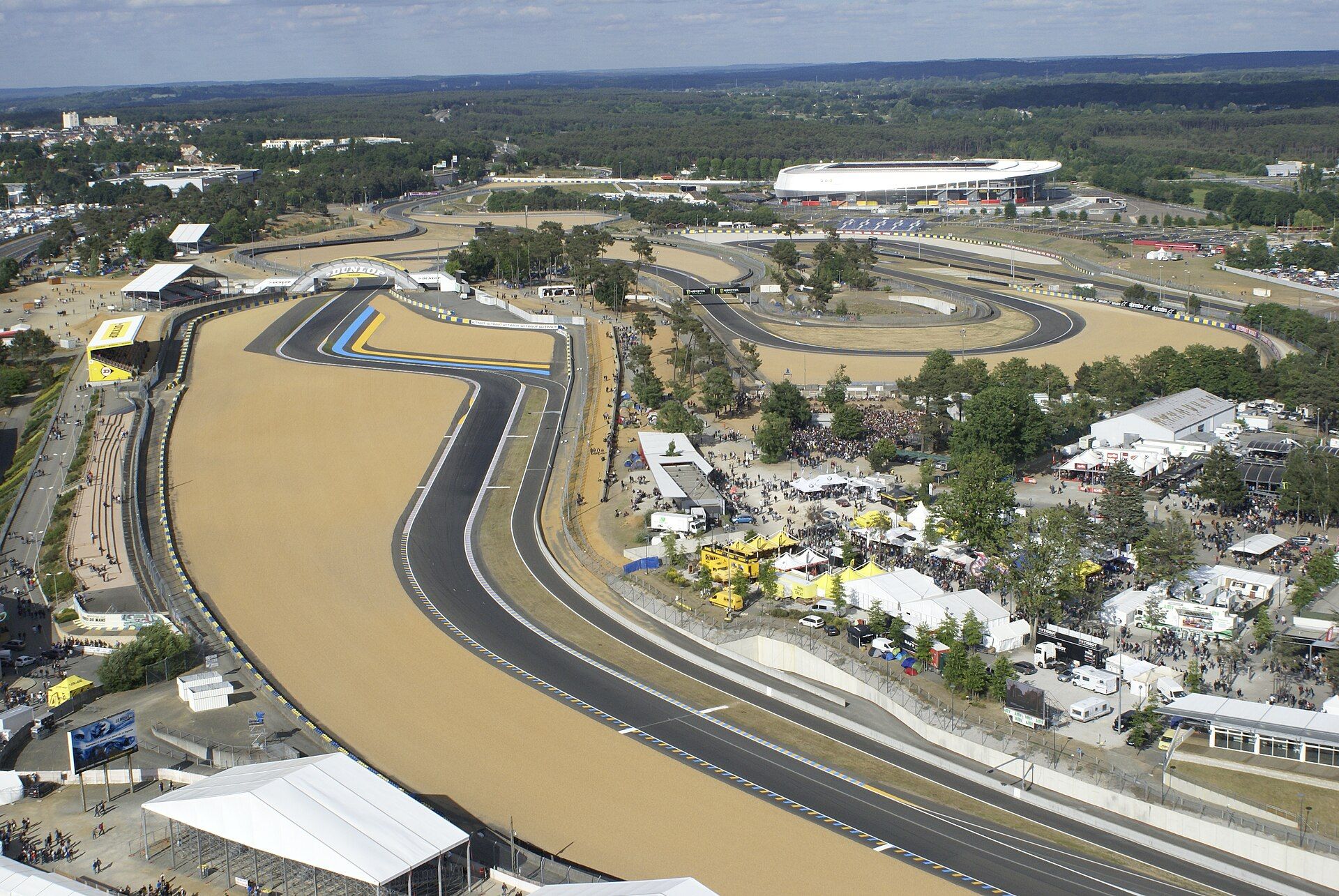
- Type
- race circuit
- Length
- 4.185 km
- Opened
- 1965
In the summer of 1967 Denis Jenkinson, correspondent of „Motor Sport”, watched fifteen Formula 1 cars roll up to the start at Le Mans while 20,000 spectators were lost in grandstands built for 200,000. The Grand Prix de France was being run on the brand new Circuit Bugatti, which the paddock had already christened the „Grand Prix of the car parks”. Formula 1 never came back here. Two years later, though, Giacomo Agostini went out on the same loop, and today this four-kilometre circuit, squeezed between the grandstands of the 24h of Le Mans and a pine forest, draws more than 300,000 people for the MotoGP weekend.
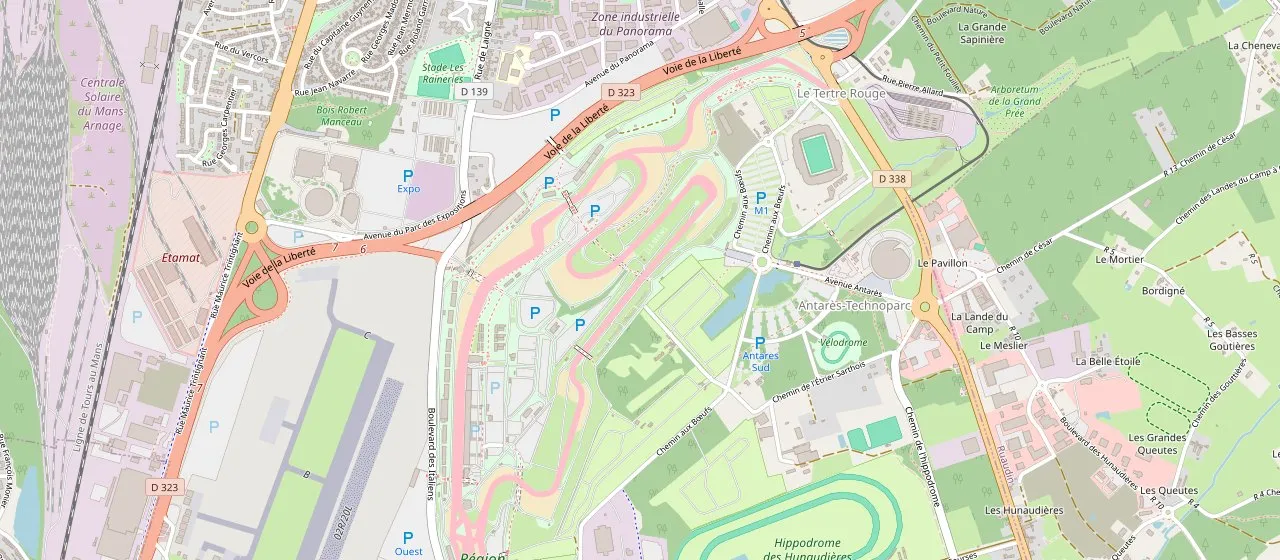
| Location | Le Mans, Sarthe department, about 5 km south of the city, on the grounds of the 24h Le Mans complex |
| Type | permanent racing circuit, homologated by the FIA and the FIM |
| Length and configuration | 4.185 km (2008 layout); track width from 10 to 15 m |
| Year of opening | built in 1965 |
| Corners | 14 (9 right, 5 left); longest straight 674 m |
| Section shared with the 24h loop | about 1500 m: the start straight, the Dunlop rise, the Dunlop chicane, the descent to the La Chapelle corner |
| Track record (outright) | 1:20.648, Tio Ellinas, Dallara-Renault Formula Renault 3.5, qualifying 2015 |
| Track record (MotoGP) | 1:29.288, Marc Márquez, Ducati, Q1 of the Grand Prix de France, 9 May 2026 |
| Owner and operator | land and infrastructure: Syndicat mixte du circuit des 24 Heures du Mans; user under a 50-year lease: Automobile Club de l'Ouest (ACO) |
| Main events | MotoGP Grand Prix de France (permanently since 2000), 24 Heures Motos (since 1978), 24 Heures Camions (since 1981), GP Explorer; the only F1 French GP (1967) |
| Attendance 2025 | Grand Prix de France Moto 311,797, 24 Heures Camions 80,100, 24 Heures Motos 71,200, GP Explorer 250,000 spectators |
| Status | active |
Charles Deutsch's left hand
The idea of a circuit that does not disappear after the race had been on the minds of Automobile Club de l'Ouest officials since the 1950s. The great 24h loop really existed only once a year, because it ran on public roads; the rest of the time the pits, the grandstands and the tunnels stood empty. In 1951 Jean-Marie Lelièvre became president of the ACO, and the only genuinely permanent circuit in France was then Montlhéry near Paris. Lelièvre wrote in the magazine „l'Action automobile” about how hard it was to organise races in the country, and he heard the same from the clubs affiliated to the ACO. Money blocked the project, however: the club was repaying a loan from the Sarthe departmental council for the rebuilding of the venue after the tragedy of 11 June 1955.
At the beginning of the 1960s Lelièvre was joined by Jacques Finance, head of the ACO sporting commission since 1949, a former driver and steward. The layout was commissioned from Charles Deutsch, co-creator of the DB marque, chief engineer at the state roads and bridges authority, later director of the 24h race. Deutsch had no permanent circuit in France to take as a model. According to the ACO's account he therefore took the outline of his own left hand as a template and arranged from it a sequence of hairpins, large-radius curves and short straights. The study was produced in 1963, the plans were approved at the end of the same year, and earthworks began that winter. The sandy ground soaked up the rain, so construction did not stop; the circuit was ready before the 24h race in 1965, and the first competition was held at the end of that year.
The original loop measured 4.422 km. Just past the Dunlop bridge, on the descent towards Tertre Rouge, the track turned right into a tight hairpin and ran parallel to the 24h loop towards the village. The freshly built Musée des 24 Heures building forced a wide, parabolic curve banked at up to 14 per cent, turning the direction of travel through more than 180 degrees; beyond it a straight led to the eastern edge of the site, then another hairpin and the long Chemin aux Bœufs straight, the esses and a flat hairpin before rejoining the start straight. The safety measures were simple and cheap: fascines of acacia and brushwood, of which there was no shortage in the area, and half-buried tyres painted white, marking the apexes of the corners. The name Chemin aux Bœufs, that is „the oxen road”, comes from a Roman road next to the circuit, along which in more recent times cattle were driven from the Vendée and Poitou to the Paris markets.
The circuit's name is the president's personal story. Between the wars Lelièvre insured the Bugatti marque as director of the Mutuelle Générale Française company, was a friend of Jean Bugatti and himself drove first a Type 13 Sport, then a Type 57; with the latter car he was helped on the streets of Molsheim by Robert Benoist, the 1937 winner of the 24h. Three decades later he proposed to the committee that the permanent circuit should bear the name of Ettore Bugatti. Finance, who in his youth had raced a Bugatti himself, took up the idea with enthusiasm. For the official inauguration the ACO invited L'Ébé, the constructor's daughter, and Pierre Veyron, author of Bugatti's second Le Mans victory in 1939. The first director of the circuit and of the driving school founded in 1965 was the former driver Charles de Cortanze; among the first instructors was his son André, the future designer of the Peugeot 905.
The Grand Prix of the car parks
Two years after the opening the ACO persuaded the Automobile Club de France to move its Grand Prix to the Circuit Bugatti, although Reims, Rouen and Clermont-Ferrand were available. Jenkinson described the layout without mercy: the cars left the start straight, climbed up under the Dunlop bridge, and instead of heading for Tertre Rouge turned in a hairpin into a „huge car park”, made two more hairpins, crossed the site to a second car park with an artificial ess and came back through a very slow right-hand corner in front of the pits. „A driving school circuit maybe, but not a Grand Prix circuit by European standards, or even by British standards”.
The heat punished the fuel systems, the drivers had no appetite for serious practice, and the public did not take the trouble to come. The cars passed the pits at 80–90 miles per hour, so slowly that team managers could almost talk to their drivers; people used to the 24h prototypes flashing past here at 160 miles per hour found it deadly dull. On race day, 2 July 1967, 20,000 people turned up at a venue holding 200,000. The race itself was settled by mechanics: the Lotus 49s of Jim Clark and Graham Hill were running away from everyone until both were stopped by their ZF gearboxes, and Dan Gurney went out of the Eagle with a broken injection pipe. Seven cars were classified, and Jack Brabham won ahead of Denny Hulme in the second Brabham-Repco. „Everyone seemed relieved that the whole farce of a Grand Prix on a driving school circuit was over”. In the ACO chronicle Hervé Guyomard, for many years the circuit's director, admitted long afterwards that some drivers had called the venue „characterless”, and that the meaner American journalists had coined the term „Mickey Mouse circuit”. Formula 1 never returned here; Formula 2 had already visited a year earlier, in 1966, and in 1987–1991 Formula 3000 raced at Bugatti.
Motorcycles take the circuit
For two wheels history went the other way round. On 18 May 1969 the Circuit Bugatti hosted a motorcycle Grand Prix de France for the first time: in the 500 cc class Giacomo Agostini on the three-cylinder MV Agusta lapped the entire field and won by a lap from Billie Nelson on a Paton; the 250 cc went to Santiago Herrero on an Ossa, the 125 cc to the Frenchman Jean Auréal on a Yamaha. In the same year Bugatti took in the 1000 km race, in 1971 the Bol d'Or moved here and stayed until 1977, and in 1978 the ACO created its own round-the-clock race: the 24 Heures Motos. The first edition, on 28 and 29 April 1978, was won by Jean-Claude Chemarin and Christian Léon on a Honda. Jean-Marc Desnues, former communications director of the ACO and today vice-president of FIM Europe, judges that it was the Bol d'Or that „most probably confirmed its vocation as an international circuit”, because in the France of the 1970s it was endurance that drew the most spectators.
The Grand Prix returned to Bugatti irregularly: in 1970, 1976, 1979, 1983, 1985, 1987, 1989 and 1990, alternating with Nogaro, Paul Ricard, Clermont-Ferrand and Magny-Cours. The 1983 edition was the blackest. On Tuesday 29 March, during free practice before the weekend, the works Suzuki rider Iwao Ishikawa was hit by Loris Reggiani's Suzuki at the La Chapelle corner, the first right-hander at the end of the start straight; with severe head injuries he was taken to hospital in Le Mans, and then to a neurosurgical clinic in Tours, where he died. Five days later, on Sunday 3 April, in the 500 cc race the Swiss Michel Frutschi, winner of the previous French GP, went off at about 220 km/h on the Chemin aux Bœufs curve, hit his head on a fence post and died in hospital the same afternoon.
It was after those years that the Fédération Internationale de Motocyclisme (FIM) demanded a slowing device before the Dunlop bridge: it feared that motorcycles accelerating to nearly 300 km/h would start to „take off” on the descent towards La Chapelle. The Dunlop chicane, used from then on by the 24h loop as well, appeared in 1987, and Chemin aux Bœufs was given a sharper left-right sequence. Gérard Jolivet, record holder for the number of starts in the 24 Heures Motos, still remembers the Dunlop curve without the chicane: „the bike lifted and dropped, you had to pump the brake to bring the pads closer”.
Bugatti also got a Grand Prix that nobody had planned. When the Brazilian GP was cancelled in 1991 for safety reasons, the FIM asked the ACO to organise a replacement round: on 8 September 1991 the Grand Prix de vitesse du Mans was held, the second world championship round in France that year. Desnues recalls that the race „was put together from scratch in barely two months”; the top five in the 500 cc class were Kevin Schwantz, Mick Doohan, Wayne Rainey, John Kocinski and Wayne Gardner. In 1994 and 1995 the French GP came back to Bugatti, for the first time in the hands of the promoter Claude Michy and his company PHA. Then, however, in practice before the 1995 Grand Prix, the Spaniard Alberto Puig, fresh from his first win in Spain, lost control of his 500 cc Honda on the Dunlop curve; the Moto-Net portal writes of „a broken career and a broken leg”. The official MotoGP site adds outright that after this serious accident the circuit was struck off the calendar until 2000, for the duration of „stringent safety improvements”; for four editions the French GP was held at Paul Ricard.
Since 2000 the Grand Prix has not moved from Le Mans. The first winner of the new MotoGP era in 2002 was Valentino Rossi, and the race became the most watched round of the 2023 and 2024 seasons. In 2025, over four days, 311,797 people came through the gates, about 14,000 more than the year before, and for the first time in MotoGP history the weekend passed the threshold of 300,000 spectators. David Dumain, journalist and former MotoGP commentator, quotes Rossi's words that at Bugatti you ride „between two walls of spectators”, especially on the start straight. The MotoGP track record belongs to Marc Márquez: on 9 May 2026 in Q1 he lapped in 1:29.288.
Eight faces of one circuit
Since the first 24 Heures Motos in 1978 the circuit has changed shape eight times; the ACO counts each version separately. The 1978–1986 configuration measured 4.240 km, after the addition of the Dunlop chicane in 1987 it was 4.267 km, and after the rebuilding of the S Bleus esses and the Raccordement corner in 1988–1989, when new pits were built and the pit lane entry was moved, it grew to 4.430 km. In the winter of 1996/1997 the run-off areas and the gravel at the Dunlop chicane were widened (4.435 km in 1997–1998). Before the 1999 season the Musée corner was rebuilt: the left-hand curve began earlier, the entry became tighter and the exit faster, which shortened the loop by 130 m, to 4.305 km.
The biggest works came with the FIM's demands. In 2002 the whole section between the Dunlop bridge and the esses was demolished, the descent to La Chapelle was replaced by a sequence of fast curves, and the run-off areas of that corner were extended to the federation's standards: 70,000 m³ of earth was moved and 12,000 tonnes of gravel spread. The loop shrank to 4.180 km. In the winter of 2005/2006 the entry to and the passage through the Dunlop chicane were tackled: the radius of the curve was tightened, the angle of the chicane was closed up, 8000 tonnes of asphalt and 15,000 tonnes of gravel were used, and the village, the riders' paddock and the northern tunnel were modernised at the same time. According to the Panhard Racing Team club the FIM threatened at the time that without these changes the Grand Prix would not be held at Le Mans. The last change of geometry is from 2008: the Garage Vert corner, unchanged since 1978, was moved about twenty metres to the right, keeping its U shape but creating a wide run-off area on the left; 750 m of track was relaid and the length settled at 4.185 km.
Guyomard points out that the safety measures changed along with the geometry: the fascines gave way to barriers, moved back from the track and shielded with nets, and then the federations forced through run-off areas and gravel. The „sea of sand” at the Dunlop curve allowed the circuit to keep the Grand Prix and the 24 Heures Motos. Details were added later: in 2009 sixty-one protective screens between the start straight and the signalling area, in 2010 a new spectator bank in the Le Houx area, in the winter of 2011/2012 kerbs adapted to the regulations, in the 2014/2015 season hydro-abrasion of the surface for grip. In the autumn of 2016, twelve years after the previous asphalt was laid, 4 cm of surface was milled off over the whole 50,000 m² in three weeks and new asphalt concrete was laid; Eurovia used a binder designed by Shell, the same one that lies at the Nürburgring, the Hockenheimring and Ferrari's Fiorano circuit. Ghislain Robert of the ACO explained that only the top layer was being replaced, because the structure was not damaged; the cost of 600,000 euros was borne by the local authorities.
Who pays for the circuit
There is a reason why the local authorities pay for the asphalt. The club built the Circuit Bugatti itself, but in 1985 the club came to the edge: it did not have the means to keep the venue at the level required by the federations, and the 24h race could have disappeared. On the initiative of the local authorities the Syndicat mixte du circuit des 24 Heures du Mans was then created, made up of Le Mans Métropole, the Sarthe departmental council and the Pays de la Loire regional council. Since then all sections of the track and the land, including the Circuit Bugatti, the Maison Blanche circuit, the kart track and the airfield, have been the property of the syndicate. The ACO leases them under a 50-year agreement (bail emphytéotique), which costs the club about 2.5 million euros a year, and in return it operates the venue, maintains it and finances the adaptations required for homologation. According to the geographer Louis-Thibault Buron the club pursues a policy of gradually recovering full ownership; in 2016 it bought the museum back from the department. Dominique Le Mèner, president of the syndicate and of the departmental council, estimated in 2016 that the venue brings the department about 107 million euros a year. The Dunlop bridge, under which Bugatti climbs at the beginning of every lap, has carried the Goodyear name since 10 February 2026: after the sale of the marque, Dunlop could no longer appear at the circuit, although ACO president Pierre Fillon assured that the names of the curve and the chicane would remain.
Guyomard, the circuit's director from 1971 to 2006, summed it up in one sentence: „The Circuit Bugatti is so versatile that you can organise anything you want on it”. In 1970 the venue was working about 90 days a year, at the end of the 1990s easily 330 days. In 2025 the ACO rented out the Bugatti and Maison Blanche circuits for a total of 147 days and received 27,720 people that way, and at the complex's six big events it hosted 1.28 million spectators.
Trucks, YouTubers and cyclists
The circuit that Formula 1 took for a car park turned out to be a stage for races that exist nowhere else. In 1981 Jean-Pierre Moreau, the ACO's sporting director, came up with a round-the-clock truck race together with two men from RTL radio, Michel Leblanc and Max Meynier, host of the programme „Les routiers sont sympas”. Guyomard recalls that at the beginning the trucks and trailers were lent by the haulier André Robineau from Soulitré, and that in a regularity and fuel consumption test one of the trucks carrying 24 tonnes of plasterboard overturned twice at Garage Vert; the director recovered 50 tonnes of material to insulate the museum. The race was initially held every two years, which is why in 2025 it was only celebrating its fortieth edition, and since 2023 it has had a night race on the programme. Fabien Calvet, the 1996 winner and head of the FFSA truck commission, reckons that 70 per cent of the public comes from the road transport world and arrives with their families; children under 16 get in free.
On 8 October 2022 twenty-two internet creators went out at Bugatti in eleven Formula 4 teams, in a race devised by the YouTuber Squeezie. More than 40,000 spectators filled the grandstands, and the Twitch broadcast, watched by more than a million people, broke the record for a French-language stream. The second edition, on 9 September 2023, drew 60,000 spectators on site and 1.3 million in front of screens; Delpielo won. In the ACO's statistics for 2025 the GP Explorer appears with 250,000 spectators, ahead of the 24 Heures Camions (80,100) and the 24 Heures Motos (71,200). In its anniversary text of 2026 the club admits that it was the internet creators' race that popularised racing among young people who previously had nothing to do with motorsport. On top of that come the 24-hour cycling and roller-skating races that the ACO lists among the circuit's events.
A track day at Bugatti
From its first day the circuit was meant to serve amateurs: it was created as the base of a driving school, and in 1969 a motorcycle school was added. Today the driving is run by Le Mans Driver, the ACO's school. In the 2026 season a car day at Bugatti costs 250 euros and consists of five sessions of 20 minutes; an FFSA licence is required, convertibles without a roll cage and passengers are excluded, and the car must fit within the FFSA noise limit of 100 dB, watched over by sensors around the circuit. A motorcycle day costs 195 euros, riding is in four ability groups, on motorcycles from 500 cc up, with a limit of 109 dB in a dynamic measurement under the FFM regulations; an FFM licence or a „Pass Circuit” is required. ACO members and licence holders have a separate calendar of club sessions with discounts and a box above the start straight.
Noise is a subject the operator does not hide. On the motorcycle entry page the ACO explains that residents' associations and the prefecture demanded additional efforts, so since the 2022 season the club allows no exceptions to the sound standards, including for motorcycles with road homologation, „because the survival of their passions depends on it”. In March 2021, as Endurance-Info reported after France Bleu Maine, the ACO filed an application with the prefecture to extend the sessions from the existing windows of 9–12 and 14–18 to 8–20, promising not to exceed 65 decibels in the additional hours; the residents' association alerted the prefecture.
Track days also have their dark page. On 27 September 2014, during a private „Tinseau Test Day” with forty cars, one of the cars began losing oil at the end of the start straight; while race control was signalling the danger, another driver lost control and hit a car stopped on the verge, which caught fire. The driver of the car that was hit was killed, the second went to hospital seriously injured. On 24 July 2020, at a motorcycle session, a rider collapsed on his machine and fell on his own; he died despite help at the circuit's medical centre. On 15 September 2021, at about 14:15, at a private session organised by the company Box23, three motorcycles collided: a 36-year-old amateur from the Paris region was killed, two people were injured, and the riding was not resumed.
The circuit itself, as the riders describe it, does not forgive weak brakes. Desnues calls it „a braking circuit, physically demanding (especially in Endurance), where the average lap speed is lower than at other, faster circuits, although the Dunlop curve is taken at more than 300 km/h, with very difficult braking while leaned over”. Vincent Philippe, three-time winner of the 24 Heures Motos, speaks of a circuit that is „a bit stop-and-go”, with heavy braking and acceleration that load the wrists, shoulders and back; Jennifer Janiec, a truck driver, praises the wide surface on which two trucks run side by side. Dumain, who as a commentator recognised the corners by the colour of the gravel, adds that the start straight „turns into a banked curve and you have to take Dunlop well to set up the rest of the lap”.
The works do not stop in any winter. Before the 2019 season the Musée corner was given 300 m of new drainage blocks, and the kerbs were improved in places; the work was carried out jointly by the ACO and the syndicate, which a year later laid new asphalt on the section from Raccordement to La Chapelle and built retention basins at Le Houx and the S Bleus. The circuit, which started out with fascines and tyres painted white, gets a new piece of gravel or asphalt every winter, so that in April it can take the 24 Heures Motos and in May the Grand Prix.
Timeline
- 1951: Jean-Marie Lelièvre becomes president of the ACO and starts pushing the idea of a permanent circuit.
- 1963: Charles Deutsch's study of the layout; plans approved at the end of the year.
- 1965: the 4.422 km circuit ready before the 24h of Le Mans; first competition at the end of the year; the driving school is founded under Charles de Cortanze.
- 1966: first Formula 2 race.
- 1967: 2 July, the only Formula 1 French Grand Prix at Bugatti; Jack Brabham wins in front of 20,000 spectators.
- 1969: 18 May, first motorcycle French GP at the circuit; Agostini wins the 500 cc; the 1000 km race; the motorcycle school.
- 1971–1977: the Bol d'Or at the Circuit Bugatti.
- 1978: 28–29 April, first 24 Heures Motos.
- 1981: first 24 Heures Camions.
- 1983: deaths of Iwao Ishikawa (29 March, practice) and Michel Frutschi (3 April, race) during the French GP.
- 1985: the Syndicat mixte is created and takes over ownership of the venue.
- 1987: the Dunlop chicane at the FIM's demand; Formula 3000 at the circuit until 1991.
- 1991: 8 September, the replacement Grand Prix de vitesse du Mans.
- 1995: Alberto Puig's accident on the Dunlop curve; the French GP moves to Paul Ricard until 1999.
- 2000: the French GP permanently at Le Mans.
- 2002: rebuilding of the Dunlop descent and the La Chapelle corner to FIM standards.
- 2005/2006: rebuilding of the Dunlop curve and chicane and of the village.
- 2008: the Garage Vert corner moved; length 4.185 km.
- 2014: fatal accident on a private track day.
- 2016: new surface over the whole circuit.
- 2022: first GP Explorer.
- 2025: MotoGP attendance record, 311,797 spectators.
- 2026: the Dunlop bridge renamed Goodyear; MotoGP track record of Marc Márquez, 1:29.288.
Sources (42)
- Denis Jenkinson, The 53rd Grand Prix of France, „Motor Sport” [en]
- Soixante ans du circuit Bugatti – MotoGP, la grande messe du Grand Prix de France, Automobile Club de l'Ouest, 2025-03-20 [fr]
- Grand Prix de France Moto : record de fréquentation battu avec plus de 300 000 spectateurs au Mans, ICI (Radio France), 2025-05-11 [fr]
- Shark Grand Prix de France – About the circuit, MotoGP.com [en]
- Circuit Bugatti, Le Mans Driver (École de pilotage ACO) [fr]
- MotoGP. Ce qu'il faut savoir sur le circuit Bugatti, qui accueille le Grand Prix de France 2026, Le Maine Libre / Ouest-France, 2026-05-04 [fr]
- Soixante ans du circuit Bugatti – Histoire d'une naissance, Automobile Club de l'Ouest, 2025-03-06 [fr]
- Soixante ans du circuit Bugatti – Bugatti, une légende, une passion, un circuit, Automobile Club de l'Ouest, 2025-03-13 [fr]
- Fête de l'ACO – Petites et grandes histoires autour du circuit Bugatti (2/3) [fr]
- The ACO's 120th anniversary – a new circuit, Automobile Club de l'Ouest, 2026-05-24 [en]
- Le Mans-Bugatti, Motorsport Database [en]
- Grand Prix de France moto 2026 au Mans : Marc Marquez bat le record absolu du tour du Bugatti, Bagnaia partira en pole, Ouest-France, 2026-05-09 [fr]
- Louis-Thibault Buron, Gouvernance et gestion du circuit des 24 Heures du Mans, 2023-05-25 [fr]
- Soixante ans du circuit Bugatti – 24 Heures Motos, le grand rendez-vous d'avril, Automobile Club de l'Ouest, 2025-04-17 [fr]
- L'ACO – Chiffres clés, Automobile Club de l'Ouest [fr]
- Hervé Guyomard, The Circuit Bugatti: 50 years of history – Part 1: The genesis, Automobile Club de l'Ouest, 2015-03-11 [en]
- Hervé Guyomard, The Circuit Bugatti: 50 years of history – Part 2: The evolution, Automobile Club de l'Ouest, 2015-03-12 [en]
- Le Mans, RacingCircuits.info [en]
- Iwao Ishikawa, Motorsport Memorial [en]
- Michel Frutschi, Motorsport Memorial [en]
- Motorcycle Racing, „The Washington Post”, 1983-04-04 [en]
- Le Saviez-vous? Les huit visages du circuit Bugatti, 24h-motos.com (Automobile Club de l'Ouest), 2016-11-22 [fr]
- [Vidéo] La terrible chute d'Alberto Puig au GP de France moto 1995, Moto-Net.com [fr]
- Soixante ans du circuit Bugatti – Pilotes, souvenirs et anecdotes, Automobile Club de l'Ouest, 2025-04-10 [fr]
- Charly Rampal, Le circuit Bugatti : la main de Charles Deutsch, Panhard Racing Team [fr]
- Le syndicat mixte des 24 Heures du Mans, Conseil départemental de la Sarthe [fr]
- Un nouveau revêtement pour le Circuit Bugatti en 2017 (vidéo), Automobile Club de l'Ouest, 2016-10-20 [fr]
- Le Mans : l'enrobé du circuit Bugatti en cours de réfection, France 3 Pays de la Loire [fr]
- Le circuit Bugatti ressurfacé [video], Ouest-France, 2016-11-15 [fr]
- Bienvenue sur le site du Syndicat Mixte du Circuit des 24 Heures du Mans, Syndicat mixte du circuit des 24 Heures du Mans [fr]
- Sur le circuit des 24 Heures du Mans, la passerelle Dunlop porte désormais le nom de la marque Goodyear, Ouest-France / Le Maine Libre, 2026-02-11 [fr]
- Soixante ans du circuit Bugatti – 24 Heures Camions, un univers singulier, Automobile Club de l'Ouest, 2025-03-27 [fr]
- GP Explorer : le youtubeur Squeezie bat un record d'audience sur Twitch, CNEWS, 2022-10-08 [fr]
- Nouvelle édition record pour le GP Explorer, Département de la Sarthe, 2023-09-11 [fr]
- Roulage auto circuit Bugatti, Le Mans Driver (École de pilotage ACO) [fr]
- Roulage moto circuit Bugatti, Le Mans Driver (École de pilotage ACO) [fr]
- Club ACO – Découvrez le calendrier 2020 des roulages autos et motos pour les licenciés, Automobile Club de l'Ouest, 2020-01-17 [fr]
- Plus de roulage au Mans ? Les riverains inquiets…, Endurance-Info, 2021-03-24 [fr]
- Dramatique accident sur le circuit du Mans, Automobile Club de l'Ouest, 2014-09-27 [fr]
- Décès d'un pilote sur le circuit Bugatti, Automobile Club de l'Ouest, 2020-07-24 [fr]
- Christelle Caillot, Le Mans : un accident mortel sur le Bugatti, un pilote amateur de 36 ans se tue en moto, France Bleu (ICI), 2021-09-15 [fr]
- Le circuit Bugatti rouvre, Automobile Club de l'Ouest, 2019-02-01 [fr]